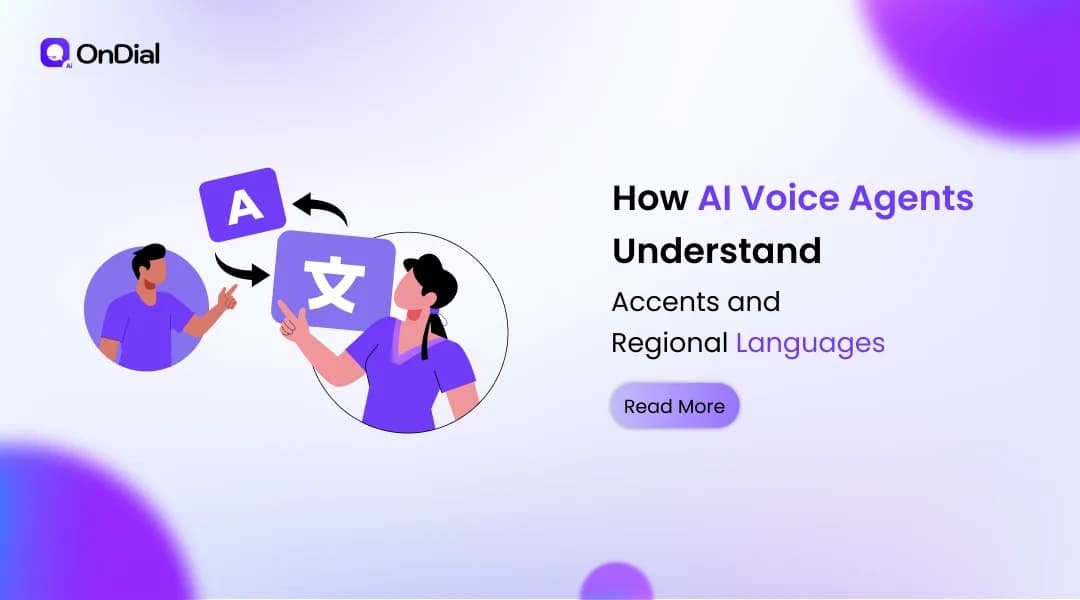
Here is a number that stuck with me: studies show 73% of people want AI systems to correctly recognize and respond to their accents. If you have ever repeated your name three times to a voice bot, you already know why. So let's answer the real question first. AI voice agents understand accents and regional languages by converting speech into sound units called phonemes, then using context and machine learning trained on diverse voices to figure out what you most likely meant, even when your pronunciation does not match a textbook. That is the whole idea in one breath.
I have spent years at OnDial building voice AI for Indian businesses, and I will be honest with you. Most people are skeptical when they first hear "multilingual voice agent," and they should be. So here is what you'll learn: how the technology actually works, where it still struggles, and the exact questions to ask before you trust one with your customers.
Why Accents Trip Up Most Voice AI
Most voice AI sounds brilliant in a demo and falls apart on a real call. That gap is not bad luck. It is built into how these systems learn.
The accent gap is real and measurable
Speech recognition performs best on the voices it trained on, and most early models trained heavily on American English. The result is a measurable penalty for everyone else. A typical voice model might get about 5% of words wrong with a standard American accent and miss roughly 15% of words from an Indian accent, three times worse.
The research backs this up at scale. The Svarah benchmark, built to test English ASR on Indian voices, found something striking. The performance gap between Indian-accented English and native English ranged from 5.65% all the way to 43.03%. That spread is the difference between a smooth call and a customer hanging up.
What frustrated callers actually experience
The numbers translate into very human moments. A caller with a strong regional accent says "right" and the system hears "rate." A bilingual customer slips a Hindi word into an English sentence and the agent treats the whole thing as noise.
Here is what that feels like from the other end of the line:
Repeating yourself: The caller restates simple details two or three times, which signals the agent does not belong in their world.
Forced language choice: A weak agent hits a mixed sentence and asks the customer to "please choose one language," which breaks the conversation instantly.
Quiet abandonment: People do not complain. They just hang up, and your team never learns why.
(That last one is the expensive one, because it hides in your data instead of showing up as a clear failure.)
How AI Voice Agents Actually Understand Accents
Good voice AI does not just listen harder. It listens differently, in stages.
From sound waves to phonemes: how ASR works
Automatic Speech Recognition (ASR) is how a voice agent understands accents: it breaks your speech into phonemes, the smallest units of sound, then maps those sounds to the words you most likely intended. A word like "tomato" carries different vowel sounds across regions, and phonetic analysis lets the system land on the right word anyway.
This is where training data does the heavy lifting. When a model has heard thousands of speakers pronounce the same word in different ways, it learns the pattern behind the sound rather than memorizing one "correct" version. That is what lets it generalize to a voice it has never heard before.
Why context beats raw sound
Accurate voice AI never relies on audio alone. It also reads context to work out meaning, which matters when a word sounds unusual because of a strong accent or blended speech.
Think of it like a well-traveled friend. They do not catch every syllable either, but they use the surrounding sentence to fill the gaps. A good agent pairs phonetic recognition with natural language understanding (NLU), so "I want to check my balance" still lands even if "balance" comes out in an unfamiliar shape. Sound tells it what you said. Context tells it what you meant.
Handling Regional Languages and Dialects at Scale
Accents are hard. Regional languages and dialects are a different mountain entirely, and India has more of them than almost anywhere on earth.
Training on diverse data
You cannot understand Tamil, Marathi, or Bengali speakers without data from Tamil, Marathi, and Bengali speakers. That sounds obvious, yet it is the single biggest bottleneck in the field.
This is why open datasets matter so much. The AI4Bharat IndicVoices project is the largest Indian speech dataset, with 23,700 hours of speech from 51,000 speakers across 22 languages. Fine-tuning on data like this produces real gains. A Whisper-Medium model fine-tuned on Indian-accented English reached a 15.08% word error rate, a clear improvement over its starting point.
Why one global model isn't enough
Here is the counter-intuitive part. A bigger, more general model is often worse for your specific business than a smaller, well-tuned one.
General multilingual models still stumble on domain-specific vocabulary. A collections agent needs to understand "EMI," "overdue," and "principal" as they actually appear in real speech, not in clean textbook English. The work that separates production-ready voice AI from a polished demo is fine-tuning on domain-specific, code-switched data from your own call recordings. At OnDial, that tuning step is where most of the accuracy gains on real Indian calls come from.
Code-Switching: The Real Test for Indian Voice AI
If you remember one thing from this article, make it this. The hardest problem is not Hindi or English. It is both, in the same sentence.
What Hinglish does to a standard model
Indian customers do not pick a language and stay in it. They blend, fluidly, mid-sentence. Over 250 million Indians use code-switched communication daily, mixing Hindi with English, Tamil with English, and more.
Standard models choke on this. Monolingual ASR models suffer roughly 42% word error rates on code-switched speech, which makes it the single biggest technical barrier to deploying voice AI in markets like India. A system that routes "Hindi" to one engine and "English" to another simply breaks the moment a caller does what comes naturally.
Building agents that switch the way people do
The fix is to stop treating Hinglish as two languages glued together. Code-switching support means the system parses a mixed sentence as one coherent instruction, end to end.
A genuinely capable agent handles "Sir, aapka EMI due hai on the 15th, can you confirm the payment account?" without a restart, captures the full intent, and replies in the same mixed register the customer used. That last point is underrated: the text-to-speech (TTS) side has to sound naturally code-switched too, not stitched together from a Hindi voice and an English voice. When buyers test vendors, this is the demo to insist on.
What This Means for Indian Businesses Choosing a Voice Agent
You do not need to become an ASR engineer. You just need to ask sharper questions than the sales deck expects.
Questions to ask before you buy
A vendor saying "we support multiple languages" tells you almost nothing. Push for proof:
Run your own test calls: Use real customer recordings, including heavy accents and mixed languages, not the vendor's clean samples.
Ask for per-language accuracy: Request transcription and intent accuracy broken down by language and by common call type, not one blended number.
Demand a live code-switching demo: Ask for a single call with several language switches in one sentence. A vendor who refuses is a red flag.
Compliance and trust signals that matter in India
Accuracy is only half of trust. The other half is doing things by the rules your customers expect.
For Indian deployments, that means real attention to TRAI DLT registration for messaging and calling, and to DPDP requirements around consent and data handling. I will be straight with you about the honest limit here: no voice agent understands every dialect perfectly yet, and the rare or very heavy accent will still need a graceful handoff to a human. The good systems plan for that fallback openly instead of pretending it does not exist. At OnDial, we treat that handoff as a feature, not a failure.
Conclusion
So, can AI voice agents understand accents and regional languages? Increasingly, yes, and you now know the three things that decide it. First, accuracy lives in the training data, which is why diverse, India-specific datasets matter. Second, context and phonetics together beat raw audio. Third, code-switching is the true test, and most vendors quietly fail it.
You walked in skeptical, and that instinct was right. Now you have the questions that separate a real solution from a slick demo. If you want to hear how an agent handles your customers' actual accents and Hinglish, ask OnDial for a test call using your own recordings, not a scripted demo. That single conversation will tell you more than any feature list.