Here is a number most vendors will not put on a landing page: nearly one in five consumers who have used AI for customer service say they got no benefit from it at all, according to the Qualtrics 2026 Customer Experience Trends Report. Sit with that for a second. If you have ever hung up on a chatbot that kept looping you back to an FAQ, you already know why that number is so high.
I run content and strategy at OnDial, and I talk to CX leaders every week who feel exactly this tension. They know enterprise AI call automation can cut costs and scale coverage. They have also been burned enough times to be skeptical of the hype.
So let me give you the honest version. Enterprise AI call automation is the use of AI voice agents to answer, route, and resolve phone conversations across customer service, sales, and support without a human on every call. Done right, it deflects the routine and frees people for the hard stuff. Done wrong, it becomes the new hold music people learn to hate.
This guide covers what the technology actually is, where it works across all three functions, what it really costs, and how to deploy it without alienating the customers you are trying to serve.
What Enterprise AI Call Automation Actually Is (and Isn't)
Let me clear up the biggest misconception first. Enterprise AI call automation is not a smarter version of the phone tree that tells you to "press 1 for billing." It is the opposite of that.
Beyond the Old IVR Menu
Traditional IVR systems route callers through fixed keypad menus and pre-recorded prompts. They were built to sort calls, not solve them, and customers have hated them for decades. The industry average IVR containment rate sits around 40%, which means most callers still get dumped into a queue anyway.
Modern AI voice agents work differently. They let a caller speak naturally, understand intent in real time, pull data from your systems, and complete the request end to end. The practical difference is night and day: an AI agent can handle "I have a question about last month's bill from when I was traveling" without forcing anyone to navigate a menu.
The Technology Stack Under the Hood
Under every natural-sounding call sits a chain of technologies working in sequence. Understanding this stack matters because it explains both the magic and the failure points.
Speech-to-text (STT): Converts the caller's audio into text in real time. Accuracy here decides whether the rest of the call goes smoothly or falls apart on the first misheard account number.
Large language models (LLMs) and NLP: Interpret intent, reason through the request, and decide what to do next. This is what lets the agent handle follow-up questions instead of resetting to a script.
Text-to-speech (TTS): Turns the response back into natural, human-sounding audio. Voice quality directly shapes whether customers trust the interaction or feel like they are talking to a robot.
Telephony and CRM integration: Connects the agent to your phone system and systems of record like Salesforce, Zendesk, or HubSpot so it can authenticate callers, update records, and trigger workflows.
When these layers run in sync, a customer calls a normal business number and speaks with an agent that never sleeps and never mishears from fatigue. When one layer lags, the whole conversation feels broken. That is why enterprise deployments live or die on latency and integration depth, not on how impressive the demo sounded.
How AI Voice Agents Handle Customer Service
Customer service is where AI voice agents for customer support deliver the fastest and most measurable business outcomes. It is also where bad automation does the most damage. Both things are true at once.
What is enterprise AI call automation good at in customer service? It excels at high-volume, structured, repetitive calls: password resets, order status checks, appointment confirmations, account balance inquiries, and basic troubleshooting. An AI agent resolves these in under two minutes with no hold time and identical quality at 3 AM and 3 PM.
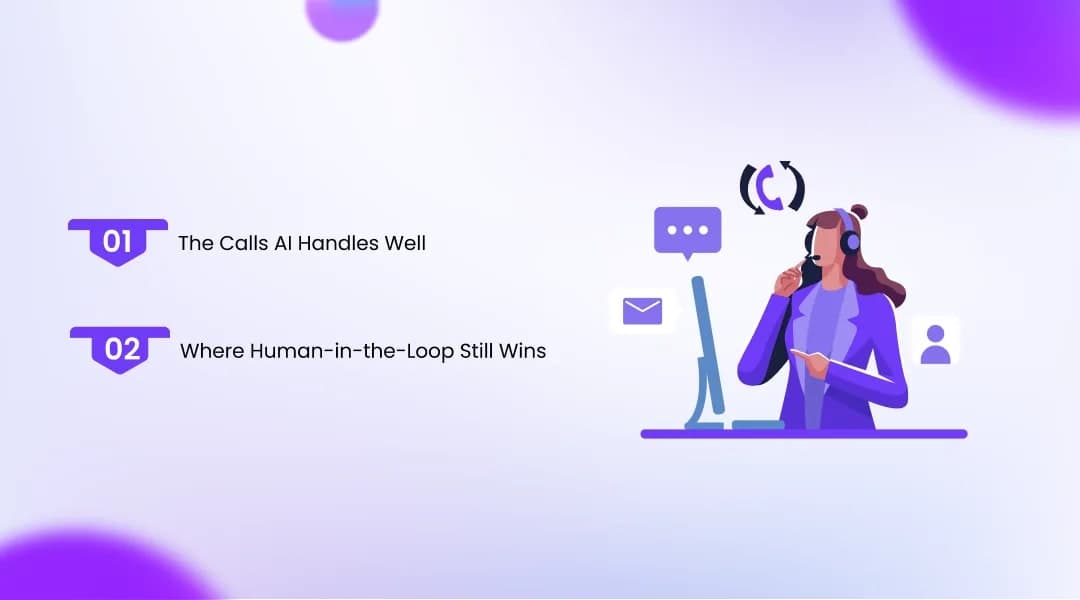
The Calls AI Handles Well
The pattern is consistent across every strong deployment I have seen: automation works best where the conversation follows a predictable path. McKinsey analysis found that tier-1 repetitive issues make up 50 to 60 percent of contact center volume, and that is exactly the slice AI should own.
In projects OnDial has worked on, the calls that automate cleanly share three traits. They are frequent, they are well-bounded, and they have a clear "done" state. Order tracking either finds the package or it does not. A balance check returns a number. These are the tasks that quietly eat your agents' hours while adding almost nothing to the customer relationship.
Where Human-in-the-Loop Still Wins
Now the counter-intuitive part: the goal of good automation is not to remove humans. It is to point them at the calls that actually need them.
Complex disputes, emotionally charged complaints, and multi-system troubleshooting still belong with people. The smartest systems use containment rate and first-contact resolution (FCR) as guardrails, then escalate the moment a call moves outside approved territory. A clean human-in-the-loop handoff passes the full transcript and context to the agent, so the customer never has to repeat themselves.
Detect and escalate frustration: Good agents read tone and repeated complaints, then route to a human retention specialist instead of plowing ahead.
Preserve context on transfer: The human should open the conversation already knowing what the AI tried, so the caller is not starting over.
Know the boundaries: If a request is out of scope, the agent should say so and hand off, not invent a confident wrong answer.
The 2026 benchmark data backs this up. Roughly 76% of contact center leaders now run a formal split where AI handles routing and routine volume while humans manage complex, high-stakes interactions. That is not a compromise. That is the model that works.
Using AI Call Automation in Sales
Service gets most of the attention, but sales is where AI call automation quietly changes the economics. The framing here is important: AI outbound calling is not replacing your reps. It is removing the lowest-value tasks, so your best people can spend their time closing.
Lead Qualification and Outbound at Scale
Sales teams lose enormous value to two problems: unqualified leads and slow follow-up. AI voice agents attack both.
Outbound AI agents can qualify leads, handle common objections, and book meetings with consistent messaging on every single call. They also solve the missed-call problem that bleeds revenue, especially after hours. Industry data suggests many small and mid-sized businesses miss a large share of inbound calls, and each missed call can represent hundreds to thousands in lost pipeline.
The other underrated win is speed. When a lead fills out a form, an AI agent can call back in seconds rather than hours. In a market where response time often decides who wins the deal, that gap matters more than most teams admit.
Where Sales Automation Goes Wrong
Here is the honest limitation. AI does not close complex, relationship-driven deals, and pretending otherwise is how you burn good prospects.
A high-value negotiation needs rapport, judgment, and the authority to make exceptions. AI can identify the opportunity, qualify it, and route it to the right rep, but the human closes. The failure mode I see most often is teams pointing automation at conversations that need nuance, then wondering why conversion drops. Match the tool to the task: let AI do the volume-heavy top of the funnel, and keep your people where empathy and improvisation create value.
The Real Numbers: Cost, ROI, and Containment
Let me get concrete, because this is where vendor marketing diverges most sharply from field reality. You deserve the numbers that survive contact with a real budget.
What does enterprise AI call automation cost? AI voice agent pricing in 2026 typically runs from about $0.05 to $1.00 per minute depending on the platform and features, while a fully loaded live-agent call costs roughly $5 to $15. For moderate volumes, monthly costs often land between a few hundred and a couple thousand dollars, versus $3,000 to $4,000 per human agent.
What It Actually Costs
Per-minute rates are the headline, but total cost of ownership is the real story. The line items that inflate invoices are the ones buried in the fine print.
LLM token consumption: Every conversational turn can incur token-based billing, which compounds fast at high volume.
Telephony routing: Carrier markups, call forwarding, and number provisioning raise the blended cost per minute beyond the advertised rate.
Add-ons and tiers: Knowledge base surcharges, PII redaction, extra concurrent calls, and enterprise support with SLAs often sit outside the base plan.
The market is expanding precisely because the math usually works. The global AI customer service market is projected to reach $15.12 billion in 2026, growing at a 25.8% compound annual growth rate, according to widely cited 2026 industry data. Money follows results.
Deflection vs Resolution (The Metric That Trips Everyone Up)
This is the single most important distinction in the entire category, and most buyers miss it.
Deflection measures containment: the call ended without a human. Resolution measures outcome: the customer's problem was actually solved. A platform can show 90% deflection with only 40% true resolution, as Fin AI's KPI framework points out. A customer who gave up in frustration counts as "deflected," but they are not a happy customer, and they will call back or churn.
Gartner projects that agentic AI will autonomously resolve 80% of common customer service issues by 2029, reducing operational costs by around 30%. That is a genuinely large opportunity. But notice the word "resolve." Chase resolution rate, not deflection rate, or you will optimize your way straight into a worse customer experience while your dashboard shows green.
How to Roll Out AI Call Automation Without Breaking Things
A clean rollout beats a clever one. The enterprises that succeed treat AI call center automation as a living system, not a box they check once. Here is the approach that consistently works.
Start Narrow, Then Expand
Do not try to automate everything on day one. That is the fastest path to a frustrating deployment.
Start by auditing your call types and ranking them by frequency and simplicity. Pick the highest-volume, lowest-complexity intents first, master those, then expand. A voice agent that handles order status really well beats one that tries to handle everything and fails at most of it. In the deployments OnDial has run, this narrow-first sequencing is the difference between early wins and early abandonment.
Then keep tuning. Track cost per call, FCR, CSAT, and resolution rate continuously, and feed what you learn back into the workflows. Automation is not set-and-forget. The centers that win are the ones that keep adjusting.
Compliance, Trust, and Transparency
Voice is unforgiving, and it is where trust is won or lost. A chatbot can be re-read; a call cannot.
Enterprise deployments must be built for security and compliance from day one, especially in regulated sectors such as healthcare, banking, and insurance. Look for platforms that meet SOC 2, HIPAA, and GDPR requirements, with encrypted storage, audit trails, and automatic redaction of sensitive data like payment details.
Transparency is not optional either. Salesforce's State of the AI Connected Customer research found that 72% of customers believe it is important to know whether they are talking to an AI or a human. So disclose the automation clearly, avoid deceptive human mimicry, and always give people an easy path to a person. At OnDial, we treat this as a partnership principle rather than a compliance checkbox, because a customer who feels tricked never comes back, no matter how efficient the call was.
Conclusion
Enterprise AI call automation is no longer experimental, but it is not magic either, and the leaders who win in 2026 are the ones who know the difference. Three things matter most. Automate the routine, high-volume calls where AI genuinely excels. Keep humans on the complex and emotional conversations where empathy creates value. And measure resolution, not deflection, so your dashboard reflects real customer outcomes.
You do not have to choose between efficiency and a customer experience people actually respect. The right setup gives you both, if you build it honestly and start where it fits.
That balance is exactly what we build at OnDial. If you are weighing where automation belongs in your service, sales, or support operations, talk to us about a narrow-first pilot on your highest-volume call type, and we will help you measure real resolution before you scale a single thing.