Here is a number that reframes the whole debate. According to IBM, organizations that have matured their use of AI in customer service report a 17% higher customer satisfaction rate and a 38% lower average inbound call handling time than their peers.
Read that again. The same technology that makes callers happier also makes your team faster. That is the quiet promise of AI call platforms, and it is why so many businesses I talk to have stopped asking whether to adopt them and started asking how.
If you run a support or sales operation right now, you are probably stretched thin. Wait times creep up. Agents burn out on the same repetitive questions. Customers get frustrated before anyone even picks up.
I have sat with teams in exactly that spot, and I know how heavy it feels.
Put simply, an AI call platform uses conversational AI to answer, route, and resolve phone calls automatically, freeing human agents for complex work while giving customers faster, more consistent service. In this article, I will show you how these platforms lift both productivity and satisfaction, what the honest tradeoffs are, and why context (especially in India) decides whether the whole thing works.
What AI Call Platforms Actually Do (And Why They Feel Different)
Most people meet an AI call platform without realizing it. You call a business, a natural voice answers, and somehow it understands your messy, half-formed question. No menu tree. No "press 4 for billing." That difference is the entire point, and it is worth understanding what sits underneath it.
From Press-1 Menus to Real Conversations
For twenty years, phone automation meant IVR: rigid, rules-based menus that made customers do the work of sorting themselves. We have all felt that specific frustration of pressing 1, then 3, then 0, hoping to escape to a human. Those menus saved companies money on paper while quietly costing them loyalty in practice. Businesses replacing traditional IVR systems often see higher customer engagement because conversational AI understands intent instead of forcing callers through rigid menus. Learn more in our guide on AI Voice Agents vs IVR: Which One Customers Actually Prefer.
AI call platforms flip that model. Instead of forcing a caller down a scripted path, the system listens to a full sentence, works out intent, and responds as a person would. It handles interruptions, tangents, and mid-call changes of subject. In projects I have worked on at OnDial, this single shift (from menu navigation to actual conversation) is what customers notice first and thank us for later.
The Technology Stack Behind the Voice
A believable voice agent is not one piece of magic. It is three technologies working together in a fraction of a second. Understanding them helps you evaluate vendors honestly rather than trusting a polished demo.
ASR (Automatic Speech Recognition): converts the caller's speech into text in real time, coping with accents, background noise, and cross-talk. Weak ASR is where most "the AI could not understand me" complaints begin.
NLP (Natural Language Processing): interprets what the text actually means, identifying intent and pulling out details like an order number or a date. This is the reasoning layer that decides what to do next.
TTS (Text-to-Speech): turns the system's response back into a natural spoken voice, with pacing and tone that do not sound robotic. Good TTS is why modern agents feel human rather than mechanical.
The reason this matters: a vendor can nail one layer and fail another. A gorgeous voice with poor intent detection still frustrates callers. I always tell teams to test the whole chain on real, imperfect calls, not a clean script.
How AI Call Platforms Increase Agent Productivity
Let me be direct about something. Agent productivity rarely drops because people are lazy. It drops because the systems around them are slow, fragmented, and full of manual busywork. Call center productivity improves most when you remove that friction, and this is exactly where AI call platforms earn their keep.
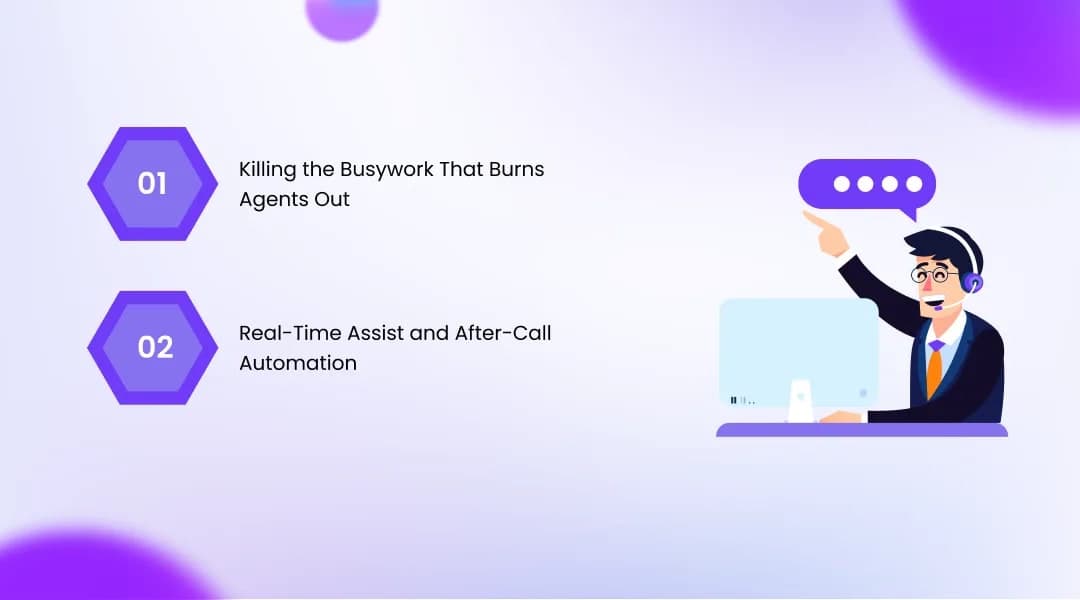
Killing the Busywork That Burns Agents Out
Roughly 60 to 80 percent of contact center call volume is routine and repetitive: order status, appointment booking, password resets, balance checks, as reported by Aloware. Those calls do not need human judgment. They need speed. When an AI platform absorbs that tier-one volume, your people stop spending their day on questions a machine can answer instantly. This is particularly valuable for retail and eCommerce businesses, where AI can instantly answer order status questions and reduce customer wait times.
The productivity math is striking. Research cited by Invoca shows generative AI in customer service can increase agent productivity by 30 to 45 percent. Separately, a National Bureau of Economic Research study found that giving support staff access to AI tools raised their output by an average of 14 percent. Fewer repetitive calls mean agents handle the hard cases with fresh attention instead of exhaustion.
Featured snippet answer: AI call platforms increase productivity by automating repetitive calls (which make up 60 to 80 percent of volume), assisting agents in real time, and handling after-call admin work. This lets human agents focus on complex issues, cutting average handle time and reducing burnout across the team.
Real-Time Assist and After-Call Automation
Productivity is not only about deflecting calls. It is also about making the calls your humans do take go faster. Modern platforms whisper help to agents mid-conversation, surfacing the right policy, the customer's history, or a suggested next step before the agent has to go hunting for it.
Then there is the wrap-up. After every call, agents historically spend minutes summarizing notes and updating the CRM. AI platforms now generate that summary automatically and sync it, which shortens AHT (average handle time) and removes the most draining part of the job. Combining automated call summaries with AI call analytics gives managers better visibility into customer conversations and agent performance.
One quick question for you: how many hours does your team lose every week just typing up call notes? For most operations I have seen, it is more than they think.
How AI Call Platforms Improve Customer Satisfaction
Productivity gains would not matter much if customers hated the experience. They do not. Handled well, customer satisfaction climbs alongside efficiency, and the data on this has shifted sharply in the last few years.
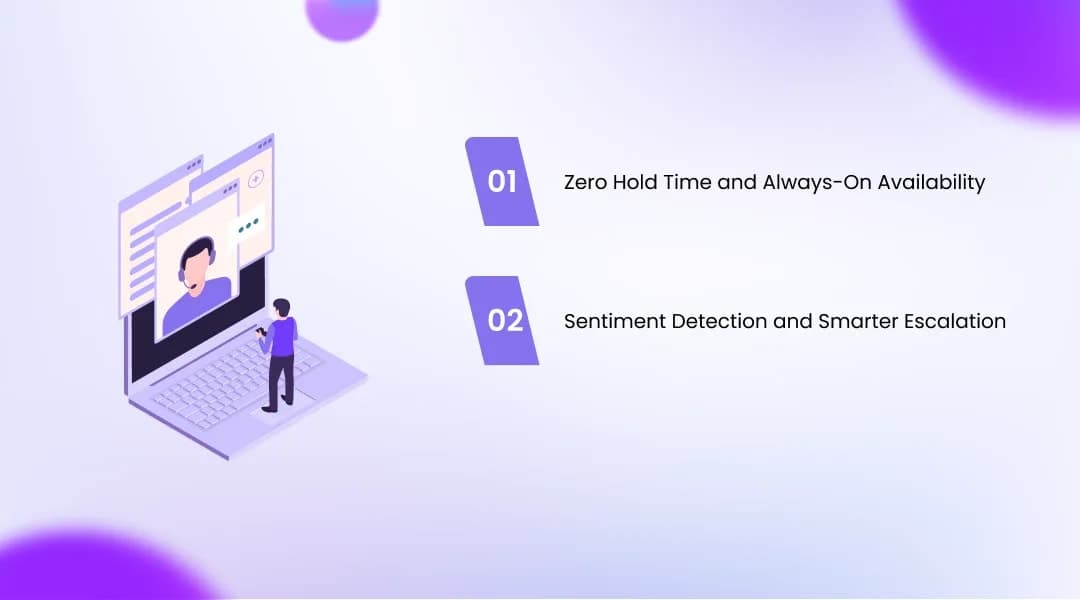
Zero Hold Time and Always-On Availability
Nobody has ever enjoyed hold music. The single biggest driver of caller frustration is waiting, and AI call platforms remove it almost entirely. The system answers on the first ring, at 2 in the afternoon or 2 in the morning, without a queue.
Customer sentiment reflects this. Satisfaction with AI voice agents has reached 72 percent, up from 53 percent three years earlier, according to data compiled by AdAI citing Zendesk.
There is a revealing contradiction underneath that number too. While most consumers say they prefer a human, 61 percent will choose a faster AI response over waiting for a person, per Jesty CRM research. Speed changes how people feel.
Definition: First call resolution, or FCR, is the share of customer issues solved on the very first contact, and it is one of the strongest predictors of loyalty.
Sentiment Detection and Smarter Escalation
Here is a counter-intuitive truth: a well-designed AI can de-escalate an angry caller better than a rushed human sometimes can. Modern platforms detect emotion through tone of voice in real time. When they sense frustration, they slow down, acknowledge it, and decide whether to keep helping or hand off.
That handoff is where satisfaction is won or lost. When an AI escalates a call to a person, it should pass full context so the customer never has to repeat themselves. In OnDial deployments, this is a rule we do not bend, because forcing someone to re-explain their problem is the fastest way to undo every good feeling the call created. Zoom's State of AI in CX report found 76 percent of organizations using AI call solutions saw a 31 percent increase in customer ratings, which lines up with what happens when escalation is done right.
The India Angle: Why Local Context Changes Everything
Most articles on this topic quietly assume a US enterprise with English-speaking callers. That assumption breaks the moment you deploy in India, and this is the part almost nobody writes about. It is also where the difference between a working platform and a failed pilot usually lives.
Multilingual and Hinglish Calling for Real Markets
Indian callers do not speak in one clean language. They code-switch, sliding between Hindi and English inside a single sentence, and they expect the person (or agent) on the line to keep up. A platform trained only on formal English falls apart here.
The domestic opportunity is real and growing fast. The Indian Voice AI market was valued at roughly 153 million dollars in 2024 and is projected to reach about 958 million dollars by 2030, a compound annual growth rate near 35.7 percent, according to NextMSC. Much of that growth is driven by Tier 2 and Tier 3 demand, where regional-language support is not a nice-to-have. At OnDial, building agents that genuinely handle Hinglish and regional languages is the work, because it is the difference between a call that connects and one that gets hung up.
Compliance That Builds Trust
Trust in India is not only about how the AI sounds. It is about how it behaves under regulation, and getting this wrong creates legal exposure, not just bad experiences.
TRAI DLT: the Telecom Regulatory Authority of India's Distributed Ledger Technology framework governs commercial calling and messaging. Any serious AI calling operation needs registered templates and a clean audit trail, not hand-waving.
DPDP Act 2023: India's Digital Personal Data Protection Act sets the rules for how you collect, store, and process caller data. Consent capture and secure handling are non-negotiable when an AI is recording and analyzing conversations.
Local number presence: a familiar +91 number measurably lifts answer rates, because callers trust a local identity far more than an unknown international string.
I will be honest here: compliance is the least glamorous part of this work and the part that most cheap platforms skip. It is also the part that keeps you out of trouble.
Are AI Call Platforms Actually Worth It?
This is the question I get asked most, usually phrased exactly this way. So let me answer it straight, including the parts that vendors tend to leave out.
The Honest Cost and ROI Picture
The economics are hard to argue with at surface level. An AI-handled voice interaction costs somewhere between 0.50 and 1 dollar, against 5 to 8 dollars for a human-handled call, per IBM figures. Looked at per minute, human agents run around 0.70 dollars while AI voice agents operate near 0.03 to 0.04 dollars, according to figures compiled by Jesty CRM.
Zoom out and the market signal is loud. Gartner projected that conversational AI would cut contact center labor costs by 80 billion dollars in 2026, and 64 percent of companies using AI for call centers report a positive ROI. For a business handling thousands of calls a month, shifting the routine share to AI frees budget and headcount for work that actually needs a human.
Definition: ROI on an AI call platform is the value from saved agent time, higher resolution rates, and captured after-hours demand, minus platform and setup cost.
Where AI Still Falls Short
Now the honest caveat, because you deserve it. Every vendor can show a flawless demo. Real deployments are messier. Pilots run in controlled conditions, and they rarely map cleanly across the full range of real customer conversations.
AI still stumbles on genuinely complex, emotional, or sensitive calls, and a badly designed handoff can make things worse than no automation at all. Only about 25 percent of contact centers that use AI have fully integrated it into daily operations, per Lorikeet, which tells you that adoption is easy and doing it well is not. The honest position is a hybrid one: AI handles the high-volume routine tier, humans own the hard cases, and the two share full context. Anyone promising you a fully autonomous replacement for your team is selling the demo, not the deployment.
Conclusion
The case for AI call platforms comes down to three things. They increase productivity by absorbing the 60 to 80 percent of calls that are pure routine. They lift customer satisfaction by removing wait times and detecting frustration before it boils over. And they only work when context, compliance, and a clean human handoff are built in from the start.
You do not have to choose between a happier team and happier customers anymore. Done right, the same system delivers both, and you walk away with a support operation that scales without burning anyone out.
If you are weighing this for the Indian market, that last point about language and TRAI DLT compliance is where most decisions are actually won or lost. That is the exact problem we build for at OnDial. Talk to us about a voice AI agent tuned to your callers, your languages, and your regulatory reality, and we will show you a real production call, not a demo script.