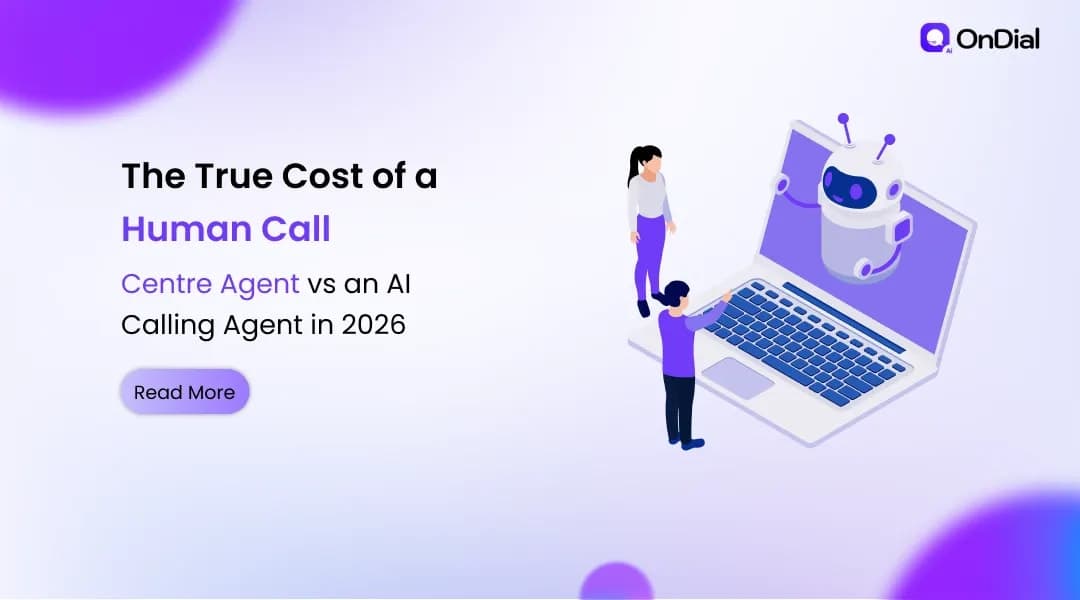
Every business owner who runs a call centre or manages a phone-based sales team knows the number on the payslip. What most do not know is the real number, the fully loaded cost that includes recruiting, training, attrition, infrastructure, management overhead, quality assurance, and the invisible cost of every call that goes unanswered because there simply are not enough agents on the floor. In 2026, the average fully loaded cost of a single human call centre agent in the United States ranges between $45,000 and $75,000 per year when every direct and indirect expense is accounted for. In India, the figure sits between $4,500 and $9,000 per agent annually, still a significant line item when multiplied across teams of 50, 200, or 500 agents. These are not salary figures alone. They represent the total business cost of putting a human being on a phone line and keeping them there productively.
Meanwhile, AI calling agents have matured from experimental prototypes into production-grade systems that handle thousands of simultaneous calls with sub-second response times, natural conversational ability, and consistent quality that never degrades at 3 AM on a Sunday. The cost of human call centre agent vs AI calling agent has become the most consequential financial comparison for any business that relies on phone-based communication, whether for sales, support, collections, scheduling, or lead qualification.
This blog breaks down the complete cost structure on both sides of that comparison. It examines every visible and hidden expense associated with human agents, maps the equivalent cost structure for AI calling agents, quantifies the ROI difference with real numbers, and gives business leaders the framework they need to make an informed decision about where their call operations should be heading in 2026 and beyond.
The Full Loaded Cost of a Human Call Centre Agent

When finance teams calculate the cost of a call centre operation, they typically start with base salary. That number, while real, represents roughly 40 to 55 percent of what a human agent actually costs the business. The remaining 45 to 60 percent hides in line items scattered across HR budgets, IT budgets, facilities costs, and management overhead that rarely gets attributed back to a per-agent figure. Understanding these hidden costs is essential for any honest comparison between human and AI calling agents.
Direct Compensation and Benefits
The base salary for a call centre agent in the US averages between $30,000 and $42,000 annually depending on location, industry, and experience level. On top of that, employers pay for health insurance, retirement contributions, paid time off, payroll taxes, and workers compensation insurance. These benefits typically add 25 to 35 percent to the base salary. An agent earning $36,000 in base pay costs the company between $45,000 and $48,600 once benefits are included. In markets like the UK, Australia, and Western Europe, benefit loading runs even higher due to mandatory employer pension contributions and national insurance obligations. Businesses operating call centres in India face lower absolute numbers, but the proportional loading is similar, with provident fund contributions, gratuity, and insurance adding 30 to 40 percent on top of base pay.
Recruiting, Training, and Attrition
Call centre attrition rates remain among the highest of any industry. The average annual turnover rate for call centre agents globally sits between 30 and 45 percent. In high-pressure outbound sales environments, turnover can exceed 60 percent annually. Every departing agent triggers a replacement cycle that includes job posting costs, recruiter time or agency fees, interviewing hours from managers and team leads, background checks, onboarding administration, and initial training that typically runs two to six weeks before a new agent handles live calls independently. The cost of replacing a single call centre agent is estimated at 50 to 75 percent of their annual salary when all replacement cycle costs are included. For a team of 100 agents with 40 percent annual attrition, that means replacing 40 agents per year at a cost of $18,000 to $28,000 each, adding $720,000 to $1,120,000 in annual attrition costs alone. This is money that produces zero additional call capacity. It simply maintains the capacity the business already had.
Infrastructure, Technology, and Management Overhead
Every human agent requires a physical or virtual workstation, a telephony licence, a CRM seat, headset hardware, and access to whatever knowledge base or scripting tool the operation uses. IT support, network bandwidth, and security infrastructure scale with headcount. In physical call centres, add rent, utilities, janitorial services, and facilities management. These infrastructure costs typically add $5,000 to $12,000 per agent per year in the US and $1,500 to $4,000 per agent in offshore markets.
Then there is management overhead. Call centre operations require team leads, quality assurance analysts, workforce management schedulers, trainers, and operational managers. The typical ratio is one supervisor or team lead for every 10 to 15 agents, one QA analyst for every 20 to 30 agents, and one workforce management specialist for every 50 to 75 agents. These support roles, when allocated proportionally across the agent base, add another $4,000 to $8,000 per agent annually. When you total direct compensation, benefits, attrition, infrastructure, and management overhead, the true fully loaded cost of a single human call centre agent in the US reaches $55,000 to $75,000 per year, with many operations exceeding that range in high-cost markets.
The Real Cost Structure of an AI Calling Agent
AI calling agents operate on a fundamentally different cost model. There is no salary, no benefits, no attrition, no sick leave, no training curve, and no management hierarchy. The cost structure is built on platform subscription or usage fees, integration and setup costs, and ongoing optimisation. Understanding this structure clearly is the only way to make the comparison honestly.
Platform and Usage Costs
Most AI calling agent platforms in 2026 charge based on a combination of monthly subscription tiers and per-minute or per-call usage. Entry-level plans for small businesses typically start at $200 to $500 per month for a defined volume of call minutes, while enterprise deployments handling tens of thousands of calls per month range from $2,000 to $15,000 per month depending on volume, complexity, language requirements, and integration depth. OnDial, for example, offers deployment options that scale from small business volumes to enterprise-grade operations handling thousands of simultaneous calls across more than 100 languages, with pricing that reflects actual usage rather than headcount. The critical difference is that an AI calling agent handles unlimited concurrent calls within its provisioned capacity. A single AI deployment can do the work of 10, 50, or 200 human agents simultaneously, and the cost does not scale linearly with each additional concurrent call the way human headcount does. An operation that would require 50 human agents at a fully loaded cost of $3 million per year might achieve equivalent or superior call handling capacity with an AI calling platform costing $60,000 to $180,000 annually, a reduction of 85 to 95 percent.
Setup, Integration, and Optimisation
Deploying an AI calling agent is not free of implementation costs, but these costs are fundamentally one-time or periodic rather than ongoing and compounding. Initial setup includes defining call flows and scripts, integrating with existing CRM and scheduling systems, configuring language and voice preferences, and testing against real call scenarios. For platforms like OnDial that offer both API and no-code deployment options, this setup can range from a few hours for simple use cases to a few weeks for complex enterprise integrations with multiple call flows, CRM systems, and compliance requirements. Ongoing optimisation involves reviewing call analytics, refining scripts based on conversion data and sentiment analysis, and adjusting agent behaviour for new products, services, or campaigns. This work is real but typically requires a fraction of one person’s time rather than an entire management hierarchy.
The Cost Dimensions Where AI Has No Equivalent Expense
Several of the largest cost categories for human call centres simply do not exist in the AI calling agent model. There is no attrition cost because AI agents do not quit, burn out, or need to be replaced. There is no training curve because updates to scripts, products, or processes are deployed instantly across all calls. There is no sick leave, no scheduling complexity, no overtime premium for nights and weekends, and no quality degradation during peak hours when human agents are fatigued or overwhelmed. These are not minor savings. For many operations, attrition alone represents 15 to 25 percent of total call centre costs. Eliminating it entirely changes the financial equation fundamentally.
Head to Head Comparison: Where Each Model Wins
A responsible comparison between human and AI calling agents must acknowledge that neither is universally superior across every dimension. Business leaders making this decision need clarity about where each model delivers genuine advantages and where the trade-offs lie.
Speed, Availability, and Consistency
AI calling agents win decisively on availability and consistency. They operate 24 hours a day, 7 days a week, 365 days a year without shift scheduling, overtime, or coverage gaps. OnDial’s platform delivers sub-500 millisecond response latency, meaning callers experience natural, fluid conversation without the pauses and holds that characterise understaffed human operations. An AI agent handling its thousandth call of the day performs identically to its first. A human agent handling their fortieth call of an eight-hour shift does not. For businesses where speed to lead matters, where after-hours calls represent lost revenue, or where call volume spikes are unpredictable, AI calling agents provide a level of reliability that human teams structurally cannot match without massive overstaffing.
Empathy, Complex Problem Solving, and Relationship Building
Human agents retain advantages in situations requiring deep empathy, complex multi-step problem resolution, and high-value relationship management. A customer dealing with a sensitive insurance claim, a patient discussing a complicated medical concern, or a high-net-worth client negotiating a significant purchase may still benefit from the nuanced emotional intelligence that a skilled human agent provides. However, the scope of these truly human-required interactions is narrower than most call centre operators assume. Research from customer experience analysts indicates that 60 to 70 percent of inbound and outbound call centre interactions follow predictable patterns that AI agents handle as effectively as or more effectively than human agents. The remaining 30 to 40 percent benefit from human involvement, but many of those calls can be pre-qualified, triaged, and partially handled by AI before being escalated to a human agent who receives full context and call sentiment data, enabling the human to be more effective rather than less.
Multilingual Capability and Market Reach
For businesses operating in linguistically diverse markets, AI calling agents offer a structural advantage that is nearly impossible to replicate with human teams. Building a human call centre team that can handle calls fluently in 10 or 15 languages requires recruiting, training, and retaining agents for each language, many of which have thin talent pools in any given geography. OnDial supports more than 100 languages, including 9 Indian languages with over 80 Indian voice variations, enabling a single platform deployment to serve customers across Hindi, Tamil, Telugu, Bengali, Marathi, Gujarati, Kannada, Malayalam, and Punjabi without hiring separate language-specific teams. The call centre cost reduction with AI becomes even more pronounced in multilingual operations where the alternative is maintaining parallel human teams for each language.
Quantifying the ROI: Real Numbers for Real Businesses
Abstract cost comparisons are useful for understanding the structural difference, but business leaders need concrete numbers. The following analysis models the ROI of switching from a human call centre operation to an AI calling agent platform across three common business sizes.
Small Business: 5 to 10 Human Agents Replaced
A small business operating a 5-agent call centre with a fully loaded cost of $60,000 per agent spends $300,000 annually on call handling. Replacing this operation with an AI calling agent platform like OnDial at an average monthly cost of $1,500 to $3,000 for equivalent capacity brings the annual cost to $18,000 to $36,000. That represents a saving of $264,000 to $282,000 per year, or a cost reduction of 88 to 94 percent, with the added benefit of 24/7 availability and zero attrition risk. Even accounting for setup, integration, and a part-time resource for ongoing optimisation, the first-year ROI typically exceeds 500 percent.
Mid-Market Business: 30 to 50 Human Agents Replaced
A mid-market operation with 40 agents at $55,000 fully loaded spends $2.2 million annually. An equivalent AI deployment handling the same call volume and complexity might cost $8,000 to $15,000 per month, or $96,000 to $180,000 annually. The saving ranges from $2 million to $2.1 million per year. At this scale, the AI calling agent ROI is not just a cost saving. It fundamentally changes the financial model of the business, freeing capital for product development, market expansion, or higher-value human roles.
Enterprise: 200+ Human Agents in Hybrid Model
Enterprise operations rarely replace their entire human workforce with AI. Instead, they deploy AI calling agents for the 60 to 70 percent of call volume that follows predictable patterns, including appointment confirmations, lead qualification, first-contact resolution for common queries, payment reminders, and survey calls. The remaining volume goes to a smaller, more specialised human team handling complex escalations. An enterprise running 200 agents at $65,000 fully loaded ($13 million annual cost) might reduce to 60 to 80 specialised human agents ($3.9 to $5.2 million) plus an AI platform at $30,000 to $50,000 per month ($360,000 to $600,000 annually), bringing total costs to $4.3 to $5.8 million. The saving of $7.2 to $8.7 million per year funds a complete transformation of the customer experience operation, with remaining human agents focused exclusively on work that genuinely requires human judgment and empathy.
Why Call Centre Automation Savings Compound Over Time

The financial advantage of AI calling agents does not remain static after deployment. It compounds in ways that human call centre economics structurally cannot match. Understanding this compounding effect is critical for business leaders evaluating the long-term investment case.
Eliminating the Attrition Tax Permanently
Human call centres pay an ongoing tax in the form of attrition. Every year, 30 to 45 percent of agents leave and must be replaced. This cycle never ends because the working conditions, career progression limitations, and compensation structures that drive attrition are inherent to the call centre model. AI calling agents eliminate this tax entirely. There is no replacement cycle, no knowledge loss when an agent leaves, and no dip in quality while new agents ramp up. Over a five-year period, the cumulative attrition savings alone can exceed the total annual cost of a human operation. A 100-agent operation with 35 percent annual attrition spending $22,000 per replacement generates $770,000 in attrition costs per year, or $3.85 million over five years. Eliminating that entirely changes the cumulative cost comparison dramatically.
Continuous Improvement Without Retraining Costs
When a human call centre needs to improve script adherence, update product knowledge, or introduce a new call flow, it requires retraining every agent individually. This means scheduling training sessions, taking agents off the phones (reducing capacity), and then monitoring compliance over weeks to ensure the new approach is being followed consistently. With AI calling agents, updates are deployed once and take effect across every call immediately. OnDial’s platform allows businesses to update scripts, add new languages, refine objection handling, and adjust call flows through its no-code interface, with changes reflected in live calls within minutes rather than weeks. The automated calling vs human agents comparison becomes increasingly lopsided over time as the AI system accumulates improvements that persist permanently, while human operations lose institutional knowledge with every departing agent.
Scaling Without Proportional Cost Increases
Human call centres scale linearly. Doubling call capacity requires doubling headcount, doubling infrastructure, expanding management layers, and doubling the attrition replacement pipeline. AI calling agents scale non-linearly. Adding capacity often means adjusting a plan tier or provisioning additional concurrent call slots, at a fraction of the cost of equivalent human scaling. For businesses in growth mode or businesses with seasonal call volume spikes, this scalability difference is worth as much as or more than the base cost savings. A retail business that needs ten times its normal call capacity during a holiday season would need to hire, train, and manage ten times its normal agent count with human teams, or simply scale its AI calling platform for that period.
How to Evaluate Whether Your Business Is Ready to Switch
Not every business should replace its entire call operation with AI overnight. The most successful deployments follow a structured evaluation that identifies the highest-value starting point and expands from there.
Identifying Your Highest-Value Call Types for AI
Start by categorising your current call volume into three tiers. The first tier includes calls that follow highly predictable patterns and require standard information exchange, such as appointment reminders, order confirmations, lead qualification, payment reminders, and satisfaction surveys. These calls are ideal for immediate AI deployment and typically represent 40 to 60 percent of total volume. The second tier includes calls that follow semi-predictable patterns but occasionally require judgment or escalation, such as first-level support, product inquiries, and booking changes. These calls work well with AI handling the standard flow and escalating to humans when the conversation moves outside expected parameters. The third tier includes calls requiring deep empathy, complex negotiation, or high-stakes decision-making. These calls are best handled by humans, but AI can still add value through pre-call qualification, data collection, and post-call follow-up.
Measuring Your Current Cost Baseline Accurately
Before you can calculate ROI, you need an honest baseline. Most businesses underestimate their true call centre costs by 30 to 50 percent because they do not attribute shared costs like management overhead, IT infrastructure, facilities, and attrition back to a per-agent figure. Build a complete cost model that includes every category discussed in this blog: direct compensation, benefits, recruiting, training, attrition replacement, infrastructure, technology licences, management and QA overhead, and facilities. Divide the total by the number of productive agent hours per year (accounting for time off, breaks, training days, and administrative tasks) to get your true cost per productive call hour. Compare this directly against AI calling platform pricing on a per-minute or per-call basis for an honest comparison.
Running a Controlled Pilot
The lowest-risk approach is to run a controlled pilot on a specific call type for a defined period. OnDial’s deployment options, which include both API integration and no-code setup, make it possible to launch a pilot on a single call flow within days rather than months. Route a subset of your Tier 1 calls through the AI agent for 30 to 60 days. Measure call completion rates, customer satisfaction scores, conversion rates (for sales or scheduling calls), and cost per completed call. Compare these directly against the same metrics for human agents handling the same call type during the same period. Businesses that run this comparison almost universally find that AI calling agents match or exceed human performance on Tier 1 call types at 10 to 20 percent of the cost.
Conclusion
The cost comparison between human call centre agents and AI calling agents in 2026 is no longer a close call for most business operations. The fully loaded cost of a human agent, including the hidden expenses of attrition, training, management, and infrastructure, is five to ten times higher than the equivalent AI calling agent capacity. AI agents deliver 24/7 availability, consistent quality, instant scalability, and multilingual capability that human teams cannot match without prohibitive expense. The businesses achieving the strongest results are those deploying AI for the 60 to 70 percent of call volume that follows predictable patterns while retaining skilled humans for genuinely complex interactions.
OnDial delivers exactly what this comparison reveals businesses need: production-grade AI voice agents with sub-500 millisecond latency, support for over 100 languages including 9 Indian languages with 80 plus voice variations, call sentiment analytics, lead qualification and scheduling, and both API and no-code deployment options that make it possible to go live in days rather than months. Whether you are running a five-person phone team or a 500-seat call centre, the economics of AI calling agents have reached the point where the cost of not switching exceeds the cost of switching. Schedule a demo with OnDial today to see exactly what the cost comparison looks like for your specific call volumes, industries, and languages.