Most sales managers manually review only one to two percent of their team's calls, which means roughly 98 percent of every coaching opportunity quietly disappears, according to analysis from Aircall. You have the recordings. You probably have more call data than any sales leader had a decade ago. What you do not have is the time to listen to all of it, and that gap is exactly where deals slip away.
AI call analytics closes that gap. It records, transcribes, and reads every sales conversation, then surfaces the specific patterns that separate a closed deal from a lost one, so your training stops being guesswork and starts being evidence. Instead of coaching from memory and the handful of calls you happened to overhear, you coach from what actually happened across hundreds of conversations.
If you have felt buried under call recordings you will never get to, this is for you. Here is what AI call analytics changes about sales training, what it realistically does for your conversion rate, and how to build a coaching system around it that your reps will actually use.
What AI Call Analytics Actually Does to Your Sales Calls
Let me clear up the confusion first, because the term gets stretched to mean everything from a basic transcript to a full revenue platform. The category that matters for training is conversation intelligence, and it does more than store audio.
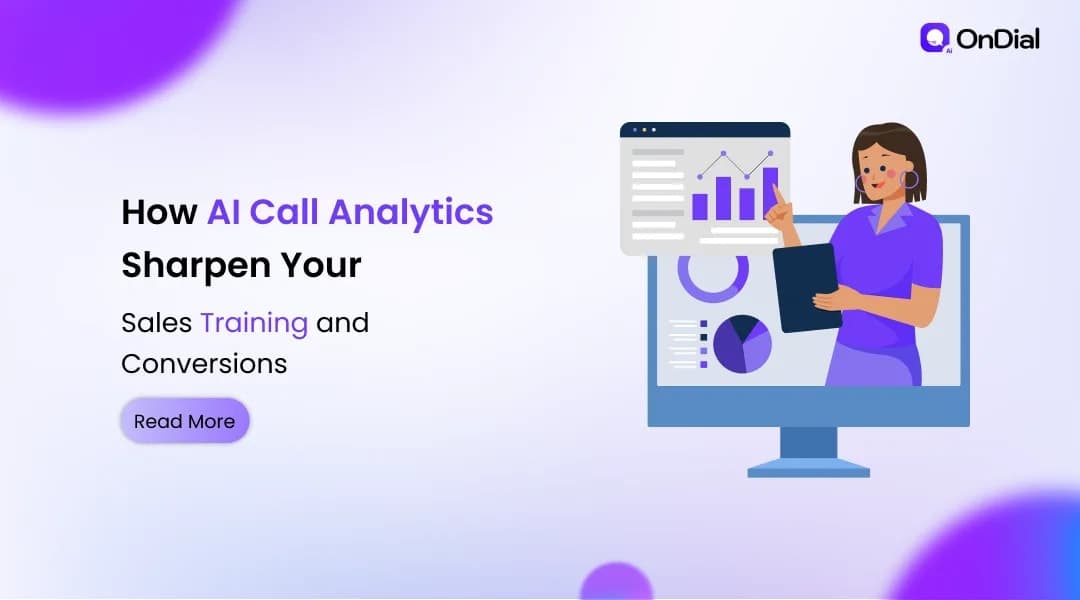
AI call analytics is software that automatically records, transcribes, and analyzes sales calls using natural language processing. It measures talk-to-listen ratios, sentiment, objection handling, and topic patterns, then turns those signals into coaching insights and scorecards, so managers can improve rep performance without listening to every call by hand.
From Recording to Insight: The Mechanics
The pipeline is more straightforward than the marketing suggests. The system captures the call, converts speech to text, and then applies natural language processing and sentiment analysis to interpret not just the words but the dynamics underneath them.
From there it tags the moments that matter: when a prospect raised a pricing concern, how the rep handled it, and which talk tracks lined up with deals that closed. Top platforms reach transcription accuracy of roughly 85 to 95 percent depending on audio quality, good enough to coach from and honest enough that you should still spot-check the edge cases.
Conversation Intelligence vs. Plain Call Recording
People treat these as the same thing. They are not, and the difference is the whole point.
Call recording stores what was said. It gives you a searchable archive and nothing more, which is useful but passive.
Conversation intelligence analyzes what was said, how it landed, and what it means for the deal, then pushes those insights into your CRM and coaching workflow.
Here is the simplest way to hold the distinction in your head. Conversation intelligence is the layer that reads what was said, how it was received, and what it means for the next step. Recording is the tape. Intelligence is the coach who watched the tape and already knows what to fix.
Why Your Coaching Stops Scaling Without It
More call recordings will not make you a better coach. That sounds backwards, but it is the trap most teams fall into. They record everything, feel productive, and review almost none of it, which means sales coaching at scale never actually happens.
The Math of Manual Review
Think about your own week. Between pipeline reviews, forecasting, and your own deals, how many full calls do you really listen to from start to finish?
For most managers the honest answer is a handful, and the data backs that up: roughly one to two percent of calls get a proper review. So ask yourself, when did you last listen to a complete call from your weakest rep, not a highlight, but the whole thing? That single blind spot is where bad habits calcify, because the reps who need coaching most are the ones whose calls nobody has time to hear.
What Top Reps Do That You Cannot See by Ear
This is where AI earns its place, because it spots behavioral patterns that are invisible across hundreds of calls. Research from Gong found that top performers keep a talk-to-listen ratio close to 40:60, meaning they let the prospect speak more, ask more discovery questions, and pause longer after an objection instead of rushing to defend.
Talk-to-listen ratio is the share of a call the rep speaks versus the prospect, and it is one of the strongest signals of discovery quality. You cannot reliably eyeball that across a team. The analytics can, and once you see that your struggling reps are talking 70 percent of the time, the coaching practically writes itself. (Most reps do not lose deals because they cannot pitch. They lose them because they talk through the moments where they should be listening.)
Turning Call Data Into Sales Training That Sticks
Insight on a dashboard changes nothing. The teams that improve are the ones who turn analysis into a repeatable training loop, and that loop is simpler than it sounds.
To train reps with AI call analytics, run a four-step loop: identify the most common skill gap in your call data, have reps practice that specific scenario, measure how the behavior changes on real calls over the next 30 days, then move to the next gap. Coaching becomes continuous and measurable instead of occasional and vague.
The Identify, Practice, Measure Loop
In the voice AI projects I have worked on at OnDial, the teams that improved fastest were never the ones with the most data. They were the ones who picked one weakness at a time and drilled it.
The loop works like this. Analytics identifies that 65 percent of your lost deals involve a pricing objection reps fumble. You build a short practice scenario around exactly that, then let the analytics measure the resolution rate on real calls over the following month. When the number moves, you pick the next gap. Sales coaching focused on discovery and qualification can improve win rates by around 29 percent, according to figures cited by Coffee.ai, but only when the practice targets a real, observed gap rather than a generic workshop.
Coaching the Moments That Decide Deals
Generic feedback like "build more rapport" helps no one. Specific, evidence-based feedback does, and analytics gives you the receipts.
Objection handling: Pull the three objections that appear most in lost deals and coach the exact language that worked in won ones.
Discovery depth: Show a rep their own talk-to-listen ratio next to a top performer's, then set a target for the next ten calls.
Follow-up commitment: Flag calls that ended without a clear next step, because sellers using conversation intelligence are 36 percent more likely to secure a follow-up meeting, per Outreach.
Each of these is a clip you can play, a number you can track, and a behavior you can drill. The most advanced platforms go a step further with real-time coaching, surfacing battle cards and prompts to the rep mid-call when a prospect raises a tough question. That is useful, but for training the post-call review loop is where lasting skill is built. Real-time help fixes one call. Coaching fixes the rep.
How AI Call Analytics Moves Your Conversion Numbers
Now the question every leader actually cares about. Does this move the conversion rate, or is it another dashboard nobody opens?
The Conversion Lift You Can Reasonably Expect
The honest answer is that it can move the needle meaningfully when paired with real coaching. McKinsey estimates that organizations applying AI-driven sales analytics can improve lead conversion rates by 20 to 30 percent, and Outreach reports that teams using conversation intelligence close deals 11 days faster on average, with a 10 percentage point improvement in win rates on deals above 50,000 dollars.
The mechanism is not magic. It is faster onboarding, more consistent objection handling, and managers who coach from evidence instead of instinct. New hires study the winning talk tracks and ramp in weeks rather than months, which compounds across a growing team.
Where the Numbers Get Honest
Here is the part most vendors skip, and skipping it is how trust gets lost.
The eye-catching "30 percent lift" claims usually come from best-case studies. Independent reviews put the realistic, repeatable win-rate improvement for most 2026 deployments closer to 5 to 15 percent, with the biggest gains in onboarding speed and manager reach rather than a senior rep's individual numbers. AI flags the patterns. It does not replace the judgment of an experienced leader who knows the specific buyer, market, and deal. Treat any tool that promises to coach exactly like your best VP as marketing, not a plan.
Making It Work for the Indian Market
If you sell in India, the standard playbook needs adjusting, because the call itself looks different. Voice AI adoption in India has surged sharply over the past year, and India is now the fastest-growing AI calling market by percentage according to Auto Interview AI. The tooling has to match that reality.
Language, Accent, and Local Context
A call analytics system trained on clean American English will quietly fall apart on a real Indian sales call. Conversations switch between English, Hindi, and regional languages inside a single sentence, and the sentiment cues carry cultural nuance a generic model misses.
This is the work we focus on at OnDial. Building voice AI for Indian businesses means the analytics has to read Hinglish, recognise regional accents, and understand local buying context, otherwise the coaching insights come back confidently wrong. A misread objection becomes a misdirected training session, and that wastes everyone's time.
Compliance and Trust Signals
Recording and analyzing customer calls in India is legal but regulated, and treating that casually is a fast way to lose customer trust.
TRAI and DLT frameworks govern how commercial voice communication is handled, so your analytics stack needs to sit inside those rules, not work around them.
The DPDP framework sets expectations for how personal conversation data is stored and processed, which matters the moment you start retaining call recordings at scale.
Being transparent with prospects about recording, and keeping conversation data out of any public model training, is not just compliance hygiene. It is the foundation of the trust that makes customers comfortable on the call in the first place.
Conclusion
AI call analytics gives you something sales training has always lacked: a complete, honest record of what your reps actually do on calls, not what they remember doing. Three things matter most. Review every call instead of a lucky few. Coach the specific moments, like objection handling and discovery depth, that decide deals. And measure the lift rather than assuming it.
You do not need a bigger team to coach better. You need a clearer view of the conversations you already have. At OnDial, we build voice AI that captures and reads those conversations in English, Hindi, and regional languages, so Indian businesses can turn everyday calls into a steady coaching engine. If your recordings are piling up unreviewed, that backlog is your next training program. Start with one week of calls and the single most common objection your reps face.