Responding to a prospective student within five minutes makes you up to 21x more likely to qualify that lead than waiting just 30 minutes, according to data cited by Kixie. Yet the average Indian institution takes 8 to 12 hours. That single gap is where most of your admission inquiries quietly die. AI calling for EdTech closes it by answering every inbound inquiry in seconds, qualifying it in plain conversation, and following up far longer than a tired counselor ever could. If you are buying thousands of leads and watching most of them go cold, you already know the problem is not demand. It is response speed and follow-through.
I have spent years inside voice AI deployments at OnDial, and the pattern repeats everywhere. Good leads, bad timing, lost students.
Here is what you will learn: where your inquiries actually leak, what an AI call sounds like start to finish, the follow-up math that decides conversion, and how to run all of it within India's calling rules.
Why admission inquiries leak before you ever call back
The honest truth is that your conversion problem is rarely a counseling problem. It is a speed-to-lead problem. Speed-to-lead is simply how fast you reach a prospect after they raise their hand, and in admissions it predicts conversion better than almost anything else.
The five-minute window that decides everything
A parent fills your form at 9 PM after researching three coaching institutes. Your office is closed. By the time a counselor calls back the next afternoon, that parent has already spoken to two competitors and mentally shortlisted them.
This is not a guess. Research consistently shows that 78% of customers buy from the first company that responds to their inquiry, per LeadAngel. In education, where families commit lakhs of rupees and years of a child's future, the first responsive institution earns disproportionate trust. The math is brutal and it favors whoever picks up first.
Why your counselors can't win the speed race alone
Your team is not slow because they are lazy. They are slow because the system asks them to do something humanly impossible.
Volume spikes nobody can staff for: During admission peaks, inbound call volumes commonly jump 4x to 6x, and you cannot hire and train quality counselors that fast.
Follow-up tied to memory and mood: Manual follow-up depends entirely on which counselor remembers which lead on which day, so most leads get two or three attempts at best.
After-hours blindness: Most students research in the evenings and on weekends, exactly when no one is at the desk to answer.
(I have watched brilliant counseling teams lose to a competitor with worse programs purely because that competitor answered the phone first.)
What AI calling actually does on an admission inquiry call
AI calling for EdTech is a voice agent that automatically calls or answers prospective students, holds a natural conversation about courses and fees, qualifies their intent, and books the next step. It is not a recorded message or a press-1-for-admissions menu.
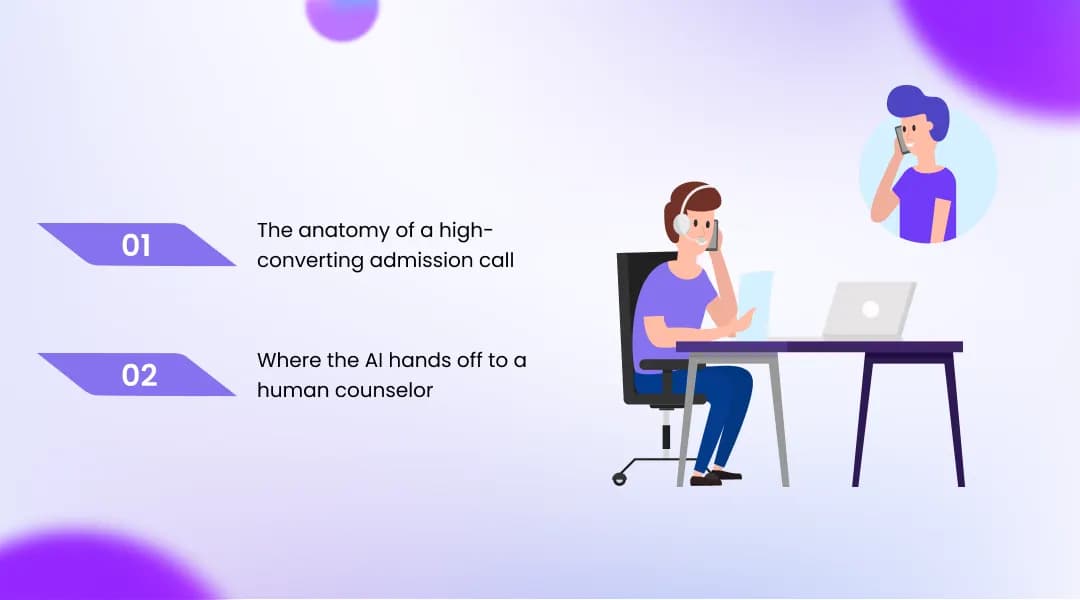
The anatomy of a high-converting admission call
Most articles describe AI calling as a black box. Let me open it. A strong admission call follows a clear shape, and the shape is what converts.
Instant pickup and warm open: The agent calls within seconds of the form submission, greets the student by name, and references the exact course they asked about.
Discovery, not interrogation: It asks a few qualifying questions about eligibility, preferred intake, budget comfort, and timeline, using natural language rather than a rigid script.
Real answers on the spot: It handles the common questions instantly, including fees, scholarship eligibility, batch timings, and program duration, drawing only from your approved information.
A booked next step: It schedules a counseling call or campus visit and writes the full discovery summary back to your CRM so the human counselor starts with context, not a cold sheet.
This is where intent detection matters. The agent flags a student who is ready to pay differently from one who is just browsing, so your team's energy goes where it counts.
Where the AI hands off to a human counselor
Here is the counter-intuitive part: the best AI calling setups talk less than you would expect. Human handoff is the deliberate moment the AI escalates a high-intent or complex conversation to a senior counselor with full context attached.
The agent should handle the repetitive 70 to 80 percent: first-touch speed, qualification, FAQs, reminders. The remaining 20 to 30 percent, the emotional reassurance, the negotiation, the genuinely complex eligibility case, belongs to a human. A practical model many Indian platforms use is AI handling routine interactions with smooth escalation to a person, preserving the human connection that online learning can lack. Done right, the AI does not replace your counselors. It hands them only the conversations worth their time.
How AI calling converts more admission inquiries
Will AI calling actually move your enrollment numbers, or is it just faster busywork? It converts more because it fixes the two things humans cannot sustain: instant response and relentless follow-up.
Featured answer: AI calling converts more admission inquiries by responding within seconds instead of hours, qualifying every lead through natural conversation, and executing the 8 to 12 follow-up touchpoints needed to enroll a student. It then routes only serious, ready-to-commit prospects to human counselors, lifting both speed-to-lead and counselor productivity at once.
Multi-touch follow-up your team can't sustain
This is the stat that should change how you staff admissions. The average Indian EdTech company contacts a lead about 3.2 times before giving up, yet the research-backed optimal is 8 to 12 touchpoints to convert an education lead, according to Auto Interview AI.
That gap is pure lost revenue. An AI agent makes touchpoint four, seven, and eleven without fatigue, at the right hour, in the right tone. EdTech companies using AI calling typically see a 30 to 50 percent improvement in lead-to-enrollment conversion, mainly because the AI executes the systematic multi-touch follow-up that human counselors realistically cannot. You are not adding effort. You are finally completing the sequence you already started paying for.
Qualifying leads so counselors only talk to serious prospects
Lead qualification is the process of separating students who are genuinely ready, eligible, and able to pay from the much larger pool of casual browsers. It is the difference between busy counselors and productive ones.
When the AI screens first, your team stops burning hours on unqualified calls. One India case I find instructive: a top EdTech platform receiving roughly 6,000 monthly queries had only a 16 to 18 percent connect ratio, and improving connection alone reshaped their funnel. AI calling attacks exactly that bottleneck. It dials every lead, connects more of them, and passes counselors a shortlist of people who actually want to enroll.
Making AI calling work in the Indian EdTech market
A voice agent built for the United States will fail in Lucknow. The Indian market has two non-negotiables: language and compliance. Get these right and AI calling works. Ignore them and it backfires.
Multilingual calling for Tier 2 and Tier 3 students
India's EdTech growth is being written in Hindi, Tamil, Telugu, Kannada, and Bengali, not only English. Students from Tier 2 and Tier 3 cities are the fastest-growing cohort, and they are the most underserved by English-first support.
Code-mixing is the norm: A working professional in Bengaluru naturally switches between English and Kannada mid-sentence, and the agent must follow without breaking.
Regional reach without regional hiring: A genuinely multilingual voice agent lets one system serve a pan-India applicant base, which no human counseling team can staff affordably.
Cultural fluency: The agent should understand references to JEE, NEET, and CAT and the academic calendar, so the conversation feels informed rather than scripted.
Staying compliant with TRAI DLT and the DPDP Act
This is the part vendors gloss over, and it can quietly sink a campaign. You need both the telecom rules and the data rules handled before you scale.
TRAI DLT and the DND Registry: Admission-counseling outbound is generally treated as promotional and requires DLT registration, and your lead list must be washed against the DND Registry before any campaign. Renewal and fee calls are usually transactional, and that distinction has to be enforced at the dialer.
The DPDP Act 2023: Student and parent personal data must be handled under India's DPDP Act, with clear consent and purpose limits, since you are processing sensitive information about minors in many cases.
Respecting calling windows: Calls should run inside permitted hours and avoid school timings, which also happens to improve pickup rates.
I will be honest about the limits here. AI calling is not a license to spam. Leads who fill a form have implicitly consented to contact, but for ongoing outreach you still need explicit, captured consent. Treat the rules as a feature, not a hurdle, and trust follows.
Conclusion
AI calling for EdTech wins because it fixes the three leaks no counseling team can plug alone: it answers in seconds, it follows up the full 8 to 12 times an enrollment actually takes, and it qualifies every lead so your counselors spend their hours only on students ready to commit. The technology does not replace your people. It hands them better conversations and protects the leads you already paid for.
You came in frustrated by leads slipping away. You can leave with a clear plan to stop the leak.
At OnDial, we build human-first voice AI tuned for exactly this: India's languages, India's compliance rules, and the precise moment an admission inquiry decides to stay or walk. If you want to see what your own admission call flow would sound like, we will map it with you, no jargon, no pressure.