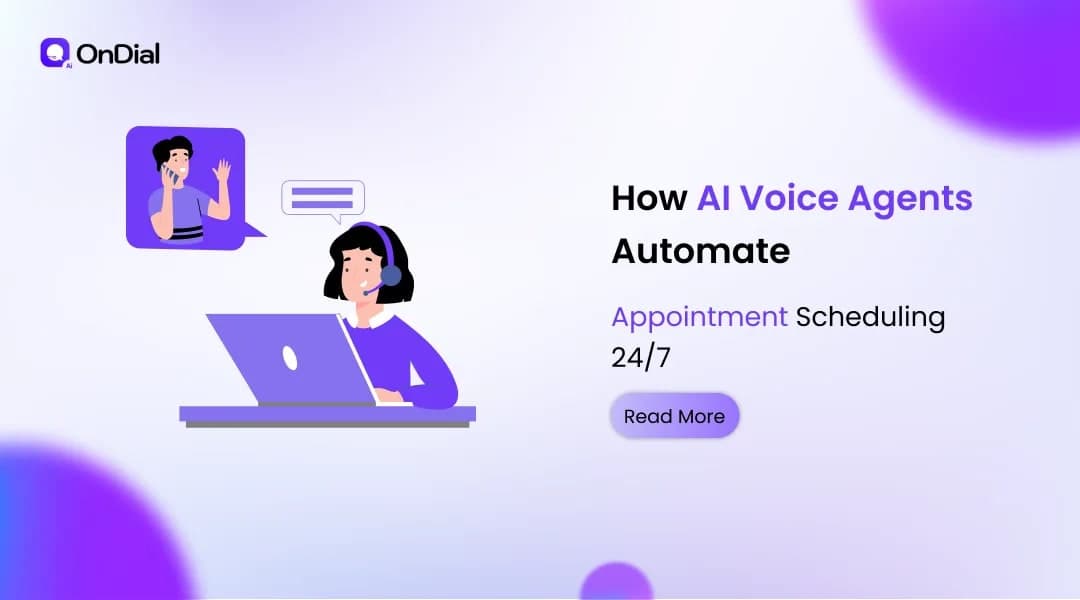
The average small business misses 62% of its calls, according to the 411 Locals study. Sit with that for a second. Every one of those calls was a person who wanted to book, ask, or buy, and most of them will not call back. AI voice agents for appointment scheduling exist to close that exact gap: they answer every inbound call, check live calendar availability, and confirm the booking inside the same conversation, at 2 PM or 2 AM, with no hold music and no voicemail. They speak naturally, follow your booking rules, and write the appointment straight into your calendar.
I have spent years building voice AI at OnDial, and the skepticism is fair. You have probably fought with an IVR phone tree that made you press four buttons to reach a human. This is not that. In this guide, I will walk through what these agents actually do, how the 24/7 mechanism works under the hood, why missed calls quietly drain more revenue than empty calendars, and the honest limits you should know before you deploy one.
What an AI Voice Agent for Appointment Scheduling Actually Does
An AI voice agent for appointment booking is a conversational system that answers the phone, understands spoken requests, and schedules the appointment without a human in the loop. It is not a chatbot bolted onto a phone line. It listens, interprets intent, and takes action against your real scheduling data.
The mechanism in plain terms
At its core, the agent combines three things: speech-to-text to hear the caller, a large language model to understand what they actually mean, and a live connection to your calendar to act on it. When someone says "I need to see the dentist next Tuesday afternoon," the system parses the request, queries open slots, and offers real times. It is the difference between a recording that collects a message and a system that finishes the job.
Definition worth quoting: An AI voice agent for appointment scheduling is software that answers calls, checks live availability, and books, reschedules, or cancels appointments through natural conversation. Modern voice AI systems reach 95% speech recognition accuracy, according to MIT Technology Review, which is the threshold that makes them usable rather than frustrating.
Where it fits in your existing stack
The agent does not replace your tools. It plugs into them. That integration layer is what separates a real deployment from a demo that looks good on stage.
Calendar sync: It connects to Google Calendar, Outlook, Calendly, or Calcom and reads real-time availability, so it never offers a slot that is already taken.
CRM and records: It writes contact details and outcomes into your CRM or, for clinics, your EHR/EMR, keeping every booking in the right place.
Notifications: It fires SMS or email confirmations and reminders automatically, closing the loop the moment the call ends.
Have you ever counted how many bookings you lose simply because the right slot was double-booked by a distracted front desk with Healthcare AI voice agents? Real-time calendar checks make that specific failure mode disappear.
How 24/7 Appointment Scheduling Works Under the Hood
Here is a counterintuitive truth: the hard part of 24/7 appointment scheduling is not the talking. It is the acting. Plenty of systems can hold a conversation; far fewer can reliably turn that conversation into an accurate calendar entry that survives contact with your booking rules.
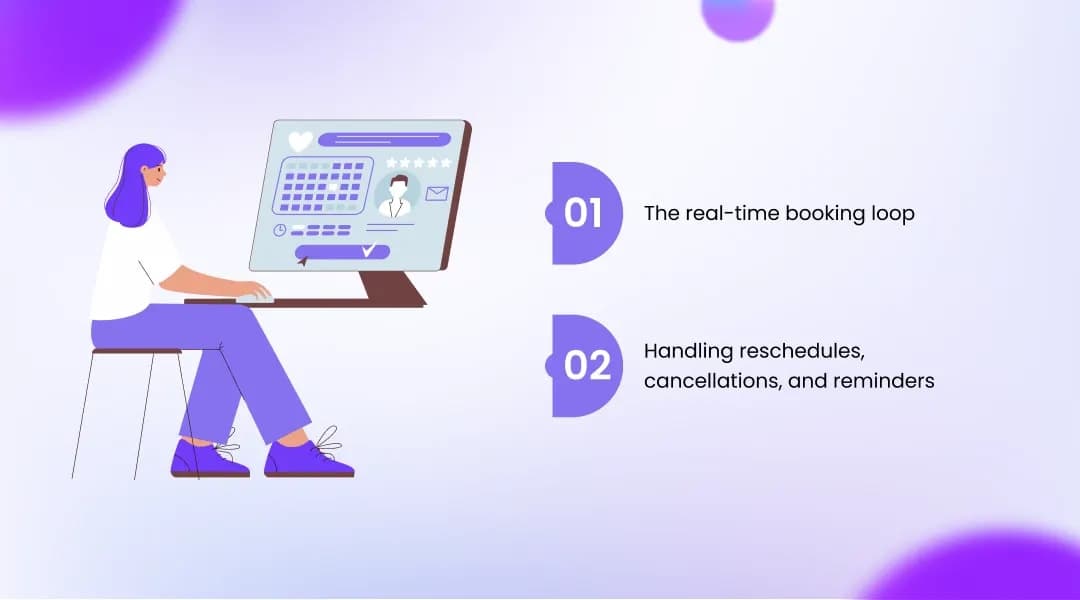
The real-time booking loop
The whole process runs as a tight loop that completes inside a single call. Speed matters here, because a caller who waits too long between turns simply hangs up.
Featured snippet answer: An AI voice agent handles 24/7 scheduling in five steps. It answers the call instantly, interprets the caller's request using natural language processing, queries live calendar availability, offers open slots, and writes the confirmed booking back to the calendar with an automatic SMS or email confirmation, all without human involvement.
In the systems we have built at OnDial, the design goal is low latency and clean handoff, so the conversation feels like talking to a capable receptionist rather than fighting a script. The agent also collects the details you actually need, whether that is a name, a reason for visit, or a phone number for verification. Every step follows the rules you set, not a generic template.
Handling reschedules, cancellations, and reminders
Booking is only half the job. The same agent manages the appointment across its whole life, which is where most manual workflows fall apart with voice AI beyond static call scripts. A front desk that is slammed at 10 AM cannot chase every reschedule; an automated agent can.
Reschedules and cancellations: The caller can move or cancel an appointment in the same natural conversation, and the calendar updates in real time.
Reminders: Automated reminders go out before each appointment, which is the single biggest lever on attendance.
Exception handling: When a request falls outside its rules, a well-designed agent hands off to a human instead of guessing.
That last point is the one honest vendors emphasize, and the rest gloss over.
Why Missed Calls, Not Empty Calendars, Are the Real Problem
Most owners think their scheduling problem is demand. It usually is not. The demand is calling; it is just not getting through. This is the angle almost no competitor page will tell you plainly.
The after-hours gap
Your customers do not keep business hours, and your phone line does. Somewhere between 40% and 60% of business calls arrive outside the 9-to-5 window, per Nextiva and Aira research. Those are not spam calls. They are people with intent who reached a voicemail and moved on to whoever answered next.
Speed compounds the problem. In one dealership dataset, 78% of buyers purchased from the first business that responded. At 9 PM on a Thursday, the business that responds is the one with a system answering the phone. A voice agent that runs around the clock captures the exact demand your staff physically cannot.
The confirmation gap and no-shows
The second leak is quieter and more expensive. In the U.S. alone, no-shows are estimated to cost providers more than $150 billion annually, with each missed appointment averaging around $200 in lost revenue, as reported by Curogram in 2024. A booked slot that no one shows up for is worse than an empty one, because you turned away someone else to hold it.
The uncomfortable part is that traditional fixes barely move the needle. An MGMA poll found 73% of practices reported no-show rates that stayed the same or increased. Generic text blasts and voicemail reminders are not closing the gap, because they are not conversations.
How AI Voice Agents Reduce No-Shows
No-shows are a confirmation problem, not a customer-loyalty problem. People miss appointments they never actively confirmed. Reduce no-shows by making the confirmation itself a real interaction, and the numbers shift with AI voice agents for business calls.
Automated confirmations and reminders
Zero-click answer: AI voice agents reduce no-shows by calling every appointment on your list, confirming attendance in a natural conversation, and offering an instant reschedule to anyone who cannot make it. Because the agent works the entire list rather than the half a human team can reach, every slot gets a live confirmation instead of an ignored text.
I have watched the mechanics of this closely. A human team running manual confirmations typically reaches only part of the list before capacity runs out, and the contacts they miss are the ones most likely to vanish. An agent does not run out of hours. It reaches everyone, every time.
Turning a would-be no-show into a reschedule
The real value is not just confirming; it is recovering. When someone says they cannot make Thursday, the agent immediately offers Friday and saves the booking. That single behavior converts lost revenue into kept revenue.
Live rescheduling: A cancellation becomes a moved appointment instead of an empty slot.
Reminder timing: Confirmations land close enough to the appointment to matter, not so early they are forgotten.
Consistency: Every contact gets the same clean process, with no reminder skipped because the desk got busy.
Where Voice Scheduling Works Best (and Where It Does Not)
Let me be straight with you, because trust is the whole game here. AI voice agents for appointment scheduling are not magic, and the vendors who pretend otherwise are the ones to avoid.
Industries seeing the fastest returns
The strongest fit is any business where phone bookings are high-volume, rule-based, and revenue-critical. That covers a lot of ground.
Healthcare and dental: High call volume, painful no-show costs, and clear scheduling rules make this a natural fit, provided the system is compliant.
Home services and dealerships: After-hours demand is huge, and confirmation gaps directly cost jobs. Fixed Ops departments commonly run no-show rates of 15% to 25%.
Salons, spas, and advisory firms: Preference-heavy booking and single high-value calls reward instant, always-on answering.
The honest limits: edge cases and human handoff
Real conversations do not follow perfect scripts, and this is where you need clear eyes with OnDial. A patient might ask a clinical question the agent should never answer, or a caller might change the appointment type mid-sentence. The right design routes those cases to a person quickly rather than forcing a booking.
There are practical constraints too. Some platforms cap how far out they can schedule or default to collecting only an email, which fails for older callers who prefer to verify with a name and date of birth. (I raise these because I have seen teams get burned by demos that hid them.) The goal is augmentation of your front desk, not blind replacement of human judgment.
What to Look For Before You Deploy One
Choosing a platform is less about the flashiest demo and more about the fit with your real workflow. A vendor with ten similar deployments in your industry beats a perfect demo with no references.
Integration depth and latency
Two technical factors decide whether the thing works in production. The first is how deeply it connects to your actual systems, and the second is how fast it responds.
Integration depth: It should write back to your calendar, CRM, and internal systems, not just read from them.
Latency: Sub-second response keeps the conversation natural and stops callers from dropping off.
Handoff quality: It should escalate cleanly to a human, with full context, on anything outside its rules.
Compliance: HIPAA, TCPA, and FCC
This is non-negotiable for regulated industries, and it is where a partnership approach earns its keep. Booking data is sensitive, and outbound calling has legal guardrails you cannot ignore.
For healthcare, the platform must handle calls and records under HIPAA, with encryption and access controls as a default rather than an add-on with AI voice agent platform features. For any outbound campaign, TCPA and FCC rules govern consent, do-not-call scrubbing, and time-zone-aware calling. At OnDial, we treat compliance as a first-class feature, because a booking that creates legal exposure is not a win.
Conclusion
AI voice agents for appointment scheduling solve a problem you can measure: the calls you miss, the slots that go unconfirmed, and the after-hours demand your team cannot cover. The three takeaways are simple. Missed calls, not empty calendars, are the real leak; no-shows are a confirmation gap that live conversations close; and the best deployments know when to hand off to a human.
You do not have to guess your way through this. If you are losing bookings to voicemail or watching no-shows eat your calendar, OnDial builds tailored voice AI that answers every call, books in real time, and stays compliant, designed around your workflow rather than a generic script. Start by mapping where your bookings actually fall through, then let us help you close that specific gap.