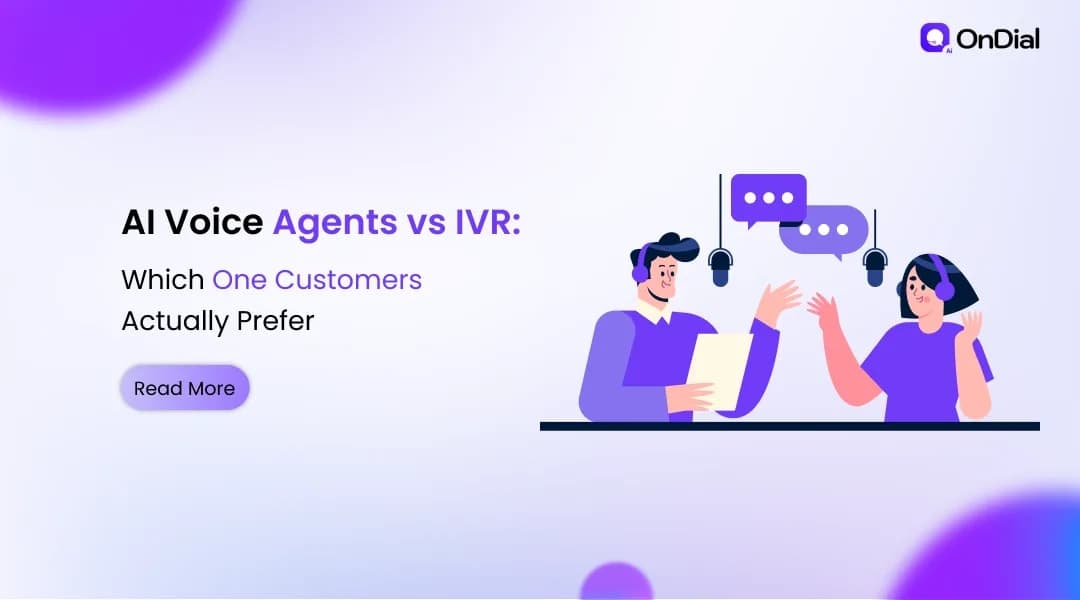
Sixty-seven percent of consumers abandon a call while navigating an IVR menu, according to a 2026 NICE Customer Experience report. Read that again. Two out of every three people who call your business and hit a phone tree hang up before they get anywhere. So when we ask the AI voice agents vs IVR question, we are not really debating technology. We are asking which system makes a frustrated person on the other end of the line feel heard instead of trapped.
Here is the honest answer up front: customers do not prefer a technology. They prefer getting their problem solved fast, without repeating themselves, and without pressing 4 to find out option 4 was the wrong one. AI voice agents win that preference far more often than IVR because they listen and resolve, while IVR mostly routes. But it is not a clean sweep, and anyone telling you it is has something to sell.
I have spent years building voice systems for businesses across India, and I have watched this preference play out call by call. Below, I will show you what the data says, where each system genuinely wins, and how to choose without the hype.
What Customers Actually Mean When They Say They "Prefer" One
The whole AI voice agents vs IVR debate gets distorted because we ask the wrong question. We ask which system customers like. They do not think in systems. They think in outcomes.
The Preference Is for Resolution, Not Technology
When a customer says they "hate the robot," they are rarely objecting to automation itself. They are objecting to not being understood. A revealing data point: an Invoca consumer survey found that 84% of callers said their biggest frustration with phone service is wait time, not whether the agent is human or AI. The technology label matters less than the result.
This reframes everything. Customer satisfaction rises when the system reduces effort, and it falls when the system adds steps. A Deloitte Digital Consumer Survey from 2026 found that 51% of consumers aged 18 to 34 have no preference between AI and a human, as long as the issue gets resolved. That generation is voting with their patience, not their ideology.
So the real question is not "do customers prefer AI or IVR." It is "which system resolves more issues with less friction." That is a question with a measurable answer.
Why "Press 1 for Billing" Became a Trust Problem
Here is something most people miss. Customers learned long ago that IVR menus are not really there to help them. They are there to contain them.
Research from Software Advice found that 46% of consumers say IVR menus are the single most frustrating part of contacting customer service. The deeper issue is trust: callers assume the menu is a wall between them and a human, so they start spamming zero before the recording even finishes.
The repetition tax: Callers enter an account number into the IVR, then a live agent asks for it again. That single broken handoff signals the whole system is not listening.
The dead end: When none of the five options match your actual problem, you are forced to guess, and a wrong guess sends you back to the start.
The emotional cost: By the time a frustrated caller reaches a person, the relationship is already strained, which is the opposite of what a customer-service call is supposed to do.
(That last point is worth sitting with. A support call is a chance to build loyalty. A bad IVR turns it into a chance to lose it.)
The Real Difference Between IVR and AI Voice Agents (Beyond the Marketing)
If you only remember one thing about the difference between IVR and AI voice agents, make it this: IVR routes calls, AI voice agents resolve them.
IVR: Rigid Menus Built for Routing
An IVR is a menu-driven phone system that uses keypad presses or basic voice commands to route a caller to a department. It was invented in the 1970s and standardised in the 1990s, when touch-tone routing was the most efficient option available.
That heritage is the problem. IVR was engineered for the business's convenience (sorting calls cheaply), not the caller's. It cannot interpret intent. If you say "I want to cancel," a legacy IVR hears nothing useful and waits for you to press a number. According to Gartner, traditional IVR achieves an autonomous resolution rate of only 10 to 30%, meaning the overwhelming majority of calls still need a human to actually finish the job.
AI Voice Agents: Conversation Built for Resolution
An AI voice agent is a software system that handles a phone call end to end using natural language processing (NLP), letting callers speak in their own words instead of choosing from a menu. It interprets intent, remembers context across the call, pulls data from your CRM, and completes the task.
Here is the snippet-worthy summary if you only have ten seconds: the core difference between IVR and AI voice agents is that IVR forces the customer to adapt to a fixed menu, while an AI voice agent adapts to the customer's natural speech and resolves the request without transfers. Gartner data shows AI voice agents reach 60 to 80% autonomous resolution, roughly double to triple what legacy IVR manages.
The practical effect is fewer handoffs. Where a typical IVR call involves multiple transfers and forces the caller to re-explain each time, a capable voice agent passes full conversation context to a human only when escalation is genuinely needed. That single design choice is why first-call resolution (FCR) climbs so sharply after a switch.
The Data: Do Customers Actually Prefer AI Voice Agents Over IVR?
Time for the question everyone actually searches. Do customers really prefer AI voice agents over IVR, or is that just vendor optimism?
What the Satisfaction Numbers Say
The short answer: yes, by a wide margin, on the metrics that measure experience.
Customers report nearly double the satisfaction with AI voice agents compared to legacy IVR, with AI scoring around 3.8 out of 5 versus 2.1 for traditional IVR on NICE's CX benchmark. That is not a marginal edge. That is one system passing and the other failing.
The cost signals point the same direction. Vonage research found that 51% of consumers reported abandoning an entire company, not just a call, because of a poor IVR experience. When a phone menu is bad enough, customers do not just hang up. They leave for a competitor and do not come back. AI voice agents directly attack the causes of that exit: hold times, repetition, and dead ends.
The Nuance: Preference Depends on the Problem
Now for the honest part the hype pieces skip. Preference is not absolute. It bends to the type of problem.
A Qualtrics XM Institute study found that 73% of consumers still prefer a human agent for complex or emotionally sensitive issues, though notably 68% of those same people are fine with AI handling the initial triage before a transfer. So the preference is layered, not binary.
Simple, transactional calls (balance checks, order status, appointment booking): Customers happily prefer fast automation over waiting for a human, and AI voice agents excel here.
Complex or emotional calls (disputes, claims, grief, financial distress): Customers want a human, and the smart move is to let AI triage and route, not resolve.
The middle ground: Most call volume sits in routine territory, which is exactly why AI voice agents shift overall preference so strongly in their favour.
In projects I have worked on, the businesses that win are the ones that stop treating this as an either-or. They let AI own the routine majority and route the sensitive minority to a person, with full context attached.
When Customers Still Prefer (or Tolerate) IVR
Counter-intuitive statement coming: there are real situations where IVR is still the right call, and pretending otherwise would be dishonest.
Simple, Predictable Tasks With Tight Budgets
A basic IVR is genuinely cost-effective for narrow, repetitive jobs. If your call flow is nothing more than "press 1 for store hours, press 2 for directions," a simple menu does the job at minimal cost. There is no conversation to interpret and no context to maintain.
IVR also has one underrated advantage: predictability. A frequent caller who knows that pressing 3 always reaches billing can move faster than they could explaining themselves to any system. For high-frequency, single-purpose lines, that muscle memory is a feature, not a bug.
That said, this is a shrinking niche. The moment your call flow involves more than a handful of branches or any natural-language complexity, the IVR's predictability turns back into a maze.
Trust, Privacy, and the Cost Question
Some customers are warier of AI than others, and that hesitation is legitimate. A few callers simply trust a structured menu more than an open-ended conversation with a system they do not understand.
There is also the budget reality. AI voice agents carry a higher setup cost than a basic IVR, and not every small operation needs that capability on day one. The deciding factor is volume and complexity, not fashion.
Keep a simple IVR when: call volume is low, flows are trivial, and budget is the hard constraint.
Move to an AI voice agent when: you handle high volume, complex or revenue-sensitive calls, or you are losing customers to abandonment and hold times.
Worth naming the open question honestly: AI voice agents are improving fast, but they still misfire on heavy accents, background noise, and genuinely novel requests. A good deployment plans for graceful handoff to a human, rather than pretending the AI will catch everything.
What This Means for Indian Businesses Choosing a Voice System
The AI voice agents for Indian businesses conversation has its own texture, and a generic Western comparison misses it.
Language, Accents, and Local Context
India is not one phone market. It is dozens. A caller might switch between English, Hindi, and a regional language inside a single sentence, and a legacy IVR collapses the moment that happens.
This is where modern voice AI earns its place. A well-built AI voice agent can handle code-switching and regional accents that a rigid menu cannot, which matters enormously for businesses serving customers across multiple states. At OnDial, this is exactly the kind of real-world communication challenge we build for: voice systems tuned to how Indian customers actually speak, not how a script assumes they will.
The practical payoff is reach. A business that previously needed separate human teams for different language regions can serve far more callers naturally, while keeping a human in the loop for the calls that need one.
Compliance and Customer Trust
Indian businesses also operate under specific rules, and customer trust depends on respecting them.
Any outbound or automated voice programme has to account for TRAI DLT registration for commercial communications, and customer data handling now falls under the DPDP Act. These are not optional footnotes. They shape how a voice system is allowed to contact people and store what it hears.
The trust dividend is real, though. When a voice system greets a returning customer by name, understands their query in their own language, and never makes them repeat an account number, it signals competence and care. That is how automation builds loyalty instead of eroding it.
How to Decide: A Practical Framework
Ready to actually choose? Forget the marketing. The decision to replace IVR with an AI voice agent comes down to matching the system to the call.
Match the System to the Call Type
Stop evaluating the technology in the abstract. Audit your real call volume first.
What share of your calls are simple and transactional? That share is your AI voice agent's natural home, where automation lifts satisfaction.
What share are complex or emotional? Route those to humans, with AI doing the triage and context handoff.
What is your current resolution rate? If your IVR or chatbot resolves fewer than 40% of contacts without a human, you have a strong case to switch.
A useful gut check: if customers regularly press zero or shout "agent" within the first ten seconds, your menu is failing and the data already favours a change.
The Hybrid Path Most Businesses Actually Take
Here is the path I see work most often. Few businesses flip a switch overnight, and they should not.
The smart rollout starts with one high-volume, routine flow (after-hours coverage is the most common entry point). You measure resolution and satisfaction against your old IVR, then expand to the next flow once the numbers prove out. The financial case tends to settle the debate: a Forrester Consulting study found companies deploying voice AI reported a three-year ROI between 331% and 391%, with payback typically under six months.
The goal is not to rip out everything you have. It is to put each call in front of the system most likely to resolve it well.
Conclusion
The AI voice agents vs IVR question has a clear answer once you stop framing it as a technology contest. Customers prefer the system that resolves their problem fastest with the least friction, and on the calls that make up most of your volume, that system is an AI voice agent. IVR still has a narrow home in simple, predictable, budget-tight flows. And the smartest businesses run a hybrid, letting AI handle the routine majority while humans take the sensitive few.
You do not have to guess your way through this. If you want to see how a voice agent would handle your actual call flows, in your customers' own languages, the OnDial team builds and tunes these systems specifically for Indian businesses, and we would rather show you a real demo on your use case than sell you a switch you do not need.