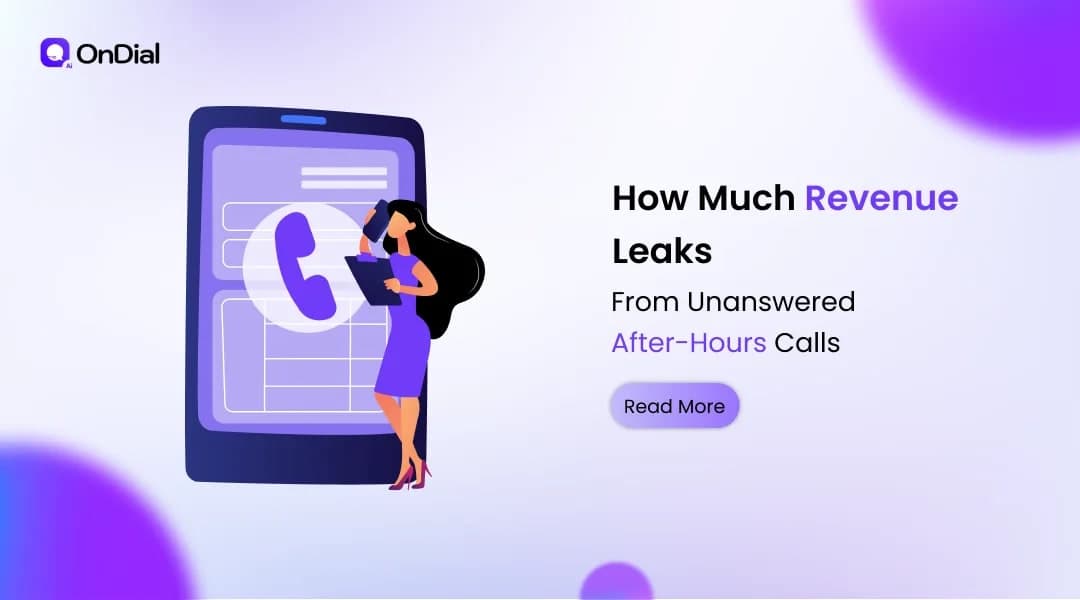
How much revenue leaks from missed after-hours calls? For most service businesses, the honest answer lands somewhere between a worrying five figures and a frightening six figures every year. Depending on the industry, 35% to 50% of all inbound calls arrive outside normal working hours, according to call-tracking data compiled by AInora from BIA/Kelsey and Forbes coverage. Most of those calls hit a voicemail box that never gets returned. And per data aggregated by Aira, 85% of callers who reach voicemail never call back.
If you have ever felt that nagging sense your phone is costing you money while you sleep, you are not imagining it.
Here is the uncomfortable part. This leak does not show up on your profit and loss statement. There is no line item called "calls we lost at 9 PM." The revenue simply never arrives, so it never gets counted. In this guide I will walk you through exactly how to size that leak in real numbers, why after-hours calls behave differently from daytime ones, and what actually closes the gap.
How Much Of Your Call Volume Actually Happens After Hours
Most owners assume the bulk of their after-hours call volume is junk: wrong numbers, robocalls, people who will call back tomorrow. The data says otherwise. Evenings and weekends are when a large share of high-intent buyers actually pick up the phone.
The Hours You Are Closed Are The Hours Buyers Are Free
Think about your own behaviour as a customer. You research the plumber, the clinic, or the loan after dinner, not during your own workday. That is why call-tracking research consistently shows a secondary spike in volume right before and after standard business hours, exactly when your team is least available.
For home services the skew is even sharper. Industry data referenced by Caseyresponse shows that 40% to 60% of home service leads come outside traditional business hours, across evenings, weekends, and holidays. A burst pipe does not check your opening times.
After-Hours Calls Are Concentrated Intent, Not Background Noise
Here is a counter-intuitive truth: an after-hours caller is often a better lead than a daytime one. Someone calling at 8 PM has chosen to act in their personal time, which signals urgency and readiness to buy.
I have seen this pattern repeatedly in projects at OnDial, where we work with Indian service businesses on voice AI. The clinics, real estate firms, and D2C brands we partner with often discover their evening callers convert at higher rates than their afternoon ones. The problem was never lead quality. It was that nobody picked up.
What A Single Missed After-Hours Call Really Costs
Now to the question everyone actually wants answered. The cost of a missed call is not the price of one transaction. It is the lifetime value of a customer who quietly went to a competitor.
The Direct Math Is Simpler Than You Think
You can estimate your annual leak with a single line of arithmetic. Take your weekly after-hours calls, multiply by your miss rate, your close rate, and your average customer value, then annualise it.
Take a real example. Say a mid-sized clinic gets 30 after-hours calls a week, misses 70% of them, closes 40% of the ones it does answer, and books each patient at an average value of ₹3,000. That single line of math points to well over ₹6 lakh in revenue walking out the door every year, and that is before repeat visits. Run your own numbers and the figure is rarely comfortable.
A useful way to read the result, adapted from MyAIFrontDesk's framework:
Under ₹40 lakh a year in lost revenue: a moderate leak. You are leaving money on the table but it is not yet structural.
₹40 lakh to ₹1.2 crore: significant. You are losing enough to justify hiring people, when a fraction of that buys an always-on system.
Above ₹1.2 crore: a critical vulnerability where every week of delay compounds.
For context, Caller Digital estimates that many Indian businesses lose ₹2 to ₹5 lakh per month purely from unanswered calls. Stack twelve of those months together and the "invisible" leak becomes very visible.
The Hidden Multiplier Nobody Counts
The face value of the call is only the start. Lifetime customer value and referrals ride on top of it, which is why the true cost often runs several times higher than the single sale.
There is a trust cost too. Zendesk's CX Trends research found that more than half of consumers will switch to a competitor after a single bad experience, and an unanswered call at a moment of need is exactly that. The caller rarely complains. They simply dial the next business on the search results and never tell you why.
Why Speed Beats Almost Everything Once The Office Closes
So why does an after-hours miss hurt more than a daytime one? Because after hours, you have no buffer. There is no colleague to catch the call and no quick callback before the buyer moves on. Lead response time becomes the whole game.
The Five-Minute Window Is Real
The research here is unusually consistent. A landmark Harvard Business Review study that analysed 2.24 million sales leads found that firms attempting contact within an hour were nearly seven times more likely to qualify the lead than those that waited even sixty minutes longer.
Speed-to-lead data from InsideSales (now XANT) goes further: leads contacted within five minutes are roughly 21 times more likely to convert than those reached after thirty. After hours, "within five minutes" is impossible for a human team that has gone home. (And yes, that gap is precisely where the money disappears.)
First To Answer, Not Best To Answer, Usually Wins
A definition worth remembering: speed to lead is the time between a customer reaching out and your first meaningful response. It is the single metric most service businesses underestimate.
The first responder wins. Multiple analyses, including Voiso's, report that around 78% of customers buy from whoever responds first, not the cheapest or best-reviewed option.
Callbacks rarely save you. With 85% of voicemail callers never trying again, "we will ring them in the morning" is usually a polite way of saying "we lost them."
Intent decays by the minute. A caller in research mode is comparing options live, so an hour of silence often means they have already booked elsewhere.
Closing The After-Hours Gap Without Hiring A Night Shift
Here is the good news. Fixing your after-hours leak is a systems problem, not a staffing problem. You do not need to pay people to sit by a phone at midnight.
Why The Old Fixes Fall Short
Most businesses have tried to patch this gap before, with mixed results. The traditional options each leave a hole.
Voicemail and phone trees (IVR): these feel impersonal and, given the 85% no-callback rate, mostly just record losses rather than prevent them.
Overnight staff or answering services: expensive, hard to manage, and still unable to cover every peak, holiday, and language a caller might use.
Missed-call text-back: better than nothing, but a text cannot answer questions, qualify, or book the slot while intent is still hot.
The Always-On Approach With An After-Hours AI Voice Agent
This is where an after-hours AI voice agent changes the economics. It answers on the first ring, every hour of every day, holds a natural conversation, qualifies the caller, and books the appointment straight into your CRM.
In India this shift is moving fast. KSBM Infotech reports that Voice AI adoption in India rose 45% over the past year, with adopters citing a 30% drop in operational costs. For Indian deployments specifically, the detail that matters is compliance and language: a serious system respects TRAI DLT rules and the DPDP Act, and it should handle Hinglish callers the way a human would. At OnDial we build exactly this kind of tailored, human-first voice AI, because a bot that sounds robotic at 9 PM loses the same lead a voicemail does. We are honest about the limits too: AI handles the qualifying and booking, but genuinely complex cases should still route to a person the next morning with full context attached.
Conclusion
The revenue lost from missed after-hours calls is real, measurable, and almost always larger than owners expect. Three things are worth holding onto: a big share of your highest-intent calls land after you close, the cost of missing them compounds through lost lifetime value, and speed of response decides who wins the customer. You now have the math to put a defensible number on your own leak, which is the hard part most businesses never do. That clarity is power, because a quantified problem is a solvable one. If you want to see what your after-hours conversations could sound like, the team at OnDial can map your call patterns and show you, in your callers' own language, exactly what an always-on voice agent would recover.