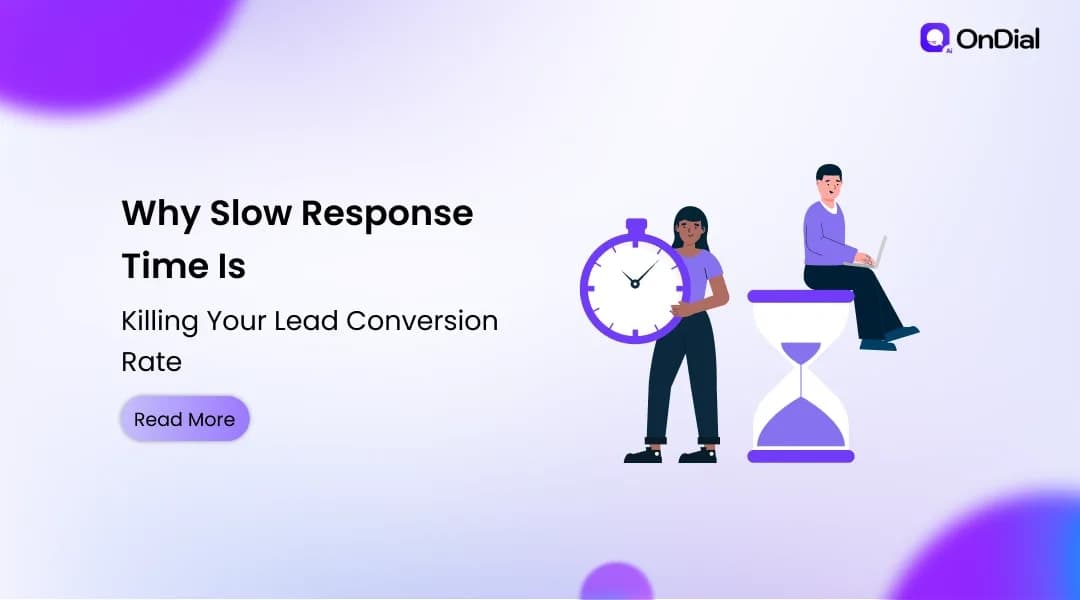
Here is a number that should stop you cold: roughly 78% of customers buy from the company that responds to them first. Not the cheapest. Not the most polished. The fastest. If your lead conversion rate keeps slipping while your ad spend climbs, the culprit is rarely lead quality. It is lead response time.
Every minute a new inquiry sits unanswered, buying intent decays and a competitor steps in. Slow response time kills conversions because intent peaks the instant someone submits a form or requests a call, and that peak fades within minutes. You did the hard part. You generated the lead. Then the handoff stalled, and the deal quietly walked to whoever picked up first.
I have watched this pattern repeat across dozens of sales operations. The leads were fine. The timing was not. In this article I will show you how slow response erodes conversions, what a competitive response window actually looks like in 2026, why your team is almost never slow on purpose, and how to rebuild the system so speed becomes automatic.
The Hidden Math: How Slow Lead Response Time Kills Conversions
Most teams assume a few hours of delay is harmless. The data says the opposite. Speed to lead is not a nice-to-have metric; it is the single biggest lever on whether marketing spend turns into revenue.
The First Responder Takes the Deal
Speed to lead is the gap between a prospect raising their hand and your first meaningful human contact. That gap decides outcomes more than price or pitch quality.
The research here is unusually consistent. A landmark Harvard Business Review study, "The Short Life of Online Sales Leads," found that contacting a lead within an hour made a firm seven times more likely to qualify that lead than waiting just one hour longer, and sixty times more likely than waiting a full day. Velocify, analyzing more than 3.5 million leads, found a 391% lift in conversion when contact happened inside the first minute.
The reason is simple human behavior. A prospect rarely contacts only you. They reach three to five providers at once, and the first to respond shapes the entire comparison. Being first often beats being best.
Why the Damage Stays Invisible
Here is the cruel part. Slow response almost never shows up cleanly in your reports.
There is no dashboard column labeled "lost because we were slow." A delayed lead simply looks like a bad lead, a weak channel, or a soft market. So leaders draw the wrong conclusion and buy more traffic to fix a problem that more traffic cannot touch. The leak is in the bucket, not the tap.
This is why slow response feels normal and reasonable from the inside while it silently inflates your customer acquisition cost. You are paying full price for leads, then forfeiting most of their value before a rep ever speaks to them.
What Counts as a Good Lead Response Time?
Ask ten sales leaders and you will get ten answers. The market, however, has already decided. The expectation is no longer measured in hours.
The Benchmark Almost Nobody Hits
A good lead response time in 2026 is under five minutes, with under one minute considered ideal. MIT and InsideSales.com research found leads contacted at five minutes are 21 times more likely to qualify than those reached at 30 minutes. The five-minute mark is the line between being in the race and being absent from it.
The gap between that standard and reality is enormous. A Workato study of 114 B2B companies found not a single one called a new lead within five minutes, and only one sent a personalized email that fast. The average personalized email reply arrived nearly 12 hours later. Drift found just 7% of companies responded inside five minutes.
So if you respond reliably within five minutes, you are not merely above average. You are in the top few percent of all businesses, full stop.
Processing Time Is Not the Same as Rep Time
Most teams measure the wrong half of the clock. Lead response time has two components: lead processing time (everything before a rep sees the lead) and representative response time (how fast the rep acts once it lands).
When response is slow, the cause is usually buried in processing, not rep behavior. Data enrichment, account matching, territory rules, and lead routing in your CRM (Salesforce or HubSpot) can burn hours before a human is even alerted. Blaming a rep for a routing delay is like blaming the pilot for a problem on the ground crew. Fix the processing layer and the rep's clock barely starts before contact happens.
Why Your Team Isn't Slow on Purpose
Let me say something that runs against the usual advice. Your reps are almost certainly not lazy. The slowness is engineered into the workflow, and no amount of "try harder" will remove it.
The Five Bottlenecks That Create Delay
In projects I have worked on, the same root causes appear again and again. They are operational, not motivational:
No real-time alert or SLA: Reps check a queue hourly instead of getting pinged the second a form is submitted, so speed is a suggestion rather than a standard.
Manual routing: Leads land in a shared inbox that nobody owns and sit there like unclaimed luggage.
After-hours gaps: A lead arriving at 9 PM or on a Sunday waits until Monday, by which point intent is gone.
Channel sprawl: Inquiries scatter across phone, web forms, chat, and social, and no one watches all of them at once.
Bad contact data: A rep calls back in five minutes, but the number is disconnected, so a fast metric still produces zero contact.
It Is an Architecture Problem, Not an Effort Problem
Notice what every one of those causes has in common. None of them is solved by a motivational speech.
A team can be hard-working, skilled, and still structurally slow, because the system inserts delay between intent and contact. Great speed is built, not willed. When you treat response time as a system to design rather than a behavior to nag, the entire problem changes shape and becomes solvable.
(This is the reframe that quietly separates the teams that win from the teams that keep buying more ads.)
How to Fix Lead Response Time for Good
So how fast should you actually call a new lead? Immediately. The goal is to remove the human bottleneck from the first response without removing humans from the relationship.
Build a Response System, Not a Reminder
Start by instrumenting the clock. Group leads into response buckets (0 to 5 minutes, 5 to 30, 30-plus) and watch your conversion rate fall off the cliff as the timer climbs. That single chart usually ends the debate internally.
Then engineer the first touch to fire automatically. Set a hard SLA by channel, enforce automated lead routing so ownership is instant, and trigger a real first contact within seconds, not a generic "we got your message" auto-reply. The point is consistency: every lead, every hour, every day, with no gap on nights or weekends.
Where AI Voice Agents Close the Gap
An AI voice agent is a conversational system that answers or places calls in real time, qualifies the prospect, and routes hot leads to your team instantly. It is the most direct way to guarantee a sub-minute first response around the clock.
At OnDial, this is the exact problem we build for. Our voice AI platform engages a new lead the moment it arrives, holds a natural conversation, qualifies intent, and hands a warm, context-rich lead to a human, so your team spends its energy closing rather than chasing. For Indian businesses, that also means handling volume across languages and staying aligned with local norms like TRAI regulations and DPDP data expectations.
I will be honest about the limits, because trust matters more than hype. Voice AI does not replace a great closer, and a poorly scripted agent can frustrate callers. The right model is human-in-the-loop: let automation win the first sixty seconds, then let your best people do what they do best.
Conclusion
Improving your lead response time is the rare growth move that costs nothing extra in traffic and pays back immediately. Three things to carry away: the first responder wins most deals, the real benchmark is minutes not hours, and slowness is a system problem you can engineer away rather than a team you have to scold.
You do not have a lead problem. You have a timing problem, and timing is fixable. Once the first response becomes instant and automatic, every dollar you already spend on marketing starts working harder, and your pipeline finally feels predictable instead of lucky.
If slow follow-up is leaking the leads you worked to earn, that is precisely the gap OnDial's voice AI was built to close. Talk to us about putting an AI voice agent on your first response, so no lead ever waits again.