Here is a stat that should make every sales leader uncomfortable: 78% of customers buy from whichever company responds first, according to the Lead Connect study. Not the cheapest. Not the most qualified. The first. And yet, research from Harvard Business Review found that the average business takes 47 hours to respond to a new lead. That is nearly two full days of silence after someone raised their hand and said, "I'm interested."
If you have ever watched qualified leads slip away despite strong marketing, strong product, and a capable team, the problem is almost certainly speed. I have worked with businesses at OnDial that were generating excellent inbound demand but converting at a fraction of their potential, and the diagnosis was always the same: their lead response time was too slow for modern buyer expectations.
In this article, I will break down what lead response time actually costs you in revenue, why human-only teams structurally cannot fix this problem, and how AI calling creates the consistent, sub-60-second response that today's buyers expect. You will walk away with a clear framework for fixing the most expensive leak in your sales pipeline.
What Is Lead Response Time and Why Does It Decide Who Gets the Sale?
The Definition Every Sales Team Needs to Internalize
Lead response time is the duration between a prospect's initial inquiry and a sales team's first meaningful follow-up. It is the single strongest predictor of whether that lead converts into a customer.
Notice the word "meaningful." An auto-reply email saying "Thanks, we got your message!" does not count. A real response means a conversation: a phone call, a personalized text, a live chat interaction where the prospect feels heard.
The Behavioral Science Behind Speed
Why does speed matter so much? It is not just about convenience. When a prospect submits a form or requests a demo, they are in what behavioral scientists call an "active decision-making state." Their interest is high. Their problem feels urgent. Neuroscience research shows that humans are most receptive to new information within the first few minutes of forming an intent.
Wait too long, and two things happen. First, the prospect's attention shifts. Studies show we retain new information for about 20 minutes before distractions take over. Second, and this is the part most teams miss, delay creates doubt. Behavioral economists call this primacy bias: if a prospect's first experience with your business is silence, they assume slow service, poor organization, and a frustrating customer experience ahead.
(Think about it from the prospect's side. They just told you they are interested. Silence is the worst possible answer.)
The Five-Minute Rule: How Speed to Lead Shapes Conversion Rates
The Data That Should Change Your Priorities
The research on lead response time is not ambiguous. It is overwhelming. The MIT and InsideSales.com Lead Response Management Study, which analyzed over 15,000 leads and 100,000 call attempts, found that contacting a lead within five minutes makes you 100 times more likely to connect than waiting just 30 minutes. Not 10% more likely. One hundred times.
Velocify's study of 3.5 million leads found that calling within one minute of inquiry produces 391% more conversions compared to calling at the two-minute mark. And the Optifai Pipeline Study of 939 B2B SaaS companies in 2026 confirmed that leads contacted within five minutes achieve a 32% close rate, compared to just 12% for those contacted after 24 hours. That is a 2.6x difference from the same leads.
The Cliff, Not the Slope
Here is what makes this so urgent: the drop-off after five minutes is not a gentle decline. It is a cliff. After five minutes, the odds of qualifying a lead plummet by 80%, according to Harvard Business Review. After one hour, the InsideSales.com data shows qualification odds drop by more than 10x.
I have seen this firsthand at OnDial when analyzing client call logs. The difference between a three-minute callback and a thirty-minute callback is not incremental. It is the difference between a warm, engaged conversation and a voicemail that never gets returned.
Why Most Sales Teams Fail at Fast Lead Follow-Up
The Structural Problem No Amount of Motivation Solves
Here is a question most sales managers do not want to answer honestly: what is your actual average lead response time? Not your best case. Your average, including evenings, weekends, and lunch breaks.
The data suggests it is worse than you think. A RevenueHero study of over 1,000 companies found that 63% of businesses never respond to leads at all. Among those that do respond, the average time exceeds 29 hours. A Drift study found that only 7% of companies respond within five minutes.
The Three Bottlenecks Killing Your Speed
Manual lead routing delays. Someone has to look at the lead, decide who should handle it, and assign it. That process alone adds 5 to 15 minutes of dead time before a rep even knows the lead exists.
After-hours coverage gaps. Nearly half of all inbound leads arrive during evenings, weekends, and off-hours when most sales teams are not available, according to LeadAngel's research. A lead that arrives at 9 PM on Friday does not get touched until Monday morning. That is a 60-hour gap at minimum.
Rep bandwidth and burnout. Salesforce research shows that sales reps spend 70% of their time on non-selling activities. When you factor in that reaching a single prospect requires an average of 8 cold call attempts, the math gets painful quickly. Your highest-cost resource is doing your lowest-value work, and the leads that need instant attention get queued behind administrative tasks.
The uncomfortable truth is that you cannot fix a systems problem with willpower. Telling your reps to "be faster" does not work when the infrastructure guarantees delay.
How AI Calling Eliminates the Response Time Gap
What AI Calling Actually Does (No Buzzwords)
AI calling uses voice agents powered by speech-to-text, large language models, and text-to-speech technology to call inbound leads within seconds of form submission. The AI conducts a natural phone conversation, qualifies the lead using frameworks like BANT (Budget, Authority, Need, Timeline), and either books an appointment or transfers the call to a human closer.
At OnDial, we build these systems to sound human, respond in under 500 milliseconds during conversation, and operate 24 hours a day, 365 days a year. The goal is not to replace your sales team. It is to make sure every lead gets a conversation at their moment of highest intent, regardless of what time it is or how busy your team happens to be.
Why Voice Outperforms Every Other Channel for First Contact
Not all response channels are equal. Research shows that a voice agent calling within 60 seconds of form submission converts 5 to 7 times higher than SMS alone. While SMS has a 98% open rate and email provides full context with booking links, voice remains the highest-conversion channel when someone actually picks up.
The best approach, and what I've seen work consistently across our client implementations, is parallel engagement: SMS, email, and voice call all triggered simultaneously within 30 seconds. The channel that lands is the one that counts. Most businesses lose leads by betting on a single channel for every person.
The 24/7 Advantage That Cannot Be Replicated Manually
A student submits an inquiry at 11 PM. By 11:05 PM, an AI voice agent has already called them, confirmed their interest, assessed their timeline, and logged a qualified lead into the CRM. No human intervention needed until the appointment.
Compare that with what actually happens at most companies: the lead sits untouched until 9 AM the next morning, by which time the prospect has already spoken to two competitors who had faster systems in place.
AI Voice Agents vs. Traditional Sales Teams: A Conversion Comparison
A Side-by-Side Look at What Changes
When I talk to business owners about AI calling, the first question is always: "Does it actually work better?" Here is what the data shows across the metrics that matter most.
Response time. Human SDR teams average 47 hours for first contact. AI voice agents respond in under 60 seconds. That is not a marginal improvement. It is a structural change in how leads experience your business.
Consistency. Human qualification varies by agent experience, mood, training, and workload. AI applies the same qualification framework to every single call, every time. No bad days. No missed steps.
Coverage. Human teams work 8 to 10 hours a day, five days a week. AI operates around the clock. For businesses with national or global reach, this means prospects in every time zone get the same immediate response.
Cost efficiency. Voice AI per-minute costs have dropped to approximately $0.05 to $0.15 per minute in 2026, compared to the fully loaded cost of an SDR handling the same qualification tasks. The Blazeo 2026 Speed-to-Lead Benchmark Report found that companies using AI are 60% more likely to meet a 15-minute response standard than manual-only teams.
Where Humans Still Win
I want to be transparent about this, because it matters for trust: AI calling is not better at everything. Complex, emotionally nuanced sales conversations still benefit from human judgment. Creative problem-solving, relationship building over multiple touchpoints, and high-stakes negotiations remain human territory.
The optimal model, and the one we recommend at OnDial, is AI handling the initial call and qualification, then transferring high-intent leads to a human closer with full context. The human conversation begins exactly where the AI left off: knowing the prospect's budget, timeline, and key concerns. That is not a replacement. That is a force multiplier.
How to Build a Sub-60-Second Lead Response System
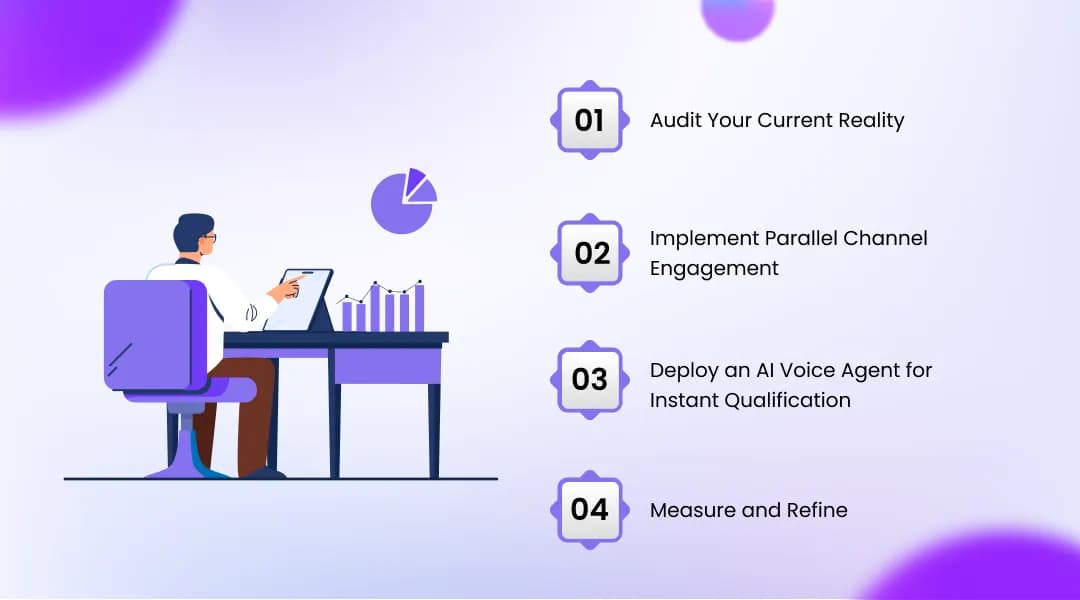
Step One: Audit Your Current Reality
Pull a sample of 50 recent leads from your CRM. Calculate the actual time between form submission and first call attempt. If your average is over five minutes, you are leaving significant revenue on the table.
(Most teams are shocked when they see their real number. I have worked with clients who assumed they were responding in minutes and discovered their actual average was measured in days.)
Step Two: Implement Parallel Channel Engagement
Do not pick one channel. Set up simultaneous triggers for SMS, email, and voice call the moment a lead submits a form. The architecture is straightforward: form submission fires three parallel workflows within 30 seconds.
Step Three: Deploy an AI Voice Agent for Instant Qualification
This is where the real speed advantage comes in. Configure your AI voice agent to call immediately after form submission, ask one or two qualifying questions, and either book an appointment directly into your calendar or tag the lead for human follow-up based on fit.
Step Four: Measure and Refine
Track three metrics religiously: average time to first response, contact success rate by response time bucket (under 5 minutes vs. 5 to 30 minutes vs. 30 minutes or more), and conversion rate by response speed. Build dashboards that show these metrics in real time. When reps can see their own speed stats, performance improves naturally.
Conclusion
Lead response time is not a minor operational detail. It is the single highest-impact variable in your conversion equation. The research is consistent across every study and industry: respond within five minutes and you are 21 times more likely to qualify the lead. Respond within 60 seconds and conversions increase by 391%. Wait an hour, and you have already lost the majority of your opportunity.
The businesses winning market share right now are not spending more on ads or hiring bigger sales teams. They are responding faster than everyone else, and AI calling is how they are doing it at scale, around the clock, without adding headcount.
At OnDial, we build AI voice systems designed for exactly this problem: connecting with your leads at their moment of highest intent, qualifying them through natural conversation, and handing your sales team warm, context-rich appointments instead of cold callbacks. If your current lead response time is measured in hours rather than seconds, that gap is costing you revenue every single day. Visit OnDial to see how a sub-60-second response system would work for your specific business.
Speed is not a strategy. It is the strategy. And AI calling is how you make it real.