A buyer spots a listing online at 9:14 PM, clicks the call button, and hears the phone ring six times before it rolls to voicemail. They hang up. Within ninety seconds, they have already tapped the next listing and dialed a competing agency. That single missed call may have represented a commission of $7,500 or more, and the agent who missed it will never know it happened. According to research from the National Association of Realtors and industry conversion studies, 78% of buyers choose to work with the first agent who responds to their inquiry. When an agency misses a call, it does not simply lose a conversation. It loses the entire deal to whoever answers first.
The scale of this problem across the real estate industry is enormous. Industry data indicates that approximately 46% of calls to real estate agents go unanswered, and 85% of callers who reach voicemail will not call back. For an agency receiving 30 to 50 inquiry calls per week, that translates to roughly 14 to 23 lost conversations every single week, each one carrying the potential for a five or six figure commission. The average real estate agent takes over 15 hours to respond to a new lead inquiry, according to findings published by Inman and TimeToReply. By that point, the prospect's intent has evaporated, and a competitor has already made first contact.
AI calling is the technology that closes this gap. AI voice agents answer every inbound property inquiry instantly, qualify the caller, capture their requirements, and schedule showings or callbacks, all without a human agent needing to pick up the phone. This blog explains exactly how real estate agencies are using AI calling to recover missed property inquiries, respond to leads at the moment of peak intent, and convert significantly more callers into appointments and closed deals. Whether you run a boutique brokerage, a mid-sized agency, or a large multi-office operation, the mechanics of missed inquiry recovery apply directly to your business.
The True Cost of Missed Property Inquiries in Real Estate
Most agency owners understand that missed calls are bad. Few have quantified exactly how bad. When you map the actual revenue impact of unanswered property inquiries across a typical month, the numbers become difficult to ignore.
How One Missed Call Becomes Thousands in Lost Commission
A single missed property inquiry does not just cost the value of that one potential transaction. It costs the lifetime value of that client relationship, including referrals, repeat business, and the reputational damage of appearing unresponsive. Based on NAR data citing average commission rates of 2.5% to 3% on a median home price near $400,000, each missed or poorly handled lead represents a potential loss of $7,500 or more in commission income. For an agency losing 15 to 20 leads per week to unanswered calls, the annual revenue leakage can exceed $200,000 in forgone commissions.
The financial impact compounds when you consider that many of these callers were generated by paid advertising. Agencies spend heavily on Zillow, Realtor.com, Google Ads, and social media campaigns to drive phone inquiries. When those calls go unanswered, the agency has paid to generate a lead and then failed to capture it. The cost per acquisition does not just increase; it approaches infinity for every lead that never receives a response. Investing in lead generation without investing in lead capture is the equivalent of filling a bucket with a hole in the bottom.
Why Evenings and Weekends Are the Biggest Revenue Leak
Research from NAR and Zillow Group shows that 62% of real estate inquiries are submitted outside traditional business hours. Peak inquiry times fall between 6 PM and 9 PM on weekday evenings and throughout the weekend, precisely the hours when most agents are unavailable, at dinner, with family, or simply off the clock. This creates a structural problem that no amount of discipline or hustle can solve. Even the most dedicated agent cannot physically answer every call at 8:47 PM on a Saturday while showing a property to another client.
The after-hours gap is where the largest volume of high-intent leads goes unrecovered. Buyers browsing listings in the evening are often in active decision-making mode, comparing properties, calculating budgets, and ready to schedule a showing. When their call goes to voicemail, their intent does not pause and wait for Monday morning. It redirects immediately to the next available agent or agency. For real estate businesses, the after-hours window is not a minor edge case. It is the majority of inquiry volume, and it is where the greatest concentration of recoverable revenue sits.
Why Traditional Lead Capture Methods Fail in Real Estate
Real estate agencies have not ignored the missed call problem. Most have tried multiple approaches to address it. The issue is that traditional methods all share the same fundamental limitation: they depend on human availability, and human availability is inherently inconsistent.
The Voicemail and Callback Trap
Voicemail is the default fallback for most agencies, and it is also the least effective. Studies consistently show that 80% of callers who reach voicemail hang up without leaving a message. Among younger demographics, the avoidance rate is even higher because modern consumers expect real-time interaction, not a recorded greeting and a promise to call back. Even when a caller does leave a voicemail, the callback often comes hours later, well past the window of peak intent. By then, the buyer has moved on.
Manual callback systems suffer from the same timing problem compounded by inconsistency. Agents intend to return calls promptly, but showings run long, paperwork demands attention, and the callback list grows faster than it shrinks. One study found that 51% of leads are never contacted at all, not because agents do not care, but because the operational demands of real estate make consistent follow-up nearly impossible without automation. The gap between intention and execution is where leads quietly disappear from the pipeline.
Automated Text and Email Responses Fall Short
Many agencies have implemented automated text or email responses as a stopgap. While these systems acknowledge the inquiry quickly, they lack the depth of engagement that a phone conversation provides. A text message saying "Thanks for your inquiry, an agent will call you shortly" does not qualify the lead, capture specific property requirements, or build rapport. It merely buys time, and in a market where the first agent to have a real conversation wins the client, buying time often means losing the deal.
Email follow-up performs even worse. Open rates for real estate marketing emails hover around 20% to 25%, and response rates are a fraction of that. By the time a prospect reads an email, they have likely already spoken with a competing agent who answered the phone. Text and email serve a role in multi-channel nurture sequences, but they cannot replace the immediacy and depth of a live voice conversation as the first point of contact. The agencies that are winning the speed-to-lead race are the ones that respond with an actual conversation, not a notification.
How AI Calling Recovers Missed Property Inquiries
AI calling solves the missed inquiry problem by removing the dependency on human availability entirely. An AI voice agent answers every call instantly, 24 hours a day, seven days a week, and conducts a natural, intelligent conversation with the caller that qualifies their needs, captures their information, and moves them toward the next step in the buying process.
Instant Response at the Moment of Peak Intent
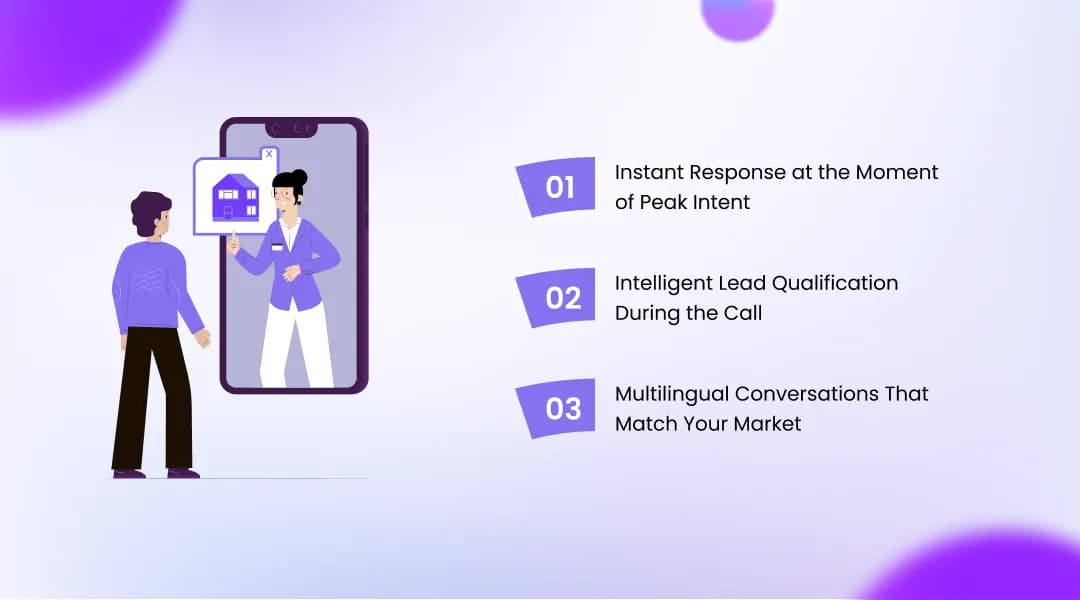
The most critical capability of AI calling for real estate is response speed. When a buyer calls a listing at 9 PM on a Thursday, the AI voice agent answers within the first ring. There is no hold music, no voicemail prompt, and no "please call back during business hours" message. The caller immediately hears a professional, natural sounding voice that greets them, identifies the agency, and asks how it can help. OnDial's AI voice agents respond with sub-500 millisecond latency, meaning the conversation begins before the caller has even finished processing that someone picked up. This speed is not a technical novelty. It is the mechanism that captures the lead at the exact moment their intent is highest.
Research from MIT and Harvard Business Review shows that companies responding to leads within five minutes are 100 times more likely to make contact than those waiting 30 minutes. AI calling compresses that response window from minutes to seconds, achieving a response speed that no human team can match consistently. For real estate agencies, this means every single inquiry, whether it arrives at 2 PM on a Tuesday or 11 PM on a Sunday, receives an immediate, professional response that puts the agency first in line for the client's business.
Intelligent Lead Qualification During the Call
Answering the phone is only the first step. What happens during the conversation determines whether the lead converts. AI voice agents do not simply greet the caller and take a message. They conduct a structured qualification conversation that captures the information an agent needs to prioritize follow-up and prepare for a productive interaction.
During a typical AI-handled property inquiry, the voice agent covers key qualification points:
The type of property the caller is looking for, including location preferences, size requirements, and budget range.
The caller's timeline for purchasing, whether they are actively searching or exploring options for the future.
Their financing status, including whether they are pre-approved, working with a lender, or paying cash.
Their current housing situation, such as whether they need to sell an existing property before buying.
Their preferred method of follow-up and best times for an agent to call them back or schedule a showing.
This qualification data flows directly into the agency's CRM, tagged and scored so that agents can prioritize the hottest leads first. Instead of calling back a list of voicemail messages with no context, the agent receives a qualified lead profile with all the information needed to have a productive, personalized conversation. OnDial's platform integrates with popular real estate CRMs and scheduling tools, ensuring that the handoff from AI to human agent is seamless and nothing falls through the cracks.
Multilingual Conversations That Match Your Market
Real estate markets are inherently local, and local markets are linguistically diverse. In India, a property developer in Mumbai may receive inquiries in Hindi, Marathi, Gujarati, and English within the same afternoon. In the United States, agencies in Texas, Florida, and California regularly handle calls in both English and Spanish. A missed call becomes doubly costly when the reason for missing it is a language barrier that prevents the front desk from engaging effectively.
OnDial's AI voice agents support over 100 languages, including 9 Indian languages with more than 80 Indian voice variations. This means a real estate agency serving a multilingual market can deploy AI calling that responds to every caller in their preferred language, without needing to hire multilingual staff or route calls through complicated language-based IVR menus. The AI detects the caller's language naturally and continues the conversation fluently, creating a comfortable experience that builds trust from the first interaction. For agencies operating in linguistically diverse regions, this capability is not a feature. It is a competitive requirement.
Quantified Results: What AI Calling Delivers for Real Estate Agencies
The business case for AI calling in real estate is not theoretical. Agencies that have deployed AI voice agents for inquiry handling report measurable improvements across every stage of the lead-to-close pipeline. Understanding these results in concrete terms helps agency owners evaluate whether the investment makes sense for their specific operation.
Speed-to-Lead Improvement
The most immediate and measurable impact of AI calling is the compression of response time. Agencies that previously averaged 15 or more hours to respond to new inquiries see that number drop to under 10 seconds with an AI voice agent handling first response. This improvement alone can increase lead qualification rates by a factor of 20 or more, based on the well-documented relationship between response speed and conversion probability.
A real estate team handling 200 property inquiries per month with a 15-hour average response time and a 1% conversion rate closes approximately 2 deals per month. By compressing response time to under one minute and increasing conversion to even 3%, that same team closes 6 deals per month, tripling revenue from the same lead volume without spending an additional dollar on advertising. The math is straightforward: faster response recovers leads that were already being generated but lost to delay.
After-Hours Lead Capture
Before AI calling, most agencies effectively shut down their lead capture operation at 6 PM. With an AI voice agent handling calls around the clock, agencies capture and qualify the 62% of inquiries that arrive outside business hours. This is not incremental improvement. It is the recovery of the majority of inquiry volume that was previously going entirely unaddressed. For agencies that invest heavily in online advertising and portal listings that generate calls at all hours, 24/7 AI calling transforms the return on that advertising spend from partial to complete.
Consistent Follow-Up and Re-engagement
AI calling is not limited to answering inbound inquiries. Outbound AI calling enables agencies to re-engage leads that went cold due to previous delayed responses. A buyer who called three days ago and never received a callback can be contacted by an AI voice agent that references their original inquiry, confirms their interest, and schedules a showing or agent callback. OnDial's outbound calling capabilities allow agencies to systematically work through their backlog of uncontacted leads, recovering revenue from prospects that would otherwise be written off as lost.
Research shows that 80% of real estate sales require five or more follow-up contacts, and leads that receive six or more contact attempts convert at rates 70% higher than those with fewer touches. AI calling makes consistent, systematic follow-up operationally feasible, even for small teams that lack the bandwidth to manually call through their entire lead database on a regular cadence. The AI handles the repetitive outreach, and human agents step in only when a lead is qualified and ready for a substantive conversation.
How OnDial Handles AI Calling for Real Estate, Specifically
While the general benefits of AI calling apply across industries, the real estate use case has specific requirements that the technology must meet. Property inquiries are not simple information requests. They involve nuanced conversations about location preferences, budget flexibility, financing, timelines, and emotional factors like neighborhood feel and school quality. The AI voice agent handling these calls must be capable of natural, flexible dialogue, not rigid script-following.
OnDial deploys AI voice agents specifically configured for real estate workflows. The platform handles both inbound inquiry response and outbound lead follow-up, with conversation flows designed around the specific qualification criteria that real estate professionals use to prioritize leads. Call sentiment analysis tracks the emotional tone of each conversation, flagging high-intent buyers who express urgency or excitement so that agents can prioritize them for immediate personal follow-up. Smart analytics provide agency managers with visibility into call volumes, qualification rates, peak inquiry times, and conversion metrics, enabling data-driven decisions about staffing, marketing spend, and operational adjustments.
Deployment is designed to be practical for agencies of any size. OnDial offers both API integration for agencies with existing tech stacks and no-code deployment options for teams that want to get started without developer resources. A boutique agency with three agents can deploy AI calling in the same timeframe as a multi-office brokerage with 50 agents. The platform scales with call volume, handling hundreds of simultaneous conversations without degradation in response quality or latency, which means that marketing campaigns, open house events, and seasonal surges in inquiry volume never overwhelm the system.
Implementation: What Real Estate Agencies Should Expect
Deploying AI calling is not a multi-month IT project. For most agencies, the path from decision to live deployment is measured in days, not weeks. Understanding what the implementation process involves helps agency owners set realistic expectations and plan for a smooth transition.
Setup and Configuration
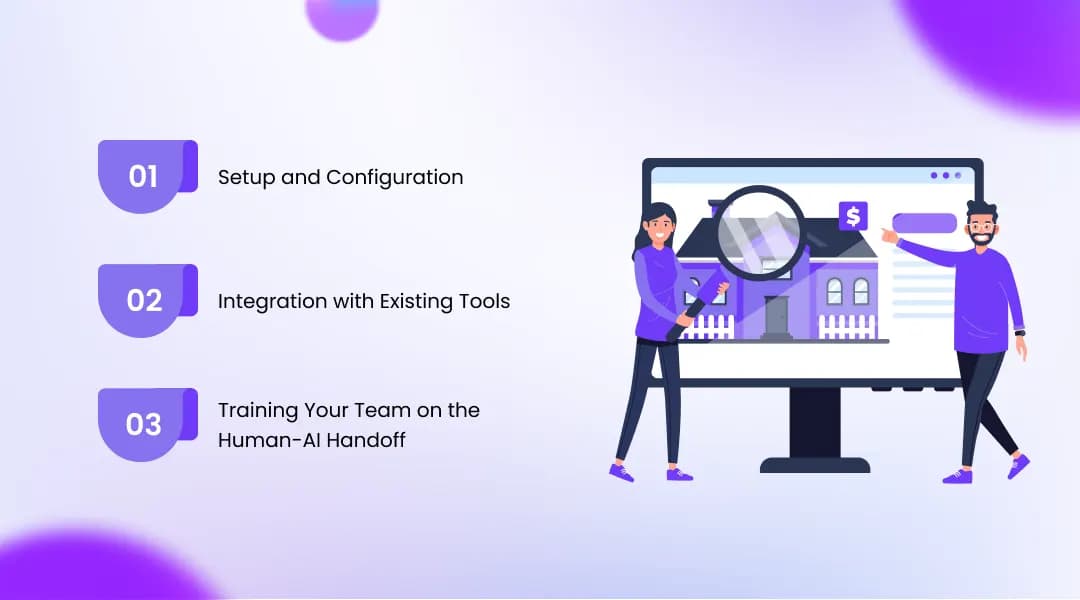
The initial setup involves defining the conversation flows that the AI voice agent will follow when handling property inquiries. This includes the greeting, the qualification questions, the responses to common caller questions about listings or the agency, and the actions the AI takes after the call, such as creating a CRM record, sending a confirmation text, or scheduling a callback. Most platforms, including OnDial, provide pre-built real estate conversation templates that agencies can customize to match their brand voice and qualification criteria. The configuration process typically takes one to three days, depending on the complexity of the agency's requirements.
Integration with Existing Tools
AI calling delivers the most value when it connects seamlessly with the tools an agency already uses. This means integration with CRM systems like Follow Up Boss, kvCORE, or Salesforce, calendar tools like Google Calendar or Calendly, and communication platforms like Slack or email for internal notifications. OnDial supports these integrations through both direct API connections and no-code integration platforms, so that lead data captured during AI-handled calls flows automatically into the agency's existing workflow without manual data entry.
Training Your Team on the Human-AI Handoff
The most important implementation step is not technical. It is operational. Agents need to understand how the AI and human roles complement each other so that qualified leads receive prompt, informed follow-up. The AI handles first response, qualification, and scheduling. The human agent handles relationship building, property expertise, negotiation, and closing. When this handoff is well-defined, agents spend less time on administrative calling and more time on the high-value activities that actually close deals. Agencies that establish clear response protocols for AI-qualified leads, such as a commitment to call back every hot lead within 30 minutes of AI qualification, see the strongest conversion improvements.
Conclusion
Three realities define the missed inquiry problem in real estate. First, the majority of property inquiries arrive outside business hours, and most agencies have no effective system for handling them. Second, response speed is the single most important factor in lead conversion, with agents who respond within five minutes being 21 times more likely to qualify a lead than those who wait 30 minutes. Third, the traditional approaches of voicemail, manual callbacks, and automated texts cannot close the gap between when buyers call and when agents are available.
AI calling addresses all three realities simultaneously. It provides instant, 24/7 response to every property inquiry. It qualifies leads through natural conversation at the moment of peak intent. And it delivers qualified, scored lead profiles to agents who can then focus their time on the high-value work of building relationships and closing deals.
OnDial delivers exactly this capability, with sub-500 millisecond response latency, support for over 100 languages, seamless CRM and calendar integration, and deployment options that work for agencies of every size. Whether you are a solo agent losing five leads a week to missed calls or a large brokerage losing hundreds, the technology to recover those inquiries and convert them into closed deals is available today. Schedule a demo with OnDial to see how AI calling works for your agency, and stop letting your next commission walk to a competitor who simply answered the phone first.