I lost ₹3.2 lakhs in commission because I was showing a property.
Let me explain. It was 2018. I was a real estate sales manager in Bangalore, walking a serious buyer through a 3BHK in Whitefield. My phone buzzed. Three times. I ignored it—you don't take calls when you're closing a deal, right?
Wrong.
Those three missed calls? All qualified leads from our Facebook ad campaign. By the time I called them back two hours later, two had already scheduled site visits with competitors. One didn't even pick up.
That day cost me more than commission. It taught me the brutal truth about real estate: Speed isn't everything. It's the only thing.
And here's what keeps me up at night, that scenario plays out hundreds of times every single day across real estate companies in India. Leads come in hot from 99acres, MagicBricks, Google Ads. They call. Nobody answers. They move on.
The average real estate lead contacts 3-5 properties before making a decision. If you're not first to respond, you're not even in the race.
This is where AI call automation stops being a "nice to have" and becomes your unfair advantage.
Why Speed Matters in Real Estate Lead Conversion
There's a study from Harvard Business Review that should terrify every real estate professional: Leads contacted within 5 minutes are 21x more likely to convert than those contacted after 30 minutes.
Twenty-one times.
Not 21%. Twenty-one times.
I've seen this play out in my consulting work with developers across NCR, Pune, and Hyderabad. The pattern is always the same: properties that respond fastest win the site visit. Properties that win the site visit close 60-70% of deals.
Here's what actually happens when a lead calls your real estate business:
Scenario A: Without Automation
Lead calls at 8:47 PM (prime browsing time for working professionals)
The phone rings. Nobody answers. The office closed at 6 PM.
Lead thinks: "Probably not serious sellers" or "Must be sold already"
Lead moves to next property listing
You discover the missed call at 10 AM next day
You call back. Voicemail. They're at work now.
Game over.
Scenario B: With AI Call Automation
Lead calls at 8:47 PM
AI voice assistant picks up in 0.8 seconds
Conversation happens: "Hi! Thanks for calling about the 2BHK in Whitefield. I can help you schedule a site visit. Are you free this weekend?"
Site visit booked
CRM updated automatically
Sales manager gets WhatsApp notification
Human calls next morning to build relationship and confirm details
Which scenario closes more deals? (Rhetorical question. You already know.)
What Is AI Call Automation for Real Estate?
Let me strip away the marketing nonsense and explain what this actually is.
AI call automation for real estate means using conversational AI voice bots to handle inbound inquiries and make outbound follow-up calls - automatically, at scale, 24/7/365.
Think of it as a tireless sales development rep who:
Never sleeps
Never takes a sick day
Speaks multiple languages fluently
Remembers every detail of every conversation
Responds in under a second
Costs about ₹15,000-30,000/month instead of ₹25,000-40,000 per human employee
But here's what most articles won't tell you: AI voice bots aren't replacing your sales team. They're filtering, qualifying, and scheduling so your human closers can focus on what they do best—building relationships and closing deals.
How AI Voice Bots Actually Work
There are two types of AI call automation:
Inbound Call Automation: A potential buyer calls your listed number. Instead of ringing endlessly or hitting a robotic IVR menu ("Press 1 for sales, Press 2 for..."), they connect with an AI voice assistant that sounds remarkably human. The bot answers property questions, checks availability, and books site visits, all in a natural conversation.
Outbound Call Automation: Your AI system proactively calls leads from your CRM, property portals, or advertising campaigns. It qualifies their interest, gathers requirements (budget, location preferences, timeline), and schedules appointments for your sales team.
The technology behind this? Natural Language Processing (NLP), speech recognition, and text-to-speech engines that have gotten scary good in the last 18 months. Companies like OnDial build these systems specifically for Indian accents, languages, and conversational patterns.
(And no, it doesn't sound like a robot from a 1990s sci-fi movie. Modern AI voice assistants have natural pauses, tone variations, and can even handle interruptions gracefully.)
How AI Call Automation Works in Real Estate Businesses
Let me walk you through the actual technical flow, not because you need to build this yourself, but because understanding the mechanics helps you evaluate solutions properly.
Step 1: Lead Capture Integration
Your AI calling system connects to your lead sources:
Property portals (99acres, MagicBricks, Housing.com)
Google Ads & Facebook Lead Forms
Your website contact forms
Missed calls to your business number
Your existing CRM (if you have one)
Step 2: Instant AI Call Triggering
The moment a lead enters the system—literally within 10-30 seconds—the AI initiates contact. For inbound calls, it answers immediately. For outbound, it places the call based on rules you define.
Step 3: Intelligent Conversation
The AI follows a conversation script you've approved, but here's the clever part: it adapts based on responses. If someone asks about pricing, it provides information. If they want to know about amenities, it answers. If they're ready to visit, it moves to scheduling.
Natural. Responsive. Contextual.
Step 4: Qualification & Data Capture
While chatting, the AI is extracting critical information:
Budget range
Preferred locations/projects
Timeline (immediate, 3 months, 6 months)
Specific requirements (2BHK vs 3BHK, parking needed, etc.)
Best time to schedule site visit
Step 5: CRM Synchronization
Everything - call recording, transcript, extracted data, appointment details, flows directly into your CRM or database. Your sales team sees enriched, qualified leads with complete context.
No data entry. No missed details. No "let me check my notes."
Key Use Cases of AI Calling System for Real Estate
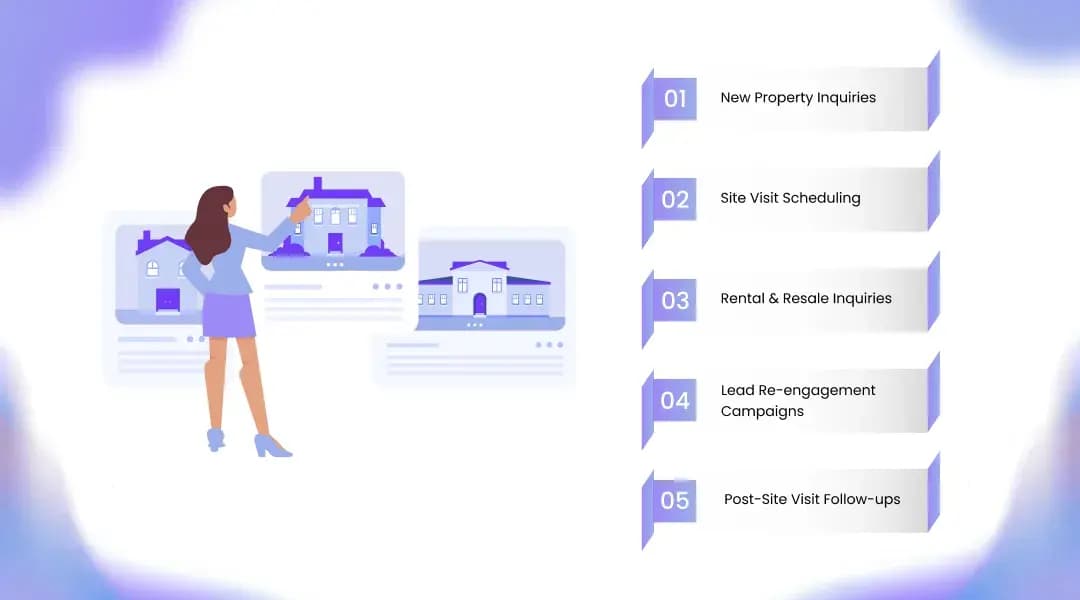
I've implemented AI voice solutions for everyone from individual brokers to large developers. Here are the use cases that deliver ROI fastest:
1. New Property Inquiries (The Obvious One)
Someone sees your ad, calls to ask about that 3BHK with the balcony view. AI answers immediately, provides details, gauges interest, books site visit if they're hot.
2. Site Visit Scheduling (The Revenue Accelerator)
This is where AI shines. Instead of playing phone tag for three days to find a mutually convenient time, the AI accesses your team's calendar and books the slot in real-time during the first call.
I've seen this alone reduce the inquiry-to-visit timeline from 4-6 days to same-day or next-day.
3. Rental & Resale Inquiries (The Volume Handler)
Rental inquiries are high-volume, often low-value individually, but collectively significant. AI handles the initial screening - budget, move-in date, requirements and only passes serious prospects to humans.
Same logic for resale properties where you're juggling dozens of listings.
4. Lead Re-engagement Campaigns (The Goldmine Everyone Ignores)
You have leads in your CRM from 3, 6, 9 months ago who didn't convert. Maybe the timing wasn't right. Maybe they got distracted.
AI can call them systematically: "Hi, this is calling from [Your Company]. We spoke last year about 2BHK properties in Whitefield. We have some new inventory that matches your requirements. Would you like to hear about it?"
Conversion rates on re-engaged leads? Often 15-25% because these people already showed intent.
5. Post-Site Visit Follow-ups (The Closer)
Someone visited your property three days ago. Are they interested? Compared with others? Need financing information?
AI follows up systematically so hot leads don't go cold while your sales team is busy with new site visits. This is where AI Voice Assistants configured for real estate workflows show their true value, they maintain momentum in your sales pipeline.
Benefits of AI Call Automation for Real Estate Companies
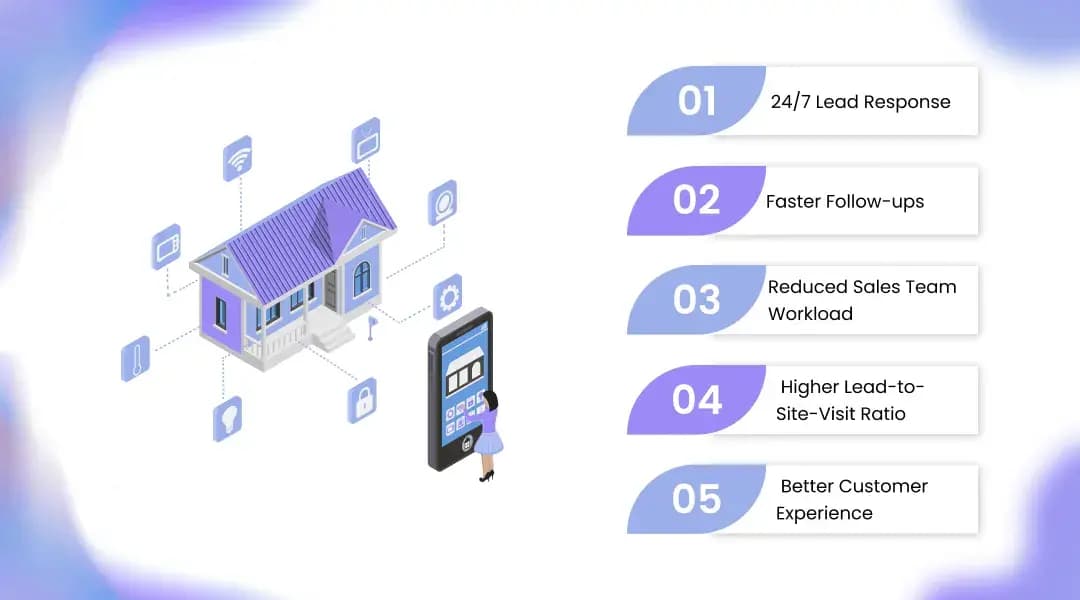
Let's talk about what actually changes when you implement this properly.
1. 24/7 Lead Response (The Obvious Benefit)
Leads don't respect business hours. Your AI does. Someone calls at 10 PM on Sunday? Handled. Inquiry comes in on Diwali? Captured.
2. Faster Follow-ups (The Competitive Edge)
Remember that Harvard study? Five minutes vs. 30 minutes = 21x difference. AI responds in seconds. Every. Single. Time.
3. Reduced Sales Team Workload (The Efficiency Gain)
Your closers spend 60-70% of their time on unqualified leads, scheduling calls, and administrative tasks. AI handles that. They focus on the 30% that actually requires human persuasion and relationship-building.
One developer client in Pune reduced his sales team from 8 to 5 people while increasing site visits by 35%. Math that shouldn't work, but does.
4. Higher Lead-to-Site-Visit Ratio (The Revenue Impact)
When you respond instantly, qualify properly, and schedule efficiently, more inquiries convert to site visits. I typically see 30-50% improvements here within 60 days of implementation.
5. Better Customer Experience (The Brand Differentiator)
Here's something nobody talks about: AI is often MORE patient than humans.
A frustrated prospect asking the same question three different ways? AI answers politely each time. A lead who needs information at midnight? AI helps enthusiastically.
Customers notice. They remember. And in a relationship-driven industry like real estate, that matters.
AI Call Automation vs Traditional Call Centers
I need to address this because it comes up in every conversation: "Why not just hire more people or outsource to a call center?"
Fair question. Here's the honest comparison:
Factor | Traditional Call Center | AI Call Automation |
Cost | ₹25,000-40,000 per agent/month | ₹15,000-30,000 for unlimited calls |
Response Speed | Minutes to hours (depends on queue) | Instant (0.8-2 seconds) |
Availability | Limited hours (or 3 shifts = 3x cost) | True 24/7/365 |
Consistency | Varies by agent mood, energy, knowledge | Identical quality every call |
Scalability | Need to hire & train (4-6 weeks) | Scale to 1000 calls instantly |
Languages | Limited to agent's fluency | Multilingual out of the box |
Accuracy | Manual data entry = errors | Perfect CRM sync every time |
Look, I'm not anti-human. I'm pro-efficiency.
Call centers make sense for complex negotiations, relationship-heavy interactions, and situations requiring empathy and judgment. But for initial inquiry handling, qualification, and scheduling? AI does it better, faster, and cheaper.
Use humans for what humans do best. Use AI for everything else.
Real-World Example: How AI Voice Bots Improve Real Estate Sales
Let me share a specific case study from my consulting work. (Details slightly modified for client confidentiality, but numbers are accurate.)
Client: Mid-sized developer in Hyderabad with 3 residential projects under construction
Problem: They were spending ₹4-5 lakhs monthly on Google Ads and property portal listings, generating 400-500 leads/month. But their 4-person sales team could only meaningfully follow up with ~200 leads. The rest? Lost in the chaos.
Lead-to-site-visit conversion: 12% Site-visit-to-booking conversion: 18%
They were leaving money on the table.
Solution: We implemented an AI calling solution with these parameters:
Inbound call handling for all inquiries
Outbound calls to all web leads within 5 minutes
Qualification questionnaire built into conversation flow
Calendar integration for automatic site visit booking
WhatsApp confirmations with location details
Timeline: 90 days from implementation to steady state
Results:
Quantitative:
Lead-to-site-visit conversion: 12% → 41%
Average response time: 4.3 hours → 47 seconds
Site visits scheduled: 48/month → 164/month
Sales team productivity: +67% (they now focus only on qualified, scheduled visits)
Cost per site visit: ₹8,333 → ₹2,926
Qualitative:
Sales team morale improved (less grunt work, more actual selling)
Customer feedback mentioned "quick response" in 78% of surveys
Re-engagement campaigns recovered 31 older leads that converted
ROI: The AI system paid for itself in 23 days.
Features to Look for in Real Estate Call Automation Software
Not all AI calling platforms are created equal. After evaluating dozens of solutions for my clients, here's what actually matters:
1. Multilingual AI Voice Support India is multilingual. Your AI should be too. Look for Hindi, English, and regional languages relevant to your market -Tamil, Telugu, Kannada, Marathi, Bengali, etc.
Bonus: Can it code-switch mid-conversation? (Hindi-English mixing is very common in tier-1 cities.)
2. CRM & Calendar Integration If your AI doesn't connect seamlessly with your existing systems, you'll create more work, not less. Verify integration with:
Popular real estate CRMs (SalesBabu, PropertyPistol, Sell.Do)
Google Calendar & Outlook
Property portal lead forms
WhatsApp Business API for follow-ups
3. Custom Call Scripts Generic scripts sound generic. Your AI should sound like YOUR brand. The best platforms let you customize:
Greeting and introduction
Property-specific talking points
Qualification questions
Objection handling responses
Work with providers like OnDial who build tailored scripts that match your actual sales process.
4. Call Analytics & Recordings You need visibility. What questions do leads ask most? Where do conversations drop off? Which campaigns generate the best leads?
Look for dashboards that show:
Call volume, duration, outcomes
Conversion funnel metrics
Lead quality scores
Call recordings for training and quality assurance
5. Scalability Without Cost Explosions Some platforms charge per minute or per call, which gets expensive fast. Others offer flat monthly rates with generous or unlimited call volumes.
Do the math based on your expected lead volume. A high-volume broker needs different pricing than a boutique developer.
6. Human Handoff Capability Sometimes the AI encounters a question it can't answer or a lead who insists on speaking to a human. The system should gracefully transfer the call to your team with full context.
No "let me transfer you" followed by starting the conversation over.
How AI Call Automation Improves Customer Engagement in Real Estate
Here's where I get a bit philosophical about this technology.
Real estate is fundamentally a relationship business. People are making one of the biggest financial decisions of their lives. They want to feel heard, understood, valued.
So how does robotic AI improve that?
Answer: By handling the transactional stuff so humans can focus on the emotional stuff.
Personalized Conversations at Scale
Modern AI voice systems don't just read scripts. They adapt based on:
Lead source (someone from 99acres vs. Google search has different context)
Previous interactions (repeat caller gets acknowledged)
Property preferences (mentions relevant amenities)
Conversation flow (picks up on cues about urgency, budget constraints, concerns)
A well-configured AI asks follow-up questions. It listens. It responds contextually.
Instant Answers to FAQs
"What's the carpet area?" "Is parking included?" "What about loan assistance?" "Are pets allowed?"
Your AI knows all of this. Instantly. Accurately.
Contrast with a human agent who's new, or busy, or covering for someone else: "Umm, let me check and call you back."
Speed of information builds trust.
Trust-Building Through Consistency
Every lead gets the same high-quality experience. Nobody gets ignored because they called during lunch. Nobody gets wrong information because an agent misremembered.
Consistent, accurate, immediate—that's how you build trust at scale.
And when your sales manager calls to confirm the site visit and build that personal rapport? The groundwork is already done. The lead is warm, informed, and qualified.
That's when your human team closes the deal.
Conclusion
I started this article with a story about losing ₹3.2 lakhs because I couldn't answer my phone.
Here's the truth I've learned since then: In real estate, you're not competing with other properties anymore. You're competing with other companies' response times.
The property with similar specs, similar pricing, similar location, but 10-minute response time, will beat you. Every. Single. Time.
AI call automation isn't about replacing your sales team with robots. It's about ensuring that every lead gets captured, every inquiry gets answered, every opportunity gets maximized.
It's about your closers spending their day building relationships and signing deals instead of playing phone tag and answering "What's the carpet area?" for the 47th time.
The real estate companies winning right now? They're using technology to handle the predictable, repeatable tasks so their humans can focus on the irreplaceable human work—trust, persuasion, closing.
The question isn't whether AI call automation works in real estate.
The question is: How much longer can you afford to miss calls?
If you're serious about converting more leads faster, explore how AI Phone Calls and voice automation can transform your real estate operations. Companies like OnDial specialize in building AI Voice Assistants specifically for the Indian real estate market—multilingual, CRM-integrated, and designed around actual sales workflows.
The technology exists. The ROI is proven. The only thing stopping you is inertia.
Stop losing leads to competitors who answer faster.
Start winning with automation.