A 2026 MorganMyers survey found that 75% of farmers and ranchers have already used AI tools, and nearly half of that group reaches for them weekly or more. That number surprised me, because most farmers I meet still say they hate apps. So here is the honest answer to the question in the title: AI voice agents for farmers are phone-based assistants that let a farmer ask a question out loud, in their own language, and get a clear spoken answer or action in seconds. No typing, no dashboard, no learning curve.
If you have watched a "smart farming" tool get downloaded once and never opened again, your skepticism is fair. I have seen plenty of those graveyards too. But voice changes the equation, because it fits the one thing farming always demands: busy hands and eyes on the land. In this guide, I will walk you through an ordinary farming day, show how the technology actually works underneath, and share what the real-world data says (including where it still falls short).
What Are AI Voice Agents for Farmers?
A voice AI for crop advisory is simply a system a farmer can talk to over a call or voice interface, which understands the question and responds with useful guidance. It removes reading and typing entirely.
The Simple Idea Behind Voice-First Farming
Think of it as a helpline that never sleeps and never puts you on hold. A farmer dials a number or opens a voice interface, speaks a question in Marathi, Hindi, Telugu, or any supported language, and hears back a practical answer. Behind that simple conversation sit automatic speech recognition (ASR) and natural language processing (NLP), but the farmer never has to think about either.
At OnDial, our whole design principle is that good voice AI should feel invisible. The farmer should feel like they are talking to a knowledgeable neighbor, not operating software with AI voice agents for agriculture. When it works, nobody notices the technology at all, and that is the point.
Why Voice Beats Apps in the Field
The field is not a friendly place for screens. Gloves, grease, sun glare, and calloused fingers all fight against clean app interfaces that startups spend fortunes designing.
Here is what voice-first farming solves that apps cannot:
No literacy barrier. A farmer who never types comfortably can still speak fluently, which opens the tool to millions who apps quietly exclude.
No free hand required. During planting or milking, speaking a note is possible when swiping a screen is not.
No learning curve. Conversation is the interface humans have used since birth, so adoption does not depend on tech comfort.
(That last point is the quiet reason voice wins. You cannot fail to learn how to talk.)
A Day in the Life: How Voice AI Fits Real Farm Work
This is where AI voice agents for farmers stop being abstract. Let me walk you through one ordinary day, morning to evening, the way I have seen it play out in real deployments.
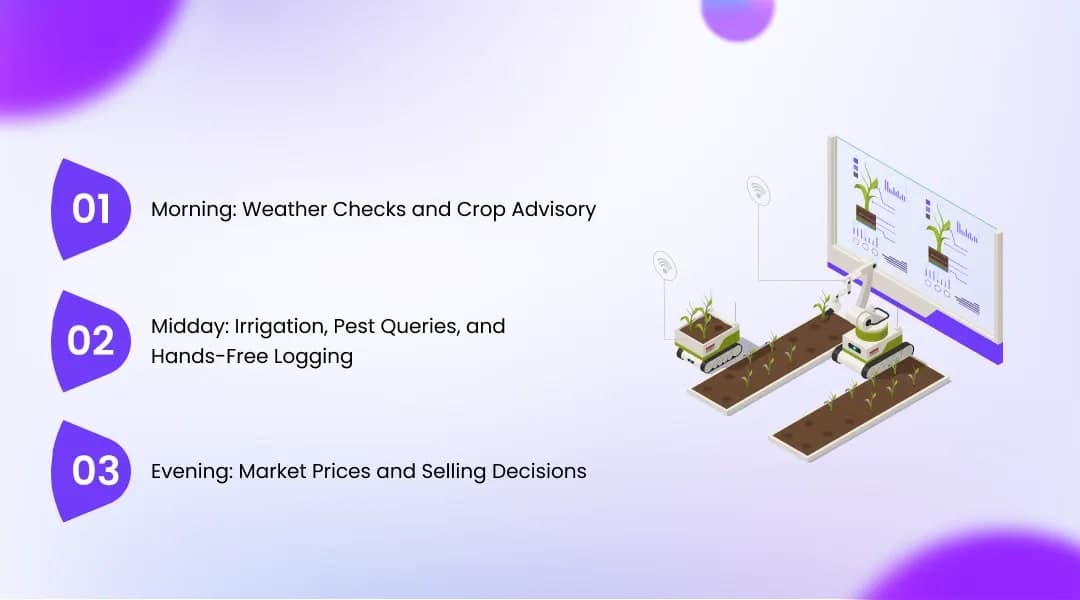
Morning: Weather Checks and Crop Advisory
The day starts with a question every farmer asks: will it rain? Instead of waiting for an extension officer or guessing, a farmer in Maharashtra can open a voice service, ask in Marathi, and get a local forecast within seconds. The MahaVISTAAR-AI platform in India has done exactly this, reaching more than 30 lakh farmers, with over 1.06 lakh registrations in the Nagpur district alone.
That same morning, check can fold in crop advisory. A farmer might ask what to spray on a yellowing wheat patch and receive region-specific guidance tuned to local soil and season. Services like FarmerChat from Digital Green already answer these questions by voice, text, or photo in a farmer's own language.
Midday: Irrigation, Pest Queries, and Hands-Free Logging
By midday, the hands are full, and the sun is high. This is when hands-free farm logging earns its keep, because speaking a command beats stopping work to tap a tablet.
Real deployments show farmers saying things like "start irrigation block 7 for 25 minutes" or "log treatment for cow 134," and the agent completes the task instantly with CRM integrated AI calling platform. In dairy operations, staff record calving events and treatments by voice right in the milking parlor. A pruner in an orchard can dictate a pest observation, and the system files it as a geotagged task without breaking stride.
Have you ever tried typing a field note with muddy gloves on? Neither has anyone who designs voice agents well. The whole idea is to turn minutes of friction into seconds of speech.
Evening: Market Prices and Selling Decisions
Selling at the wrong time can wipe out a season's margin. In the evening, a farmer can ask a voice agent for the day's mandi prices and hear current rates before deciding whether to sell tomorrow or wait.
This closes the loop that used to depend on middlemen and rumor. India's long-running Kisan Call Centre proved farmers will pick up the phone for advice, and voice AI now scales that instinct to thousands of simultaneous callers with what is voice AI. The farmer ends the day with better information than they started it with, and that is the whole quiet promise of voice-first farming.
How Voice AI Works for Crop Advisory and Farming Support
Here is the 40-second version: Voice AI for farming uses automatic speech recognition to convert a farmer's spoken question into text, natural language processing to understand the intent, and a trained agricultural knowledge base to generate an accurate answer, which is then spoken back in the farmer's own language. The farmer only ever experiences a normal conversation.
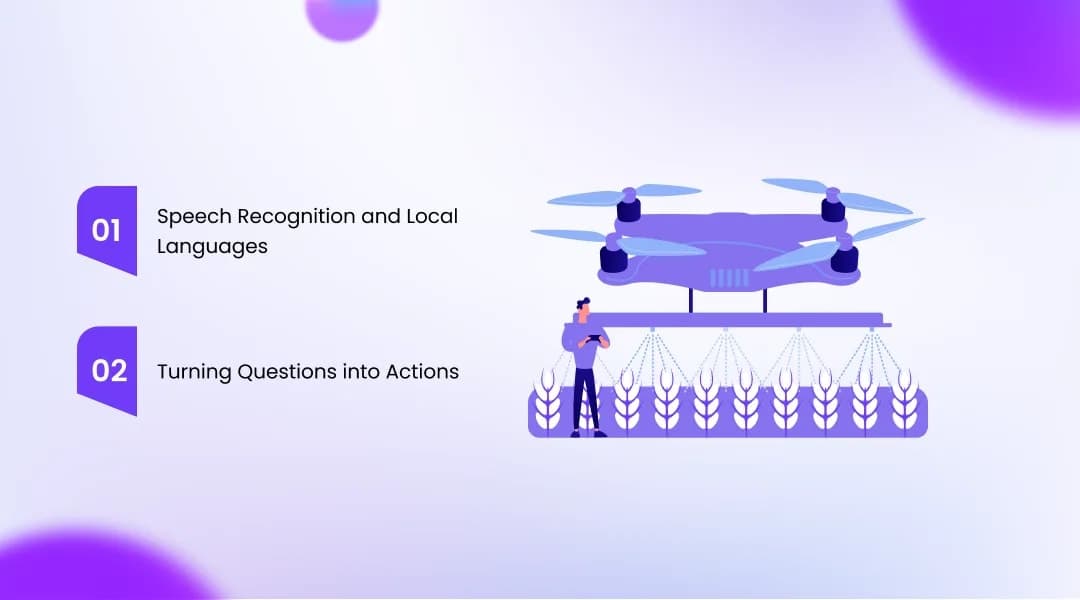
Speech Recognition and Local Languages
The hardest part is language, and I will not pretend otherwise. India is not one language but hundreds, and within those sit countless dialects that trip up generic speech models.
Getting local language voice assistant performance right takes real fieldwork. One India-based advisory platform logged more than 5,000 minutes of live farmer interactions in Telugu and Tamil during beta trials just to validate accuracy. In Nigeria, the Crop2Cash IVR advisory reached 26,000 smallholders and hit 88 to 95% transcription accuracy across local dialects, which shows the bar is reachable with enough groundwork.
Turning Questions into Actions
Understanding a question is only half the job. A useful agent also has to do something with it.
The better systems connect to farm data and equipment through secure integrations, so a spoken request becomes a real action:
Advisory responses pull from weather feeds, satellite data, and agronomy knowledge bases to answer crop and pest questions.
Task execution triggers irrigation valves, logs livestock events, or places input orders through connected APIs.
Escalation routes genuinely complex queries to a human expert instead of guessing, which protects trust.
Trust matters more than cleverness here. Bad AI is worse than no AI, because one confidently wrong answer about a pesticide can cost a farmer a crop.
Do AI Voice Agents Really Work for Small and Rural Farmers?
This is the question skeptics actually care about, so let me give it a straight answer rather than a sales pitch.
What the Data Shows
The early evidence is genuinely encouraging. A peer-reviewed IJERT pilot of a voice-enabled farming assistant found that 90% of farmers preferred voice input over typing because of literacy barriers, 87% said it helped them make better decisions, and adherence to its advice tracked with a 10 to 15% rise in crop yield.
Beyond voice specifically, AI-driven advisory at scale has produced hard results. Agripilot AI's deployment in India delivered a 40% yield increase alongside a 30% reduction in water use, as documented by the World Economic Forum with AI conversations that replace rigid call scripts. Numbers like these are why voice AI for AI voice assistants in rural areas has moved from pilot curiosity to real infrastructure.
Where It Still Falls Short
Now the honest part, because pretending this is solved would insult your intelligence. Voice AI is not magic, and the gaps are real.
The known limitations are worth naming plainly:
Dialect accuracy still drops for strong regional accents, which frustrates the exact users who need it most.
Connectivity remains patchy, so offline modes usually offer fewer features than online ones.
Trust takes time. A 2025 Syngenta study found many farmers still described AI in agriculture as feeling "distant and alien," and they weigh its advice against years of hard-won personal experience.
None of these are reasons to walk away. They are reasons to build carefully, test in the field, and keep a human expert in the loop for the hard calls.
Conclusion
AI voice agents for farmers are not a distant promise anymore; they are a daily working tool that fits the real rhythm of farm life. The three things worth remembering are simple: voice removes the literacy and app barriers that quietly excluded millions, it slots naturally into a farmer's day from the morning weather check to the evening market call, and the early data on yield and adoption is genuinely strong even while dialect and trust gaps remain.
You do not have to choose between respecting farmers and modernizing their tools. Good voice AI does both, by meeting people where their hands are already busy. At OnDial, that is exactly what we build: tailored, human-first voice assistants that talk to farmers in their language and turn everyday questions into instant answers. If you are shaping a farmer advisory or rural service and want it to actually get used, let's design a voice agent your farmers will pick up the phone for.