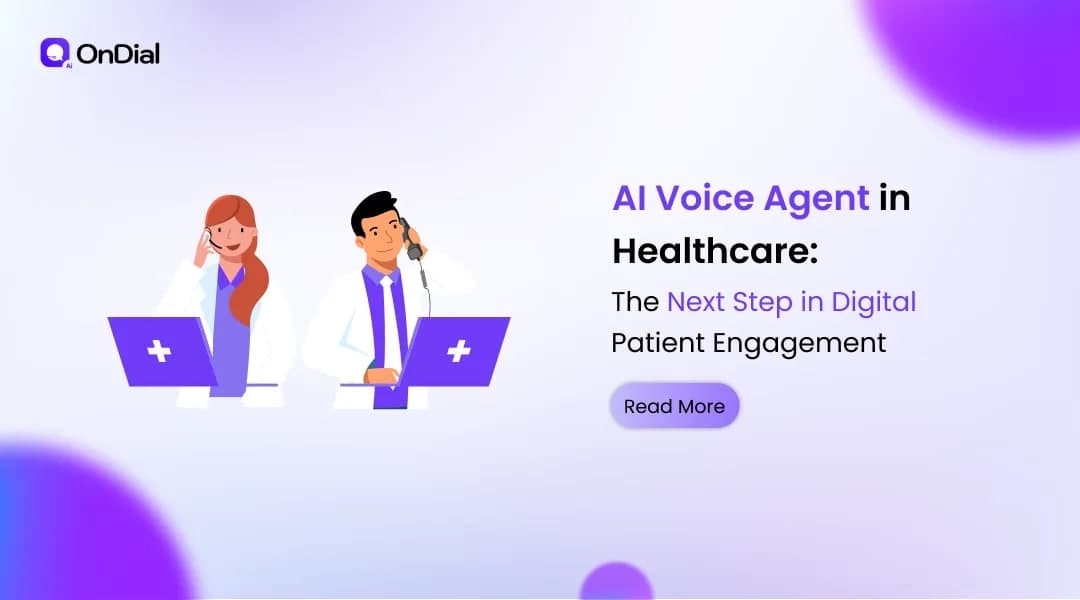
Around 41% of patients have considered switching doctors simply because they could not get through on the phone. Not because of the care. Because of a busy line. An AI voice agent in healthcare is a conversational system that answers and places patient calls in natural language, handling scheduling, reminders, intake, and follow-up around the clock, and it has quietly become the most practical fix for that broken front door. This is the real next step in digital patient engagement: not one more portal login patients forget, but a voice that picks up on the first ring, in their language, at 3 AM.
If you run a clinic or a health system, you already feel the squeeze. Rising call volume. Thinner front-desk teams. Patients who give up before they ever reach you (roughly 62% won't even bother leaving a voicemail). Here is what you will learn: what these agents actually do, whether patients trust them, how they stay compliant with HIPAA and India's DPDP Act, and what the return really looks like.
Why Patient Engagement Broke (And Why the Phone Is Still the Front Door)
Everyone keeps announcing that healthcare has gone digital. Then a patient with a fever calls at 9 PM, navigates six menu levels, and hits voicemail. The gap between the promise and the phone line is where engagement quietly dies.
The Access Gap Nobody Wants to Talk About
The numbers are not subtle. About 88% of healthcare appointments are still booked by phone, yet the average practice misses somewhere between 23% and 42% of inbound calls. Every missed call is a patient who waited, then gave up.
That access gap has a price tag. Average hold times in healthcare call centers run over four minutes, and about 34% of patients abandon a booking because they couldn't get through. In projects we've run at OnDial, the pattern is always the same: the front desk is not lazy; it is simply outnumbered. Digital patient engagement fails not because patients don't want it, but because the first human touchpoint is a queue.
From Button-Press Menus to Real Conversations
Here is the counter-intuitive part: the phone was never the problem. The IVR was. An IVR follows a rigid "press 1 for scheduling" script, while a modern AI voice agent understands natural language, asks clarifying questions, and completes multi-step tasks in a single call.
An AI voice agent is a voice-first system that resolves patient requests through conversation, not menus, making AI Voice Agents for Healthcare an effective solution for improving patient access, appointment management, and digital engagement. That one shift changes the emotional texture of the call. A patient calling to reschedule no longer gets transferred to hold; they get rescheduled and receive a confirmation before they hang up. The technology behind this, built on NLP and speech synthesis, is what finally lets voice carry the front-door load again.
What an AI Voice Agent in Healthcare Actually Does
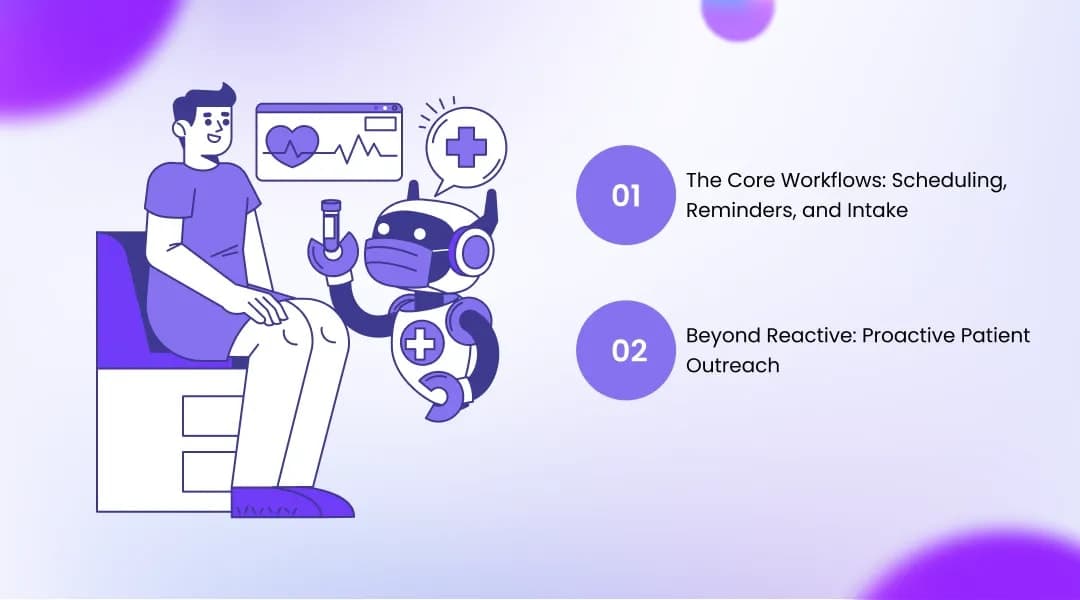
Let me be direct about scope, because the hype blurs it. These agents are not diagnosing anyone. They are absorbing the enormous volume of routine, repetitive contact that has always overwhelmed staff, and doing it consistently.
Featured answer: An AI voice agent in healthcare handles inbound and outbound patient calls using natural conversation. It books, confirms, and reschedules appointments, sends reminders, runs pre-visit intake, answers billing and insurance questions, checks medication adherence, and escalates anything urgent to a human clinician with full context attached.
The Core Workflows: Scheduling, Reminders, and Intake
AI voice agents for patient scheduling are the highest-volume entry point, and for good reason. Organizations looking to automate appointment booking and inbound calls can learn more in our guide on Hire AI Voice Agents for Smarter Customer Service. A mid-sized health system can field hundreds of thousands of scheduling calls a year, most following predictable patterns: book, confirm, reschedule, cancel. The agent pulls availability from the EHR, verifies identity, and closes the loop without a coordinator ever touching it.
Reminders are where the money lives. In deployments we've seen, a structured outreach cadence (a confirmation call two days out, a reschedule nudge the day before, a final reminder hours ahead) does the heavy lifting on attendance. Voice AI reminder campaigns have hit confirmation rates of 75% to 85% on outbound calls with no agent involvement. Intake works the same way: an outbound call collects demographics and history before the visit, so the clinical team starts prepared instead of scrambling.
Beyond Reactive: Proactive Patient Outreach
Most engagement tools wait for the patient to act. The genuine shift in 2026 is the move to proactive patient outreach: the system initiates contact based on clinical triggers like care gaps, refill timelines, and post-visit follow-ups. This is the difference between a switchboard and a care navigator.
The evidence here is striking. A published study of a multilingual generative voice agent for colorectal cancer screening found more than double the test opt-in rate among Spanish-speaking patients compared to English speakers (18.2% versus 7.1%). Read that again. Proactive, language-matched outreach did not just automate a task; it closed a real health equity gap. That is what engagement is supposed to mean.
The Trust Question: Do Patients Actually Want This?
So here is the question every operator is quietly asking: will my patients hang up the second they realize it's a machine?
It's a fair worry. And the honest answer has two halves.
What the Skepticism Gets Right
Some caution is earned. Not every patient is comfortable talking to AI, particularly older adults or those with lower digital literacy. A triage agent that misreads "chest pain" is not a UX bug; it is a clinical risk. Any team that pretends otherwise is selling something.
The safeguards that address this are practical, not theoretical:
Warm human handoff: Urgent symptoms, patient frustration, and complex billing should trigger an immediate transfer, with the full conversation context passed along so the patient never repeats themselves.
Escalation on demand: A patient should be able to reach a person at any point, no maze required.
Empathetic voice design: Tone matters. A call to a worried family cannot sound like a call about an abandoned shopping cart.
What Changes When Patients Feel Heard
Now the personal part. The reason skepticism fades in practice is that the alternative was already failing patients. A voice that answers instantly, in the caller's own language, at midnight, beats a voicemail box every single time.
The preference data backs this up. An Accenture Health survey found 79% of patients prefer digital-first communication with their providers, and satisfaction with AI-driven scheduling consistently outperforms traditional phone systems. When a pediatric health system we studied rolled out agents in multiple languages, families who had struggled with English finally accessed care guidance directly. Engagement is not a feature you install. It is the feeling that someone picked up.
Keeping Patient Data Safe: HIPAA, DPDP, and the Compliance Bar
This is the section that decides deployments, and it is where most generic AI tools quietly fall apart. Handling patient conversations means handling protected health information, and that raises the bar far above ordinary chatbots.
What HIPAA Actually Requires
Let me clear up the biggest myth first. HIPAA does not ban AI or automation; it requires that patient data be controlled.
Featured answer: Yes, AI voice agents can be HIPAA compliant. HIPAA does not prohibit automation. It requires encryption of data in transit and at rest, strict access controls, full audit logs, and a signed Business Associate Agreement (BAA) with the vendor. When those safeguards are built into the architecture, voice AI can actually lower breach risk by reducing repetitive human handling of PHI.
There is a subtler trap worth naming. One security team calls it the "secure but leaky" problem: infrastructure passes every audit, yet the agent discloses medication details before verifying who is on the line. Compliance is behavioral, not just architectural. The system must ask for identity first and information second, every time. Standards like HL7/FHIR handle the integration; disciplined conversation design handles the safety. The stakes are real, given HHS issued over $4 million in HIPAA penalties in 2023 alone.
The India Layer: DPDP, ABHA, and Multilingual Care
For OnDial, compliance is not only a US conversation. India's DPDP Act treats health data as sensitive personal data, demanding explicit consent, purpose limitation, Indian data residency, and defined breach timelines. A platform processing call audio on US-located servers is not compliant for Indian hospital data, and the Ayushman Bharat Digital Mission is steadily moving the identity layer toward ABHA IDs.
Then there is language, which is really an access issue in disguise. Multilingual voice AI is not a nice-to-have in India; for a patient in a Tier 2 city, formal Hindi, Marathi, Bengali, or Gujarati may be the only viable channel. Older patients want warmth and deference, not the casual code-switching that works for a millennial buying sneakers. Getting that tone right, across dialects and low-literacy speakers, is the hard part nobody screenshots. It is also the part that decides whether engagement actually reaches everyone.
The Business Case: No-Shows, Costs, and ROI
You can care about patients and still need the math to work. Fortunately, the math here is unusually clean.
The No-Show Math
Start with the wound that never heals: missed appointments. Outpatient no-show rates still sit between 15% and 30%, costing the US healthcare system an estimated $150 billion a year and roughly $150,000 per physician. That is not an inconvenience; it is a structural leak.
Voice AI plugs it. Clinics using conversational AI report no-show reductions of 25% to 38%. Other deployments show an 18% to 35% drop within the first 90 days. A single, well-designed reminder cadence recovers appointments that were simply falling on the floor before.
What ROI Really Looks Like
The cost comparison is where finance leaders lean forward. Voice AI runs roughly $0.50 to $2.00 per call against $4 to $8 for a live agent, and most organizations reach measurable ROI within 6 to 12 months with AI Voice Agent Development Services designed for secure, scalable healthcare automation. Add in administrative work making up about 34% of US healthcare spend, plus reported 40% cuts in front-desk call volume, and the payback picture gets clearer fast.
This is why the market is not waiting. Gartner projects 80% of healthcare providers will invest in conversational AI by 2026, and voice AI plus digital health pulled in $1.8 billion in Q1 2026 alone, about 60% of all digital health venture funding. The honest caveat: mature systems reliably handle 60% to 80% of inbound volume, not all of it. Complex billing, clinical triage, and emotionally heavy calls still belong to humans. Voice AI clears the routine so your team can do the work that actually needs a person.
Conclusion
An AI voice agent in healthcare is no longer a demo waiting for the future; it is the most practical answer to a front door that has been broken for years. Three things matter most. First, it shifts engagement from reactive queues to proactive, language-matched outreach that closes real care gaps. Second, it can be fully HIPAA and DPDP compliant when safety is designed into both the architecture and the conversation. Third, the ROI is fast and measurable, led by no-show reductions and lower cost per call.
You do not have to choose between caring for patients and running a sustainable operation. The right voice AI lets you do both. At OnDial, we build multilingual, human-centric voice agents tuned to how your patients actually speak, so the next patient who calls at midnight hears a warm hello instead of a busy tone. Start with one workflow, measure it against your baseline, and let the results make the case.