Gartner projects that conversational AI will cut contact center labor costs by $80 billion in 2026, and that single number explains why boardrooms everywhere are rethinking the phone channel. If you run customer operations, you already feel the pressure. Rising call volume, agent attrition that never slows down, and a customer who abandons the line the moment they hear a touch-tone menu. I get the skepticism, because most people who evaluated early chatbots walked away unimpressed. AI call center voice agents are the reason that skepticism is fading. These are software systems that hold spoken, natural conversations, understand caller intent, pull answers from your business systems, and resolve issues without a menu maze. Enterprises are not swapping humans for robots on a whim. They are responding to economics that stopped adding up. This article breaks down why the shift is happening, what it actually costs, where the technology genuinely wins, and the honest limits you need to plan around before you move a single call.
What Is an AI Call Center Voice Agent?
An AI call center voice agent is a software system that answers phone calls, understands spoken language, and resolves customer requests through natural conversation rather than menu prompts. At OnDial, this is the core of what we build, so let me explain what actually sits under the hood.
How These Agents Differ from Legacy IVR
Traditional IVR systems listen for rigid keywords like "billing" or "cancel" and route callers through decision trees. Forrester research from early this year found that 67 percent of consumers abandon a call when they hit a touch-tone menu longer than four options, yet the average enterprise IVR still routes through six.
Modern voice agents flip that model completely. They understand intent, not keywords, which changes everything at scale. A caller can say "my package never arrived and I also need to change my address," and the agent handles both in one flow.
Intent understanding: The agent parses meaning from natural speech, so callers speak the way they normally would instead of memorizing menu paths.
Action, not just answers: These systems authenticate the caller, check a calendar, update a record, or process a request inside your live business systems.
Context retention: The agent remembers what was said earlier in the call, so nobody has to repeat an account number three times.
The Technology Stack Behind Natural Conversations
Under the surface, most production agents chain three components: speech-to-text, a large language model for reasoning, and text-to-speech for the reply. Each stage has been optimized so the total round trip feels human rather than robotic.
Human conversation has a natural rhythm of roughly 200 to 300 milliseconds between turns. The current generation of agents has compressed latency into that same window, which is why callers often cannot tell they are speaking to a machine. In projects I have worked on, that latency number is the first thing we tune, because a half-second delay is the difference between "helpful" and "annoying."
Natural language processing, or NLP, is what lets the system recognize accents, code-switching, and messy real-world speech. For our Indian enterprise clients, that includes Hinglish conversations where a caller switches between Hindi and English mid-sentence. This is table stakes for any serious deployment, not a bonus feature.
Why Enterprises Are Replacing Traditional Call Centers
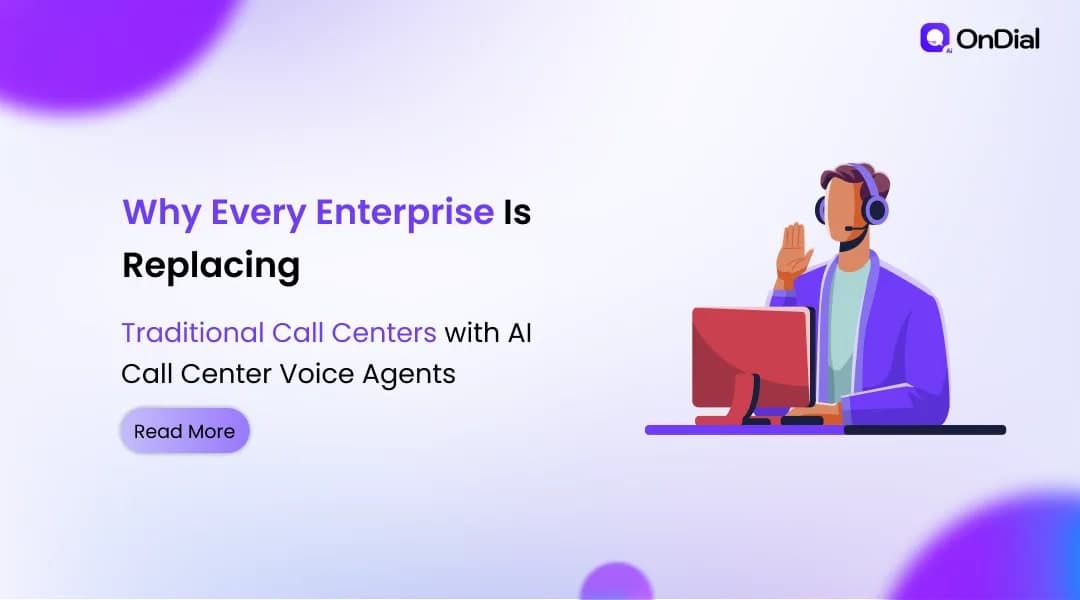
The short answer for replacing traditional call centers is that the old model has not fundamentally changed in thirty years while customer expectations have, which is why many enterprises are adopting AI Voice Agents for Call Centers & BPO to improve customer experience while reducing operational costs. Long queues, agents without context, and coverage gaps at 3 AM are structural problems, not staffing hiccups.
Featured answer: Enterprises are replacing traditional call centers with AI voice agents because the economics shifted decisively. AI handles routine, high-volume calls at a fraction of human cost, offers instant 24/7 coverage, scales without hiring cycles, and frees skilled agents for the complex, emotional conversations that actually decide whether a customer stays or leaves.
The Economics That Broke the Old Model
Here is the counter-intuitive part: the contact center was never really a cost problem. It was a utilization problem. Most businesses see 80 percent of calls fall into 20 percent of scenarios, and those repetitive calls burn expensive human hours.
A U.S.-based agent costs between $29 and $42 per hour once you add benefits, management, and infrastructure, making the ROI of replacing your IVR system with a conversational AI voice agent much easier to justify for enterprises looking to reduce operational expenses. An AI-handled call runs closer to $0.30 to $0.50 per interaction, against $6 to $12 for a human-handled one. When even 40 percent of a 10,000-call month shifts to AI, the labor savings run into tens of thousands of dollars monthly.
The Staffing and Attrition Trap
Now the part nobody enjoys discussing. Call center attrition runs 30 to 45 percent annually, and every departed agent costs $10,000 to $20,000 to replace once you count recruiting, training, and lost productivity.
That churn creates a permanent staffing trap. You are either overstaffed for quiet periods or drowning during spikes, and you are always training someone new.
Instant scale: AI voice agents handle ten concurrent calls or ten thousand with no recruiting cycle and no overtime, which matters enormously during seasonal crises.
Consistency: Every call gets the same quality answer at 3 AM on a Saturday, something no human team can promise across shifts.
Better human work: Agents who remain move from queue-clearing to problem-solving, which lowers burnout and, in turn, lowers that brutal attrition number.
The Real Cost Savings Behind the Switch
The AI voice agent cost savings story is the loudest reason enterprises move, and for once the hype roughly matches the math. But the savings go deeper than the per-call sticker price.
Per-Call Economics
The core driver is a 10x to 20x gap between AI-handled and human-handled call costs. That gap is why well-configured deployments deflecting 30 to 60 percent of routine inbound calls change contact center unit economics so quickly.
Consider the healthcare and banking sectors, where BFSI leads adoption with roughly 32.9 percent of the voice AI market. These are high-volume, rule-heavy environments (loan status checks, appointment scheduling, balance inquiries) where automation pays back almost immediately. I have seen appointment-reminder and confirmation workflows alone cut no-show rates in half.
ROI Timelines Enterprises Are Seeing
Speed to value is what separates this from most enterprise software. A Forrester Consulting study found a three-year ROI between 331 and 391 percent, with a composite organization saving $10.3 million in agent labor over three years and cutting call abandonment by half.
The payback period in that same study landed under six months. Most well-executed enterprise deployments report measurable returns within 90 days, alongside operational cost reductions of 30 to 50 percent.
Fast payback: Weeks to a few months for call-heavy businesses, not the multi-year horizon of typical enterprise systems.
Compounding gains: Resolution rates improve month over month as the knowledge base grows and the agent learns from real calls.
Revenue upside: One airline turned its contact center from a cost center into a revenue engine by triggering targeted upsells during service calls.
The Hybrid AI-Human Model Winning in 2026
Let me be blunt about something the marketing rarely admits. Full replacement is usually the wrong goal. The hybrid AI-human model is what actually performs, and the data backs it.
What AI Handles Best
AI excels at the predictable, high-volume work that makes up 60 to 80 percent of most call queues. Password resets, order status, scheduling, account inquiries. Research cited by Retell found hybrid AI-human models reach an 87 percent resolution rate with 8.7 out of 10 customer satisfaction, outperforming either approach alone.
The principle we design around at OnDial is simple. Give the machine what the machine does well: speed, scale, consistency, and 100 percent call coverage for containment rate measurement and quality scoring, which is exactly why many enterprises are hiring AI voice agents for smarter customer service.
Traditional quality assurance teams review 2 to 5 percent of calls. AI reviews every single one, scoring tone, compliance, and resolution quality. That eliminates sampling bias and gives supervisors a complete picture instead of a random snapshot.
What Still Needs a Human
Would you want a bot handling the call where someone's parent was just diagnosed with a serious illness, and they are trying to navigate insurance coverage?
Neither would I.
AI can detect distress in a caller's voice, but it cannot replicate the judgment to pause the script, acknowledge the emotion, and reshape the conversation around what that person needs. Complex disputes, emotionally charged complaints, multi-system troubleshooting, and regulatory edge cases still belong to a skilled human.
Empathy under pressure: An experienced agent knows when to bend a policy, when to escalate, and when to simply listen, which no model reliably matches.
The handoff moment: When AI reaches its limit, it should transfer the call with full context (what was asked, what it tried, the likely resolution path) so the human picks up mid-stride.
Brand voice: Defining tone, vocabulary, and escalation language is a human task that keeps automated channels sounding like your company rather than a generic bot.
What Most Enterprises Get Wrong About the Transition
Here is where I will be honest about the failure modes, because a costly mistake usually comes from ignoring one of these. The technology is ready. The deployment discipline is often not.
The Handoff and Integration Gap
The single most damaging failure is a bad handoff. A poor system dumps a frustrated caller into a generic queue with zero context, forcing them to start over, which is worse than the IVR you replaced.
The other quiet trap is the integration gap. AI deployment is soaring, but results lag when the agent is not wired into your CRM, whether that is Salesforce, Zendesk, or your own systems. An agent that cannot see account history is just a friendlier menu, not a resolution engine.
Context-rich transfers: Insist on handoffs that carry the full conversation, not a cold restart, as your top platform evaluation criterion.
Deep integration: Pre-built connectors and reliable APIs are non-negotiable, since the value lives in the agent taking action inside your stack, supported by advanced AI voice agent features built for enterprise automation.
Compliance and Trust Cannot Be Bolted On
Voice AI now sounds indistinguishable from a person, which raises real concerns around consent, deepfakes, and data handling. Regulators noticed. The EU AI Act enforces transparency obligations, meaning you must clearly tell callers when they are speaking with an AI system.
For our India-based clients, the DPDP Act and TRAI DLT rules shape how consent and data must be handled, and healthcare or finance deployments layer on HIPAA and PCI-DSS obligations. This is exactly why partnership and transparency sit at the center of how OnDial builds. Skipping this step does not just risk fines. It erodes the customer trust the whole system depends on.
Conclusion
AI call center voice agents are replacing traditional call centers because the math finally forced the issue, not because of hype. Three things matter most as you plan your move. First, the savings are real and fast, with payback often measured in weeks. Second, the winning approach is hybrid, letting AI absorb routine volume so your people handle what truly needs a human. Third, handoff quality and compliance decide whether a deployment succeeds or embarrasses you.
You do not have to gamble on an all-at-once switch. Start with one workflow, measure the containment rate honestly, and expand from proof rather than promise. If you want a partner who will map that first workflow with you and stay transparent about what AI should and should not handle, that is exactly the conversation OnDial exists to have. The shift is already underway. The only real question is whether your contact center leads it or catches up later.