Ask any operations manager why they hesitate to put an AI voice agent on their inbound line, and the answer is almost always the same. They picture a furious customer trapped in an endless loop, hammering the zero key, screaming "agent" at a machine that keeps offering the wrong menu options. That single image, the customer with no escape route, is the reason many businesses stall on automation even when the numbers clearly justify it.
The fear is understandable, but it is built on an outdated picture of what voice automation can do. A well-designed AI voice agent human handoff is not a dead end; it is a bridge. The modern version of this technology is measured not only by how many calls it resolves on its own, but by how cleanly it moves a call to a human the moment the situation genuinely needs one. Research on customer experience consistently shows that roughly 60 percent of consumers still want the option to reach a person for complex or emotional issues, and the businesses winning with automation are the ones that respect that preference rather than fight it.
This blog is written for the operations leaders, call centre heads, and business owners who like the economics of automation but worry about the human cost of getting it wrong. It explains what an AI-to-human call transfer actually looks like today, why older systems failed at it so badly, when a handoff should be triggered, what the business impact of getting it right looks like in real numbers, and how a production-grade platform manages the whole process without dropping the customer. By the end, you will understand handoff not as a fallback that admits defeat, but as a designed capability that makes full automation safe to deploy.
Why Traditional IVR and Early Bots Trapped Customers
To understand why modern handoff works, it helps to see clearly why the old approach failed. Traditional interactive voice response systems and first-generation chatbots were never built to hand off gracefully. They were built to deflect, to keep the customer inside the system for as long as possible so a human never had to pick up. That design goal is exactly backwards from what customers actually want.
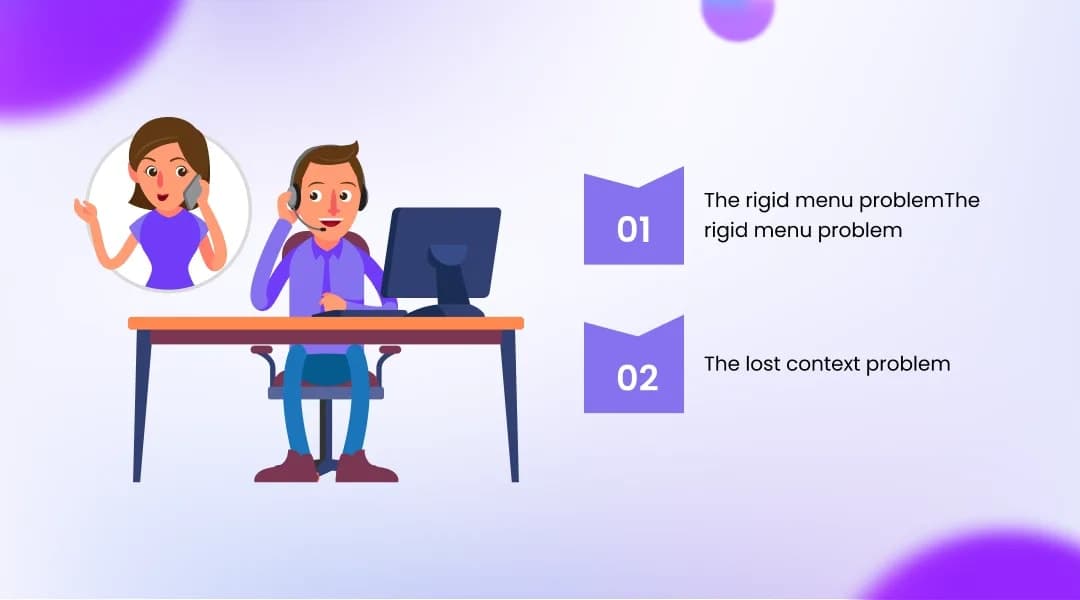
The rigid menu problem
Legacy IVR systems force every caller down a fixed decision tree that the business designed, not the one the caller needs. When a customer has a problem that does not fit any menu option, the system has no path for them. They press zero repeatedly, they say "representative" over and over, and the system either ignores them or routes them somewhere irrelevant. The friction is not a bug in these systems; it is a direct result of a design that treats human transfer as a cost to be minimised rather than a service to be delivered.
The lost context problem
Even when an older system did transfer a caller to a person, it usually threw away everything the customer had already said. The caller spent two minutes navigating menus and explaining their account number, then reached a human who asked them to start over from the beginning. This repetition is one of the most reliable ways to turn a mildly annoyed customer into an angry one. A transfer that loses context is barely better than no transfer at all, because the emotional damage of repeating yourself is exactly what pushes satisfaction scores down.
The core lesson from a decade of failed IVR deployments is simple. The problem was never that machines answered the phone; the problem was that the machines could not recognise their own limits and could not move the customer to a human without losing the thread. Solving handoff properly is what separates a modern AI voice agent from the frustrating phone trees customers have learned to dread.
How AI Voice Agent Human Handoff Actually Works
A modern AI voice agent human handoff works by continuously deciding, in real time, whether the current conversation is one the agent should keep handling or one a human should take over, and then executing that transfer while carrying the full conversation with it. Instead of a rigid rule that only fires when a customer explicitly demands a person, the agent monitors the call on several dimensions at once and can escalate the moment any of them cross a threshold. This is a fundamental shift from menu logic to conversational judgement.
There are three mechanisms working together to make this reliable, and understanding each one shows why the modern approach avoids the traps that sank older systems.
Sentiment-triggered escalation
The most important advance is sentiment-triggered escalation, where the agent tracks the emotional state of the caller throughout the conversation rather than only the words they say. When the system detects rising frustration, sharper tone, or signals that the customer is losing patience, it can adjust its own responses or move directly to a live human transfer before the situation deteriorates further. This matters because the cost of a bad call is rarely the first sign of irritation; it is the point where a frustrated customer decides to leave. Sentiment-triggered escalation is designed to intervene before that point, catching the emotional turn early enough that a human can still recover the relationship.
Intent and complexity detection
Alongside emotion, the agent evaluates whether the request itself is one it can complete. A routine appointment booking, an order status check, or a straightforward account question stays with the agent a straightforward account question stays with AI voice agents transforming customer support. A dispute, a sensitive complaint, a high-value negotiation, or a request that falls outside the agent's authority is flagged for AI call center escalation to a person who has the judgment and permission to handle it. The agent is effectively triaging every call in real time, keeping the volume that automation handles well and routing the exceptions that genuinely need human nuance.
Context preserving transfer
When the handoff fires, the entire conversation moves with it. The human who picks up sees or hears a summary of what the customer wanted, what has already been discussed, and any information the agent has already pulled or verified. The caller never has to repeat themselves, which removes the single biggest source of transfer frustration. This context-preserving AI-to-human call transfer is the difference between a handoff that feels seamless and one that feels like starting over, and it is the capability that makes customers comfortable with an automated first line.
When an AI Voice Agent Should Hand Off to a Human
Knowing how transfer works is only half the design decision. The other half is knowing when it should trigger. Getting the threshold right is what keeps automation from feeling cold on one side and pointless on the other. Escalate too rarely, and you recreate the trapped customer problem; escalate too often, and you have automated nothing.
A well-configured AI voice agent should trigger a live human transfer in the following situations:
The caller directly asks to speak with a person, which the agent should always honour immediately rather than trying to talk them out of it.
Sentiment tracking detects clear and sustained frustration or distress that the agent's own tone adjustments are not resolving.
The request involves a decision outside the agent's defined authority, such as approving a refund above a set value or altering contract terms.
The conversation touches a sensitive or high-stakes matter, for example, a medical concern, a bereavement, a legal question, or a serious complaint.
The caller is a high-value account that the business has flagged for human attention regardless of the nature of the call.
The agent has attempted to resolve the same issue more than once and is not making progress, which signals the automated path has been exhausted.
The goal is not to maximise the automation rate at any cost. The goal is to automate everything that automation handles well and to move everything else to a human quickly and cleanly. A platform that treats AI call center escalation as a core feature rather than an afterthought lets you tune these triggers to your own risk tolerance, tightening them for regulated industries and relaxing them for simple transactional lines.
The Business Impact of Getting Handoff Right
Getting handoff right is not a soft, feel-good improvement; it produces measurable results across cost, satisfaction, and revenue. The businesses that design escalation properly capture the savings of automation without paying the customer experience penalty that scared them away in the first place.
Consider the arithmetic of a typical inbound operation. A large share of inbound calls are routine and repetitive, often 60 to 80 percent for many businesses, covering questions like order status, hours, appointment changes, and basic account queries. When an AI voice agent handles that volume, human agents are freed to spend their entire shift on the complex, emotional, and high-value calls that actually need them, which is one of the biggest reasons businesses are reducing customer support costs with AI voice agents. This is where the economics turn sharply positive, because you are no longer paying skilled people to read out your opening hours forty times a day.
The customer experience impact is just as concrete. Long hold times are one of the leading drivers of call abandonment, and a meaningful percentage of callers hang up when made to wait too long. An AI agent answers instantly, with response latency under 500 milliseconds on a capable platform, so nobody waits on hold for the first line of contact. When escalation is needed, the customer reaches a human who already has the context, which cuts handle time and removes the repetition that damages satisfaction scores. Businesses that combine instant answering with clean escalation frequently report double-digit improvements in customer satisfaction alongside their cost reduction.
There is a revenue dimension as well, and it is often overlooked. Every missed call after hours, every abandoned call during a volume spike, and every frustrated customer who gives up is lost revenue or a lost relationship. Studies of missed call impact suggest businesses can lose a substantial portion of potential leads simply by not answering, and after-hours enquiries frequently go to whichever competitor picks up first. A voice agent that answers 24 hours a day and escalates the calls that need a person turns those lost moments into captured opportunities, which is why handoff quality belongs in a growth conversation and not just a cost one.
How OnDial Handles Live Human Transfer Mid Call
OnDial is built around the principle that automation is only safe to deploy at scale when the handoff is genuinely seamless, so live human transfer is treated as a first-class capability rather than a bolted-on escape hatch. OnDial deploys production-grade AI voice agents that handle inbound and outbound calls autonomously, and at any moment in a conversation, the agent can pass the call to a human agent instantly, carrying the full context of the interaction so the customer never repeats themselves. This is the design that lets a business automate the front line without fearing the trapped customer scenario.
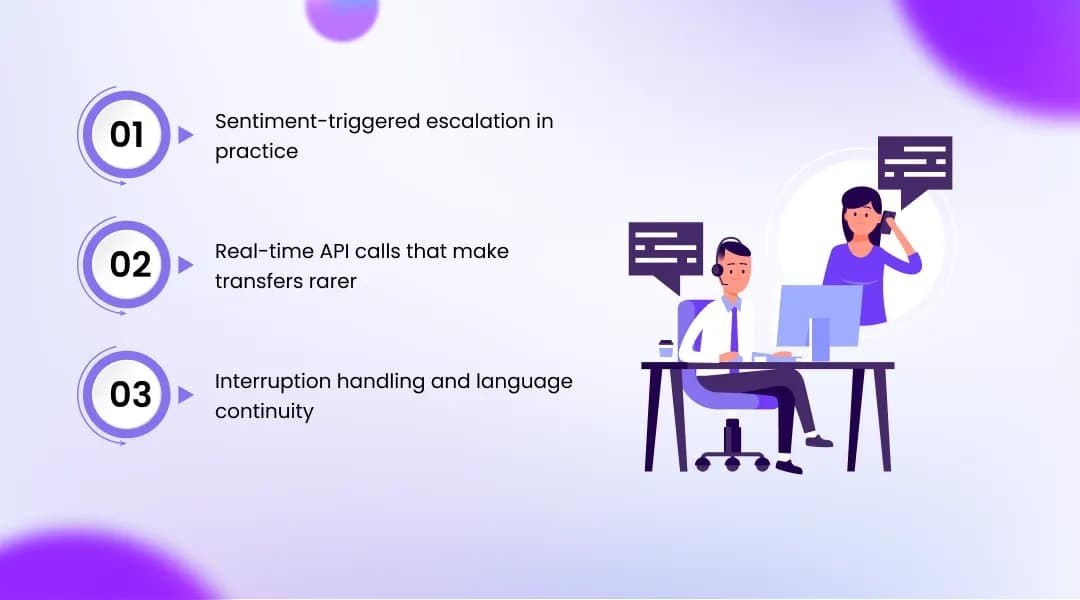
Sentiment-triggered escalation in practice
OnDial performs AI voice agent features such as real-time call sentiment analysis on every conversation, and this feeds directly into escalation logic. When the system detects that a customer is becoming frustrated, the agent can either adjust its own tone to de-escalate or trigger an immediate transfer to a live person. This sentiment-triggered escalation means the handoff often happens before the customer even asks for it, catching the emotional turn early enough for a human to recover the call. For an operations leader, this is the capability that converts automation from a risk into a controlled, monitored process.
Real-time API calls that make transfers rarer
A large share of transfers in older systems happened simply because the bot could not look anything up. OnDial reduces that problem at the source by making real-time API calls during a live conversation, so the agent can fetch order status, account details, or booking availability while still on the call with the customer. Because the agent can actually retrieve and act on live information, many calls that would otherwise have required a human are resolved directly, and the transfers that do happen are the ones that genuinely need a person's judgement. Fewer unnecessary escalations means your human team stays focused on the calls that matter.
Interruption handling and language continuity
Real conversations are messy, and OnDial is built to handle that without breaking flow. Its intelligent interruption handling lets the agent respond naturally when a caller talks over it, changes direction, or corrects itself mid-sentence, which keeps the interaction feeling human right up to the moment of transfer. OnDial's multilingual AI voice agent supports on-call language switching across more than 100 languages, including 9 Indian languages with over 80 Indian voice variations and natural code-switching between Hindi and English. This matters enormously for Indian businesses, where a rigid single-language agent simply does not reflect how customers actually speak.
Beyond the call itself, OnDial maintains one consistent agent across voice, WhatsApp, SMS, web chat, and email, so the context that makes a handoff smooth is not confined to a single channel. A customer who started a conversation on WhatsApp and calls in later is met by an agent that already knows the history, and if that call needs a human, the person who takes over inherits the same continuous context. OnDial also integrates flexibly with existing CRM and business software, so escalated calls and their full history land where your team already works.
Implementation: Designing Escalation Rules That Work
Deploying an AI voice agent with reliable handoff is far less complex than most teams expect, but it does reward a little upfront design. The businesses that get the most value are the ones that think through their escalation rules before going live rather than treating them as a setting to fix later. The good news is that this planning is a business exercise, not a technical one.
Start by mapping your call types into two groups: the routine volume that automation should own and the exceptions that should always reach a person. Then define your escalation triggers in plain terms, deciding which sentiment thresholds, which request types, and which customer segments should always route to a human. This is a conversation between your operations and customer experience leaders, and it is the single most important input to a successful deployment. Getting these rules right is what makes AI call center escalation feel intentional rather than random.
On the technical side, OnDial offers both a 100 percent no-code deployment path and full API access, which means teams without engineering resources can configure and launch an agent through a visual interface, while businesses that want deeper custom integration into their existing systems can build against the API. This flexibility matters because it removes the two most common blockers to adoption at once: the fear that automation requires a development project and the fear that a no-code tool will not integrate with the software you already run. OnDial also handles data in a GDPR and CCPA-compliant manner, which removes another common hesitation for regulated industries evaluating voice automation.
Expect your first weeks to be a tuning period rather than a set-and-forget launch. Review the calls that escalated and the calls that stayed automated, and adjust your triggers based on what you learn. Most businesses find that within a short window, the agent is resolving the large majority of routine calls cleanly and escalating the right exceptions, and the human team is measurably less stretched than before.
Conclusion
Three things should stay with you from this discussion. First, the fear that stops businesses from automating, the trapped customer with no way to reach a person, is a solved problem, and a modern AI voice agent human handoff is a designed bridge to a human rather than a dead end. Second, the mechanisms that make it work- sentiment-triggered escalation, intent detection, and context-preserving transfer- let you automate the routine majority of calls while cleanly routing the exceptions that genuinely need a person. Third, getting handoff right is not a cost decision alone; it protects satisfaction and captures revenue that missed and abandoned calls would otherwise lose.
OnDial delivers exactly the capability this blog describes, deploying production-grade AI voice agents that answer instantly with response latency under 500 milliseconds, hand off to a human mid-call with full context, and escalate automatically when real-time sentiment analysis detects a frustrated customer. With support for over 100 languages including 9 Indian languages, more than 80 Indian voice variations, and natural Hinglish code-switching, real-time API calls that resolve requests during the conversation, flexible CRM and software integration, and both no-code and API deployment, OnDial gives real businesses the reliability and control that make full automation safe to trust. If you want to see how a live human transfer feels when it is built properly, schedule a demo with OnDial and put your own escalation scenarios to the test.