After analyzing more than four million production voice calls, the AI testing firm Hamming found a gap most buyers never see: platforms advertise sub-300 millisecond response times, yet live systems often deliver 1.4 to 1.7 seconds. That gap is where AI voice agent quality at scale quietly starts to break down. If you are evaluating voice AI and worried that what works in a polished demo will fall apart across thousands of real calls, that worry is reasonable. It is the right question to be asking.
Here is the short answer. AI voice agents keep quality across thousands of calls through continuous monitoring of every conversation, automated evaluation, drift detection that catches slow degradation, and escalation rules that hand off to a human before a caller gets frustrated. Consistency is not a feature you switch on. It is an operating discipline you maintain.
I am Alex, and at OnDial I have watched voice deployments both succeed and stall for exactly this reason. In this guide I will show you what quality really means at scale, the metrics that prove it is holding, and why the genuine risk shows up three months after launch, not on day one.
Why Voice Agent Quality Gets Harder as Call Volume Grows
Scale does not just multiply your call count. It multiplies your failure surface. A single conversation already passes through speech recognition, language understanding, reasoning, and speech synthesis, and a weak link in any layer breaks the call. Run that across thousands of callers with different accents, phone lines, and intents, and the edge cases stop being rare.
The hidden cost of scale: small errors compound
A 5 percent error rate sounds harmless until you do the arithmetic. On 10,000 calls, that is 500 conversations where the agent misheard, misrouted, or misunderstood the caller. Each one is a real person with a real problem.
The trap is averages. A dashboard showing 95 percent accuracy can still hide a specific intent, say a refund request in Hindi, that the agent fails most of the time. Long-tail edge cases are individually rare, but collectively they can represent 10 to 20 percent of production traffic, according to analysis from voice QA platform Bluejay. You will never script a test for every one of them.
Quality is not a launch-day metric
Counterintuitively, the most dangerous moment for a voice agent is not launch day. It is the quiet months that follow.
Your model provider updates its weights. Your knowledge base goes stale. Caller patterns shift as a new campaign brings in a different audience. None of these show up as a deploy or a code change, yet your agent slowly gets worse. So how would you even know it was happening? That is the question the rest of this guide answers.
What Quality Actually Means at Scale
Before you can hold quality, you have to define it precisely. At scale, "the agent sounds good" is not a measurement. Voice agent quality is the consistency of accurate, fast, on-policy responses measured across every call, not a sample.
The four-layer pipeline behind every call
Every voice interaction moves through four layers, and quality assurance means watching all of them.
ASR (speech-to-text): converts the caller's audio into text. Word Error Rate (WER) here is now under 10 percent for many languages on clean telephony audio, per published benchmarks, but it climbs fast in noise.
NLU (intent recognition): decides what the caller actually wants. Mature deployments hit 90 to 97 percent intent recognition accuracy on well-bounded tasks like booking or order status.
LLM (reasoning): chooses the response and keeps track of earlier turns so the conversation stays coherent.
TTS (text-to-speech): turns the answer back into natural speech with the right pacing and tone.
Here is the practitioner's catch. WER does not capture semantic errors. "I want to cancel" mis-transcribed as "I want to handle" scores a near-perfect WER while pointing the agent at completely the wrong intent. That is why single-number accuracy can lie to you.
The metrics that tell you quality is holding
Three numbers matter more than the rest. Containment rate is the share of calls the agent resolves fully without escalating to a human. Intent recognition accuracy confirms the agent understood the caller. P90 latency, the response time 90 percent of calls beat, reveals whether the conversation feels natural or slow.
A note on benchmarks worth keeping honest about: a 2026 Deloitte Digital survey put the cross-industry average containment rate around 41 percent, while optimized enterprise deployments regularly pass 80 percent. The spread between those figures is the difference between a tuned operation and a hopeful one.
How AI Voice Agents Maintain Consistent Quality Across Thousands of Calls
This is the section most vendor pages skip. They promise consistency without explaining the machinery underneath it.
AI voice agents maintain consistent quality across thousands of calls by scoring every conversation automatically, running fixed test calls on a schedule to catch regressions, and triggering a human handoff the moment confidence or sentiment drops below a set threshold. Quality is sustained by systems, not goodwill.
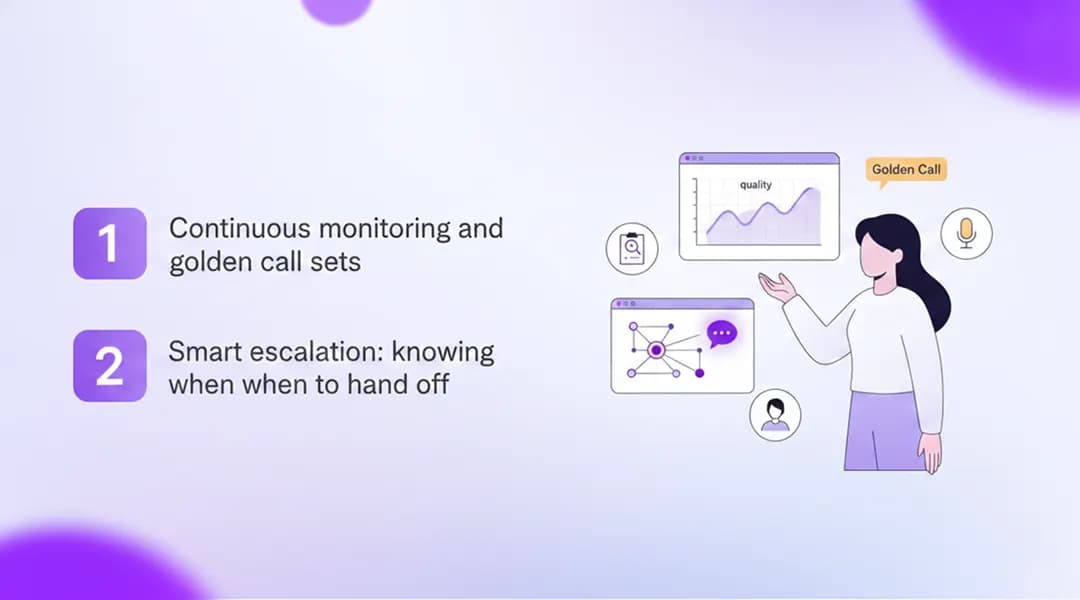
Continuous monitoring and golden call sets
Spot-checking a handful of calls does not survive scale. Modern operations score 100 percent of production calls using LLM-as-judge evaluation combined with periodic human review, so no failing pattern stays hidden.
The second pillar is the golden call set: a fixed library of benchmark conversations replayed regularly against the live agent. (Think of it as a unit test suite, but for conversations instead of code.) When this week's scores drop against last month's baseline, you have caught a problem before customers report it. In OnDial deployments, I have seen this single practice surface a stale knowledge-base answer days before it would have shown up in complaint volume.
Smart escalation: knowing when to hand off
The best quality safeguard is the agent knowing its own limits. Confidence thresholding routes low-confidence responses straight to a human rather than guessing.
Even better is a frustration detector. Bluejay's work shows that callers transferred before they explicitly demand a human report a far more positive experience than those forced to ask. A well-built agent reads hesitation and hands off early. Honest scope beats false bravado every time.
Why Voice Agent Quality Drops After Launch
Let me tell you the scenario that keeps operations teams up at night. Three months after launch, satisfaction scores slide. Callers complain the bot "does not understand them anymore." Containment falls from 85 percent to 72 percent. Nothing in your infrastructure changed. No deploy, no config update.
That is drift, and it is the quiet killer of voice agent quality at scale.
Detecting drift before customers do
Drift is a month-three-plus problem, which is exactly why launch testing misses it. Voice agent drift is the gradual decline in response quality caused by model updates, stale data, or shifting caller behavior, with no code change to blame.
You catch it by running daily synthetic tests and comparing against a baseline, and by setting alerts on P90 latency rather than averages. Generic application monitoring tools miss roughly 60 percent of voice-specific failures, per Hamming, because they watch servers, not conversations. Voice needs voice-specific monitoring. The payoff is large: Gartner has projected conversational AI will cut contact center costs by 80 billion dollars by 2026, and almost all of that value depends on containment staying high rather than drifting down.
The India-specific quality challenge
Holding quality is harder in a multilingual market, and this is where OnDial focuses. An Indian caller may switch between Hindi, English, and Hinglish inside a single sentence, and an agent tuned only on clean English audio will see its WER climb the moment code-switching starts.
There is a compliance layer too. Under the DPDP Act 2023 and TRAI DLT rules, every call recording and consent flow has to be auditable, so quality monitoring and regulatory record-keeping are the same system, not two. I will be candid: no agent handles every dialect and edge case perfectly today. The teams that win are the ones who measure honestly and improve continuously instead of trusting a demo.
Conclusion
Holding AI voice agent quality at scale comes down to three things: measure every call rather than a sample, catch drift before customers feel it, and let the agent escalate honestly when it reaches its limits. The agents that stay reliable across thousands of conversations are not the ones with the best demo. They are the ones with the best monitoring discipline behind them.
You do not have to take quality on faith. You can watch it, prove it, and protect it. If you are scaling voice AI in a multilingual, compliance-heavy market like India, OnDial builds and monitors voice agents with this discipline at the core, so consistency holds at call ten thousand the same way it did at call one.