Pick up the phone at almost any insurance company today, and the odds are good you will spend the first ninety seconds in a hold queue, not talking to a person. In one national survey of more than 500 consumers, eHealth found that 66 percent named long hold times their single biggest frustration with customer service, and 59 percent said reaching an actual human ranks nearly as high on their list of complaints. If you have called your own insurer lately, you already know the feeling.
That frustration is exactly what AI voice agents for insurance companies are built to solve: software that answers the phone instantly, understands natural speech, pulls real policy data, and hands off to a licensed agent the moment a call needs a human touch. This guide walks through what these systems actually do, where they genuinely help, what compliance rules you cannot ignore, and how to evaluate a vendor without falling for a demo that looks better than it performs in production. By the end, you will have a clear framework for deciding whether voice AI belongs in your call center with AI voice agents for call centers.
What Are AI Voice Agents for Insurance Companies?
Start with the plain definition, because most of the marketing language around this topic buries it. An AI voice agent for insurance is software that answers phone calls, understands natural speech, and completes real policy tasks, such as checking coverage or filing a claim, without a human agent on the line. It is not a smarter version of "press 1 for billing." It is a different technology altogether.
Quick answer: An AI voice agent for insurance companies is a phone-based software system that uses natural language processing to understand callers, retrieve live policy and claims data, and resolve routine requests automatically, escalating complex cases to a licensed human agent when needed.
How AI Voice Agents Differ From Old IVR Systems
Traditional IVR (interactive voice response) systems route calls through rigid menus: press 1 for this, press 2 for that. Callers who don't fit neatly into a menu option get stuck. In the UK, the Association of British Insurers found that automated phone menus were the second most common customer complaint, cited by 46 percent of respondents, trailing only long wait times at 61 percent.
AI voice agents work differently. They use natural language processing (NLP) to understand open-ended speech, so a caller can say "I need to check if my roof repair is covered" instead of hunting through a phone tree. The agent listens, interprets intent, and pulls the answer from live policy data rather than reading a static script. A policyholder calling after a car accident is stressed, gives details out of order, and often interrupts mid-sentence. Good IVR systems fail here, because they are matching keywords, not meaning.
The Technology Working Behind the Scenes
Under the hood, most AI voice agents for insurance combine three layers: speech recognition that converts the caller's voice to text, a language model that decides what to say and do next, and integrations that connect to your policy administration system, claims platform, or agency management system (AMS) such as Applied Epic or EZLynx. Removing any one of those layers breaks the experience.
The integration layer is where most implementations actually succeed or fail. A voice agent that sounds articulate but cannot pull real claim status from your system is just a polished dead end. In projects I've worked on at OnDial, the conversations that go smoothly are almost always the ones where the agent has direct, real-time access to accurate policy data, not a cached snapshot from the night before.
Why Insurance Companies Are Adopting Voice AI Now
The honest reason most insurance companies are deploying voice AI has less to do with the technology itself and more to do with a hiring problem they cannot solve any other way.
The Staffing and Call Volume Problem
Insurance call centers are short-staffed, and the gap is widening. Vertafore's Agency Trends Outlook for 2026 found that hiring timelines for claims representatives now stretch beyond six months, up from 60 to 90 days just a few years earlier, while annual turnover on those teams exceeds 15 percent. Meanwhile, call volume keeps climbing, especially after catastrophe events, when claims surge overnight.
Human agents also take time. Industry data puts average handling time for a phone interaction around 3.35 minutes. Multiply that across thousands of daily calls, and the math stops working, particularly when a single weather event can double or triple inbound volume within hours.
What the Adoption Numbers Actually Show
The shift is already well underway. According to Perspective AI's industry report on agency AI adoption, 64 percent of U.S. insurance agencies used AI in at least one core workflow in 2026, up from 38 percent two years earlier. Customer service was one of the faster-growing categories, alongside quoting and claims handling.
Financial services and insurance now lead every other industry in voice AI adoption, holding roughly a 32.9 percent share of the conversational AI market, according to Mordor Intelligence's research. That's not a coincidence. Insurance calls are procedural, often repetitive, and tied to structured data, which is exactly the kind of workflow voice AI handles well. Would your team rather spend its day quoting new policies, or explaining for the fifth time that a payment posted a day late?
Where Voice AI Actually Helps Insurance Teams
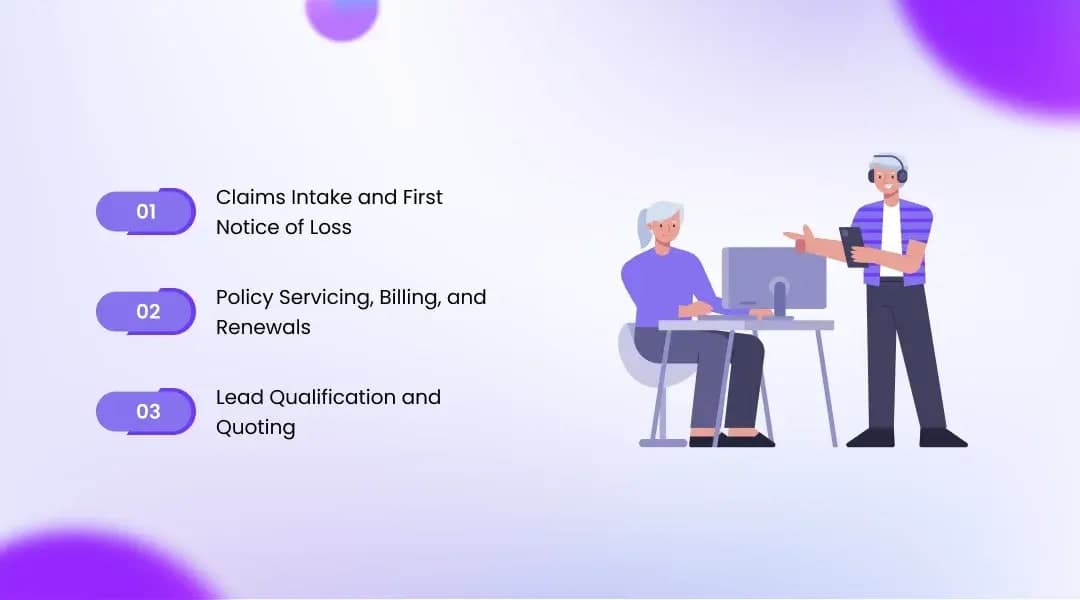
Not every call belongs in front of an AI voice agent, and being upfront about that is part of building something people actually trust. The workflows below are where the technology consistently earns its keep.
Claims Intake and First Notice of Loss
First notice of loss (FNOL) is the initial report a policyholder makes after an accident, theft, or damage event, and it is one of the highest-value use cases for voice AI. A well-designed agent asks what happened, when, where, who was involved, and what damage occurred, adapting its questions depending on whether the claim involves an auto accident, property damage, or a liability issue.
Carriers using voice AI for FNOL intake have reported claims-processing time drops of up to 70 percent, according to industry analysis from CloudTalk, because the information arrives structured and complete on the first call instead of requiring a callback. Lemonade already runs a virtual assistant that fields home and auto claims around the clock, a model more traditional carriers are now studying closely.
Policy Servicing, Billing, and Renewals
Most calls into an insurance company aren't claims at all. They're questions about coverage limits, deductibles, billing due dates, or requests for a certificate of insurance. These follow predictable patterns, which makes them well suited to automation.
Coverage and policy questions: The agent authenticates the caller, pulls current policy details, and explains deductibles or endorsements in plain language instead of reading legal text aloud.
Billing and payment support: Callers can confirm a due date, make a payment, or understand why a bill changed, without waiting for a live representative.
Certificates and documentation: Routine document requests, like a certificate of insurance, can be generated and emailed automatically during the call itself.
Zurich Insurance uses AI in a similar way, answering frequently asked questions and guiding customers through routine procedures without pulling a human agent into every conversation.
Lead Qualification and Quoting
On the sales side, voice AI can answer after-hours calls from prospective customers, collect the information needed for a quote, and schedule a follow-up with a licensed producer. This is where missed revenue tends to hide.
One Atlanta-based agency, SecureLife Insurance, reported recovering 38 percent of previously missed after-hours quote requests within 90 days of deploying a voice agent, with average claim response time falling to under a minute, according to deployment data published by Intellnova with AI voice agent services. Independent of the exact figures, the pattern holds across the industry: after-hours and overflow calls are where voice AI shows return fastest, because the alternative is usually no answer at all.
Compliance and Trust: What You Cannot Skip
This is the section vendors tend to gloss over in their demos.
Disclosure, Consent, and State Rules
Regulation in this space is tightening, not loosening. Several U.S. states now require companies to disclose to a caller that they're speaking with an AI system, and call recording consent rules vary by state and country. A voice agent that skips this step isn't just a compliance risk; it's a trust problem waiting to surface.
I've seen vendor demos that quietly make the AI sound more human than it is, adding background office noise or a name that implies a live person, purely to boost "acceptance" rates (a trick I'd treat as a warning sign, not a feature). Policyholders who realize later they were misled tend to trust the whole company less, not just the AI.
Data Security and HIPAA Considerations
If your voice agent touches health information, such as Medicare or health-plan calls, HIPAA applies, and you need a signed Business Associate Agreement (BAA) with your vendor, not just a compliance claim on a marketing page. For general liability and property lines, SOC 2 compliance is a reasonable baseline to expect from any serious vendor.
Every automated conversation should also produce a complete, reviewable record: what was said, what data was accessed, and what action the system took. In a regulated industry, "the AI handled it" isn't an answer a regulator will accept. Traceability has to be built in from the start, not added later.
How to Evaluate and Implement an AI Voice Agent
Questions to Ask Before You Buy
Most vendor comparisons focus on voice quality and price, and those matter, but they aren't where deployments actually fail. Ask harder questions before you sign anything.
Can it connect to your systems? A voice agent that can't read and write to your AMS (Applied Epic, EZLynx, or whatever you run) or claims platform in real time will always feel disconnected from the rest of your operation.
What happens when it doesn't know the answer? The best systems escalate gracefully, with full conversation context, rather than looping the caller through the same questions again with Best AI Voice Agents For Call Centers.
Who owns the compliance risk? Get clarity, in writing, on disclosure requirements, data retention, and BAA coverage if health information is involved.
Can you hear it fail? Ask for recordings of real production calls, not scripted demos. A system that sounds great on easy questions can fall apart with a stressed, interrupting caller.
A Practical Rollout Plan
Start small. A narrow pilot, such as after-hours FNOL intake or billing questions for one line of business, shows real value fast and limits your exposure while you learn how the system behaves with actual callers.
Expand only after you've reviewed call recordings, not just a dashboard of resolution rates. Bring your compliance and claims teams into that review early, because they'll spot problems a product dashboard won't.
What It Actually Costs
Quick answer: AI voice agents for insurance typically cost between $0.05 and $0.15 per call under per-minute or per-agent pricing, compared to roughly $7 to $12 for a human-handled call, though enterprise deployments with deep AMS integration are priced individually based on volume and complexity.
According to cost benchmarking compiled by CloudTalk, drawing on Zendesk's customer service research, AI-handled minutes run around $0.08 each, compared to roughly $7.16 for a human-handled call. Pricing models vary: per-minute, per-agent, tiered, or custom enterprise agreements, and the right structure depends on how predictable your call volume actually is.
AI Voice Agents vs Human Agents: Where to Draw the Line
The goal was never to replace your claims team, and any vendor pitching it that way is selling you the wrong thing.
What AI Should Never Handle Alone
Some conversations require judgment that software shouldn't carry alone: coverage disputes, settlement negotiations, liability determinations, and any call involving genuine distress. Elderly policyholders and people reporting a serious loss often ask clarifying questions that don't follow a script, and they deserve a human who can adapt.
Regulators and customer experience leaders converge on one principle here: callers must always have a clear, fast path to a person. Building that path in from day one isn't a limitation of the technology; it's what makes the technology usable in a regulated industry.
Designing a Handoff That Doesn't Frustrate People
A bad handoff is worse than no automation at all: the caller repeats their whole story to a human after already telling it to the AI. Would you want to explain a car accident twice, back to back, to two different listeners? Good systems pass the full conversation context, so a producer or adjuster picks up exactly where the AI left off.
Context preservation: The human agent sees the transcript, the caller's intent, and any data already collected, not a blank screen.
Clear triggers for escalation: Complex coverage questions, disputes, or signs of distress in the caller's voice should route out automatically, not wait for the caller to ask three times.
A visible option, always: Callers should be able to reach a person on request at any point, without the system stalling or looping them back through menus.
Conclusion
AI voice agents for insurance companies work best when they're treated as a tool for handling volume, not a replacement for judgment. The clearest wins sit in FNOL intake, policy servicing, and after-hours lead capture, where speed matters more than nuance. Compliance isn't optional: disclosure, data security, and a genuine human handoff need to be built in from the first pilot, not bolted on after a regulator asks questions.
Get those pieces right, and voice AI stops feeling like a gamble and starts feeling like infrastructure your team can rely on. At OnDial, we build voice AI around that same principle: tailored to how your team actually works, transparent with the people who call you, and designed to earn trust rather than fake it. If you're weighing whether voice AI belongs in your call center, that's a conversation we'd welcome having with you directly.