Medication non-adherence costs the U.S. healthcare system an estimated $300 billion every year, according to an analysis of adherence data by PatientPartner. A meaningful share of that traces back to something as ordinary as a phone call nobody picked up. AI voice agents for pharmaceutical companies exist to close that gap: they answer every inbound call, verify the patient, and resolve or route the request, without hold music or a busy signal. At OnDial, I've watched pharma companies lose patients not because a medicine failed, but because a refill call simply rang out.
If you're responsible for patient access, call center performance, or compliance at a pharmaceutical company, you're probably skeptical that AI can handle calls this sensitive. That skepticism is fair. Patient calls involve protected health information, controlled substances, and adverse event reports, not just appointment bookings. This guide walks through why missed calls happen in pharma, how AI voice agents actually fix the problem without breaking HIPAA, what a real rollout looks like, and where human agents still need to stay in the loop.
Why Missed Calls Are a Bigger Problem for Pharmaceutical Companies Than You Think
Missed calls in the pharmaceutical industry don't look like a crisis from the outside. They look like a slightly long hold time, a voicemail nobody has time to return, a Friday afternoon call queue that never quite clears.
The Real Cost of a Missed Call in Pharma
Put a number on it, and the picture changes fast. Bain research found that 93% of callers never ring back after reaching a busy signal, and a 2024 Zendesk Benchmark study pegs the average missed call at roughly $450 in lost value. For a pharmaceutical company fielding thousands of refill, adherence, and provider calls a month, that math adds up quickly.
Quick answer: A missed call at a pharmaceutical company or specialty pharmacy costs roughly $450 in lost opportunity, based on 2024 Zendesk Benchmark data. Multiply that by dozens of missed calls a day across refill lines, patient support, and provider inquiries, and the monthly loss climbs into six figures fast.
Scale that to a mid-sized pharmaceutical company or specialty pharmacy handling a few hundred inbound calls a day, and even a 15% missed-call rate adds up to real numbers fast, in lost adherence, repeat calls, and patients who simply give up and call a competitor's pharmacy instead.
Where Most Missed Calls Actually Happen
Refill requests are the biggest single driver. Up to 30% of all inbound calls to primary care offices and pharmacies are routine refill requests, according to MGMA data cited in a 2026 industry analysis of pharmacy voice AI. Each one takes a technician two to four minutes to handle manually, mostly re-entering information that already lives in the system.
Nobody calls a pharmacy twice for the same refill.
They just find a mail-order option instead. Add in seasonal spikes (flu season, formulary changes, product recalls) and after-hours calls from patients who only remember their medication at 9 p.m., and it's clear why hold queues buckle. One 2026 healthcare contact center analysis found average wait times hitting 4.4 minutes, with 60% of callers abandoning after just 90 seconds. Ninety-six percent of patient complaints in healthcare trace back to service issues like this, not the medicine itself.
How AI Voice Agents Actually Reduce Missed Calls
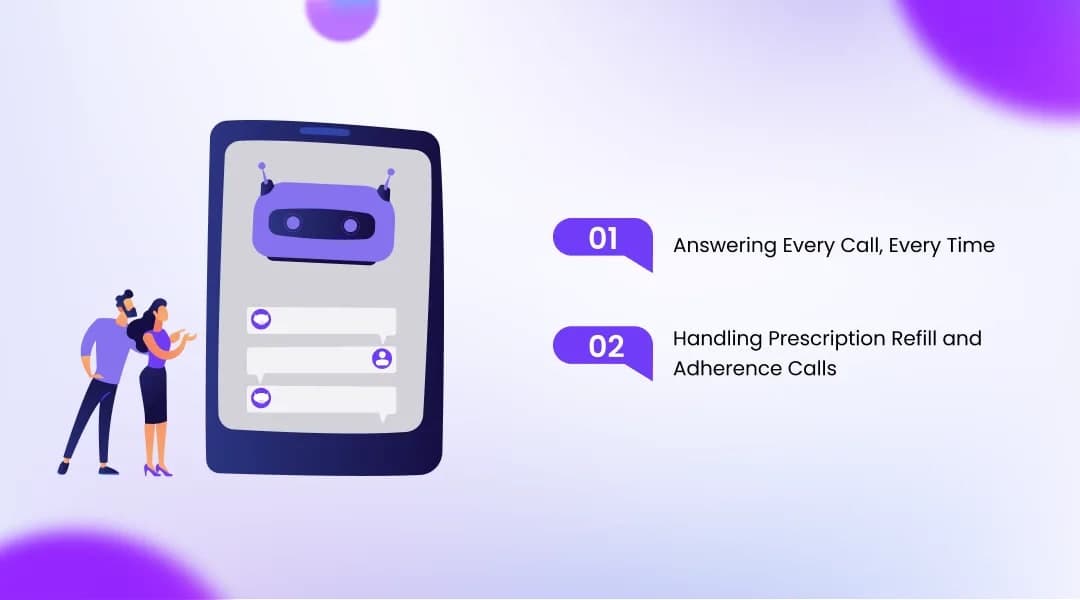
The fix for missed calls isn't a bigger call center. It's not staffing up for a shift nobody wants to work at 2 a.m. It's having something else answer the phone that never gets tired, never gets sick, and never puts a caller on hold because three other lines just lit up.
Answering Every Call, Every Time
An AI voice agent is software that listens to a caller, understands intent, and responds in natural speech without a human on the line. Unlike a phone tree, it can hold an actual conversation: verify who's calling, answer a question, or transfer to a pharmacist when needed. Platforms like OnDial are built to answer multiple calls at once, with response latency under 200 milliseconds, so a patient calling at 11 p.m. gets the same experience as one calling at 11 a.m.
That consistency matters more than it sounds. A caller doesn't know or care whether they're the first call of the day or the four-hundredth. What they notice is whether someone (or something) picks up, and whether that conversation actually resolves what they called about with AI conversations that replace rigid call scripts.
Every call also needs to go somewhere afterward. A voice agent that just talks isn't enough on its own: it should log the call to your CRM or pharmacy system automatically, flag sentiment when a patient sounds frustrated or confused, and hand a summary to whoever picks up the follow-up. That's less about the AI sounding human and more about the data being useful the next morning.
Handling Prescription Refill and Adherence Calls
Refill calls follow a predictable pattern, which makes them a good first workflow to automate. A well-built voice agent verifies the patient's identity, checks refill eligibility against the pharmacy management system, and either submits the refill or flags it for a pharmacist. Controlled substances get routed to a human by default; no AI system should process those autonomously.
One pharmaceutical answering service vendor reported that after full integration, a client captured 95% more after-hours inquiries and cut missed calls by 80%. Numbers like that are worth taking with a grain of salt. They're vendor-reported, and your results will depend on call volume, integrations, and how much of the workflow you're willing to automate on day one.
Is an AI Voice Agent HIPAA Compliant? What Pharma Teams Need to Know
Quick answer: Yes, when it is built for healthcare. A HIPAA-compliant AI voice agent encrypts every call, verifies patient identity before sharing protected health information, logs an audit trail, and operates under a signed business associate agreement with the vendor, the same requirements that apply to any other vendor touching PHI.
The Compliance Standards That Matter
HIPAA isn't the only rule in play. The FCC's February 2024 ruling confirmed that TCPA restrictions on artificial or prerecorded voice apply to AI-generated voice too, with no exception for AI simulating a live agent with OnDial. Outbound calls need documented consent, and violations run $500 per standard claim up to $1,500 for willful ones, with no cap on class action exposure.
For a pharmaceutical company, the platform underneath the AI voice agent needs to check several boxes at once: HIPAA for protected health information, GDPR if you serve patients in the EU, PCI DSS if payment details ever come up, and SOC 2 or ISO 27001 as proof the vendor's own security controls hold up to an audit. At OnDial, we built these controls into the platform itself rather than adding them after a client asks.
There's also a pharma-specific wrinkle beyond general healthcare compliance. Adverse event and product complaint calls often carry their own regulatory reporting clock, separate from HIPAA. A voice agent needs to recognize when a call turns into a safety report, not just a service request, and route it accordingly. Getting that detection wrong isn't just a compliance gap; it's a patient safety one.
What Can Go Wrong Without the Right Safeguards
The FTC treats an AI agent that doesn't identify itself as non-human as a deceptive practice, and regulators are paying attention. Voice data carries more risk than text. A voiceprint counts as biometric data under laws like Illinois' Biometric Information Privacy Act, and speech patterns can reveal health conditions the caller never disclosed, from Parkinson's-related tremor to cognitive changes.
No vendor, including us, can promise zero compliance risk. What a good platform can do is reduce it: encrypted storage, role-based access, immutable audit logs, and a clear escalation path when a call touches something the AI shouldn't handle alone. Ask any vendor for their SOC 2 report and business associate agreement before you sign anything.
What This Looks Like in a Real Pharmaceutical Call Center
A Day in the Life: Before and After
Picture a specialty pharmacy supporting a specialty biologic with a narrow refill window. Before automation, a Monday morning queue might have 40 calls waiting by 9:15, half of them patients asking the same three questions: is my refill ready, what's my copay, and can someone call me back? Staff spend the morning triaging instead of handling the calls that actually need a pharmacist's judgment.
After an AI voice agent is in place, most of those 40 calls resolve in under two minutes each, with no hold time involved. Patients get their refill status and copay instantly, at 7 a.m. or 11 p.m., and the calls that do need a human (an insurance denial, a dosing question, a side effect report) get flagged and routed with full context already attached. I've seen this shift change what a support team's day actually looks like: less time on repetitive calls, more time on the ones that matter.
Language adds another layer that most call center metrics miss. A patient calling about a refill in Spanish, Hindi, or Mandarin often gets bounced to a callback queue simply because no bilingual staff member is free. A voice agent built for 100-plus languages, with accent-tuned recognition, picks up that same call without a transfer, which matters even more for pharma companies serving diverse patient populations across regions.
Where Human Agents Still Matter
Some calls should never resolve autonomously, and any pharma company evaluating this technology should ask a vendor directly how it handles them with CRM integrated AI calling platform. Adverse event reports and safety signals need to reach a trained person, often within regulatory timelines. Controlled substance requests need a pharmacist's sign-off. Complex clinical questions need a human who can read between the lines of what a patient is actually asking.
This is where a feature like context-aware live handoff earns its keep. Instead of transferring a caller cold, the system passes along what's already been said: the patient's identity, the reason for the call, and any relevant history, so nobody has to repeat themselves to a second person. Should you actually replace your live call center with an AI voice agent? For most pharma companies, the honest answer is no, not entirely; the right model pairs AI for volume and speed with humans for judgment and nuance.
How to Evaluate and Roll Out an AI Voice Agent Without Disrupting Patient Trust
Is an AI voice agent worth it for a pharmaceutical company specifically, versus a general-purpose contact center tool? It depends on how it's evaluated before launch, not just how it performs after.
Questions to Ask Before You Pilot
Before signing anything, walk through these questions with the vendor and your compliance team:
Does it hold a signed business associate agreement? If a vendor can't produce one before the contract, that's a signal to walk away.
What happens on a controlled substance or adverse event call? The answer should be an immediate, documented handoff, not an attempt to resolve it autonomously.
Can it integrate with your existing EHR, PMS, or CRM? A voice agent that can't write back to your systems just creates another manual step.
What languages and accents does it support? Pharma serves patients who don't all speak the same language, or the same version of English.
What does the audit trail look like? You should be able to reconstruct exactly what was said, verified, and decided on any call, six months later.
A Realistic Rollout Timeline
Most secure voice AI deployments, across healthcare and other regulated industries, take about six to eight weeks from kickoff to a live pilot, according to a 2026 implementation guide. That timeline covers a compliance audit, integration with existing systems, script and workflow design, and a limited pilot before a full rollout.
Track three numbers during the pilot: percentage of calls fully resolved without a human, average time to resolution, and patient satisfaction on the calls the AI actually handles. If those numbers hold up after a few weeks, expanding to a second call type, like appointment reminders or adherence check-ins, is a much easier conversation with legal and clinical stakeholders.
At OnDial, we start every pharma engagement with that audit step: what calls are coming in, which ones can safely automate first, and which ones need a human today with AI voice agents for call centers. We'd rather run a smaller, honest pilot than promise a same-week launch we can't back up. That's the partnership model we believe in: transparent about what the technology can and can't do yet.
Conclusion
AI voice agents for pharmaceutical companies solve a problem that's been hiding in plain sight: the phone calls nobody had time to answer. Get the rollout right and three things change. Every patient call gets picked up, day or night, without adding headcount. Refill and adherence calls resolve in minutes instead of sitting in a queue, and the calls that genuinely need a pharmacist (adverse events, controlled substances, complex questions) reach a human with full context instead of starting from zero.
If missed calls are costing your team patients or trust, start small: pilot refill calls first, measure the results, then expand. OnDial builds HIPAA- and SOC 2-compliant AI voice agents for pharmaceutical companies that want fewer missed calls without cutting corners on patient safety. Book a demo to map your call volume to a pilot.