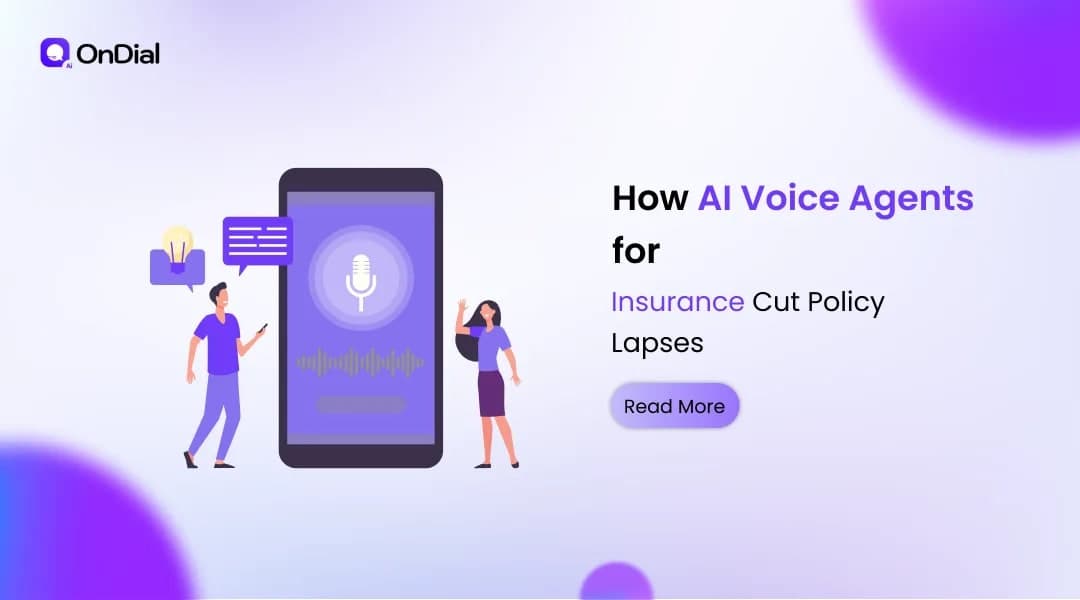
Every year, insurers watch a measurable slice of their book walk out the door for a reason that has nothing to do with price, product, or competitor poaching. The customer simply forgot to renew. Across life, health, motor, and general insurance, lapses driven by missed renewals quietly drain enormous recurring premium revenue, and a large share of those lapses were preventable with one timely conversation. This is exactly the problem that AI voice agents for insurance are built to solve, and it is one of the clearest cases where automation pays for itself in weeks rather than years.
The numbers are not small. Many insurers report that early year policy lapse rates sit in the high single digits to low double digits, and that a significant portion of those lapses happen not because the customer rejected the product, but because the renewal moment passed without a real follow up. When you multiply an avoidable lapse rate of even five to ten percent against an entire renewal book, the lost lifetime value runs into figures that would justify an entire new outbound team. Yet most insurers still rely on a thin layer of reminder SMS messages and an overstretched calling team that can only reach a fraction of customers before the grace period expires.
The good news is that this is now a solved category. AI voice agents can call every renewing customer, in their own language, at the right time, have a natural conversation, answer questions, and either close the renewal or schedule a human callback. This article breaks down why renewal lapses happen, why traditional outreach keeps failing, how AI voice agents fix the problem in practical terms, the measurable impact on lapse rates and revenue, and what a real deployment looks like for an insurance business.
The Hidden Cost of Policy Lapses in Insurance
Policy lapses are one of the most underestimated profit leaks in the entire insurance business. A lapse does not just cost the next premium payment. It erases the full future lifetime value of that customer, wipes out the acquisition cost already spent to win them, and often hands the relationship to a competitor at the next purchase cycle. For products with long premium horizons such as life and health, a single avoidable lapse can represent the loss of years of expected revenue.
The frustrating part is how preventable many of these lapses are. The customer usually still wants the cover. They have not had a bad claims experience and they have not found a cheaper alternative. They were busy, the reminder landed in a crowded inbox, the payment link expired, or they had one small question that no one was available to answer. Each of those small frictions is enough to turn a renewing customer into a lapsed policy.
Why renewal reminders keep slipping through the cracks
Most renewal outreach depends on channels that customers have learned to ignore. An SMS reminder competes with dozens of other messages and gets glanced at for half a second. An email reminder lands in a promotions folder and is rarely opened. A renewal notice in the post arrives too early or too late and gets set aside. None of these channels can answer a question, handle an objection, or guide the customer through the payment in the same moment that attention exists.
There is also a timing problem that compounds the channel problem. Renewals cluster, which means thousands of customers reach their renewal window in the same few weeks every month. A human calling team that can comfortably handle a few hundred meaningful conversations a day simply cannot reach the full volume inside the grace period. The most valuable conversations, the ones with hesitant or confused customers, are exactly the ones that get skipped when the queue is too long.
The real revenue at stake
To understand the scale, picture an insurer with a renewal book of one hundred thousand policies a year and an average annual premium that is meaningful for the segment. If even seven percent of those policies lapse for preventable reasons, that is seven thousand lost relationships every year, each carrying not just one premium but the entire remaining lifetime value of the policy. The recovered revenue from saving even a third of those at risk renewals would dwarf the cost of any automation needed to do it.
This is why renewal retention is increasingly treated as a growth lever and not just an operations task. Saving an existing policy is far cheaper than acquiring a new one, and the customer is already qualified, already onboarded, and already paying. Reducing the policy lapse rate is one of the highest return activities available to any insurer, and it is precisely the activity that has been hardest to scale with human teams alone.
Why Traditional Renewal Outreach Falls Short
Insurers have not ignored this problem. They have thrown people, scripts, and reminder systems at it for years. The reason it persists is that every traditional approach hits a hard ceiling on either reach, quality, or cost, and usually on all three at once. Understanding where each approach breaks is the key to seeing why AI voice agents change the equation.
The limits of human calling teams
Human renewal calling teams do good work, but they are constrained by simple arithmetic. An agent can hold only one conversation at a time, works a fixed shift, needs training and ramp time, and carries a per agent cost that includes salary, management, telephony, and attrition. When renewal volume spikes, the only way to keep up is to hire more agents, which means the cost of retention scales linearly with the size of the book. That is the opposite of what a profitable retention program needs.
There is also a coverage problem that no amount of hiring fully solves. Many customers are only reachable in the evening or on weekends, exactly when staffing is thinnest and most expensive. Calls go unanswered, voicemails pile up, and the callback queue grows faster than the team can clear it. The customers who needed a conversation the most are often the ones who never received one.
Why SMS and email reminders underperform
Automated reminders solve the reach problem but sacrifice the quality that actually drives renewals. A reminder can tell a customer that their policy is due, but it cannot answer the question that is stopping them from paying. It cannot explain why the premium changed, reassure a customer who is worried about a claim, or walk an older policyholder through a digital payment they find confusing. Renewal is often an emotional and informational decision, and a one way text message cannot have that conversation.
The result is a familiar pattern across the industry. Reminder open rates are low, click through to payment is lower, and the customers who do not act on the first message rarely act on the fifth. The channel is cheap and scalable, but it converts the easy renewals that would have happened anyway while doing almost nothing for the at risk renewals that need a real conversation. Closing that gap is where AI voice agents earn their place.
How AI Voice Agents for Insurance Solve the Renewal Problem
An AI voice agent for insurance is a software system that places and receives phone calls, understands what the customer says in natural speech, responds in a human sounding voice with very low delay, and carries out a goal driven conversation such as confirming a renewal or scheduling a callback. It combines the unlimited reach of an automated system with the conversational quality that used to require a human agent. That combination is what finally makes it possible to call every renewing customer, every cycle, without expanding headcount.
The breakthrough is in the responsiveness of the conversation. A voice agent that pauses awkwardly or talks over the customer feels robotic and gets hung up on. A platform like OnDial responds in under 500 milliseconds, which is close to the natural rhythm of human conversation, so customers stay on the line and engage rather than disconnecting. That single technical capability is the difference between a call that recovers a renewal and a call that gets cut off in the first ten seconds.
What an AI renewal call actually sounds like
A well designed renewal call does not feel like an automated broadcast. The agent greets the customer by name, references the specific policy due for renewal, and confirms whether the customer intends to continue cover. If the customer has a question about the premium, the agent answers it. If the customer is ready to pay, the agent guides them to the payment link or transfers them to a secure process. If the customer needs to think or wants to talk to a human, the agent books a callback into the calendar and logs the reason in the notes.
What makes this practical at scale is the breadth of conversational handling built into modern platforms. The strongest insurance call automation systems can do the following inside a single renewal program:
Reach the entire renewal book in the customer's preferred language rather than a single default language.
Qualify which customers are likely to renew, which are at risk, and which need a human specialist, then route accordingly.
Handle the most common renewal objections such as premium changes, coverage doubts, and payment confusion with consistent, approved answers.
Schedule callbacks and appointments directly into the team calendar so no interested customer is ever dropped.
Capture call sentiment and outcomes so retention managers can see exactly where renewals are being won and lost.
Because outbound AI calling for insurance runs on software rather than shifts, it can place thousands of these conversations in parallel and complete the full renewal sweep inside the grace window instead of weeks after it has closed. The conversation quality stays consistent on the first call and the ten thousandth call, which is something no human team can promise. This is the core reason AI voice agents for insurance have moved from experiment to standard practice for retention focused insurers.
The Measurable Impact on Lapse Rates and Revenue
AI voice agents reduce the policy lapse rate by making sure every renewing customer actually has the conversation that drives the renewal, at the moment that matters, in the language they speak. Instead of reaching a fraction of the book with reminders and an even smaller fraction with live calls, an insurer can contact close to one hundred percent of renewing customers with a real conversation. The renewals that were quietly leaking out of the bottom of the funnel are the ones this directly recovers.
The economic case is straightforward once you compare the costs. A human renewal agent in many markets carries a fully loaded cost that scales with every additional conversation needed, and that cost climbs further for evening, weekend, and multilingual coverage. An AI voice agent carries a usage based cost that is a fraction of a human conversation and does not rise with shift premiums or attrition. When you can call ten times the volume without hiring ten times the staff, the math behind retention changes completely.
The benefits compound across several dimensions at once. Insurers that deploy AI voice agents for renewal calling typically see the following kinds of improvements:
A higher share of the renewal book actually contacted with a real conversation rather than a one way reminder, often moving from partial coverage to near complete coverage.
A lower preventable lapse rate as at risk customers get their questions answered before the grace period expires rather than after.
A faster renewal cycle because thousands of calls can run in parallel and complete inside the renewal window instead of trailing it.
A measurable drop in cost per recovered policy compared with expanding a human calling team to chase the same volume.
There is also a quality dividend that is easy to overlook. Because every call is logged, transcribed, and scored for sentiment, retention managers gain a clear, structured view of why renewals succeed or fail. That data becomes a coaching tool for human specialists and a feedback loop for improving the scripts and offers themselves, turning the renewal program into something that gets sharper every cycle rather than staying flat.
How OnDial Handles Insurance Renewals from First Call to Policy Confirmation
OnDial is a platform that deploys production grade AI voice agents for insurance businesses, built to run complete renewal campaigns from the first outbound call through to a confirmed renewal or a scheduled human callback. Rather than a generic chatbot bolted onto a phone line, OnDial provides autonomous inbound and outbound agents designed for the volume, compliance, and language demands of real insurance operations. It is built to do the unglamorous, high value work of reaching the entire book reliably and converting at risk renewals into retained policies.
The language coverage is where OnDial fits the Indian and global insurance market unusually well. The platform supports more than one hundred languages, including nine Indian languages with over eighty Indian voice variations, which means a renewal customer in a tier two or tier three city can have the conversation in the language they are most comfortable with rather than struggling through a default. For insurers serving diverse regional customer bases, this single capability often does more for renewal conversion than any script change, because comfort and clarity drive trust, and trust drives the decision to renew.
Beyond language, OnDial brings the operational pieces that turn calling into a retention system rather than a dialer. It performs lead qualification and scoring so high intent and at risk renewals can be prioritized and routed correctly. It handles appointment scheduling with calendar integration so any customer who wants a human conversation is captured and booked. It runs around the clock for both inbound questions and outbound campaigns, so renewals are not limited to office hours, and it provides smart analytics with call sentiment tracking so retention leaders can see exactly what is happening across thousands of conversations.
Compliance and data handling built in
Insurance is a regulated, data sensitive business, and any automation touching customer records has to respect that. OnDial handles customer data in line with GDPR and CCPA requirements, which matters because renewal calls necessarily involve personal and policy information that must be processed and stored responsibly. Treating compliance as a built in property of the platform rather than an afterthought is what allows insurers to deploy at scale without creating new regulatory exposure.
OnDial also offers both API and no code deployment, which means an insurer can either integrate the voice agents deeply into existing policy administration and CRM systems through the API, or launch a renewal campaign through a no code setup without a long engineering project. That flexibility lets a large carrier embed AI calling into its core stack while a smaller broker or agency can go live quickly with minimal technical lift. Serving more than twenty industries, OnDial brings patterns proven across sectors back into how it runs insurance renewal programs specifically.
What Deployment Actually Looks Like
A common worry among operations and retention leaders is that deploying AI voice agents will be a long, risky technology project. In practice, a focused renewal use case is one of the fastest automation programs to stand up, because the conversation is well defined and the data already exists in the policy system. The realistic path is to start narrow, prove the lift on a slice of the book, and then expand.
A typical insurance deployment follows a clear sequence that operations leaders can plan around:
Define the renewal segment and goal, such as motor renewals in a specific region or health renewals within a thirty day grace window.
Connect the customer and policy data, either through an API integration or a structured upload, so the agent can personalize each call accurately.
Configure the conversation flow, including the renewal confirmation path, the common objections, the payment guidance, and the rules for transferring to a human.
Run a controlled pilot against a sample of the book and compare the recovered renewals and lapse rate against a holdout group handled the traditional way.
Scale the proven flow across the full renewal book and add languages, products, and inbound handling as confidence grows.
The pilot stage is the most important and the most reassuring. By comparing the AI handled segment against a control group, an insurer gets a clean, honest read on the actual lift in renewals and the actual reduction in the policy lapse rate before committing the whole book. This evidence based rollout removes most of the perceived risk, because the decision to scale is made on real numbers from the insurer's own customers rather than on a vendor promise.
Expectations should be set correctly on what the agent does and does not do. The goal is not to replace the human specialists who handle complex, sensitive, or high value renewals. The goal is to make sure those specialists only spend time on the conversations that truly need them, while the AI handles the vast volume of straightforward renewal confirmations, reminders that need a real conversation, and the routing of everything in between. That division of labor is what lets a lean team cover an entire book.
Conclusion
Three points stand out for any insurer thinking seriously about renewals. First, a large share of policy lapses are preventable and are driven not by price or product but by a missing conversation at the renewal moment. Second, traditional approaches fail because human teams cannot scale affordably and reminder messages cannot have the conversation that actually recovers an at risk renewal. Third, AI voice agents close that gap by giving every renewing customer a real, multilingual conversation at scale, which lowers the policy lapse rate and protects recurring premium revenue.
This is exactly what OnDial is built to deliver. It deploys production grade AI voice agents that run complete insurance renewal campaigns with responses in under 500 milliseconds, support for more than one hundred languages including nine Indian languages and over eighty Indian voice variations, around the clock inbound and outbound calling, lead qualification, appointment scheduling, sentiment analytics, and GDPR and CCPA compliant data handling. With both API and no code deployment, an insurer can start with a focused renewal pilot and expand across the full book once the lift is proven on its own customers. If reducing preventable lapses and protecting renewal revenue is a priority this year, the most useful next step is to book a demo with OnDial or start a free trial and run a controlled renewal campaign against a slice of your book to see the recovered renewals for yourself.