Voice AI now handles 19% of inbound contact-center volume in 2026, up from just 6% in 2024, according to Forrester Wave research, a shift that is reshaping contact-center automation across support teams everywhere. That is a tripling in twenty-four months, and if you are reading this with a healthy dose of skepticism, you are in good company. Most people evaluating this technology have sat through a polished vendor demo, felt vaguely impressed, and walked away unable to explain what they just saw.
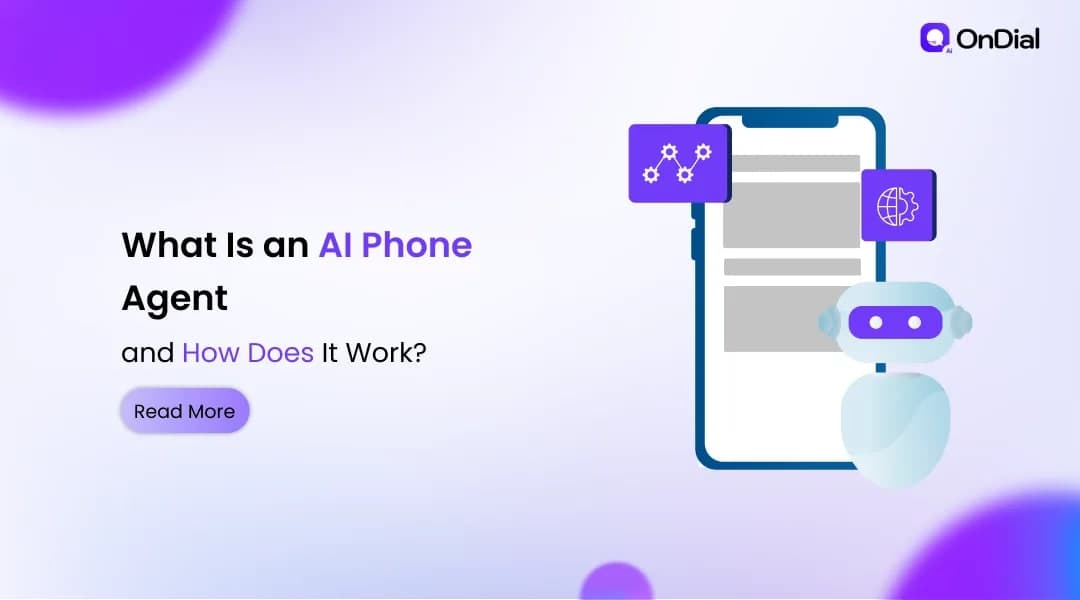
An AI phone agent is software that answers or places phone calls, understands spoken intent in natural language, and completes real tasks such as booking appointments, qualifying leads, or updating a CRM, without a human on the line. It listens, it reasons, it speaks, and it knows when to hand off. That is the whole idea in one sentence.
I run OnDial, an India-based voice AI company, and I have watched more of these systems succeed and fail than I care to count. What follows is the mechanism explained honestly: the four-stage pipeline every vendor uses, the orchestration layer almost nobody talks about, what it costs, and the specific question that separates a working deployment from an expensive experiment.
What Is an AI Phone Agent, Exactly?
Understanding the difference between an AI voice bot vs traditional IVR is where most evaluations should start, because the two get conflated constantly. One waits for you to press a number. The other has a conversation.
The Definition That Holds Up Under Pressure
An AI phone agent is an autonomous voice system that holds open-ended spoken conversations over the telephone network and takes action based on caller intent. The word doing the heavy lifting there is autonomous. It is not following a decision tree; it is interpreting what you meant and choosing a response.
That distinction matters commercially. A system that follows a script fails the moment a caller says something the script did not anticipate, which is roughly every fourth call. A system that interprets intent degrades gracefully instead of collapsing.
How an AI Phone Agent Differs From IVR
Here is the honest comparison, stripped of vendor language:
IVR: Routes callers through keypad menus. It does not understand language, only inputs. It is cheap, reliable, and universally disliked.
Chatbot: Handles text well. It cannot hear you, and voice is a fundamentally harder problem because there is no backspace and no thinking time.
Human receptionist: Handles nuance, empathy, and the unexpected. Also costs a salary, works fixed hours, and can take exactly one call at a time.
AI phone agent: Understands open speech, takes action, runs at any hour, and handles concurrent calls. It fails on emotional and genuinely complex conversations, which is why escalation design matters more than the voice.
Notice what is missing from that list: a claim that the AI phone agent wins on every axis. It does not. It wins on the specific band of calls that are high-volume and structurally repetitive, which for most businesses is a large majority of the queue.
How Does an AI Phone Agent Work?
If you want to understand how AI phone agents work, ignore the marketing and look at the pipeline. Underneath every platform on the market, the same four things happen in a loop, dozens of times per call.
Featured snippet answer: An AI phone agent works by chaining four technologies in real time. SIP connects the call to the phone network. Speech-to-text converts the caller's words into text. A large language model interprets intent and decides a response or action. Text-to-speech converts that response back into audio and plays it. The loop repeats every turn.
The Four Stages: SIP, STT, LLM, TTS
SIP (Session Initiation Protocol) handles the telephony itself: dialing, connecting, carrying audio both ways, and hanging up. Traditional phone audio runs at 8 kHz MuLAW, not the 16kHz most audio tools assume, which is a small detail with real latency consequences. Speech-to-text then transcribes the caller in real time, and this is where accent and language handling either works or embarrasses you.
The large language model reads the transcript, decides what the caller wants, and either answers or calls a tool: check the calendar, look up the order, write to HubSpot or Salesforce. Finally, text-to-speech turns the reply into audio and sends it back down the SIP leg. Four stages. One loop. Repeat until someone hangs up.
Why Streaming Changed the Whole Category
The early versions of this ran sequentially: wait for the caller to finish, transcribe fully, generate fully, synthesize fully, then speak. That architecture produces two to four seconds of dead air per turn, which is exactly why people used to say voice bots sounded robotic. They did not sound robotic. They sounded slow.
Modern systems stream. Speech-to-text emits partial transcripts roughly every 50 milliseconds, the LLM streams tokens as it generates them, and text-to-speech starts producing audio from the first complete sentence while the model is still writing the rest. Streaming cuts perceived latency by three to five times. It is the single architectural decision that moved this category from novelty to production.
The Part Nobody Explains: Timing, Not Technology
Here is the counter-intuitive part. In 2026, the pipeline is a commodity. Every serious platform uses the same components, often literally the same vendors, and the thing that gives an AI phone agent away is no longer the voice quality. It is the timing.
Voice AI Latency Is a Budget, Not a Delay
Voice AI latency is the total gap between the caller finishing their sentence and the agent starting its reply. Under 800 milliseconds feels natural. Past 1,500 milliseconds, it feels like a bad satellite call, and the caller starts talking over the agent out of pure instinct.
Think of that 800ms as a budget you spend across the whole chain. Speech-to-text takes 100 to 500ms depending on whether it streams. The model takes 200 to 2,000ms depending on size and prompt length. Text-to-speech takes another 200 to 800ms. Save 150ms on transcription, and you can afford a database lookup mid-sentence without the caller noticing. That is the actual engineering game.
Barge-In and the Art of Shutting Up
Then the caller does what humans always do: they interrupt. Maybe they meant Wednesday, not Tuesday. Maybe they are annoyed. Either way, the agent has to stop speaking instantly, discard the rest of its planned reply, and start listening again.
This is barge-in handling, and it is governed by Voice Activity Detection tuning and turn-detection models. A naive build keeps happily reading out its sentence while the caller talks over it, which is the single worst feeling on a phone call. In projects I have worked on at OnDial, barge-in tuning consumed more engineering hours than the entire language model integration. Nobody demos it. Everybody feels it.
Ask any vendor how they handle interruptions. Their answer tells you more than the demo does.
AI Voice Agent Use Cases That Survive Contact With Reality
The AI voice agent use case list is wider than most buyers expect, but the pattern is consistent: high volume, structurally repetitive, clearly scoped. Where those three conditions hold, it works. Where they do not, it struggles.
Inbound: Reception, Triage, and Tier-One Support
Inbound is the obvious starting point because the calls are already arriving and a meaningful share are already going unanswered. Tier-one support covers order status, business hours, balance checks, password resets: questions with a lookup and a factual answer. Appointment booking and rescheduling work well because the intent is narrow and the action is a calendar write.
The quiet benefit is data. Every call is transcribed, logged, and searchable, which means you finally know what your callers actually ask about. That is customer insight a human receptionist never generates automatically.
Outbound: Qualification, Reminders, and Follow-Up
Outbound covers lead qualification, appointment reminders, payment follow-ups, and reactivation campaigns. Speed-to-lead is the strongest case: an inbound form submission answered in ninety seconds converts dramatically better than one answered the next morning, and no human team can guarantee ninety seconds at 11 pm.
Outbound also carries the heaviest compliance weight. In India, the DPDP Act 2023 governs how you collect and process caller data, and TRAI regulations constrain unsolicited commercial communication. Consent, disclosure, and opt-out are not optional features. Treat any vendor who does not raise them unprompted as a liability.
How Much Does an AI Phone Agent Cost?
AI phone agent cost is where most evaluations go quietly wrong, because the sticker price and the invoice rarely match.
The Four Pricing Models You Will Encounter
Per-minute: The most common model, typically $0.05 to $1.00 per minute according to Aircall's 2026 pricing analysis. Infrastructure-layer platforms where you build your own stack start at $0.05 to $0.15. Managed platforms with CRM integrations included run $0.25 to $0.50.
Per-call: A flat rate regardless of length. Sensible when your call durations vary wildly.
Platform plus usage: A base monthly fee covering a minute allowance, with overage charges. Common for SMB-focused products.
Custom enterprise: Negotiated, usually bundled with implementation services.
The Costs That Hide Inside the Invoice
Most platforms bill by connected seconds, which means you are paying for the AI's thinking time. A slow pipeline with 2,000ms response gaps does not just sound bad; it inflates your bill across thousands of calls. Latency is a line item.
Watch for failed-call billing on outbound campaigns, where voicemail hits, and instant hangups still trigger a minimum charge. Watch for integration fees, additional language premiums, and one-time setup ranging from a few hundred dollars to five figures for custom implementations. Ask whether billing pauses during dead air. The answer is revealing.
Is an AI Phone Agent Actually Worth It?
Snippet answer: An AI phone agent is worth it when a meaningful share of your call volume is repetitive and clearly scoped. It pays back fastest on missed calls, after-hours coverage, and tier-one questions. It does not pay back on emotionally complex, regulated, or genuinely unpredictable conversations.
Where It Works and Where It Fails
Gartner projected conversational AI would cut global contact-center labor costs by $80 billion during 2026, a number closely tied to the ROI of replacing IVR with AI voice agents, and the procurement pressure it created is real. But the honest picture is narrower than the headline. Financial services and telecom lead adoption because password resets and balance queries map cleanly onto scoped voice intents.
Healthcare and travel lag, and for good reason: emotional handling, regulated topics, and edge cases remain genuinely hard for voice models. If your calls are mostly people in distress or situations with legal exposure, an AI phone agent belongs at the front of the queue for triage, not at the resolution point. Anyone telling you otherwise is selling.
The Pilot-to-Production Gap
This is the statistic that should shape your entire plan. Gartner CX research found that 64% of enterprise CX teams ran an agentic AI pilot in 2026, but only 27% had at least one channel in full production. More than half of everyone who tried this never shipped it.
The gap is almost never the model. It is escalation design, integration depth, and the unglamorous orchestration work that a demo never surfaces. At OnDial, we push clients to scope narrow and ship, rather than scope broad and pilot forever, precisely because the second path is where budgets go to die.
Conclusion
An AI phone agent is not magic, and it is not a gimmick: it is four technologies chained in a loop, and the quality lives entirely in the orchestration between them. Three things are worth carrying away. The pipeline is commodity, so timing and escalation design are your real differentiators. Cost is driven by latency and hidden billing rules, not the headline per-minute rate. And more than half of pilots never reach production because teams scope too broadly.
You now know more about this technology than most people sitting across from a vendor. Use it. Ask about end-to-end latency, barge-in handling, and what happens on escalation, and the sales conversation changes shape immediately; the same questions are worth checking against OnDial's features page before you commit to a vendor.
If you want a voice agent scoped honestly against your actual call mix, OnDial builds tailored voice AI for exactly this: narrow first, production fast, transparent about what it will not handle. Bring us your call transcripts, and we will tell you which calls are worth automating and which are not.