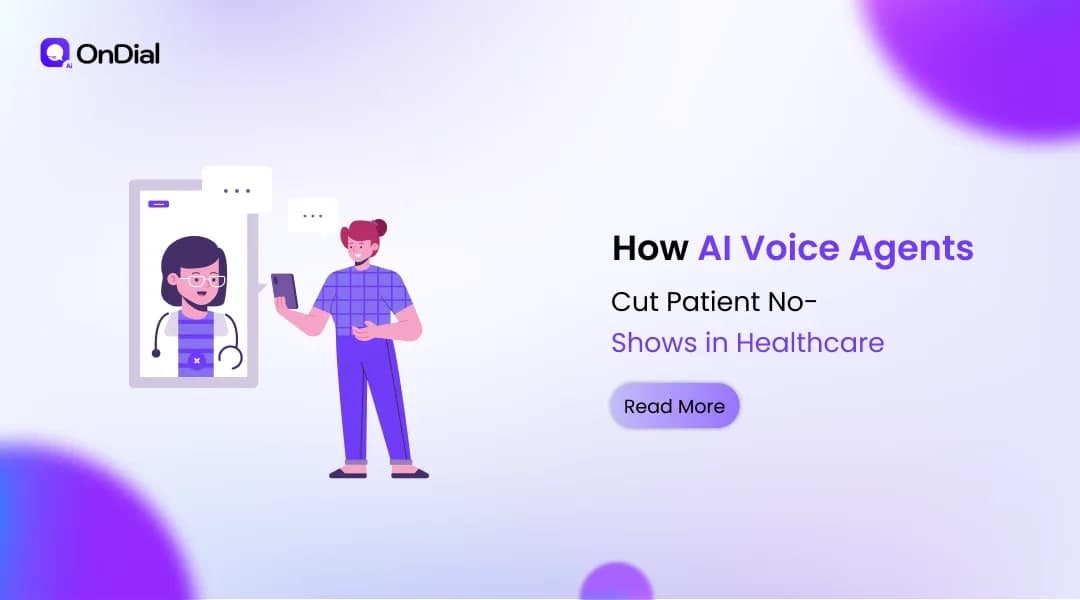
Patient no-shows are rarely caused by one simple problem. A patient may forget the appointment, discover a scheduling conflict, struggle to reach the clinic, misunderstand preparation instructions, or decide that rescheduling is too inconvenient.
Traditional reminder systems can notify patients, but notification alone does not always solve the underlying problem. An SMS can tell someone that an appointment is tomorrow. A conversational AI voice agent can ask whether they can attend, understand when they cannot, offer another available time, and complete the next step during the same conversation.
That difference makes voice AI particularly relevant for hospitals, clinics, diagnostic centres, dental practices, specialty providers, and other appointment-based healthcare organizations.
Why Patient No-Shows Are an Operational Problem
A missed appointment affects more than one calendar slot. The provider loses time that could have been used for another patient, while administrative teams still spend resources preparing for the visit.
The impact can become more significant when cancellations happen close to the appointment time. A slot that becomes available shortly before the visit may be difficult to refill unless the practice has an efficient way to contact patients on a waiting list.
No-shows can also create a frustrating cycle for patients. Someone who cannot attend may want to reschedule but may not want to wait on hold, navigate a phone menu, or wait until the next business day to speak with staff.
The most useful no-show strategy therefore needs to address two problems at once:
Remind patients about upcoming appointments.
Make it easy for patients to take action when they cannot attend.
AI voice agents can support both parts of that workflow.
Why Traditional Appointment Reminders Have Limits
Healthcare organizations commonly use SMS, email, patient portals, automated calls, and manual phone calls. Each channel has a useful role, but each also has limitations.
SMS and email are efficient for delivering appointment details. However, the patient may still need to contact the clinic when they want to change the appointment.
Manual calls provide a more personal interaction, but staff capacity is limited. Front desk teams also have to manage check-ins, inbound calls, billing questions, insurance requests, and other administrative work.
Traditional robocalls sit between these approaches. They can make large numbers of calls, but a prerecorded message cannot understand why a patient cannot attend or help them choose another appointment.
The limitation is not simply the communication channel. It is the lack of an action-oriented conversation.
How AI Voice Agents Reduce Patient No-Shows
An AI voice agent changes the reminder from a one-way notification into a two-way workflow.
The agent can contact a patient before the scheduled appointment, confirm the relevant details, and ask whether the patient still plans to attend. If the answer is yes, the confirmation can be recorded.
If the patient cannot attend, the conversation can move directly into rescheduling. The agent can check available appointment slots through a connected scheduling system and offer appropriate alternatives.
This approach removes several common points of friction.
Confirmation Happens Through Conversation
Instead of requiring patients to read a message and decide what to do next, the AI agent can ask a direct question and process the response.
For example, the conversation can establish whether the patient can attend, whether they need to change the appointment, or whether they want to cancel.
This creates a clearer operational outcome from every contact attempt.
Rescheduling Can Happen During the Same Call
Rescheduling is one of the most important parts of no-show prevention.
A patient who knows they cannot attend has already provided valuable information. If the process immediately offers an alternative appointment, the practice has a better opportunity to retain the visit rather than lose it completely.
OnDial's appointment scheduling workflow can check live availability, offer suitable slots, confirm the selected time, and write the appointment into the connected system.
For healthcare organizations, this can connect reminder calls with the wider scheduling process instead of treating reminders as a separate communication task.
Cancellations Can Trigger Recovery Workflows
Not every cancellation can be converted into a rescheduled appointment.
However, cancellation does not necessarily have to mean an empty slot.
A healthcare workflow can capture the cancellation, release the appointment, and trigger a waitlist or follow-up process where the underlying scheduling system supports it.
This creates a broader objective: not simply reducing no-shows, but improving appointment utilization.
The Patient No-Show Workflow With Voice AI
A practical implementation can be structured around several stages.
Step 1: Identify Upcoming Appointments
The system receives upcoming appointment information from the clinic's scheduling or practice management system.
The workflow should include only the information necessary for the reminder and should follow the organization's privacy, consent, and data-handling policies.
Step 2: Contact the Patient
The AI voice agent calls the patient according to the configured reminder schedule.
Many organizations test outreach around the two to three days before an appointment, with additional contact attempts based on whether the patient answered or confirmed.
The exact timing should be measured against the organization's patient population rather than treated as a universal rule.
Step 3: Confirm Attendance
The agent confirms the appointment details and asks whether the patient expects to attend.
A successful confirmation can be recorded automatically so staff do not need to repeat the same manual call.
Step 4: Handle Rescheduling
If the patient cannot attend, the agent checks available appointment options.
The patient can select an alternative time during the conversation when the integration supports real-time booking.
Step 5: Escalate When Necessary
Not every healthcare conversation should be automated.
Clinical questions, urgent symptoms, complex insurance issues, complaints, distressed patients, or requests that fall outside the configured workflow should be routed to an appropriate human team member.
A good healthcare AI system is therefore not designed to replace every conversation. It is designed to automate predictable administrative interactions while preserving a clear path to human support.
Why Integration Matters More Than the Voice
A natural-sounding voice can improve the patient experience, but voice quality alone does not reduce operational friction.
The real value comes from what happens after the patient responds.
If the AI understands that a patient wants to reschedule but cannot actually access appointment availability, the patient still has to call the clinic.
A useful implementation connects the voice agent to the systems responsible for scheduling and patient workflows. OnDial's appointment scheduling service supports calendar connectivity, booking, rescheduling, cancellation workflows, CRM updates, confirmations, and human handoff.
This is why healthcare teams should evaluate AI voice platforms based on completed workflows rather than simply asking whether the voice sounds human.
Multilingual Patient Communication in India
Language can influence whether a reminder is understood, especially in healthcare environments serving multilingual populations.
Indian hospitals and clinics may communicate with patients who prefer Hindi, Gujarati, Marathi, Tamil, Telugu, Bengali, Kannada, Malayalam, Punjabi, English, or other languages.
A written reminder assumes the patient will read and understand the message. A voice interaction creates an opportunity to communicate naturally in the patient's preferred language.
OnDial states that its platform supports more than 100 languages, including multiple Indian languages and voice variations.
For healthcare organizations operating across different regions, multilingual calling can therefore become part of the patient communication strategy rather than an additional manual staffing requirement.
AI Voice Agents Can Support More Than Reminders
Reducing no-shows is one use case within a broader patient communication workflow.
Healthcare organizations can also use voice AI for appointment booking, rescheduling, cancellations, follow-ups, routine inquiries, prescription-related routing, and other administrative interactions that can be clearly scoped.
For example, a patient who calls after business hours to move an appointment should not necessarily have to wait until the next morning.
An AI inbound healthcare agent can answer the call, understand the patient's intent, check available appointments, and route requests that require human attention. OnDial's healthcare offering is designed around these inbound and outbound workflows.
For organizations evaluating broader healthcare automation, AI voice agents for healthcare and medical providers provides an overview of how these workflows can be applied across patient communication.
How to Measure Whether Voice AI Is Working
Reducing no-shows should be measured as an operational outcome, not simply by counting completed calls.
Healthcare teams should establish a baseline before deployment and compare results after implementation.
Track No-Show Rate
Measure the percentage of appointments that become no-shows before and after the new workflow.
The comparison should ideally be segmented by appointment type, department, provider, location, and patient group where appropriate.
Track Confirmation Rate
A confirmation tells the clinic whether the patient was successfully reached and whether they intend to attend.
This metric helps identify whether the problem is primarily contactability or whether patients are confirming and still failing to appear.
Track Rescheduling Rate
A patient who cannot attend but successfully reschedules has a different outcome from a patient who simply cancels.
Tracking this metric shows whether the AI workflow is actually recovering appointments.
Track Waitlist Recovery
When a cancellation occurs, measure how often the released slot is successfully reassigned.
This connects patient communication with actual schedule utilization.
Track Human Escalations
A high escalation rate may indicate that the workflow is too broad, the knowledge base is incomplete, or the AI is being asked to handle tasks that require human judgment.
The objective is not to eliminate human involvement. It is to make human involvement more focused and useful.
Privacy, Compliance, and Human Oversight
Healthcare organizations should treat AI voice deployments as operational systems that handle sensitive information.
The exact compliance requirements depend on the patient's location, the healthcare organization, the information being processed, and the systems connected to the AI agent.
Organizations operating in the United States may need to consider HIPAA requirements and appropriate contractual arrangements. Organizations in India need to consider applicable privacy, consent, telecommunications, and data protection obligations.
The AI should also follow strict boundaries around clinical conversations.
An appointment reminder agent does not need to diagnose symptoms. If a patient describes an urgent medical problem, the workflow should recognize that the conversation has moved outside the agent's intended scope and route it appropriately.
This combination of automation and human oversight is important for building patient trust.
How to Implement AI Voice Reminders Without Disrupting the Clinic
Healthcare organizations do not need to automate every patient interaction at once.
A smaller pilot can begin with one appointment type, department, or location.
Start With a Narrow Workflow
Appointment confirmation and rescheduling are usually easier to define than complex clinical communication.
Create clear rules for what the agent can do, what information it can access, and when it must transfer the call.
Connect the Scheduling System
The agent should have access to the appointment information required for the workflow.
Where rescheduling is enabled, real-time availability and booking should be tested carefully before expanding the deployment.
Define Human Escalation Rules
Create explicit escalation conditions.
Examples include clinical questions, urgent symptoms, billing disputes, complaints, requests for a specific staff member, and situations where the AI cannot confidently understand the patient's request.
Test Different Patient Scenarios
Testing should include successful confirmations, cancellations, rescheduling, unanswered calls, voicemail, wrong numbers, language changes, interruptions, background noise, and requests outside the agent's scope.
The objective is to test the complete workflow, not just whether the AI can hold a conversation.
Measure Before Scaling
Compare the pilot against the original baseline.
If the results show fewer no-shows, more successful rescheduling, better staff utilization, or improved patient access, the organization has evidence for expanding the workflow.
AI Voice Agents Should Complement Healthcare Staff
The strongest healthcare implementations do not position AI as a replacement for every human interaction.
Administrative conversations are often repetitive and predictable. Clinical conversations are different.
An AI agent can confirm an appointment, check availability, answer approved administrative questions, and route a patient to the right team. A nurse, receptionist, physician, or specialist can then focus on conversations that require judgment, empathy, clinical knowledge, or decision-making.
That division of work can make automation more practical and safer.
For healthcare leaders evaluating the technology, the question should therefore be less about whether AI can replace staff and more about which parts of the patient communication workflow are structured enough to automate.
Conclusion
Patient no-shows are not simply a reminder problem. They are often a workflow problem caused by forgotten appointments, scheduling conflicts, limited access to staff, language barriers, and friction around rescheduling.
AI voice agents can address these issues by turning a reminder into a conversation. The patient can confirm attendance, explain that they cannot attend, receive an alternative option, or reach a human when the request requires additional support.
The most effective implementation is not the one that automates the largest number of calls. It is the one that connects the right conversations to the right actions while keeping human oversight where it matters.
For healthcare organizations considering voice AI, the practical starting point is simple: establish a baseline, automate a clearly defined appointment workflow, integrate it with scheduling, measure the outcomes, and expand only when the results justify it.
For additional context on automated patient reminders and the broader role of AI in appointment communication, AI appointment reminders for healthcare covers the reminder workflow, multilingual engagement, after-hours access, and human escalation considerations.
If you are evaluating voice AI for patient communication, OnDial provides AI voice agents for healthcare organizations that need automated calling, appointment workflows, multilingual communication, and human handoff.