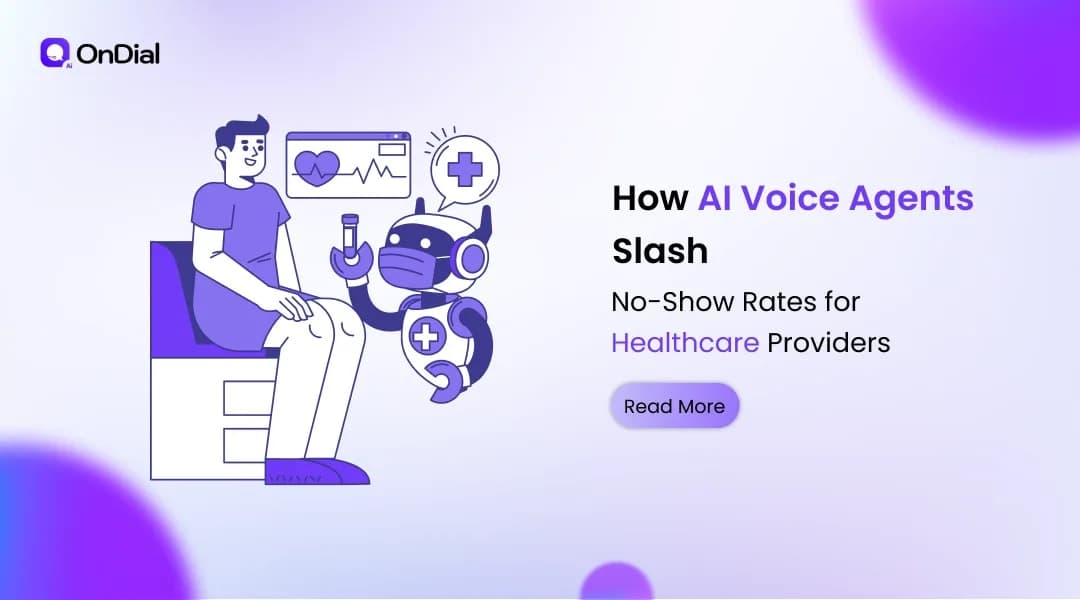
Discover how AI voice agents reduce patient no-shows by up to 45%, recover lost revenue, and automate appointment reminders for healthcare providers.
Every morning, medical practices across the world open their doors expecting a full schedule. By noon, the reality looks different. Chairs sit empty. Physicians wait between patients. Staff scramble to fill gaps that could have been prevented. Patient no-shows are not a minor scheduling inconvenience. They represent one of the most persistent and financially damaging operational failures in modern healthcare.
The scale of the problem is staggering. Research published in BMC Health Services Research estimates that the average no-show rate across outpatient clinics falls between 23% and 34%, depending on the speciality and patient population. For a mid-sized practice generating $1.5 million in annual revenue, a 25% no-show rate can translate to $375,000 in lost billable time every single year, including teams adopting AI voice agents for healthcare and medical teams. That figure does not account for the downstream costs of staff idle time, rescheduling overhead, disrupted physician workflows, and the compounding effect of delayed patient care.
Traditional approaches to managing no-shows have remained largely unchanged for decades. Front desk staff make manual reminder calls, often reaching voicemail or getting no answer at all. SMS reminders help but lack the interactive quality needed to reschedule on the spot. Overbooking creates its own chaos when too many patients actually arrive. None of these methods addresses the root cause, which is that patients need timely, personalised, and conversational engagement before their appointment, and most healthcare practices simply do not have the human bandwidth to deliver it at scale.
This is where AI voice agents are fundamentally changing the equation. Learn more in AI Voice Agents Handle Hindi-English Code Switching. By deploying autonomous voice agents that can call every patient, confirm or reschedule appointments, answer questions about preparation requirements, and handle cancellations in real time, healthcare providers are cutting no-show rates by 35% to 45% while simultaneously freeing their administrative staff for higher value work. This blog breaks down exactly how that works, what the real financial impact looks like, why traditional reminder systems fall short, and what healthcare organisations should look for when evaluating AI voice agent platforms like OnDial for their practice.
Why Traditional Appointment Reminder Systems Fail Healthcare Practices
Understanding why no-shows persist despite decades of reminder technology requires looking at the problem from the patient's perspective. The typical patient receives a text message or an automated robocall that delivers a one-way notification. There is no opportunity to ask a question, negotiate a different time, or explain a concern. The interaction is transactional rather than conversational, and that distinction matters enormously in healthcare, where anxiety, confusion about preparation instructions, and scheduling conflicts are among the top reasons patients miss appointments.
The Limitations of SMS and Email Reminders
Text and email reminders have become standard practice, and they do produce measurable improvements over no reminders at all. Studies suggest that SMS reminders reduce no-show rates by approximately 10% to 15%. However, they hit a ceiling quickly. Patients who intend to cancel but do not know how to easily reschedule will often simply ignore the message. Patients who have questions about fasting requirements, medication instructions, or what to bring to their visit cannot get answers from a text. Elderly patients or those with limited digital literacy may not engage with SMS reminders at all. In multilingual communities, a reminder sent in only one language may fail to reach the patients who need it most.
The fundamental problem is that SMS is a notification channel, not a communication channel. It tells the patient something but does not listen, adapt, or help solve the patient's actual problem, which is often not that they forgot the appointment, but that they have an unresolved barrier to attending it.
The Cost of Manual Reminder Calls
Many practices still rely on staff making manual phone calls to confirm appointments. This approach is more effective than SMS alone because it allows for real conversation, but it is extraordinarily expensive in terms of labour hours. A front desk coordinator making reminder calls can typically complete between 8 and 12 meaningful patient calls per hour, accounting for hold times, voicemail, callbacks, and actual conversation. For a practice with 80 appointments per day, that represents 7 to 10 hours of dedicated phone time, effectively requiring a full-time employee whose sole job is making reminder calls.
Even with that investment, manual calling rarely achieves full coverage. Staff call during business hours, which means patients who work during the day miss the call and return it after the office closes. Callbacks create phone tag cycles that consume additional time. Bilingual or multilingual patients may need staff who speak their language, which is not always available. The result is that even practices investing heavily in manual calling still see no-show rates between 15% and 20%, while bearing the full cost of dedicated staffing for that function.
Overbooking Creates New Problems
Some practices adopt overbooking strategies borrowed from the airline industry, intentionally scheduling more patients than available slots to compensate for expected no-shows. While this can improve revenue capture on average, it introduces significant operational risk. On days when more patients show up than expected, wait times spike, patient satisfaction drops, physicians feel rushed, and the quality of care suffers. Overbooking also creates an adversarial dynamic where the practice is essentially planning for patient failure rather than working to prevent it.
How AI Voice Agents Transform Patient Appointment Management
AI voice agents represent a fundamentally different approach to the no-show problem because they combine the scalability of automated systems with the conversational capability of human callers. A well-deployed AI voice agent does not simply remind patients about appointments. It engages them in a natural, two-way conversation that identifies barriers, offers solutions, and completes the necessary action, whether that is confirming attendance, rescheduling to a better time, or providing pre-visit instructions.
Proactive Outbound Calling at Scale
The most immediate advantage of AI voice agents in healthcare is their ability to call every single patient, every single time, without any human labour. A platform like OnDial can initiate thousands of simultaneous outbound calls, reaching patients 48 hours before their appointment, again 24 hours before, and once more on the morning of the visit if confirmation has not been received. This multi-touch cadence, which would require an army of staff to execute manually, runs automatically and adapts based on patient response patterns.
OnDial's sub-500 millisecond response latency means that patients experience a natural, fluid conversation rather than the awkward pauses that characterise older interactive voice response systems. The AI agent speaks, listens, processes the patient's response, and replies in under half a second, creating an interaction that feels conversational rather than robotic.
Real-Time Rescheduling and Cancellation Handling
When a patient indicates they cannot make their appointment, the AI voice agent does not simply log a cancellation. It immediately offers alternative time slots, checks availability in real time through calendar integration, and books a new appointment during the same call. This single capability alone can recover 20% to 30% of appointments that would otherwise be lost entirely. The patient who was going to no-show becomes a patient who is rescheduled, and the original slot opens up for another patient from the waitlist.
This is where the difference between a notification system and a conversational AI agent becomes most apparent. An SMS reminder that receives a "can't make it" reply leaves the practice scrambling to follow up. An AI voice agent that receives the same information resolves it on the spot, within the same 90-second call, with no human intervention required.
Multilingual Patient Engagement
Healthcare providers serving diverse communities face a unique challenge. Patients who are not fully comfortable in English are statistically more likely to no-show, partly because communication barriers make it harder for them to engage with reminder systems, ask questions, or navigate rescheduling. OnDial addresses this directly with support for over 100 languages, including 9 Indian languages with more than 80 Indian voice variations. For hospitals and clinics in multilingual regions, this means every patient receives their reminder call in their preferred language, spoken with natural pronunciation and culturally appropriate phrasing.
A cardiology clinic in Mumbai, for example, might serve patients who speak Hindi, Marathi, Gujarati, and English across a single day's schedule. OnDial's AI voice agents can handle all four languages without any manual switching, automatically detecting or being configured for each patient's language preference. This capability is not a luxury feature. In multilingual markets, it is the difference between a reminder system that reaches 60% of patients and one that reaches 95%.In multilingual markets, it is the difference between a reminder system that reaches 60% of patients and one that reaches 95% through a multilingual AI voice agent.
The Quantified Business Impact of Reducing No-Shows with AI
Healthcare decision-makers evaluating AI voice agents need concrete numbers, not vague promises of improvement. The financial case for AI voice agent deployment in healthcare is built on several measurable outcomes that compound across a practice's operations.
Direct Revenue Recovery
The most straightforward calculation involves the revenue recovered from reduced no-shows. If a practice currently loses $375,000 annually to a 25% no-show rate, and an AI voice agent reduces that rate to 14% (a conservative 44% reduction consistent with published case studies on AI-driven appointment reminders), the practice recovers approximately $165,000 in previously lost revenue per year. For multi-location health systems, this figure scales linearly. A network of 10 clinics with similar profiles would recover $1.65 million annually.
Staff Time Reallocation
Beyond direct revenue, the labour hours freed by automating reminder calls create significant operational value. If a practice eliminates the need for a full-time reminder coordinator (average annual cost of $38,000 to $45,000 including benefits), that savings flows directly to the bottom line or can be redirected to patient-facing roles that improve care quality. In larger practices where multiple staff members share reminder call duties, the time savings are distributed across the team, increasing overall productivity rather than eliminating positions.
Downstream Operational Efficiency
Reduced no-shows also improve downstream metrics that are harder to quantify but operationally significant. Physician utilisation rates increase when fewer slots go unused. Patient wait times decrease when schedules run more predictably. Staff morale improves when the frustrating cycle of chasing unresponsive patients is removed. Patient outcomes improve when appointments are kept and care plans proceed without interruption. While these benefits are harder to assign a dollar value, they contribute meaningfully to the overall case for deployment.
What to Look for When Choosing an AI Voice Agent for Healthcare
Not all AI voice platforms are built for healthcare. The regulatory environment, patient sensitivity, and operational complexity of medical scheduling create specific requirements that generic AI calling tools may not meet. Healthcare organisations evaluating AI voice agent platforms should assess candidates against several critical criteria.
Compliance and Data Security
Healthcare voice AI must comply with applicable data protection regulations. Patient health information discussed during calls, appointment details, and contact records all fall under regulatory frameworks like HIPAA in the United States, GDPR in Europe, and various national data protection laws. OnDial is built with GDPR and CCPA compliance as a foundational requirement, ensuring that patient data is handled, stored, and processed according to the strictest privacy standards. Any platform that cannot demonstrate clear compliance documentation should be eliminated from consideration immediately.
Conversational Quality and Latency
Patients interacting with a voice agent need to feel that they are in a real conversation. Systems with noticeable latency, robotic phrasing, or inability to handle interruptions and overlapping speech will frustrate patients and damage the practice's reputation. The threshold for acceptable response latency in healthcare voice interactions is under 700 milliseconds. OnDial's sub-500 millisecond latency sits well within this range, delivering responses fast enough that patients do not perceive any unnatural delay.
Integration with Practice Management Systems
An AI voice agent that cannot read from and write to the practice's existing scheduling system creates more work rather than less. The platform must integrate with electronic health record systems, practice management software, and calendar tools so that appointment confirmations, cancellations, and rescheduling actions are reflected in the system of record without manual data entry. OnDial offers both API integration for technically sophisticated health systems and no-code deployment options for smaller practices that need to get started without a development team.
Language and Demographic Coverage
Healthcare providers must evaluate whether a voice AI platform can serve their full patient population. A platform that only supports English leaves significant gaps in multilingual communities. Practices should look for breadth of language support, quality of accent and dialect handling, and the ability to configure language preferences at the individual patient level rather than at the practice level.
How AI Voice Agents Work in a Healthcare Appointment Workflow
Understanding the practical mechanics of AI voice agent deployment helps healthcare administrators evaluate whether the technology fits their operational reality. The workflow is less complex than many administrators expect, which is part of what makes it viable even for smaller practices.
Pre-Appointment Outreach Sequence
The typical deployment begins with configuring an outreach cadence. Most healthcare organisations find that a three-touch sequence produces optimal results. The first call occurs 48 hours before the appointment, providing enough lead time for the patient to reschedule if needed. The second call occurs 24 hours before, targeting patients who did not answer or confirm during the first call. A final call on the morning of the appointment catches last-minute changes. Each call in the sequence adapts based on previous interactions. If a patient confirmed during the first call, they do not receive the second or third call. If a patient rescheduled, the new appointment enters its own confirmation cadence with OnDial.
The Conversation Flow
During each call, the AI voice agent follows a conversation framework designed for healthcare interactions. The agent identifies itself, states the practice name and appointment details, and asks for confirmation. If the patient confirms, the agent provides any pre-visit instructions such as fasting requirements, documents to bring, or arrival time recommendations. If the patient needs to reschedule, the agent accesses available slots and books a new time. If the patient has questions, the agent handles common inquiries using a knowledge base configured by the practice. Complex clinical questions are flagged for a human callback.
OnDial's call sentiment analysis tracks the emotional tone of each interaction, allowing practice managers to identify patients who may be anxious about upcoming procedures and could benefit from a pre-visit call from a nurse or care coordinator. This layer of intelligence transforms the reminder call from a purely administrative function into a patient engagement tool.
Post-Call Actions and Analytics
After each call, the AI agent logs the outcome in the practice management system and triggers any necessary follow-up actions. Confirmed appointments are marked accordingly. Rescheduled appointments are updated in real time. Cancellations trigger waitlist notifications so that open slots can be filled. OnDial's smart analytics dashboard gives practice managers a real-time view of confirmation rates, no-show trends, peak cancellation times, common patient concerns, and language distribution across their patient population. These insights allow practices to continuously refine their outreach strategy and identify systemic issues contributing to no-shows.
Industry Applications Beyond Basic Appointment Reminders
While reducing no-shows is the most immediate use case, healthcare organisations that deploy AI voice agents often discover broader applications that deliver additional value across their operations.
Post-Discharge Follow-Up
Hospitals and outpatient surgery centres use AI voice agents to conduct post-discharge follow-up calls, checking in with patients 24 to 48 hours after they leave the facility. These calls assess pain levels, medication compliance, and whether the patient has questions or concerns that might otherwise lead to an unnecessary emergency room visit. Automated post-discharge calling at scale helps health systems reduce readmission rates, which directly impacts both patient outcomes and financial performance under value-based care models.
Prescription Refill and Chronic Care Reminders
Patients managing chronic conditions like diabetes, hypertension, or asthma benefit from regular outreach reminding them to refill prescriptions, schedule follow-up labs, or attend wellness visits. AI voice agents can manage these ongoing touchpoints without adding any incremental workload to clinical staff. The conversational nature of the call allows patients to ask questions or request prescription renewals during the same interaction.
Patient Satisfaction Surveys
Collecting post-visit feedback by phone produces significantly higher response rates than email surveys, but manual surveying is cost prohibitive at scale. AI voice agents can call patients after their visit, ask a structured set of satisfaction questions, and log responses for analysis. Because the call is conversational, patients often provide more detailed and candid feedback than they would in a written survey, giving practices richer insight into the patient experience.
Insurance Verification and Pre-Authorization
AI voice agents can conduct pre-appointment calls that verify insurance information, collect copay details, and confirm that any required pre-authorizations are in place. Handling these administrative tasks before the patient arrives reduces check-in time, eliminates day-of surprises that can lead to cancellations, and ensures the practice captures all billable revenue. OnDial's 24/7 call handling capability means these verification calls can happen outside of business hours, reaching patients who work during the day and are only available in the evening.
Making the Shift from Reactive Scheduling to Proactive Patient Engagement
The patient no-show problem in healthcare is not fundamentally about forgetful patients. It is about a communication gap between healthcare providers and the people they serve. Patients miss appointments because they have unresolved questions, scheduling conflicts they did not know how to fix, anxiety about procedures, or simply because no one engaged them in a way that made confirming easy. Traditional reminder systems treat the symptom by sending notifications. AI voice agents treat the cause by having actual conversations.
Three points stand out from the evidence and operational reality discussed in this blog. First, the financial cost of no-shows is large enough to justify significant investment in solving the problem, with mid-sized practices losing hundreds of thousands of dollars annually. Second, AI voice agents outperform every traditional reminder method because they combine the scalability of automation with the engagement quality of human conversation. Third, multilingual capability is not optional for healthcare providers serving diverse populations, and the gap between a monolingual reminder system and one that speaks a patient's own language is the gap between mediocre and transformative results.
OnDial delivers exactly this combination of capabilities for healthcare organisations ready to solve the no-show problem permanently. With sub-500 millisecond conversational latency, support for over 100 languages, seamless calendar integration, real-time rescheduling, call sentiment tracking, and both API and no-code deployment paths, OnDial gives healthcare providers a production-grade AI voice agent platform that works from day one. If your practice or health system is ready to recover lost revenue, reduce administrative burden, and give every patient the engagement they deserve, schedule a demo with OnDial today and see the impact within your first month.