According to IRDAI data, nearly 25 to 30 percent of life insurance policies in India lapse within the first five years. That is not a rounding error. That is crores of rupees in premium walking out the door every quarter, mostly because a renewal reminder went unanswered or arrived as a SMS nobody read.
If you run retention at an insurer or broking firm, you already feel this. Insurance firms now automate renewal calls with AI agents to close the gap: software voice agents that phone every policyholder before the due date, explain the grace period in their own language, take the payment intent, and route anything complex to a licensed human. The reason is simple. You have more renewals due each month than your team can call, so without help the calls go out late, or not at all, and the book quietly leaks.
This guide breaks down how that actually works, what it costs in Indian terms, where the regulatory lines sit, and where AI should hand the call back to a person.
Why Renewal Calls Break Down at Scale
Renewal is not a marketing problem. It is a coverage and timing problem, and it fails for boringly structural reasons.
The manual outreach math never adds up
Picture a mid-market life insurer with 30 lakh in-force policies. That book throws off roughly 2.5 lakh renewals every month. Even a large tele-calling floor cannot dial that volume three times each, on the right days, in ten languages, without something slipping.
So teams triage. They call the high-value policies and let the rest ride on automated SMS. But persistency on mid-market books typically sits at only 78 to 82 percent, so roughly one in five policyholders drifts toward lapse while your callers are busy elsewhere. Adding headcount only moves the ceiling, it does not remove it.
What policyholders actually experience
Here is the part most decks skip. The policyholder is not ignoring you out of disloyalty. They forgot the date, the SMS felt like spam, and when they did pick up, a rushed script missed their one real question. Consider the call from their side:
They do not remember the policy number, so a rushed agent makes them feel tested rather than helped.
They want to know why the premium changed, and a scripted caller often cannot explain it clearly.
They speak Hindi or Tamil or Gujarati at home, but the call comes in stiff English.
Fix those frictions and a large share of "lapsed" policies were never really lost. They were just never reached well.
How AI Agents Automate Insurance Renewal Calls
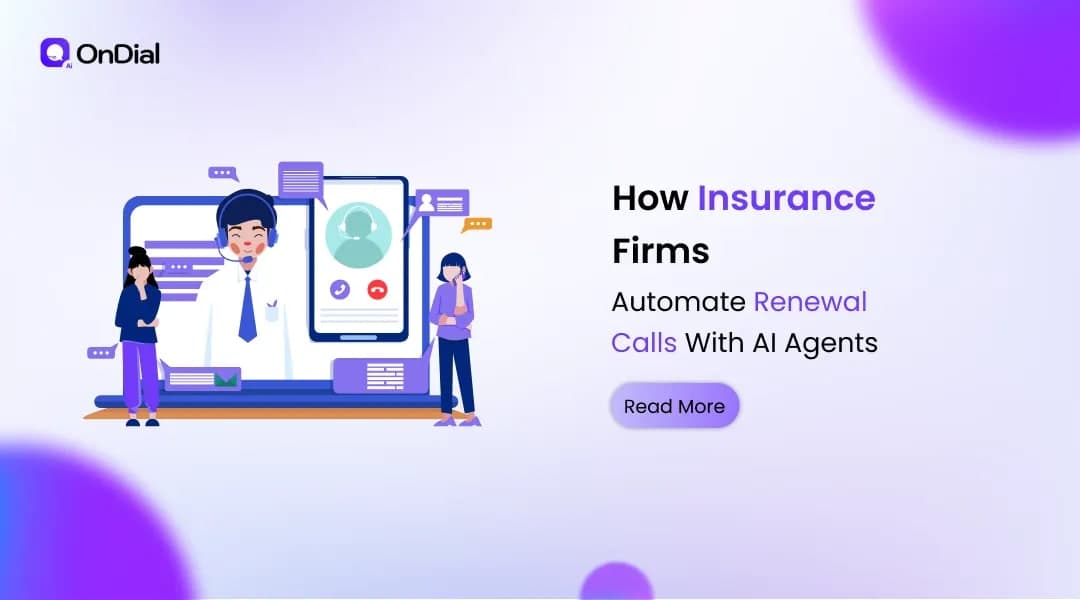
Let me define the core idea plainly. An AI renewal agent is a voice system that calls policyholders on a schedule, holds a natural two-way conversation, and completes or routes the renewal without a human dialing.
Featured answer: AI agents automate insurance renewal calls by phoning each policyholder on a timed cascade before the due date, confirming intent to renew in the customer's own language, explaining the grace period and premium, sending a secure payment link, and routing complex or advice-heavy questions to a licensed human agent with full call context.
The cascading reminder sequence
The single biggest lever is consistency, not cleverness. In renewal campaigns we have built at OnDial, the agent runs a timed cascade, typically calling at 45 days, 15 days, and 3 days before the due date, with each touch escalating gently in urgency. Each call does a specific job rather than repeating the same message:
Day 45: a soft heads-up that confirms the policy details and the upcoming amount.
Day 15: the real reminder, with payment options and grace-period explanation.
Day 3: a final, urgent nudge with a one-tap payment link sent during the call.
This catches the policyholder before lapse, not after, and it does it for the whole book rather than only the accounts a human had time to reach. In one OnDial renewal pilot, moving from a single SMS reminder to this three-call voice cascade in the policyholder's own language measurably lifted on-time payments, largely because the Day 3 link arrived while the person was still on the call.### What the agent does on the call
The conversation follows the predictable pattern every renewal shares: identify the policyholder, confirm intent, surface coverage changes, and close or route. Because that pattern is stable, voice AI handles it reliably across thousands of simultaneous calls.
A well-built renewal agent verifies identity, states why it is calling, answers common questions about premium and grace period, and captures a structured outcome that writes straight back into your CRM or AMS. (The write-back matters more than the call itself, because a renewal you cannot see in your system is a renewal you cannot manage.) When the policyholder asks something that crosses into advice, the agent stops and hands off.
Voice AI for Insurance Renewals: The India Reality

Most coverage of this topic is written for US agencies. India is a different operating environment, and that difference is exactly where the gains hide.
Multilingual calling and Hinglish
A renewal reminder in the wrong language is a missed renewal. Voice AI for insurance renewals in India means handling Hindi, English, Hinglish, and regional languages like Tamil, Telugu, Marathi, Bengali, and Gujarati on the same campaign, switching to whatever the policyholder is comfortable with.
This is not a vanity feature. Field reports from Indian deployments show regional-language renewal calls outperforming SMS by a wide margin, with one insurer citing a 25 percent drop in lapse rate after moving from text to language-matched voice. People act on a call in their mother tongue. They scroll past a text.
The INR unit economics
Here is the counter-intuitive part: the cheaper channel is the more human one. AI renewal calls in India often run at a few rupees per minute, which changes the entire retention equation. Run the numbers on that 30 lakh policy book again:
2.5 lakh renewals a month become callable three times each without new hires.
A persistency lift of 8 to 15 points is reported on books moved to timed voice cascades.
On a 5,000 crore in-force book, that lift means roughly 50 to 90 crore in retained premium.
Independent research from Lorikeet pegs the cost per retained policy under structured AI outreach at a fraction of traditional call-back, mail, and discount campaigns. The premium you keep dwarfs the cost of the calls.
Staying Compliant: IRDAI, TRAI DLT, and the DPDP Act
Skip this section and nothing else matters, because a non-compliant campaign is a liability, not a saving. India governs insurance calling through four overlapping layers, and a renewal agent has to respect all of them.
Disclosure and consent on every call
Compliance here is not a wrapper you add later. It has to live inside the conversation script.
The non-negotiables on an Indian renewal call include:
Identity and capacity disclosure in the opening seconds: who is calling, on behalf of which insurer, and in what capacity, as IRDAI fair-practice norms require.
DND scrubbing and TRAI DLT registration, including Principal Entity and template registration, before any campaign dials. Violations can mean number blacklisting and fines.
Informed consent under the DPDP Act 2023, with purpose limitation and erasure rights. Penalties for serious data violations can reach 250 crore.
The 1600-series numbering mandate that IRDAI is phasing in for insurer outbound calls.
A good platform bakes these in as structured events, so consent is a logged data point, not a verbal assumption.
Audit trails and the human handoff boundary
Now the honest part. AI cannot do everything here, and pretending otherwise gets you fined.
Every renewal call needs an audit trail that survives a supervisory request: a recording, a transcript, the consent context, and the script version, all queryable on demand. The agent must also avoid giving specific policy advice or making binding decisions. IRDAI has signalled that AI-driven insurance solicitation will get its own sectoral guideline, so the safe design today is AI for routine confirmation and a licensed human for anything resembling advice.
Reducing Policy Lapse Rates Without Adding Headcount

The goal was never "more calls." It was fewer lapses, measured cleanly against your historical baseline.
Persistency lift you can measure
Retention is the number that funds everything else, and small moves are worth a lot. Bain & Company research found that improving customer retention by just 5 percent can increase insurer profits by 25 to 95 percent, which is why a few points of persistency justify the whole program.
In practice, carriers running structured renewal outreach report retention climbing 2 to 4 points within a couple of quarters, simply because outreach became consistent. The AI does not out-charm your best agent. It just never forgets to call and never runs out of hours before the due date.
The recovery math is concrete. Industry analysis from TurboCall finds insurers lose around 22 percent of renewal revenue to lapsed policies, while well-timed AI reminder calls recover up to 40 percent of at-risk accounts. On a mid-size book, that recovery rate alone can fund the program several times over before you count the headcount you did not add.
Where AI hands off to a licensed agent
Do you trust an algorithm to handle a grieving claimant or a tricky coverage dispute? You should not, and a serious vendor will tell you so. The clean division of labour looks like this:
AI owns the routine: reminders, identity verification, grace-period explanation, payment links, and CRM write-back.
Humans own the judgment: coverage advice, distress on the line, complex endorsements, and anything with regulatory weight.
The agent's job is to recognise the boundary and route the call with full context, so the policyholder never repeats themselves. That handoff, done well, is what makes the whole system feel human rather than robotic.
Conclusion
Insurance firms automate renewal calls with AI agents for one reason: it keeps premium that was quietly leaking away. Three things make it work: a timed reminder cascade that reaches every policyholder before lapse, language-matched voice that gets people to act where SMS fails, and built-in IRDAI, TRAI, and DPDP compliance that keeps the program defensible.
You do not have to choose between scale and trust. The right design hands routine calls to AI and judgment calls to your licensed team, and your persistency number tells you it is working.
At OnDial, we build India-ready voice agents tuned for exactly this: multilingual renewal cascades, consent logging, and clean human handoffs. If renewal lapse is leaking premium from your book, let us map a compliant pilot against your current numbers.