Somewhere in a planning meeting this quarter, a capable engineer looked at a demo of an AI voice agent and said the words that quietly cost companies months of runway. We could just build this ourselves. It sounds reasonable in the room, because the individual pieces are all available as public APIs, and any strong team can wire together a speech model, a language model, and a phone number in a weekend. The build vs buy AI voice agent decision almost always starts here, with a working prototype that answers one call convincingly and makes the whole thing look solved.
The problem is that the weekend prototype is not the product. A voice agent that holds up in front of real customers, across thousands of concurrent calls, in multiple languages, under 500 milliseconds of latency, with call recordings and compliance handled properly, is a different animal entirely. Businesses that miss this distinction routinely spend six figures and two or three quarters discovering it the expensive way. The gap between a demo and a deployment is where budgets go to die.
This blog breaks down the real economics of building an AI voice agent in-house versus buying a production-ready platform. It covers what building actually involves, the true cost to build an AI voice agent when you count everything, realistic timelines to a live deployment, where in-house builds tend to break, when building genuinely does make sense, and how to run a proper AI voice agent vendor evaluation if you decide to buy. By the end, you will be able to make this call with numbers instead of optimism.
What "Build an AI Voice Agent" Actually Means
The reason build looks cheap is that people price the demo, not the system. A convincing demo needs a speech-to-text model, a large language model to generate responses, a text-to-speech voice, and a way to connect to a phone line. All four are available off the shelf, so the mental math becomes "some API calls plus a few weeks of engineering." That math is wrong because it excludes roughly eighty percent of the actual work.
The components you are actually signing up to build
A production voice agent is an orchestration problem, not a model problem. The hard part is making four independent systems behave like one responsive human under real-world conditions, and that orchestration layer is entirely yours to build and maintain when you go in-house. The list of components that separate a toy from a product is longer than most teams expect.
Real-time turn-taking that knows when the caller has finished speaking, handles interruptions gracefully, and does not talk over people or leave awkward silences.
Latency engineering that keeps the round trip from speech to response under half a second, because anything slower feels robotic and callers start hanging up.
Barge-in handling so a caller can interrupt the agent mid-sentence, and the agent stops, listens, and adapts instead of finishing its scripted line.
Telephony infrastructure including carrier connectivity, call routing, retries on failed calls, and handling the messy reality of dropped and low-quality lines.
Conversation state and memory so the agent remembers what was said earlier in the same call and across follow-up calls to the same customer.
Integrations into your CRM, calendar, and ticketing systems so the agent can actually book appointments, update records, and qualify leads rather than just talk. Secure integrations are particularly important for banking and financial services, where customer information must be handled with strict compliance requirements.
Analytics, call recording, transcription, and sentiment tracking so you can measure what the agent is doing and improve it over time.
Compliance and data handling that satisfies GDPR, CCPA, and any sector-specific rules, including consent, retention, and the right to deletion.
Why the demo is the easy twenty percent
The demo works because it runs one call, in one language, on a good connection, with no edge cases and nobody watching the cost meter. Production is the opposite of every one of those conditions. You will face callers with heavy accents, background noise, code-switching between languages mid-sentence, angry customers, silence, and questions the agent was never scripted for, all while a hundred other calls run at the same time.
This is the core insight of any honest build vs buy AI voice agent analysis. Getting to a demo is a sprint that a good team wins in days. Getting to a reliable deployment is a marathon that takes quarters and never truly ends, because voice models, carrier behavior, and customer expectations keep moving. A platform like OnDial exists precisely to absorb that marathon, delivering production-grade AI voice agents with sub-500-millisecond response latency and the orchestration layer already solved, so your team never has to rebuild it.
[IMAGE SUGGESTION: Side by side diagram showing "Demo stack" as four simple boxes versus "Production stack" as the same four boxes surrounded by twelve additional infrastructure layers]
The True Cost to Build an AI Voice Agent In-House
The cost to build an AI voice agent is almost never the number in the first budget estimate, because the first estimate only counts the build and ignores the run. When you count both, the economics shift sharply. A useful way to think about this is to separate the one-time cost of reaching a working system from the permanent cost of keeping it working.
Upfront development cost
Building a genuinely production-ready voice agent in-house typically requires a small specialized team, not a single developer. You need at least one senior backend engineer who understands real-time systems, someone comfortable with machine learning and model integration, and a portion of a DevOps engineer to handle scaling and reliability. In most markets, a team of two to four experienced engineers working for six to nine months to reach a stable first deployment is a realistic baseline, and salary loaded that commonly lands between a hundred thousand and three hundred thousand dollars before the system handles its first real customer at scale.
That figure assumes the team gets it right on the first serious attempt, which rarely happens with real-time voice. Latency tuning, interruption handling, and telephony reliability are notoriously fiddly, and each one can absorb weeks on its own. The upfront number is real, but it is the smaller of the two costs you are committing to.
The ongoing costs nobody budgets for
The AI voice agent total cost of ownership is dominated by what happens after launch, not before it. Once the agent is live, the underlying models keep changing, carriers change behavior, customers find new ways to confuse it, and every integration you depend on ships breaking updates. Someone has to own all of that permanently, which means the engineers who built it cannot simply move on to the next project.
The recurring cost line items that in-house builds consistently underestimate are worth naming plainly.
Per-minute usage costs for speech-to-text, the language model, and text-to-speech, which stack up fast at real call volume and often exceed the original build cost within the first year.
A dedicated maintenance and reliability budget, because a voice system that goes down during business hours is directly losing revenue every minute it is offline.
Ongoing model and prompt tuning as customer behavior shifts and as newer, better, or cheaper models are released and need to be re-integrated.
Compliance upkeep as regulations evolve, which requires legal and engineering time you will not have anticipated.
When you add the upfront build to a realistic first year of running and maintaining the system, the honest cost to build an AI voice agent in-house frequently reaches several hundred thousand dollars before it produces reliable results. Buying a platform converts that unpredictable capital and headcount commitment into a predictable operating expense, which is why the AI voice agent total cost of ownership almost always favors buying for companies whose core business is not building voice infrastructure.
Time to Deploy: The Build vs Buy AI Voice Agent Timeline
Speed to a working deployment is where the two paths diverge most dramatically, and for most businesses, time is the more expensive resource than money. Building a production-ready AI voice agent in-house typically takes six to nine months to reach a stable first deployment, and often longer before it performs well across languages, accents, and high call volumes. Buying a proven platform typically takes days to a few weeks to reach a live, tested deployment, because the hard infrastructure already exists and your team only configures the parts specific to your business.
That difference is not a rounding error; it is two or three business quarters of missed calls, lost leads, and delayed revenue. Every week the in-house build is not live is a week your customers are still hitting voicemail after hours or waiting in a queue during peak demand. For a business losing deals to slow response times, the opportunity cost of a nine-month build usually dwarfs the license cost of a platform.
With a platform such as OnDial, a business can deploy AI voice agents across inbound and outbound calls using either a no-code interface or an API, which means a sales team can go live on outbound lead qualification and an operations team can go live on 24/7 inbound call handling without waiting on a long engineering roadmap. The point of buying is not only that it is cheaper, but it is also that it starts working almost immediately. Time to value, not just cost, is the number that should drive the build vs buy AI voice agent decision.
Where In-House Builds Break Down
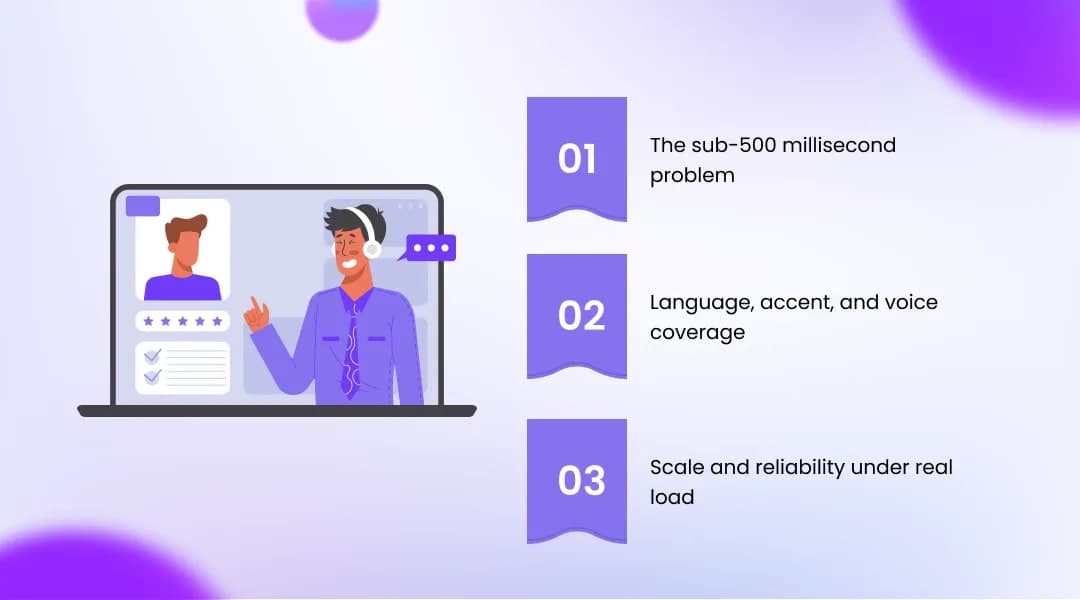
Most in-house builds do not fail at the demo; they fail when they meet the real world at scale. Three problems in particular sink internal projects with striking regularity, and each one is genuinely hard to solve, which is exactly why platforms invest years into solving them. Understanding these failure points before you commit is the difference between an informed decision and an expensive lesson.
The sub-500 millisecond problem
Response latency is the single most underestimated challenge in building a voice agent. Human conversation has a natural rhythm, and once the gap between a caller finishing their sentence and the agent responding stretches past roughly half a second, the interaction starts to feel broken, and callers lose confidence. Hitting sub-500 millisecond response latency consistently, across a full round trip of speech recognition, language model reasoning, and speech generation, requires deep engineering into streaming, model selection, and infrastructure placement that most teams have never done before.
This is not a problem you solve once and forget. It has to hold under load, across regions, and on poor connections, and it degrades the moment any part of the pipeline slows down. Purpose-built platforms treat this as a core engineering discipline, which is why OnDial is architected around sub-500 millisecond response latency as a baseline rather than an aspiration.
Language, accent, and voice coverage
The second common breaking point is language and accent coverage, and it is especially punishing for businesses serving diverse markets. Supporting a hundred-plus languages, or even handling regional accents and code-switching within a single language, is not something you get by calling one model. It requires curated voice options, robust accent recognition, and careful tuning per language, and building that breadth in-house for anything beyond one or two languages is a multi-year effort on its own.
For a business operating in India, this challenge is immediate and concrete. Customers switch fluidly between Hindi and English within a single sentence, and they expect to be understood in their own regional language. OnDial supports over 100 languages, including 9 Indian languages with more than 80 Indian voice variations, which is the kind of coverage that is effectively impossible to replicate in-house without a dedicated language engineering team and a long roadmap.
Scale and reliability under real load
The third breaking point is scale. A prototype that handles one call beautifully can collapse when a thousand calls arrive at once during a campaign or a peak period. Maintaining quality, low latency, and reliability across thousands of simultaneous calls is a distributed systems problem that requires serious infrastructure investment, and it is the kind of thing that only reveals itself when you are already live, and a spike takes the whole system down. Platforms are built for this from day one because it is their entire business, whereas an in-house build usually discovers its scaling limits at the worst possible moment.
When Building Actually Makes Sense
Buying is the right call for most businesses, but not all, and an honest guide has to say so. There are specific situations where building an AI voice agent in-house is defensible, and they share a common thread. Building makes sense when the voice agent itself is your core product or a genuine source of competitive advantage, not merely a tool you use to run the business you are actually in.
Building can be the right decision in a narrow set of conditions worth stating clearly.
Your company sells voice AI as its product, in which case the infrastructure is your business and outsourcing it would mean outsourcing your differentiation.
You have highly unusual requirements that no platform serves, and you have validated that no vendor can meet them through a proper evaluation rather than assumption.
You have deep, standing machine learning and real-time systems expertise in-house already, so the marginal cost of building is lower than it would be for most teams.
You operate at a scale where per-minute platform pricing genuinely exceeds the fully loaded cost of running your own infrastructure, which is a threshold most businesses never reach.
If none of those conditions clearly apply to your situation, the build vs buy AI voice agent math almost always points to buying. The reason is simple. For a healthcare group, a real estate agency, a lender, or an ecommerce brand, the voice agent is a means to an end, and every month and dollar spent building infrastructure is a month and dollar not spent on the actual business. Owning the plumbing is only worth it when the plumbing is the point.
How to Run an AI Voice Agent Vendor Evaluation
If you decide to buy, the quality of your decision now depends on the quality of your evaluation, because AI voice agent platforms vary enormously in what they actually deliver in production. A disciplined AI voice agent vendor evaluation protects you from the trap of buying based on a polished demo that behaves nothing like the platform will under your real conditions. The goal is to test the things that break in production, not the things that look good in a sales call.
The criteria that actually matter
A serious AI voice agent vendor evaluation should score each platform against the dimensions that determine real-world performance rather than surface features. These are the questions that separate a production-grade platform from a demo dressed up as one.
Latency under real conditions, measured as the full round-trip response time on live calls, since sub-500-millisecond performance is what keeps conversations feeling natural.
Language and accent coverage that matches your actual customer base, including regional languages and code-switching if you serve diverse or multilingual markets.
Concurrency and reliability, meaning the platform's proven ability to handle your peak call volume without quality dropping or calls failing.
Integration depth into your CRM, calendar, and other systems, because an agent that cannot book appointments or update records is only half a solution.
Analytics and sentiment tracking, so you can measure call outcomes, spot problems, and improve performance over time rather than flying blind.
Compliance posture, including GDPR and CCPA-aligned data handling, consent management, and clear data retention and deletion controls.
Deployment flexibility, meaning both no-code options for fast rollout and API access for deeper custom integration when you need it.
Breadth of proven use across industries, since a platform that already serves your sector has solved problems you have not yet encountered.
Matching the platform to real business needs
The strongest vendors demonstrate these capabilities on your calls, not on a canned demo, so insist on a trial against your own use case before committing. OnDial is built to be evaluated on exactly these terms, deploying AI voice agents that handle 24/7 inbound and outbound calls, qualify and score leads, schedule appointments with calendar integration, and track call sentiment through smart analytics, all with GDPR and CCPA-compliant data handling across more than 20 industries. Running your shortlist through this checklist turns a fuzzy build vs buy AI voice agent conversation into a clear, evidence-based decision. The platform that scores highest on the criteria that matter to your business is the one to choose.
Conclusion
The build vs buy AI voice agent decision comes down to three realities that the weekend demo hides. First, the demo is the easy twenty percent, and the real work is the orchestration, latency, scale, and compliance that turn a prototype into a product. Second, the honest cost to build an AI voice agent in-house frequently reaches several hundred thousand dollars in the first year and takes six to nine months to reach a stable deployment, while the ongoing maintenance never truly ends. Third, building only makes sense when voice AI is your core product, and for almost everyone else, the AI voice agent total cost of ownership and the time to value both point clearly toward buying. Hotels, restaurants, and other hospitality businesses frequently rely on 24/7 call answering to manage reservations and guest enquiries.
This is exactly the gap OnDial is built to close. OnDial deploys production-grade AI voice agents with sub-500-millisecond response latency, support for over 100 languages including 9 Indian languages with more than 80 Indian voice variations, 24/7 inbound and outbound call handling, lead qualification and scoring, appointment scheduling, and call sentiment analysis, all with GDPR and CCPA-compliant data handling and both no-code and API deployment across more than 20 industries. Instead of committing quarters of engineering time and unpredictable budget to rebuilding infrastructure that already exists, you get a platform that goes live in days and holds up under real call volume.
If you are weighing this decision right now, the fastest way to settle it is to test a real platform against your own calls rather than a demo. Start a free trial or schedule a demo with OnDial and see what a production-ready AI voice agent does for your business before you spend a single engineering sprint trying to build one.