More than half of consumers will give an automated phone system just three minutes before they hang up and walk away, according to a Parloa survey of over a thousand adults. Three minutes. That is the entire margin you have.
If you have ever felt that AI call handling is a gamble, that it might annoy your callers more than help them, you are not being cynical. You are paying attention.
Here is the direct answer. AI call handling reduces customer wait times by answering every call instantly, routing each caller to the right place, and resolving routine requests without a queue. It raises satisfaction when it is built to hand off gracefully to a human. Done well, it removes the hold music. Done badly, it becomes the thing people scream "human" at.
In this guide, I will show you how AI actually cuts wait times, where the satisfaction gains really come from, the failure modes to avoid, and what this looks like for businesses calling customers across India.
Why long wait times quietly cost you, customers
Hold time is not a minor annoyance. It is one of the oldest, most reliable reasons a customer decides to never call you again.
The real cost of making people wait
The numbers are blunt. Roughly 64% of customers say being kept on hold for more than 30 minutes would stop them using a company again, and 96.5% rate a fast response as important or very important, according to data compiled by Dialzara. Speed is not a nice-to-have. It is the price of staying in the game.
There is a quieter cost too. Every unanswered call at 8 pm or during a festival rush is a lead that moves to a competitor who picked up. I have seen businesses obsess over ad spend while losing more revenue in the missed-call gap than any campaign could recover.
What customers actually expect now
Expectations have hardened. In research cited by Dialzara, 90% of customers rate an immediate response as critical, and 60% define "immediate" as within ten minutes. The patience buffer has shrunk to almost nothing.
Ask yourself this honestly: how many calls did your business miss last Tuesday after 6 pm? Most owners do not know the number, and the not-knowing is the problem. Wait time is the first impression your service makes, and a busy signal or a long queue says everything before a human ever speaks.
How AI call handling reduces customer wait times
AI call handling reduces wait times by answering calls on the first ring, using natural language processing to understand intent, and routing or resolving each request in real time. Because it handles many calls at once, queues shrink or disappear, so customers reach an answer in seconds instead of minutes.
AI call handling is the use of voice AI to answer, understand, and act on inbound phone calls without a human needing to pick up first.
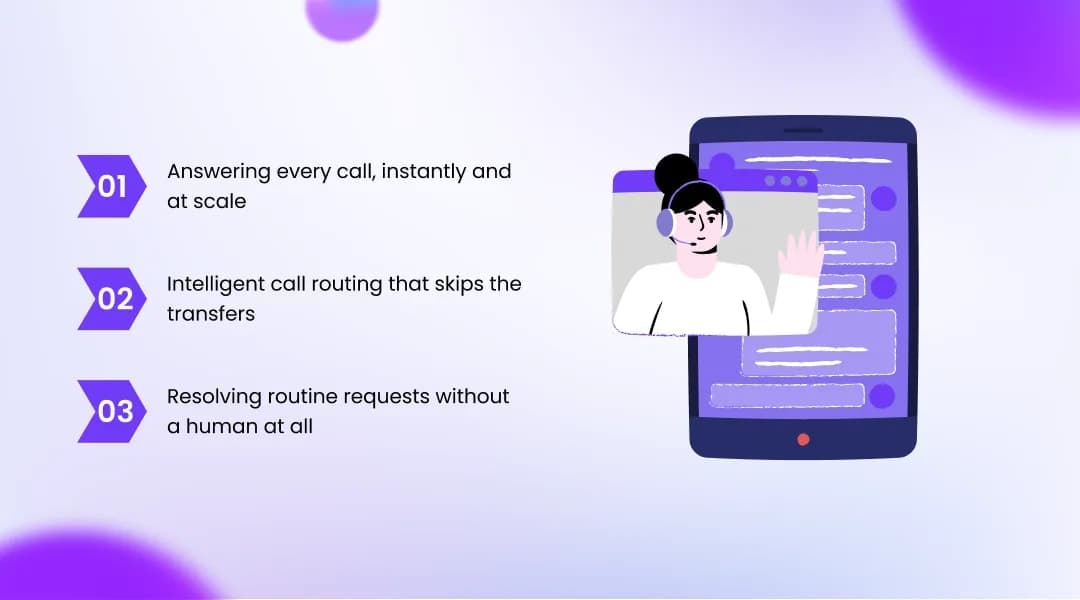
Answering every call, instantly and at scale
A human agent handles one call at a time. An AI voice agent handles hundreds in parallel, which is where the queue simply stops forming. There is no "your call is important to us" loop because there is no line.
This matters most at the edges of your day: after hours, weekends, and sudden volume spikes. In the deployments we have worked on at OnDial, the single biggest early win is almost never fancy: it is that every call now gets answered, so nobody waits, and nobody gets voicemail.
Intelligent call routing that skips the transfers
Intelligent call routing is AI matching each caller to the best-suited agent or workflow based on intent, history, and urgency. Instead of the old "press 1, press 2" maze, the system listens, understands, and sends the caller straight to the right place.
The payoff is measurable. One large telecom using Genesys Cloud CX cut wait times by 40% and lifted satisfaction scores by 15%, according to Dialzara. Fewer transfers means less time bounced between departments, and less repeating the same story three times.
Resolving routine requests without a human at all
A large share of inbound calls are repetitive: store hours, booking appointments with voice AI, checking an order, or resetting something. These do not need a person. They need a fast, correct answer.
When AI closes out these routine calls end to end, two things happen at once:
Queues shrink for everyone else. Every routine call the AI resolves is a call your human team never has to hold in a line, so complex callers reach a person faster.
Your team stops burning out on repetition. Agents spend their hours on the calls that actually need judgment, which raises both quality and morale.
From faster to happier: where satisfaction gains come from
Speed alone does not create loyalty. A fast answer that solves nothing still leaves a customer frustrated. The satisfaction lift comes from resolution, not just response.
First-call resolution is the real satisfaction lever
First-call resolution is one of the strongest predictors of customer satisfaction and experience.
Consider Netwealth, an Australian financial firm profiled by Zendesk: with an AI-powered call center, customers reach an agent within 60 seconds, agents resolve nearly 99% of tickets in a single touch, and the company fields more than 20,000 inquiries a month. That combination, fast plus resolved, is the whole point.
Consistency, context, and round-the-clock availability
AI does not have a bad day, a lunch break, or a Monday-morning mood. It gives the same accurate answer at 3 am that it gives at 3 pm, and it arrives at every call already holding the customer's history.
The evidence backs the feeling. The IBM Institute for Business Value found that mature AI adopters reported 15% higher satisfaction scores, and Zendesk reports that AI paired with human agents improves CSAT by up to 20% compared with AI-only setups. The lesson hiding in that second number matters: the best results are AI and human, not AI instead of human.
The honest part: when AI call handling frustrates people
Here is the uncomfortable truth most articles skip. AI can make your wait times feel worse.
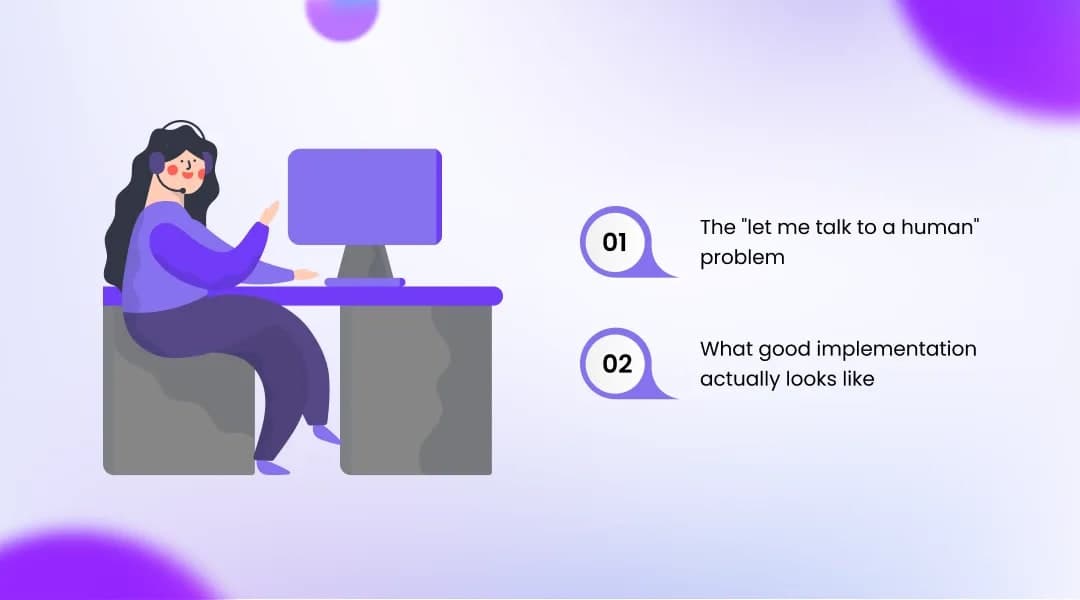
The "let me talk to a human" problem
A Qualtrics 2026 report found that nearly one in five consumers who used AI for customer service saw no benefit at all. In a Parloa survey, the single biggest pain point was not long holds. It was "talking to a bot that doesn't understand me," which ranked above hold time and transfers.
That is the trap. An AI that traps a caller in a loop, refuses to escalate, and cannot recognize frustration does not reduce wait time. It adds a wall in front of it.
What good implementation actually looks like
The difference between a system people love and one they scream at comes down to design choices. A well-built AI call handling setup does a few non-negotiable things:
It offers a human path early and clearly. No maze. If the caller wants a person, or the issue is emotional or complex, the handoff happens fast.
It passes full context on escalation. The customer never repeats their name, number, or problem to the human who picks up.
It knows its own limits. Around 58% of customers abandon a session the moment they sense a bot cannot help, per Dialzara. A good system reads that signal and escalates before frustration builds.
I will be candid about the limitation: AI is excellent for volume and routine, and weaker for high-emotion, high-stakes moments. The goal is not to automate everything. It is to automate the right things and protect the human moments.
What AI call handling looks like for Indian businesses
The Indian voice AI market was valued at about USD 153 million in 2024 and is projected to reach USD 957 million by 2030, a CAGR of roughly 35.7%, according to NextMSC. The shift is happening fast, and it has India-specific requirements that generic global tools tend to miss.
Multilingual and Hinglish calling that customers trust
A caller in a tier-2 city does not want "press 1 for English." They want to be understood in the language they actually speak, including the natural Hindi-English mix of everyday conversation.
Modern voice agents like OnDial are built for exactly this: Hindi, English, Hinglish code-switching, and expanding regional language support. When a customer can explain their problem in their own words, resolution is faster and the wait, real or perceived, feels shorter.
Compliance built in, not bolted on
Outbound and service calls in India sit under real rules. TRAI DLT governs commercial calling and DND scrubbing, and the DPDP Act 2023 governs how personal data is handled on every call.
This is where partnership matters more than features. At OnDial, we treat TRAI alignment, consent handling, and DPDP-aware data practices as part of the build, not an afterthought, because a fast call that breaks a regulation is not a win. Speed and trust have to travel together.
Conclusion
AI call handling reduces customer wait times and lifts satisfaction for one simple reason: it removes the queue while protecting the human moments that matter. Three takeaways are worth keeping. Speed comes from instant answering and intelligent routing. Satisfaction comes from first-call resolution and a graceful human handoff. And results depend entirely on implementation, not the label on the software.
You do not have to choose between fast and human. The best systems give you both.
At OnDial, we build voice AI for Indian businesses that answers every call in seconds, speaks your customers' language, stays TRAI and DPDP aligned, and knows exactly when to pass a caller to your team. If long hold times or missed calls are quietly costing you customers, that is precisely the gap we close, and we are happy to show you the numbers on your own call data.
AI call handling cuts wait times by answering instantly and routing intelligently, and it raises satisfaction when it resolves routine calls and hands the rest to humans. Built right, it delivers speed and warmth at once.