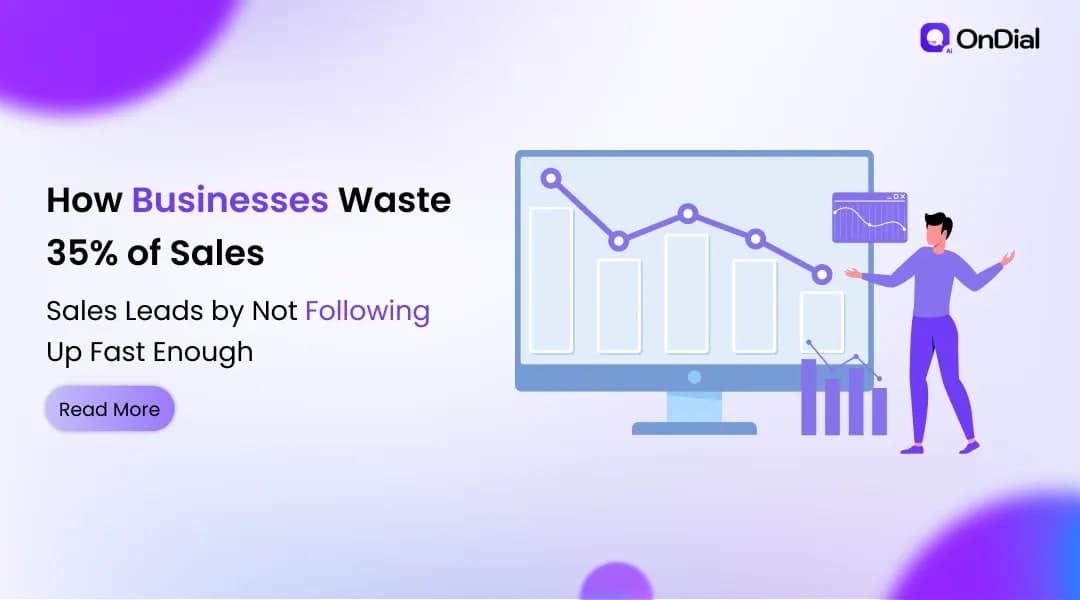
Between 35% and 50% of B2B sales go to the vendor that responds first, not the best vendor, not the cheapest, just the fastest. That finding, from research by Google and the Corporate Executive Board, stopped me mid-meeting the first time I read it. We were reviewing a client's pipeline at OnDial, trying to figure out why their paid campaigns were generating volume but not revenue. The answer was embarrassingly simple: their average response time to a new lead was over four hours. By then, three competitors had already called. If you have ever looked at your ad spend and wondered where all those leads went, the answer is probably not that they were bad leads. It is that someone else got to them first. In this article, I will walk you through exactly where leads die in the follow-up process, why speed matters more than most sales teams realize, and what you can do about it without doubling your headcount.
Where Your Sales Leads Actually Go to Die
Most businesses assume the problem is lead quality. I hear it constantly: "Marketing sends us junk." But the data tells a very different story.
The Follow-Up Gap Nobody Talks About
According to research published by InsideSales.com, up to 73% of sales leads are never contacted by a salesperson. Let that number sit for a moment. Nearly three out of four leads that a company paid to generate never receive a single call or email.
A Conversica survey at Dreamforce found that sales and marketing teams agreed at least 50% of their lead generation budget was wasted on leads that were never contacted. The marketers in that survey said the problem was straightforward: salespeople were not making enough attempts, and they were not reaching out soon enough.
This is not a lead quality problem. This is a follow-up problem.
What This Costs in Real Revenue
B2B companies spend anywhere from $40 to $1,000 per marketing-generated lead. B2C firms typically spend $2 to $50 per hot lead. When 48% of salespeople never follow up with a prospect (a figure reported across multiple sales industry surveys), you are not just losing leads. You are setting money on fire and watching it burn.
Here is a question worth asking yourself right now: do you actually know your team's average response time? Not what you assume it is. What it actually is.
Why Lead Response Time Decides Who Wins the Deal
Sales lead follow-up speed is the single most controllable variable in your pipeline, and it is the one most teams ignore.
The Five-Minute Rule That Changes Everything
How fast should you follow up with a sales lead? The answer, backed by one of the most cited studies in sales: within five minutes.
Featured Snippet Answer: Businesses should follow up with a new sales lead within five minutes. Research from MIT and InsideSales.com analyzing over 2.2 million leads found that leads contacted within five minutes are 21 times more likely to be qualified than those contacted after 30 minutes.
That study, led by Dr. James Oldroyd and published in Harvard Business Review, analyzed 2.2 million leads across 1,200 companies. The drop-off is not gradual. It is a cliff. After five minutes, your odds of making contact start collapsing. After 30 minutes, you are essentially cold-calling someone who has already moved on.
And yet, research cited by Forbes found that the average company takes 46 hours and 53 minutes to call a lead back. Not 46 minutes. Forty-six hours. (That is not a typo, and yes, I have confirmed this number with the original source more than once.)
What Happens After the Window Closes
When a prospect fills out a form at 9:47 PM, they are interested right now. By 10 AM the next morning, they have already Googled three alternatives, maybe spoken to one of them, and mentally moved on. The intent that drove them to your site has cooled. Harvard Business Review confirmed that contacting a lead within the first hour makes you seven times more likely to qualify them compared to waiting even 24 hours.
Speed to lead is not a soft preference. It is a conversion multiplier.
Three Reasons Sales Teams Still Respond Too Slowly

If the data is this clear, why do 41% of companies still struggle with timely lead follow-up? In my experience building voice AI systems at OnDial, I have seen the same three root causes again and again.
Manual Processes and Outdated Systems
Many businesses still rely on manual data entry to capture lead information. A form gets submitted, it lands in a shared inbox, someone copies the details into a CRM, and then a rep gets around to calling. Every handoff adds delay. According to a Saleslion analysis, a lack of technology or automation is one of the top reasons companies cannot respond quickly enough.
No Clear Ownership of Inbound Leads
When multiple departments or sales teams handle different lead types, confusion follows. Nobody is sure whose lead it is. The lead sits in a queue while three people assume someone else is handling it. By the time ownership is established, the five-minute window closed hours ago.
I have personally seen this pattern in companies generating over $10 million annually. The volume is there. The system is not.
After-Hours Gaps That Competitors Exploit
Your sales team works 9 to 6. Your website generates leads 24 hours a day. That gap between when a lead comes in and when a human being is available to respond is where competitors win deals you never even knew you lost. In industries like real estate, insurance, and SaaS, after-hours inquiries can represent 30% or more of total volume.
How AI Voice Agents Eliminate Follow-Up Delay

This is the part where most articles suggest "get a better CRM" or "train your reps to respond faster." Those are fine ideas. They are also insufficient. A CRM does not pick up the phone at 11 PM on a Saturday.
Instant Response Without Adding Headcount
AI voice agents respond to leads within seconds of form submission, not minutes, not hours. The technology has matured significantly: modern conversational AI platforms can hold natural, context-aware conversations, ask qualification questions, and route serious prospects to human reps with full context attached.
At OnDial, this is exactly the kind of solution we build. Our AI voice assistants are designed to engage leads the moment they show interest, whether that is 2 PM on a Tuesday or 3 AM on a Sunday. The goal is not to replace your sales team. It is to make sure no lead ever waits.
Is it really worth calling a lead within five minutes? The data says you are 21 times more likely to qualify them if you do. An AI voice agent makes that possible at scale, without hiring a night shift.
Qualifying Leads While Your Team Sleeps
Beyond speed, AI voice agents solve the qualification bottleneck. They ask structured questions based on your sales criteria, score the lead, log the interaction in your CRM, and escalate the ones worth a human conversation.
HubSpot's 2026 State of Marketing Report found that 40% of marketers cite lead quality as their top metric for success. Lead quality improves when the first conversation happens fast and follows a consistent framework, two things AI does better than a sales rep juggling 40 open tabs.
Building a Follow-Up System That Never Sleeps
Speed gets you in the door. Persistence keeps you there.
The Non-Negotiable Cadence
Research from RAIN Group shows that 80% of sales require at least five follow-up touches after the initial meeting, yet 44% of reps give up after just one attempt. That gap between buyer readiness and seller persistence is where deals go quiet.
A functional cadence looks like this: immediate AI-powered response within seconds, a human follow-up within the first hour, a second touch on day two with a new angle or case study, a third touch on day five, and continued contact through day 14 across phone, email, and social. Each touch should add value. "Just checking in" is not a strategy.
Measuring What Actually Matters
If you are not tracking lead response time as a formal KPI, you are flying blind. Companies using CRM systems effectively are 29% more likely to exceed their sales quotas. But the CRM is only useful if you are measuring the right things: average time to first contact, follow-up rate by rep, and conversion rate by response speed tier.
Should I actually automate my sales follow-up? If your average response time is over five minutes, yes. Automation is not about removing the human element. It is about making sure the human element arrives on time.
Conclusion
Improving your sales lead follow-up speed is not a minor optimization. It is the highest-ROI change most businesses can make to their pipeline right now. The math is simple: respond in under five minutes, follow up at least five times, and never let a lead sit unanswered because nobody was available. Those three actions alone will put you ahead of the majority of your competitors.
The businesses winning in 2026 are not necessarily the ones with the best product or the biggest ad budget. They are the ones that show up first and keep showing up.
If your team is struggling with response time or losing leads outside business hours, we built OnDial to solve exactly that problem. Our AI voice assistants engage, qualify, and route leads in real time, so your sales team wakes up to warm conversations, not cold lists. Visit OnDial to see how it works with your existing workflow