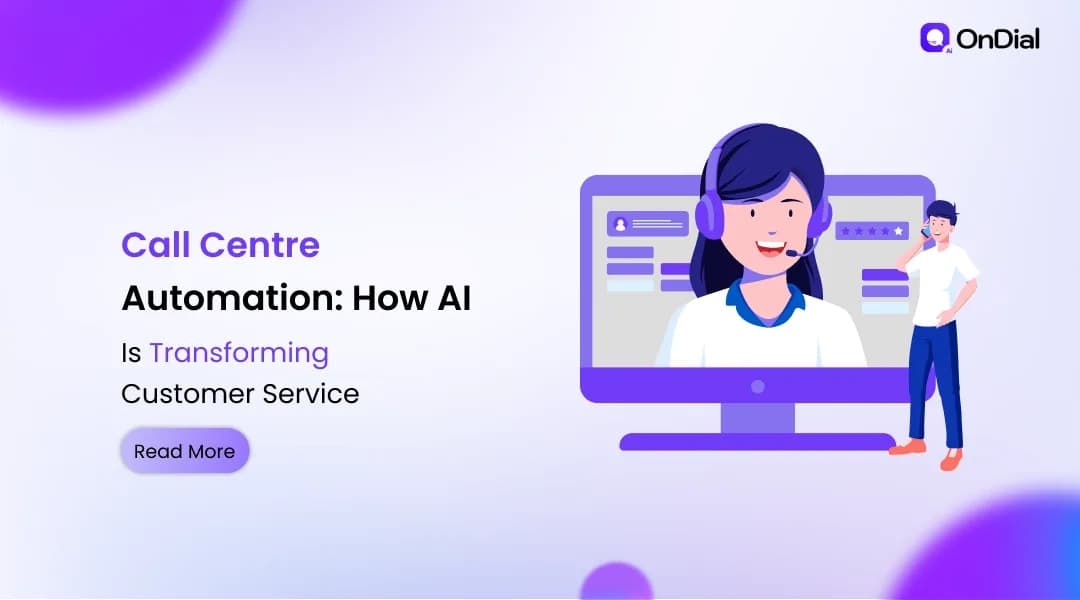
Here is a number that should stop every operations leader mid-scroll: Gartner predicts conversational AI will reduce contact centre labour costs by $80 billion globally in 2026. Not in some distant future. This year.
Call centre automation is the use of AI technologies like natural language processing, speech recognition, and machine learning to handle customer interactions, route calls intelligently, and support human agents in real time. If you have been watching the noise around AI in customer service and wondering what is real versus what is vendor marketing, you are not alone. I have spent years working with businesses that want better customer outcomes without the spiralling headcount costs, and the gap between AI promise and AI reality is something I think about daily at OnDial.
The truth? The technology has matured faster than most companies have been able to adopt it. In this guide, you will learn what call centre automation actually looks like in practice, which tasks are worth automating first, how to avoid the most common pitfalls, and what kind of ROI is realistic for businesses that are not enterprise giants.
What Is Call Centre Automation and Why Does It Matter Now?
Call centre automation is the application of artificial intelligence to manage, streamline, and resolve customer interactions across voice and digital channels. It goes far beyond the old interactive voice response (IVR) menus that made everyone press 1, press 2, and then hang up in frustration.
Modern automation uses conversational AI to understand what a caller actually wants, take action on their behalf, and only bring a human agent into the conversation when the situation genuinely requires it.
The Technology Behind Modern Call Centre AI
The foundation rests on three core technologies working together. Natural language processing (NLP) allows AI systems to interpret human speech and text, including slang, accents, and incomplete sentences. Machine learning enables these systems to improve their accuracy over time based on thousands of real interactions. And speech recognition converts spoken language into structured data that AI can act upon.
What makes 2026 different from even two years ago is the emergence of agentic AI, systems that do not just understand a customer's request but can independently execute multi-step workflows to resolve it. Think of it this way: an older chatbot could tell a customer their order status. An agentic AI system can check the order, identify that it is delayed, trigger a shipping update, apply a discount code, and send a confirmation, all without a human touching the case.
At OnDial, we have seen this shift firsthand. The AI voice agents we build do not just deflect calls. They resolve them. And the difference between deflection and resolution is the difference between a frustrated customer and a loyal one.
Why 2026 Is the Tipping Point
Three forces have converged to make this year a genuine inflection point. Customer expectations have permanently shifted toward instant, personalised service. Labour costs continue to rise, with call centre agent turnover running at 30 to 45 percent annually according to industry benchmarks from Insignia Resources. And the technology itself has reached a level of reliability where businesses can trust AI to handle real customer conversations, not just scripted FAQ lookups.
A McKinsey study found that AI-enabled agents achieved a 14 percent increase in issue resolution per hour and a 9 percent reduction in handle time. Those are not theoretical numbers. They reflect what happens when AI is deployed thoughtfully within existing operations.
But here is the counterpoint that keeps me honest: despite all this momentum, only 25 percent of call centres have fully integrated AI automation into their daily operations, according to research published by AmplifAI. The other 75 percent own AI tools they have not operationalised. Buying the software is not the hard part. Integrating it into how your team actually works every day? That is where most companies stall.
Five Ways AI Is Changing Customer Service Operations
Let me be specific about what AI in customer service looks like when it is working well, not in a demo, but in a live environment handling real customers with real problems.
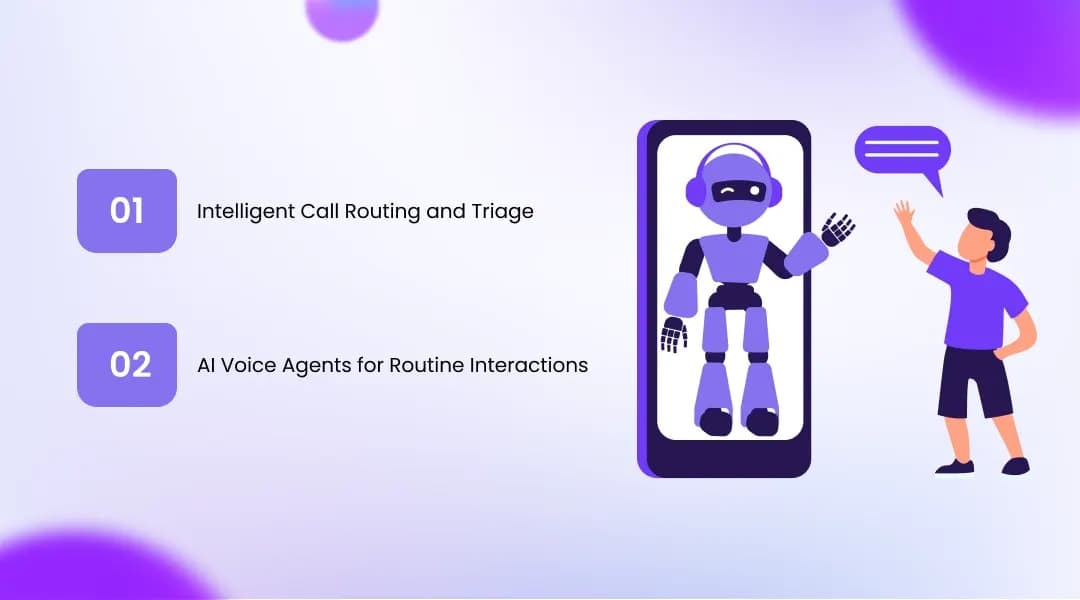
Intelligent Call Routing and Triage
Traditional IVR systems route based on menu selections. AI-powered routing analyses the caller's actual words, their tone, their account history, and the nature of their request before deciding where to send them. The result is fewer transfers, shorter wait times, and customers reaching the right person on the first try.
CNH Care, a healthcare solution provider, used AI-powered routing and achieved a 96 percent customer satisfaction (CSAT) score while reducing dropped calls. That is not a marginal improvement. It is a structural change in how their support operation performs.
Have you ever called a company, explained your issue twice, gotten transferred, and then had to explain it a third time? Intelligent routing eliminates that cycle.
AI Voice Agents for Routine Interactions
This is where the biggest volume impact happens. AI voice agents can handle password resets, appointment scheduling, order tracking, payment reminders, and basic troubleshooting without any human involvement. These tasks typically consume 60 to 70 percent of an agent's time, according to industry data from Teneo AI. If you're evaluating automation for your organization, our detailed guide on The AI Voice Agent That Works While You Sleep explains how modern AI voice agents manage customer conversations around the clock while maintaining natural, human-like interactions.
The economics are hard to argue with. Voice AI costs roughly $0.40 per call compared to $7 to $12 for a human agent, according to CX Today. Self-service interactions cost $1.84 per contact versus $13.50 for agent-assisted ones, per Gartner's benchmarks.
(Here is something I rarely see discussed: the quality of these AI voice interactions depends almost entirely on the data you feed the system. Incomplete knowledge bases produce incomplete answers. I have watched deployments fail not because the AI was bad, but because the source material was outdated or contradictory.)
At OnDial, we build AI voice agents with sub-500ms latency and multilingual support, including Hinglish and regional Indian languages. For businesses operating in India's diverse market, this is not a feature. It is a requirement.
The Real Benefits of Automated Customer Support
Let me move beyond the usual "faster, cheaper, better" claims. The benefits of call centre automation are real, but they are also nuanced.
Cost Savings That Actually Show Up on the Balance Sheet
A Gartner forecast estimates that AI will reduce customer service costs by 30 percent for organisations that implement automation effectively. Swisscom reduced operational costs by 20 percent and improved customer satisfaction by 18 percent simultaneously. HelloFresh cut average handle time (AHT) by 2 minutes per call and saw a 6 percent uplift in upsell revenue.
These are not hypothetical scenarios. They are documented outcomes from real deployments.
But I want to flag something important: the organisations seeing these results are the ones that treated AI as a strategic transformation, not a feature bolt-on. They aligned automation with clear business outcomes, integrated AI into existing workflows, and tracked metrics like first contact resolution (FCR), customer effort score, and containment rate. The companies that just bought a chatbot and hoped for the best? They are part of that 75 percent still struggling to operationalise.
Agent Experience: Less Burnout, Better Performance
This point gets overlooked too often. Call centre agent turnover is brutal, running at two to three times the average for other industries. A Salesforce study found that 89 percent of agents feel more satisfied with their jobs when they have automation handling the repetitive work.
When AI takes over password resets and order status checks, agents get to focus on the conversations that require empathy, judgment, and creative problem-solving. That is better for the agent, better for the customer, and better for the business.
One sentence I keep coming back to: the goal is not fewer agents. It is better-supported agents.
Does AI Actually Replace Call Centre Agents?
No. And that is not wishful thinking. It is what the data shows.
Call centre automation does not replace human agents; it redirects their effort toward higher-value interactions. Gartner projects that while organisations will reduce 20 to 30 percent of service agent roles through generative AI, 50 percent of companies that planned workforce reductions have already abandoned those plans, and 95 percent of customer service leaders plan to retain human agents.
The Hybrid Model That Works
The model that consistently delivers results is the hybrid approach: AI handles routine, high-volume interactions while human agents focus on complex, emotionally charged, or high-stakes conversations. New 2026 benchmarks show 76 percent of leaders are formalising exactly this split.
Think of it as an orchestra, not a replacement. AI is not the conductor replacing the musicians. It is the sheet music that helps every musician perform better.
Where Human Agents Still Win
A Gartner survey found that 64 percent of customers would prefer companies not use AI for customer service. Their top concern? Difficulty reaching a real person. Nearly half of customers still prefer speaking with a human, compared to just 12 percent who favour AI chatbots.
This is a critical insight. Customers accept AI for simple, transactional tasks. They want it for speed and convenience. But the moment a conversation involves frustration, confusion, or a high-value decision, they want a person.
At OnDial, we designed our platform around this principle. Our AI voice agents handle the volume. Our escalation logic ensures that the moment a conversation gets nuanced, a human agent steps in with full context of what the AI already discussed. No repeating. No cold transfers.
How to Start Automating Your Call Centre (Without Breaking It)
If you are reading this and thinking "this all sounds great, but where do I actually start," here is the practical framework I recommend.
Pick Your First Three Workflows
Do not try to automate everything at once. That is why 67 percent of call centre automation projects fail to deliver expected results, according to Teneo AI. Start with three high-volume, rule-based workflows where the answers are clear, and the process is repeatable.
Workflow 1: Frequently asked questions. Identify your top 20 recurring inquiries. Password resets, store hours, return policies, shipping status. These are perfect candidates because the answers are consistent and the volume is high.
Workflow 2: Appointment scheduling and reminders. AI voice agents excel at checking availability, confirming bookings, and sending reminders. This frees significant agent time while improving show rates.
Workflow 3: Identity verification and basic account lookups. The ID and verification process is the single biggest time sink for human agents, and it bores customers too. AI can handle this securely through voice biometrics or automated multi-factor authentication.
Measure What Matters: KPIs for Call Centre AI
Do not just track "calls handled by AI." That number is meaningless without context. Focus on these metrics instead.
Average Handle Time (AHT): AI can reduce AHT by up to 40 percent, per industry data. Track whether your after-call work time drops as AI automates summaries and CRM updates.
First Contact Resolution (FCR): Are customers getting their issues resolved without callbacks or transfers? This is the metric that most directly correlates with customer satisfaction.
Containment Rate: What percentage of interactions does AI resolve without any human involvement? Industry leaders target 40 to 60 percent containment on eligible call types.
Customer Satisfaction (CSAT): Monitor this closely during rollout. If CSAT drops, your automation is too aggressive, or your escalation paths need tuning.
Cost Per Contact: Compare AI-handled interactions against agent-assisted ones. The gap should widen over time as the AI improves from real interaction data.
Conclusion
Call centre automation is no longer experimental. The data is clear: AI reduces costs, improves agent satisfaction, and delivers faster customer resolutions when deployed with the right strategy. The three takeaways that matter most are: start with a small number of high-volume workflows rather than trying to automate everything, measure real business outcomes like FCR and CSAT instead of vanity metrics, and always keep human agents at the centre of your most complex customer interactions.
The businesses winning this shift are not the ones with the most AI features. They are the ones with the clearest AI strategy.
If you are ready to explore what AI voice automation looks like for your specific operation, OnDial builds tailored voice AI solutions that work in real-world conditions, multilingual, low-latency, and designed for the way your customers actually communicate. Start a conversation at ondial and see what automation can do when it is built around your business, not the other way around.
Call centre automation, at its best, is not about removing people from the equation. It is about giving every person in your organisation, agents and customers alike, a better experience with every single interaction.