A prospective buyer sees a property listing at 9:47 PM, picks up the phone, and calls the agency number on the listing. The call rings six times and goes to voicemail. That buyer hangs up, scrolls to the next listing, and calls a competing agency that answers on the second ring. The first agency never even knows the lead existed. Research from the Harvard Business Review found that companies responding to a new lead within five minutes are 100 times more likely to make contact and 21 times more likely to qualify that lead compared to those that wait 30 minutes. In real estate, where a single closed deal can represent tens of thousands in commission, the cost of a slow response is not an inconvenience. It is a direct and measurable loss of revenue.
The challenge is structural, not motivational. Real estate agents are busy showing properties, negotiating offers, managing paperwork, and handling client relationships throughout the day. They cannot physically answer every inbound call within five minutes, especially outside business hours or during weekends when buyer activity peaks. Traditional solutions like voicemail, answering services, and call forwarding each introduce their own problems, from impersonal experiences to delayed follow-up to inconsistent lead qualification. This is exactly the gap that an AI voice agent for real estate is designed to close. If you're exploring broader property automation strategies, read AI Calling for Real Estate: Never Miss a Property Lead Again, which explains how AI captures inquiries instantly and books property showings before competitors respond.
This blog examines the specific ways AI voice agents solve the lead capture and conversion problem for real estate agencies. It covers why traditional call handling methods fail to keep pace with modern buyer behaviour, how AI voice agents qualify and route leads in real time, the measurable business impact on lead conversion and agent productivity, and what implementation actually looks like for a real estate business deploying this technology. Whether you manage a boutique brokerage or a multi-office agency, the operational dynamics discussed here apply directly to your revenue pipeline.
Why Traditional Call Handling Falls Short in Real Estate
Real estate has always been a phone-intensive business. Despite the growth of online portals, messaging apps, and email inquiries, phone calls remain one of the highest-intent actions a prospective buyer or seller takes. A person who calls about a listing is significantly further along in their decision process than someone who simply browses online. Yet the infrastructure most agencies use to handle these calls has not evolved to match the speed and availability that today's buyers expect.
The After-Hours and Weekend Problem
The majority of property searches happen outside standard business hours. Buyers browse listings after work, on evenings, and heavily on weekends. Industry data consistently shows that over 40% of real estate inquiries arrive outside the 9 AM to 5 PM Monday to Friday window. For most agencies, these calls go to voicemail, get forwarded to an answering service that takes a message, or simply go unanswered. Each of these outcomes introduces a delay that dramatically reduces the probability of conversion.
The problem is compounded on weekends. Saturday and Sunday are peak showing days, which means agents are physically occupied with existing clients precisely when new buyer calls are spiking. An agent showing a home at 2 PM on a Saturday cannot simultaneously answer a call from a new lead about a different property. The call goes unanswered, the lead moves on, and the agent never knows the opportunity existed. This is not a training problem or a discipline problem. It is a capacity problem that cannot be solved by asking agents to work harder.
The Follow-Up Gap
Even when agencies do capture lead information through voicemail or web forms, the follow-up gap creates a second point of failure. Studies on lead response in real estate show that the median response time for online real estate leads is over two hours, with many agencies taking 24 hours or more. By the time an agent calls back, the buyer has already spoken to two or three competing agencies, and the window of highest intent has closed.
Traditional call answering services address availability but create a different problem. A human receptionist or virtual assistant can take a name and number, but they typically cannot answer property-specific questions, assess buyer readiness, or schedule a viewing on the spot. The caller hangs up with no new information and no next step, which reduces the likelihood they will pick up when your agent calls back hours later. The result is a pipeline full of "leads" that never convert because the moment of engagement was missed.
How AI Voice Agents Transform Real Estate Lead Capture
An AI voice agent for real estate fundamentally changes the way inbound and outbound calls work by providing an always-available, intelligent first point of contact that can do far more than take a message. Unlike a voicemail system or a basic answering service, a well-deployed AI voice agent conducts a real conversation, gathers qualified information, answers property questions, and moves the lead toward a concrete next step, all within the first call.
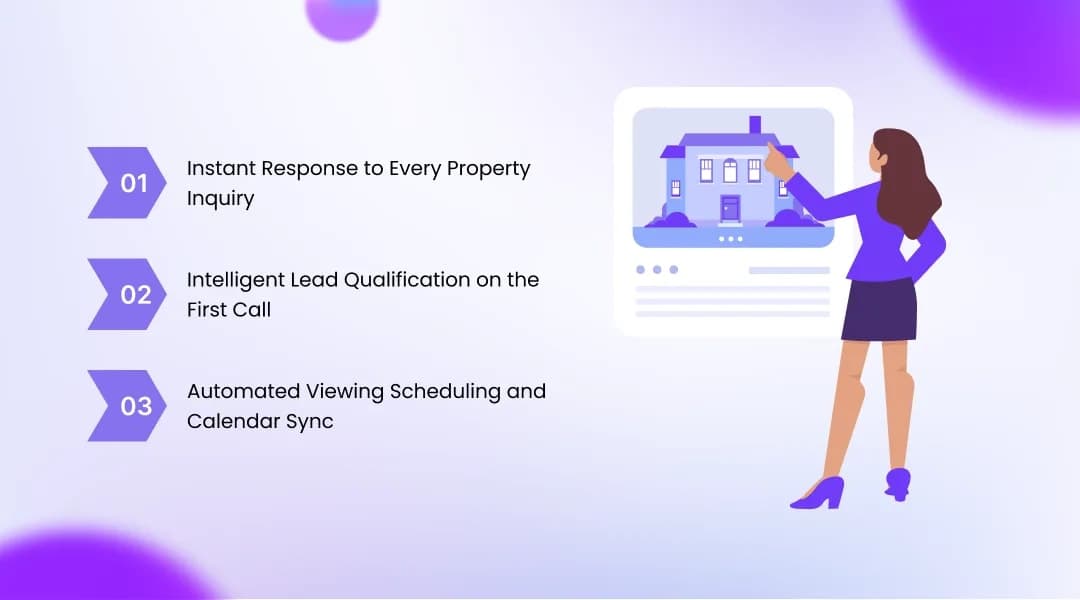
Instant Response to Every Property Inquiry
The most immediate impact of AI calling for property inquiries is eliminating missed calls entirely. When a prospect calls, the AI voice agent answers within one second, greets the caller naturally, and begins the conversation. There is no hold music, no menu tree, and no voicemail prompt. The caller experiences a responsive, professional interaction from the first moment. For agencies using OnDial, this instant response is powered by sub-500 millisecond latency, which means the AI responds with natural conversational speed and eliminates the awkward pauses that make callers feel they are speaking with a machine.
This is equally important for after-hours calls, weekend inquiries, and holiday periods. The AI voice agent operates 24 hours a day, 7 days a week, without shift changes or downtime. A buyer calling at 10 PM on a Sunday receives the same quality of engagement as someone calling at 10 AM on a Tuesday. For agencies competing in high-demand markets, this level of availability alone can capture dozens of leads per month that would otherwise be lost to competitors who answer first.
Intelligent Lead Qualification on the First Call
Answering the call is only the first step. What happens during the conversation determines whether a lead enters the pipeline as a qualified opportunity or remains an unqualified name in a spreadsheet. AI voice agents perform automated lead qualification for real estate by asking the right questions in a natural conversational flow. This includes identifying the caller's buying timeline, budget range, preferred locations, property type requirements, financing status, and level of urgency. Agencies that work closely with lenders can also benefit from AI voice agents for finance and banking to automate mortgage inquiries and loan pre-qualification before buyers speak with financial advisors.
The AI agent assigns a lead score based on the caller's responses, allowing agents to prioritise their follow-up efforts on the highest-value opportunities. A first-time buyer who has mortgage pre-approval, is looking to move within 60 days, and wants to see a specific listing gets a higher priority score than someone casually browsing with no defined timeline. This scoring happens automatically during the call, and the results are pushed to the agency's CRM immediately after the conversation ends. For busy agents managing dozens of active leads, this real estate call answering service AI capability means they spend their limited time on the leads most likely to convert.
Automated Viewing Scheduling and Calendar Sync
One of the highest-value actions an AI voice agent performs in real estate is booking property viewings during the initial call. Rather than ending the conversation with "an agent will call you back," the AI checks agent availability in real time, offers the caller specific time slots, and confirms the appointment on the spot. This eliminates the back-and-forth scheduling process that often takes multiple calls and emails, and it ensures the lead has a committed next step before they hang up.
OnDial's appointment scheduling capability integrates directly with popular calendar systems, which means confirmed viewings appear on the agent's calendar automatically with full lead details attached. The caller receives a confirmation, and the agent receives a notification with the lead's qualification data, property interest, and scheduled viewing time. This end-to-end flow from inbound call to confirmed appointment happens without any human intervention, which is particularly valuable during peak inquiry periods when agents are fully booked with existing showings.
The Business Impact: What Changes When Every Call Gets Answered
The decision to deploy an AI voice agent is ultimately a business decision, and it should be evaluated in business terms. The impact falls into three measurable categories: lead capture volume, conversion rate improvement, and agent productivity gains. Each of these contributes directly to revenue, and the combined effect is often significant enough to reshape an agency's growth trajectory.
To increase real estate lead conversion rate, the single most effective lever is speed of response. When every call is answered instantly, and every caller is engaged in a qualifying conversation, the volume of leads entering the pipeline increases substantially. Agencies that implement always-on AI call handling typically see a 30% to 50% increase in captured leads simply because calls that previously went to voicemail or were missed entirely are now being answered and processed. These are not new marketing leads. They are leads the agency was already generating through listings and advertising but failing to capture at the point of contact.
Conversion rates improve because qualified leads receive faster, more relevant follow-up. When an agent calls back a lead who has already been qualified, scored, and given a scheduled viewing, the follow-up call is productive rather than exploratory. The agent knows the buyer's budget, timeline, property preferences, and level of readiness before they dial. This preparation cuts the average sales cycle length and increases the percentage of leads that progress to viewings and ultimately to offers. Industry benchmarks suggest that reducing lead response time from hours to minutes can improve conversion rates by 300% to 400% in competitive markets.
Agent productivity improves because the time agents previously spent answering screening calls, taking messages, playing phone tag with unresponsive leads, and scheduling appointments is redirected to high-value activities: showing properties, building client relationships, negotiating deals, and closing transactions. For a typical agency with five agents each spending two hours per day on call handling and follow-up logistics, AI voice agent deployment effectively reclaims 50 hours of productive selling time per week across the team. That reclaimed time translates directly into more showings, more offers, and more closed deals.
How OnDial Powers Real Estate Lead Conversion at Scale
While the general concept of AI voice agents is straightforward, the quality of implementation varies enormously between platforms. What separates a production-grade AI voice agent from a basic chatbot with voice capability is the depth of conversational intelligence, the reliability under real call conditions, and the integration with existing business workflows. OnDial is built specifically for these production demands, and its architecture addresses the specific challenges that real estate agencies encounter when deploying AI calling at scale.
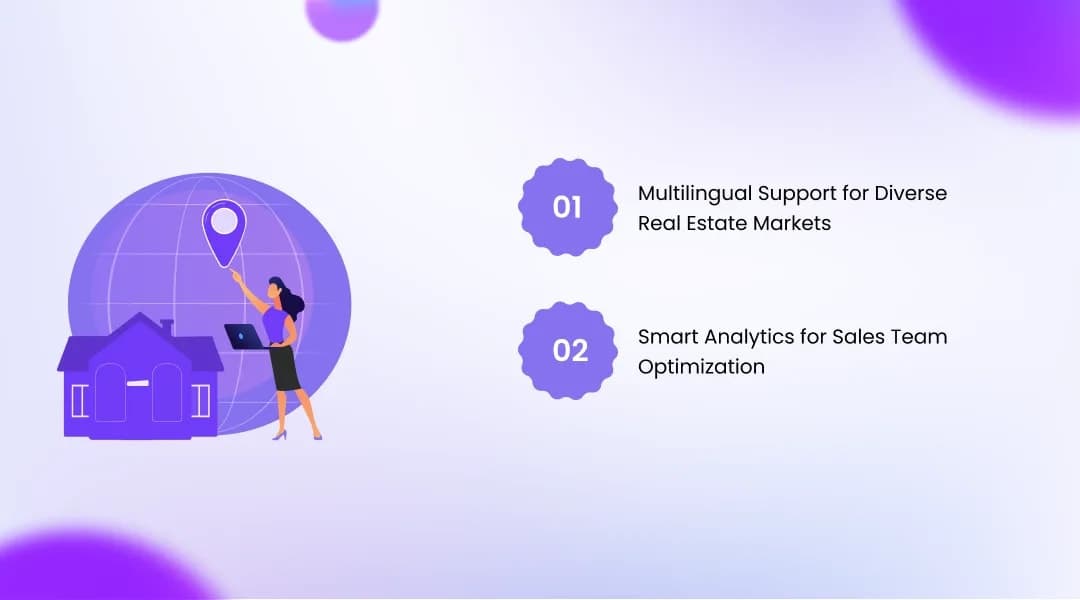
Multilingual Support for Diverse Real Estate Markets
Real estate markets, particularly in countries like India, the UAE, and multilingual regions globally, serve buyers and sellers who speak different languages and often switch between languages within a single conversation. An AI voice agent that only operates in English immediately excludes a substantial portion of potential leads. OnDial supports over 100 languages, including 9 Indian languages with more than 80 Indian voice variations, making it possible to serve callers in Hindi, Tamil, Gujarati, Marathi, Bengali, and other regional languages natively. For real estate agencies operating in Indian metros where buyers may speak Hindi at home but conduct business inquiries in English, OnDial's ability to handle natural code-switching within a single call is a critical operational advantage.
This multilingual capability is not simply a translation layer. OnDial's voice agents are trained to understand regional accents, colloquial expressions, and the conversational patterns specific to each language. A buyer calling about a property in Pune who speaks in Marathi with occasional English terms receives a natural, fluent interaction rather than a stilted machine translation. For agencies targeting NRI buyers or international investors, the platform's language breadth means inbound calls from global numbers are handled with the same quality as domestic inquiries.
Smart Analytics for Sales Team Optimization
Beyond call handling, OnDial provides smart analytics and call sentiment tracking that give agency managers visibility into their lead pipeline and team performance. Every call is analysed for sentiment, intent signals, objection patterns, and outcome. This data surfaces insights that are impossible to extract from traditional call logs, such as which properties generate the most qualified inquiries, which times of day produce the highest-intent callers, which objections appear most frequently, and how lead quality varies across marketing channels.
For agencies looking to increase real estate lead conversion rate systematically rather than anecdotally, these analytics provide the foundation for data-driven decisions. If the AI identifies that 60% of callers ask about financing options and only 20% have pre-approval, that signals an opportunity to partner with a mortgage broker or create financing-focused content. If sentiment analysis reveals that callers respond negatively to certain qualifying questions, the conversation flow can be refined. These continuous feedback loops are what distinguish a strategic AI deployment from a simple call answering tool.
Getting Started: What Real Estate Agencies Should Expect from Implementation
Deploying an AI voice agent is not a multi-year IT project. Modern platforms like OnDial are designed for rapid deployment, and most real estate agencies can go live within days rather than months. Understanding what the implementation process involves helps decision-makers plan effectively and set realistic expectations for their teams.
The implementation typically follows a structured sequence. First, the agency defines its lead qualification criteria, including the questions the AI should ask, the scoring logic, and the routing rules for different lead types. Second, the conversation flows are configured to match the agency's brand voice, property portfolio, and business processes. Third, calendar integrations are connected so the AI can schedule viewings in real time. Fourth, the system is tested with sample calls to validate accuracy, tone, and handling of edge cases. Fifth, the AI goes live on the agency's phone lines and begins handling calls.
OnDial offers both API integration for agencies with existing CRM and telephony infrastructure and no-code deployment options for agencies that want a turnkey solution. The no-code path is particularly relevant for small to mid-size brokerages that do not have dedicated IT teams. An operations manager or office administrator can configure the system, adjust conversation flows, and monitor performance through a dashboard interface without writing any code.
Training the sales team on the new workflow is equally important. Agents need to understand how leads will arrive in their queue, what qualification data will be attached, how scheduled viewings are confirmed, and how to use the analytics dashboard to review call recordings and sentiment data. The most successful deployments treat the AI voice agent as a new team member rather than a software tool, integrating it into the daily rhythm of lead management and follow-up processes.
Common concerns during implementation include call quality, caller acceptance, and data security. On call quality, OnDial's sub-500 millisecond response latency ensures conversations feel natural and responsive. On caller acceptance, real-world data shows that the vast majority of callers engage productively with AI voice agents when the experience is conversational and helpful rather than robotic and restrictive. On data security, OnDial maintains GDPR and CCPA compliance, which means caller data is handled according to established privacy frameworks, an increasingly important consideration as data protection regulations expand globally.
Conclusion
The real estate industry's lead capture problem is not caused by a lack of leads. It is caused by a gap between when leads call and when agencies are able to respond with a meaningful, qualified interaction. Closing that gap requires three things: instant response to every inbound call regardless of time or day, intelligent qualification that identifies serious buyers and captures their requirements on the first conversation, and automated scheduling that gives leads a committed next step before they move on to a competing agency.
AI voice agents deliver all three of these capabilities as a single integrated solution, and the business impact is measurable in recovered leads, improved conversion rates, and reclaimed agent productivity. For agencies competing in markets where response speed determines who wins the client, the ability to answer every call instantly and qualify every lead automatically is not an incremental improvement. It is a structural advantage that compounds with every call.
OnDial is built for exactly this operational reality. With sub-500 millisecond response latency, support for over 100 languages including 9 Indian languages, 24/7 call handling, intelligent lead qualification and scoring, automated appointment scheduling, and smart analytics that continuously improve performance, OnDial gives real estate agencies the infrastructure to capture and convert every lead their marketing generates. Deployment is fast, integration is flexible through both API and no-code options, and data handling meets GDPR and CCPA compliance standards. If your agency is ready to stop losing leads to voicemail and start converting them into viewings and closed deals, schedule a demo with OnDial today and see how AI voice agents perform on your actual call volume.