An analysis of over 130,000 customer service calls found that 74.1% of calls to small businesses go completely unanswered, according to a NextPhone study of 45 home services contractors. That is three out of every four potential customers who simply call someone else. If you are reading this, you have probably felt that sting yourself: the missed call that turned into a missed job, a missed booking, a missed client.
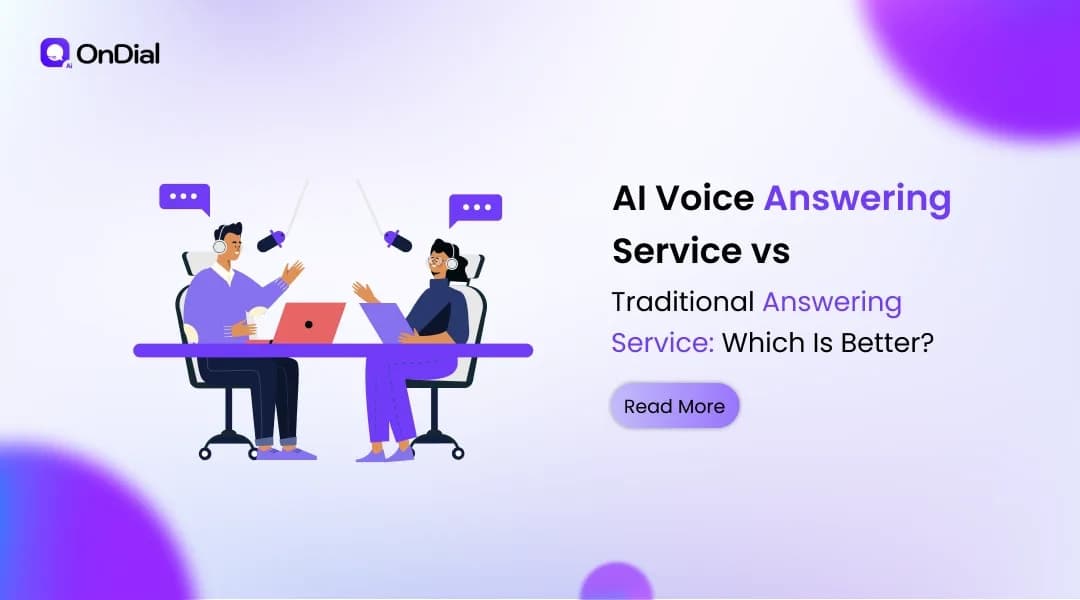
So the question of AI voice answering service vs traditional answering service is not academic. It is about money walking out your door every time a phone rings and nobody picks up. An AI voice answering service uses natural language processing to answer inbound calls, understand what the caller needs, and respond conversationally without a human in the loop. A traditional answering service routes those same calls to live human operators who follow scripts on your behalf.
Both exist to solve the same problem. They solve it in fundamentally different ways.
In this article, I will break down the real cost differences, the performance gaps, the honest limitations of each, and the hybrid model that I have seen work best for most businesses. No hype. Just data and experience.
How AI Voice Agents Actually Work
An AI voice answering service is software that picks up your business phone, greets the caller, processes their request through natural language understanding, and takes action: answering FAQs, booking appointments, capturing lead information, or routing the call to the right person. Modern systems from providers across the market connect directly to your CRM, calendar tools like Calendly or Google Calendar, and workflow platforms like Zapier.
The difference between these systems and old IVR phone trees ("press 1 for sales, press 2 for support") is significant. IVR forces callers through rigid menus. AI voice agents have actual conversations. At OnDial, I have worked on voice AI systems where the latency sits under 500 milliseconds, which means the AI responds faster than most human receptionists would. You can also compare AI with legacy phone systems in our detailed guide AI Voice Agents vs IVR: Which One Customers Actually Prefer, which explains why conversational AI delivers a significantly better caller experience.
Here is what surprises most people: setup is not a multi-week project anymore. Most AI answering platforms go live within 15 to 30 minutes. You point the system at your website, upload your FAQs, connect your calendar, and forward your phone number.
What Traditional Answering Services Still Get Right
Traditional answering services employ live operators, often working from shared call centers, who answer calls on behalf of dozens or even hundreds of businesses. Companies like Ruby Receptionists, AnswerConnect, and Smith.ai have been doing this for years. The model is proven.
A live human operator can read tone, pick up on hesitation, and adjust in real time. When a caller is upset, confused, or emotionally distressed, a trained human can navigate that moment in ways that AI still struggles with. I will be direct about this: if you run a crisis hotline, a hospice, or a mental health practice, human operators are not optional. They are essential.
That said, the traditional model has structural weaknesses that no amount of operator training can fix. And those weaknesses are exactly where AI answering services have created the biggest gap.
The Real Cost Difference: AI vs Traditional Answering Services
Upfront and Monthly Pricing Breakdown
This is where the AI answering service cost comparison gets stark. Traditional human answering services typically charge between $0.80 and $2.50 per minute of operator time, according to SIMBA Voice Agents' industry analysis. For a business handling 500 calls per month at an average of three minutes each, that works out to $500 to $1,500 per month, before overages.
AI voice agents flip that math. Most platforms charge flat monthly subscriptions between $99 and $299, or per-minute rates of $0.05 to $0.15. That same 500-call scenario costs $75 to $225 per month with AI. The total cost reduction is typically 70 to 85 percent.
(Let that number sit for a moment. Seventy to eighty-five percent cheaper for a service that picks up instantly, every single time.)
Hidden Costs Most Comparisons Miss
Most comparison articles stop at the monthly bill. They should not. Traditional answering services layer on charges that inflate your actual spend well beyond the quoted rate: setup fees, holiday premiums, after-hours surcharges, per-transfer fees, bilingual coverage add-ons, and overage penalties when your call volume spikes during busy season.
AI answering services are not completely free of hidden costs either. Some platforms require separate telephony billing through providers like Twilio. Others charge platform fees on top of per-minute usage.
But the pricing is overwhelmingly more predictable. A busy month costs the same as a slow month on most flat-rate plans.
Have you ever looked at your answering service invoice during peak season and felt a knot in your stomach? That unpredictability is a real business problem, not just a billing nuisance.
Where AI Answering Services Outperform Human Operators
Speed, Scale, and Consistency
An AI receptionist picks up every call within two seconds. No hold music. No queue. No "please hold while I transfer you to someone who knows your account." When 15 people call at the same time during a storm or a marketing push, the AI handles all 15 simultaneously. A human answering service puts 14 of them on hold, or worse, sends them to voicemail.
Consistency is the other advantage that does not get enough attention. The most common complaint about traditional answering services, based on review data across multiple platforms, is inconsistency. Operators rotate shifts. They handle calls for dozens of businesses.
They forget your pricing. They mispronounce your company name. They have bad days.
An AI voice agent delivers the same greeting, the same accuracy, and the same process on every single call. The best AI voice agent for business is the one that never has an off day.
After-Hours and Multilingual Coverage
A call at 3 AM costs the same as a call at 3 PM with AI. No after-hours premium. No skeleton crew staffing the night shift.
For service businesses like plumbers, HVAC contractors, and property managers, this matters enormously. Emergency calls do not wait for business hours.
Multilingual support is another area where AI has pulled ahead. At OnDial, we build voice AI systems that handle Hinglish, regional Indian languages, and multiple international languages without charging extra per language. Traditional services either do not offer multilingual coverage or charge steep premiums for it. Supporting multiple languages requires more than translation. Our guide How AI Voice Agents Understand Accents and Regional Languages explains how AI delivers accurate conversations across diverse customer bases.
For businesses operating in diverse markets like India, the Middle East, or multilingual regions of Europe, this is not a nice-to-have. It is a requirement.
Where Traditional Answering Services Still Win
Emotional Nuance and Complex Judgment
I would be dishonest if I pretended AI handles everything well. It does not.
When a patient calls a medical practice about a serious diagnosis, when a tenant reports a safety emergency while panicking, when a grieving family member calls a funeral home: these callers need a human voice. Not because AI cannot technically process the words, but because silence, tone, and patience carry meaning that no algorithm reliably interprets yet.
A 2026 survey cited by WildRun AI found that 79% of customers still prefer human interaction for complex or emotionally charged issues. That number is not shrinking. If anything, as AI gets more common for routine calls, the expectation for human presence on sensitive calls is getting stronger.
High-Stakes and Regulated Conversations
Certain industries operate under strict compliance frameworks: HIPAA in healthcare, attorney-client privilege in legal services, financial regulations like the RBI Fair Practices Code in India or TCPA and FCC guidelines in the United States. While some AI platforms now offer HIPAA-compliant configurations, the regulatory landscape is still catching up. Law firms typically combine AI automation with human receptionists, making AI voice agents for legal services ideal for client intake while preserving attorney interactions for complex legal matters.
AI voice agents also struggle with calls that require improvised professional judgment: a caller describing an unusual legal situation, a patient with symptoms that do not fit standard triage protocols, a customer negotiating custom contract terms. These calls need a human who can think laterally, not just follow a decision tree.
Should you actually switch to an AI answering service if your business handles these kinds of calls regularly? Not entirely. But you probably should not be routing every call through expensive human operators either.
The Hybrid Answering Service Model: Why "Both" Is Often the Right Answer
How to Deploy a Hybrid Setup in 90 Days
The smartest businesses I have worked with do not choose between AI and human. They use both, strategically. The hybrid answering service model routes routine, high-volume calls to AI and reserves human operators for complex, emotional, or high-stakes interactions.
Here is a 90-day deployment framework that I have seen work across healthcare, real estate, and service businesses:
Days 1 to 30: Route only after-hours calls to AI. Keep your existing answering service for business-hours coverage. After-hours callers are already accustomed to limited service, so this is the lowest-risk starting point.
Days 31 to 60: Add AI as the first line for business-hours overflow. When all staff lines are busy, calls go to AI instead of the answering service queue. Monitor resolution rates, caller satisfaction, and data accuracy.
Days 61 to 90: Expand AI to handle all incoming calls. Calls that require a human, based on sentiment detection, caller request, or predefined rules, get transferred to staff or your answering service as backup.
Most businesses complete this transition and find AI handling 85% or more of calls with acceptable resolution rates, according to SIMBA Voice Agents' deployment data.
Which Calls to Route Where
Not every call is the same. Here is a practical routing framework:
Send to AI: Appointment scheduling, business hours and location inquiries, pricing FAQs, lead capture and qualification, after-hours intake, callback requests, and routine service questions.
Send to a human: Emotionally distressed callers, complex complaints requiring judgment, high-value sales negotiations, regulatory-sensitive conversations, multi-party calls with real-time decision-making, and any situation where the caller explicitly asks for a person.
The key insight is this: most inbound calls to small and mid-sized businesses are routine. Industry data consistently suggests 85 to 95 percent of calls fall into categories AI handles well. The remaining 5 to 15 percent are exactly where human operators earn their cost.
Conclusion
The question of AI voice answering service vs traditional answering service does not have a single right answer, but it does have a clear framework. AI wins on cost, speed, consistency, and scalability. Human operators win on empathy, judgment, and emotional nuance. The businesses getting the best results in 2026 are using both strategically.
Here is what matters most: 74% of calls to small businesses go unanswered. Whether you choose AI, human, or hybrid, the worst option is letting phones ring into voicemail while customers call your competitor instead.
At OnDial, we build AI voice solutions designed for exactly this kind of decision. If you want to test how an AI voice agent handles your specific call scenarios, including multilingual support and sub-500ms response times tailored for the Indian market and beyond, start a conversation with us at ondial. We will help you find the right balance between automation and human touch for your business.
AI answering services are not perfect, and honest providers will tell you that. But for the 85% of calls that are routine, they are faster, cheaper, and more consistent than any human team. The remaining 15% is where your people shine. Build your system accordingly.