Here is a number that should bother every sales leader: most managers review fewer than two random calls per rep each week, which CloudTalk notes is less than 1% of total call activity. You are coaching on a tiny, unrepresentative sample. Call analytics for sales training flips that ratio, turning every recorded conversation into evidence you can teach from instead of anecdotes you half-remember.
If you run a busy sales floor, you already feel the gap. One rep closes 30% of demos, another closes 10%, and the space between the dial and the deal stays a black box. You coach on gut feel because there is no time to do anything else.
That is the problem this guide solves. I have spent years inside voice AI projects at OnDial watching teams drown in calls they never analyze, and the fix is rarely a new pep talk. It is a system. In the next few sections you will learn what call analytics actually measures, how to convert that data into a real coaching playbook, how to handle multilingual Indian sales calls, and how to prove the training is working.
Why Most Sales Coaching Misses the Calls That Matter
Sales coaching is broken in a quiet, expensive way. Managers want to help, but they are guessing which moments to fix because they simply cannot listen to everything.
The hidden cost of gut-feel coaching
When coaching runs on memory, the wrong things get fixed. A manager remembers the one call they happened to overhear, not the pattern across two hundred calls that actually loses deals. The result is feedback that feels personal but is statistically blind.
The data backs this up. Hyperbound's 2026 Sales Coaching Benchmarks report found that 38% of reps are rarely or never coached in a structured way, and that reps who experience high-quality coaching are 50% more likely to hit or exceed quota. Coaching quality, not coaching frequency, is the lever. Yet most teams have no objective way to find the coachable moment in the first place.
What call analytics actually changes
Call analytics is the use of AI to transcribe, score, and extract patterns from sales calls so you can coach from evidence instead of memory. That one shift changes who gets coached, on what, and when.
Instead of two random calls a week, you see every call sorted by outcome, objection, and behavior. You can filter for the exact moment a rep dropped the price too early or talked past a buying signal. (This is the part teams underestimate: the value is not the recording, it is the search.) The manager stops being a spot-checker and becomes a pattern-spotter.
What Call Analytics Really Measures Beyond Recordings
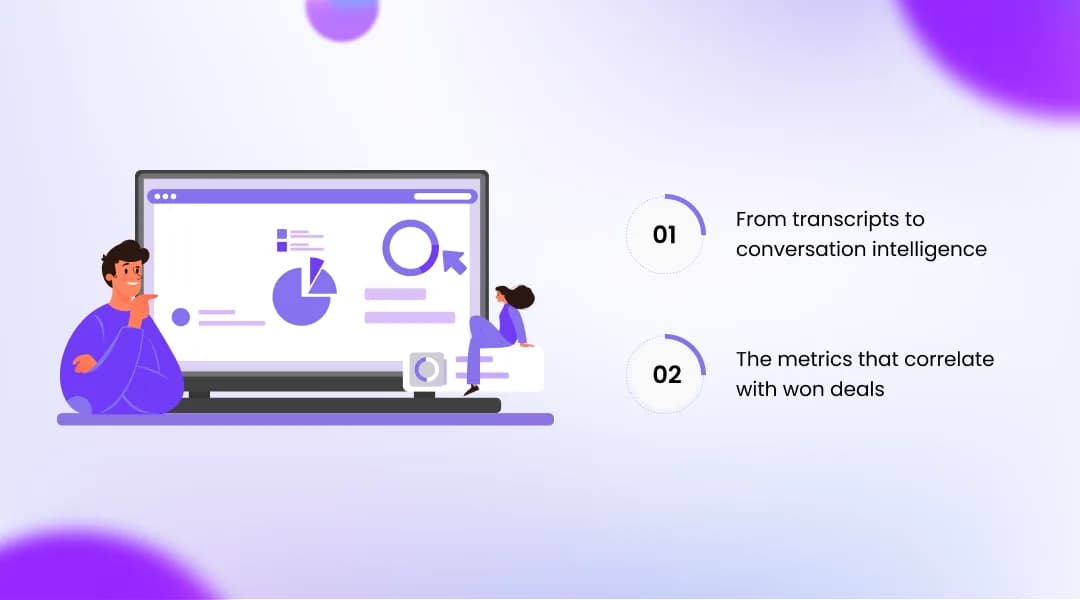
Call recording stores audio. Conversation intelligence reads it. The difference is the difference between a filing cabinet and an analyst who has listened to every single call.
From transcripts to conversation intelligence
Modern platforms run natural language processing and sentiment analysis across each conversation, then attach the output to your CRM. They tag objections, competitor mentions, questions asked, and the emotional turn in a call where a prospect leans in or pulls away.
Tools like Gong, Chorus by ZoomInfo, and Salesforce Einstein Conversation Insights built their reputation on exactly this. The point for a trainer is not the dashboard, it is the structured signal underneath it. Once a call is data, it becomes searchable, comparable, and teachable at scale.
The metrics that correlate with won deals
Not every metric matters. A few consistently separate closers from the rest, and these are the ones worth building training around:
Talk-to-listen ratio: Analysis from Auto Interview AI puts the ideal sales-call balance near 40% rep talking and 60% prospect talking. Reps who dominate the airtime usually close less.
Questions asked and their timing: Top performers ask qualifying and budget questions later and with more intent, not in the first two minutes.
Objection handling: How a rep responds to price and timing pushback is the single most coachable skill call analytics surfaces.
Sentiment shift: The moment a call turns warm or cold tells you which behaviors to repeat and which to retire.
Track these over weeks, not single calls, and patterns appear that no manager could catch by ear.
How to Turn Call Data Into a Coaching Playbook
This is where most articles stop and most teams stall. Insight without a workflow is just a prettier report. Here is the practical loop.
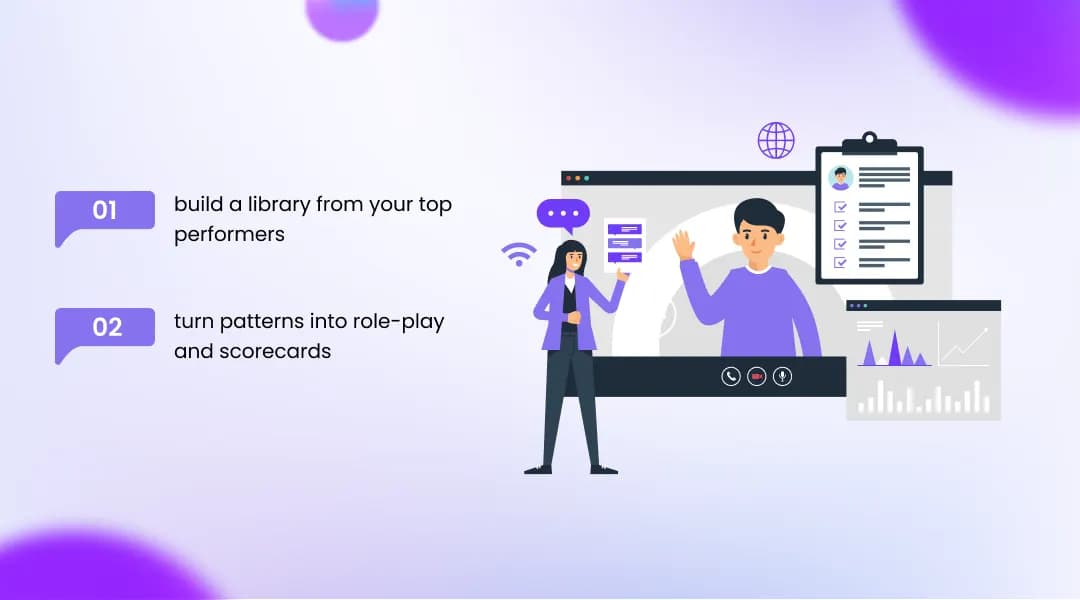
To turn call analytics into a sales training advantage, build a library of your top performers' real calls, score every rep against those benchmark behaviors, then run targeted role-play on the specific gaps the data exposes. Review the metrics monthly and refresh the library as your best calls change.
Step one: build a library from your top performers
Your best reps are already running the training program. You just have not recorded it. Pull the calls tied to won deals from your highest closers and organize them by skill, such as discovery, pricing, and objection handling.
This becomes your living top-performer call library. New hires study real winning moments from people they actually work with, not stock scripts from a generic course. In projects we have supported at OnDial, this single step shortens the "what does good sound like" question that slows every new rep down.
Step two: turn patterns into role-play and scorecards
Once you know what good sounds like, build call scoring scorecards around those behaviors. Score each rep against the benchmark, and the gaps tell you exactly what to drill. A rep stuttering on competitor questions does not need general training, they need ten role-plays on that one scenario.
Then close the loop. Effective sales coaching programs increase deal sizes, win rates, and new leads by 25 to 40%, according to Rain Group, but only when the coaching targets a specific behavior and gets reinforced. Generic coaching does not move that number. Targeted, evidence-based coaching does.
Data-Driven Sales Coaching for Indian Sales Teams
Most call analytics advice assumes an English-only, single-market sales floor. Indian teams do not work that way, and the coaching has to account for it.
Coaching across Hinglish and multilingual calls
A single Indian sales call can switch between Hindi, English, and a regional language inside one sentence. Generic transcription tools mangle this, and a mangled transcript produces useless coaching signal. Multilingual conversation intelligence has to handle code-switching to be worth anything here.
This is precisely where India-built voice AI earns its place. Accurate Hinglish transcription means objection patterns in Tier 2 and Tier 3 markets actually surface instead of getting lost as noise. The coaching is only as good as the data, and the data is only as good as the language model behind it.
Compliance and trust: DPDP and TRAI considerations
Recording and analyzing customer calls in India sits inside a real regulatory frame. The DPDP Act 2023 governs how you collect and process personal data from those conversations, and TRAI rules shape outbound calling itself.
Before you scale a call analytics program, two things matter:
Consent and storage: Make sure call capture and retention follow DPDP consent requirements, not just a vendor's default settings.
Outbound compliance: Align your dialing and recording practices with TRAI norms so your training engine does not create downstream legal risk.
I will be honest about the limit here: tools handle the analysis, but the compliance responsibility stays with you. A trustworthy program is built deliberately, not bolted on after launch.
How to Measure Whether Your Training Is Actually Working
If you cannot measure the lift, you cannot defend the budget. The good news is that call analytics gives you the measurement system for free, because it is already tracking the inputs.
Baseline metrics before you start
Before you change anything, record where you stand. Capture your current win rate, average deal size, sales cycle length, and new-hire ramp time as a baseline.
Without that snapshot, every later improvement is debatable. With it, you can attribute change to coaching rather than luck. This is the step impatient teams skip and later regret.
Connecting coaching to win rates and ramp time
After three to six months, compare the same metrics against your baseline and look at where you applied targeted coaching. Did talk-to-listen ratios move toward the benchmark? Did objection-handling scores rise on the reps you drilled?
The industry signal is encouraging. The 2025 Sales Enablement Landscape Report links structured enablement to a 42.2% win-rate improvement, and call analysis is now used by half of enablement teams. Your own before-and-after numbers, tied to specific coaching, are the proof that turns a pilot into a program.
Conclusion
Used well, call analytics for sales training turns your noisiest asset the daily flood of customer conversations into your sharpest teaching tool. When powered by an AI Voice Agent, every call becomes a source of actionable insights that help teams improve faster. Instead of relying on memory or assumptions, managers can coach from real evidence, identify patterns from top-performing conversations, and build training programs around proven winning behaviors. An AI Voice Agent also makes it easier to measure performance improvements against a clear baseline, ensuring that sales training delivers measurable business results over time.
You do not need to listen to every call to coach well. You need a system that surfaces the moments that matter and a way to drill them. That is the shift from feeling buried to feeling in control.
If your team sells across Hindi, English, and regional languages, the analytics are only as good as the transcription underneath them. OnDial builds India-first voice AI that captures those multilingual conversations accurately, so the coaching signal you act on reflects what your reps and customers actually said. Start there, and your call data stops being a black box and starts being a training advantage.