When response time slips from five minutes to thirty, the odds of qualifying a lead drop by 21 times. That single finding from the MIT Lead Response Management Study, which analyzed more than 15,000 leads, explains why so much advertising spend quietly evaporates. AI calling for real estate is the most direct fix: software that picks up or dials out within seconds, holds a natural conversation, qualifies the prospect, and books a showing before a competitor ever rings back. I have spent years at OnDial building voice AI for businesses across India, and I have watched good agents lose deals not because they lacked skill, but because they were standing in someone else's living room when the next call came in. If you feel like leads keep slipping through your fingers, you are not imagining it. This guide walks through how the technology works, what it genuinely costs, whether it sounds human, and the compliance questions Indian agents in particular need to ask before they switch it on.
Why Real Estate Leads Slip Away (and What That Costs You)
Most agents do not have a lead generation problem. They have a lead response problem, and the two look identical on a quiet month.
The speed-to-lead problem nobody schedules around
Speed-to-lead is the gap between a prospect raising their hand and you actually reaching them. According to LeadSimple research, 78% of sales go to the first agent who responds, regardless of price or experience. Yet industry data reported by Inman puts the average agent response time at roughly 917 minutes, which is over fifteen hours.
By the time you call back, the buyer has already spoken to two other agents. Forbes has reported that 71% of internet leads are wasted because of poor or slow follow-up. The lead was never bad. The timing was.
The after-hours gap that drains your pipeline
Buyers do not shop on your schedule. Research cited by EnvisionSFC finds that about half of all real estate leads arrive after business hours, when you are at dinner, asleep, or driving between listings.
Here is what makes it worse:
Voicemail is a dead end. Roughly 85% of callers who reach voicemail never call back. They simply dial the next number on the listing.
Missed calls are normal, not rare. Agents miss an estimated 40% to 46% of incoming calls during a typical week, because showings and closings cannot pause.
The cost compounds. At a modest commission, even two lost leads a month can quietly cost an agent thousands in annual income.
What AI Calling for Real Estate Actually Is
Let me clear up the biggest misconception first, because it is the one that makes agents hesitate.
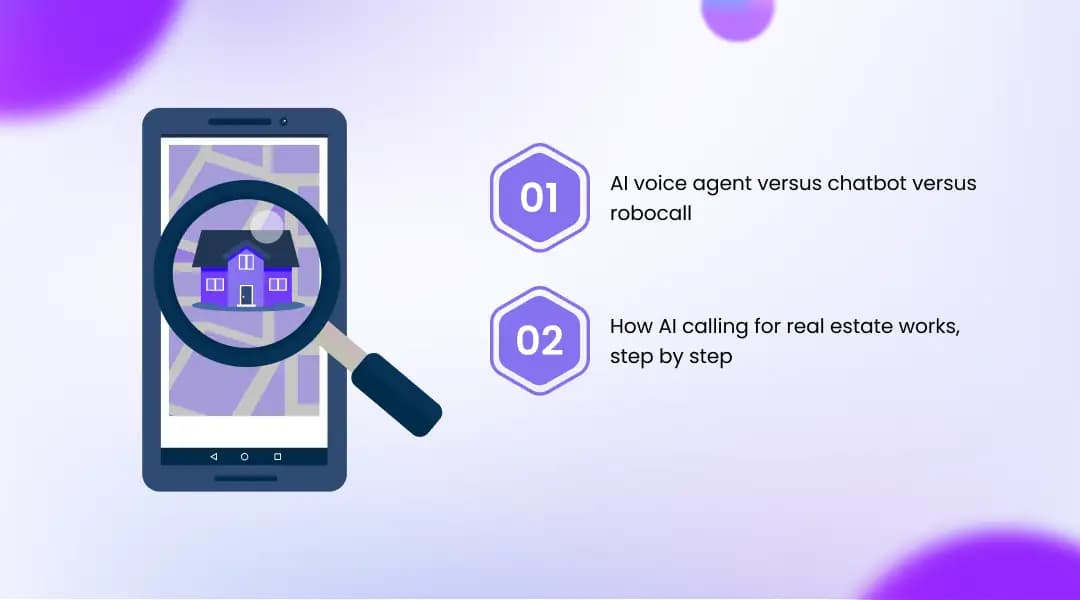
AI voice agent versus chatbot versus robocall
An AI voice agent is not a robocall and it is not a website chatbot. A robocall plays a recording. A chatbot types. An AI voice agent actually talks, listening and responding in real time using large language models and natural language processing.
The practical difference matters on the phone:
A robocall broadcasts one message and cannot answer a question. Buyers hang up.
A chatbot only works when someone is already on your site, and it never makes the outbound call that wins the race to respond.
An AI voice agent holds a genuine two-way conversation, understands property terminology, handles interruptions, and routes the call to you when a buyer is ready.
How AI calling for real estate works, step by step
AI calling for real estate works by instantly calling or answering a lead, asking qualifying questions about budget, timeline, and property type, then booking a showing or transferring hot buyers to a live agent while logging everything to your CRM. That is the whole loop, and it runs in under a minute.
In the projects we have deployed at OnDial, the flow is consistent. A lead submits a portal form or dials your listing number, and the voice agent engages within seconds. It introduces itself on behalf of your team, confirms which property the caller means, and asks the same qualifying questions a trained Inside Sales Agent (ISA) would. High-intent buyers get a live transfer or a booked viewing on your calendar, while exploratory callers enter a follow-up sequence so nothing goes cold.
How AI Voice Agents Qualify Leads and Book Showings
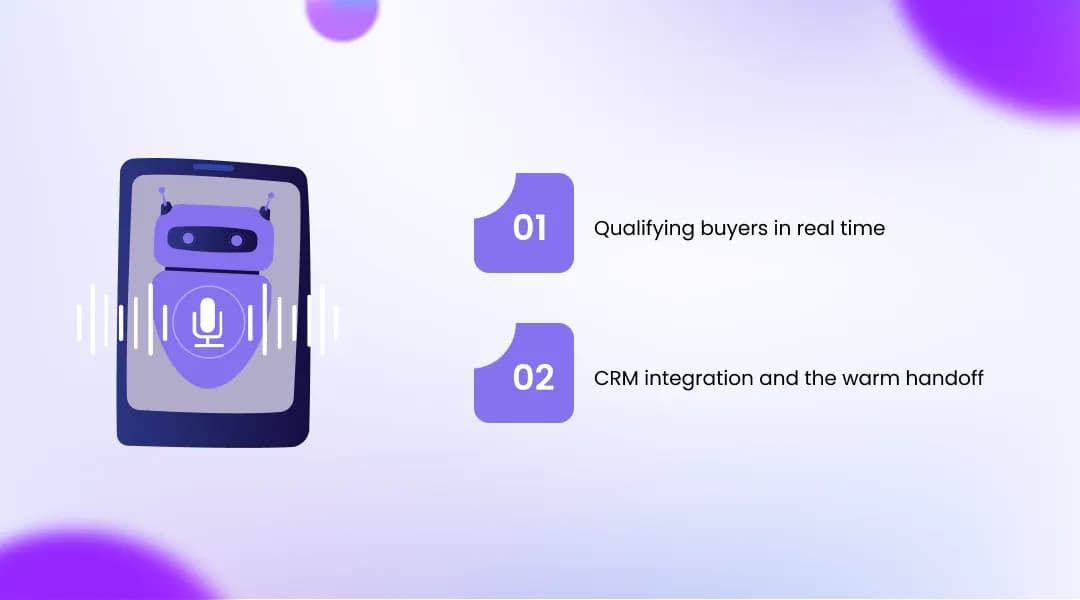
Qualification is where AI calling earns its keep, because consistency is something humans struggle to maintain at 9pm on a Sunday.
Qualifying buyers in real time
A good voice agent scores intent during the call itself, not afterward. It asks about timeline, budget, financing readiness, and property type, then categorizes the lead before anyone on your team lifts a finger.
This solves a problem agents rarely admit out loud. You do not actually want every call; you want the right ones. By filtering serious buyers from tyre-kickers and vendor spam automatically, the system hands you a shorter list of warmer conversations. Your hours go to closing, not screening.
CRM integration and the warm handoff
Qualification is useless if the data lives nowhere. Strong platforms sync natively with CRMs like Salesforce, HubSpot, and Zoho, writing call notes, contact details, and outcomes without manual entry.
The handoff is the part buyers feel:
Hot leads trigger an instant transfer or a confirmed showing on your calendar, with a confirmation message sent automatically.
Nurture-stage leads receive scheduled follow-ups, so a lukewarm prospect today is still in your pipeline next month.
Every call leaves a transcript and a clean summary, which means you walk into each conversation already knowing what the buyer wants.
(The quiet benefit here is psychological: agents stop dreading their own lead list.)
What AI Calling for Real Estate Costs
Time for the question everyone actually opened this article to ask.
Pricing and the real return on investment
AI voice agents for real estate typically cost between 500 and 1,500 dollars per month depending on call volume and features, which works out to roughly 70% to 85% less than a full-time human ISA. Industry analysis from monday.com and Aloware puts a human ISA at 40,000 to 60,000 dollars a year, while the software handles the same call volume at a fraction of that.
The math is not subtle. McKinsey has found that businesses deploying conversational AI cut customer service costs by 20% to 40% on average. When a single captured commission can dwarf a year of subscription fees, the return question almost answers itself, provided your lead volume is high enough to justify it.
Does it really sound human?
Here is the honest answer, and it is the part most vendor pages skip. Yes, modern AI voice agents sound convincingly human in most conversations, but they are not flawless, and quality varies enormously between platforms.
A well-trained agent handles natural pauses, interruptions, and follow-up questions about school districts or amenities by pulling from a knowledge base mid-call. A poorly configured one stumbles and loses the lead. This is exactly why I tell agents to demand a recorded production call before signing anything, not a polished demo script. The technology is genuinely good now. The implementation is what separates a booked showing from a hang-up.
The India Angle: The Compliance Layer Most Guides Skip
Almost every guide ranking for this topic was written for the US market. If you operate in India, that advice is incomplete in a way that can get your numbers disconnected.
TRAI DLT, DPDP, and RERA
AI calling in India is legal, but it sits under several regulators at once. For real estate specifically, you are looking at three layers working together.
TRAI DLT governs commercial outbound calls, requiring sender registration, template approval, and scrubbing against the DND registry. TRAI's detection systems now actively flag bulk AI calling patterns.
The DPDP Act requires informed consent, purpose limitation, and data erasure rights, with penalties that can reach 250 crore rupees for serious breaches.
RERA adds real estate disclosure duties: marketing claims about possession dates, carpet area, and amenities must match the project filing, and brokers must disclose their status when asked.
Regional language and Hinglish
A buyer in Rajkot or Pune is not always going to converse in clean English. The platforms that actually convert in India support Hindi, regional languages, and natural Hinglish code-switching trained on Indian telephony audio.
This is not a nice-to-have feature; it is the difference between a qualified lead and a confused caller who hangs up. At OnDial we treat regional-language fluency and DLT compliance as the starting line, because a voice agent that cannot speak the way your buyer speaks, or that risks a regulatory flag, is not saving you anything. It is creating a new liability.
The Bottom Line on AI Calling for Real Estate
AI calling for real estate is not about replacing you; it is about making sure you are the first agent every buyer reaches, every time. Three things matter most: respond in seconds because the first responder wins, qualify automatically so your hours go to closing, and in India, never deploy without TRAI, DPDP, and RERA compliance built in. You no longer have to choose between being present at a showing and answering the lead that lands during it.
That is the shift. Calmer pipeline, warmer conversations, fewer leads lost to a competitor's faster phone. If you want to see what a compliant, regional-language AI voice agent sounds like on a live property call, book a demo with OnDial and ask us to play you a real recorded conversation, not a script. Hear it before you decide.