Here's a number that stopped me the first time I saw it: 83% of customers say they'd avoid a company altogether if it still uses a frustrating phone menu, according to research from Landis Technologies. If you run a logistics company, that stat isn't abstract. It's the shipper who gives up on "press 3 for tracking" and calls your competitor instead.
I get it if you're tired of vendor pitches that promise the phone system will fix everything. You've heard it before, and most of it didn't hold up under real call volume. So let's be direct: an AI voice agent understands natural speech and resolves requests end-to-end, while traditional IVR routes callers through a fixed menu of pre-recorded options and keypad presses. That's the core difference, and it's the one that decides whether your customers get an answer or a runaround.
At OnDial, I've spent enough time inside logistics call queues to know where this actually breaks or holds up. In the sections below, I'll walk through what each system does, where the real gap shows up for carriers and 3PLs, what the ROI numbers actually say, and how to decide which one your operation needs. No fluff, no forced upsell. Just what I'd tell a friend running dispatch.
What Traditional IVR Actually Does in a Logistics Call Center
Traditional IVR isn't useless. It was built for a specific job: sort high call volume into buckets fast, cheaply, and predictably. For decades, that job was good enough.
But logistics calls rarely sort cleanly. A shipper calling about a delayed pallet might also need a new pickup window. A driver checking in might also have a route exception. IVR wasn't designed for that kind of overlap, and it shows.
How IVR Menus Handle Shipment and Dispatch Calls
A typical IVR flow in a freight or 3PL call center looks like this: the caller dials in, hears a recorded menu, presses a number for "tracking" or "dispatch," and gets routed based on that single input. The system uses DTMF (Dual-Tone Multi-Frequency) signaling, meaning it listens for keypad tones, not spoken intent.
That works fine when the request is simple, and the caller already knows which menu option fits. It falls apart fast when it doesn't.
Single-path routing: Every possible caller need has to be pre-mapped to a menu option before the system goes live, which is nearly impossible in logistics where exceptions are the norm.
No context carryover: If a caller picks the wrong option, they usually start over from the top, adding minutes to a call that should have taken thirty seconds.
Rigid escalation: Menu trees don't ask clarifying questions. They either match an option or transfer the caller somewhere that may not have the answer either.
Where IVR Breaks Down for Carriers and 3PLs
Logistics has a volume problem that makes IVR's weaknesses worse than in most other industries with AI voice agents for logistics customer updates. WISMO ("where is my order?") contacts make up an estimated 40 to 50 percent of all logistics customer inquiries. That's a staggering share of call volume riding on a system that can only route, not resolve.
Industry benchmarks put traditional IVR containment rates at 20 to 40 percent, according to CallBotics, meaning most calls still land on a human agent regardless of how the menu is designed. In a logistics call center already stretched thin during peak season, that gap is where SLAs slip and dispatchers burn out.
I've seen this pattern repeat across the logistics operators we've worked with: the phone system was never the bottleneck people assumed it was. It was the menu forcing every unique request into a handful of generic buckets.
What an AI Voice Agent for Logistics Actually Does
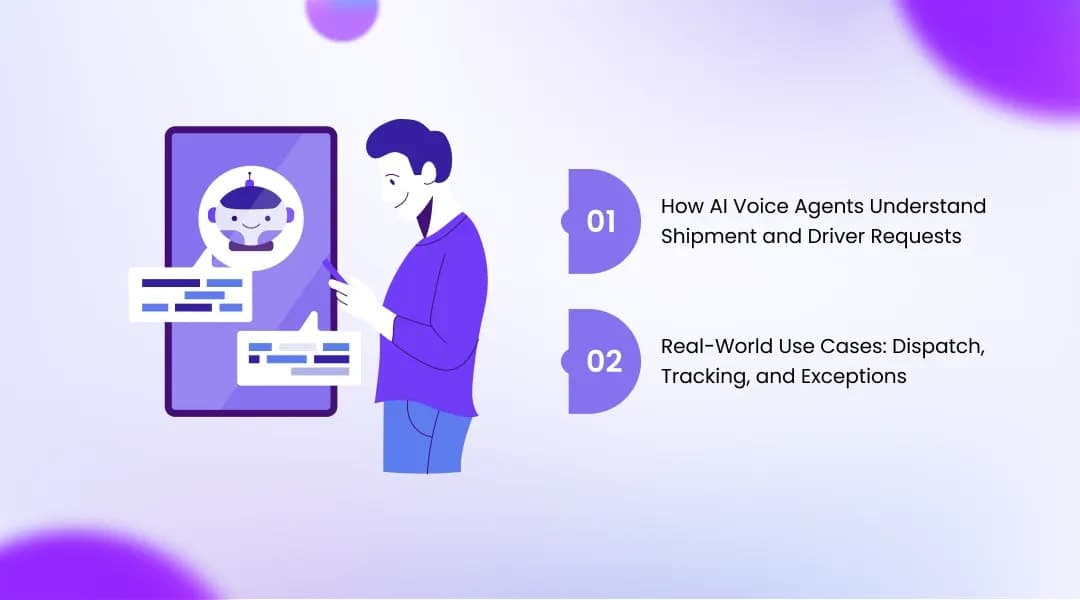
An AI voice agent flips the model. Instead of the caller adapting to the system, the system adapts to the caller. It listens, understands intent, and takes action, all in the same call.
How AI Voice Agents Understand Shipment and Driver Requests
Under the hood, a logistics-focused AI voice agent runs on a layered architecture: speech-to-text (STT) converts spoken words into text, natural language processing (NLP) interprets intent, and an action layer executes the request against your existing systems. This is why a driver can say, "I'm at the gate, but my BOL number got wet, can you look it up by PRO number?" and get an actual answer instead of a transfer.
Definition worth remembering: an AI voice agent is a conversational system that uses speech recognition and NLP to understand spoken requests and complete tasks, without forcing callers through a fixed menu.
That single shift changes what a call center can handle without adding headcount:
Multi-intent handling: A shipper asking about a delayed shipment and then pivoting to a billing question gets both answered in one call, no restart required.
24/7 coverage across time zones: Drivers hitting road closures at 3 a.m. or shippers in different regions get answered immediately instead of hitting voicemail.
Multilingual dispatch: Fleets running Spanish, Polish, or Ukrainian-speaking drivers can get native-language dispatch support without staffing separate lines.
Real-World Use Cases: Dispatch, Tracking, and Exceptions
This isn't theoretical. Logistics operators are already running AI voice agents against specific, high-volume call types.
One example we've seen cited industry-wide: a logistics deployment reduced dispatcher call volume by roughly 50% by handling MC number verification, shipment status extraction, and load confirmations automatically. Another, documented by Retell AI, cut average handle time from 6 minutes down to 3.8 minutes for a logistics firm after deploying voice AI.
The pattern across these deployments is consistent. AI voice agents aren't replacing judgment calls. They're absorbing the repetitive 80% (tracking, scheduling, check-calls) so dispatchers can spend their time on the 20% that actually needs a human with OnDial.
Is AI Voice Actually Better Than IVR for Logistics Companies?
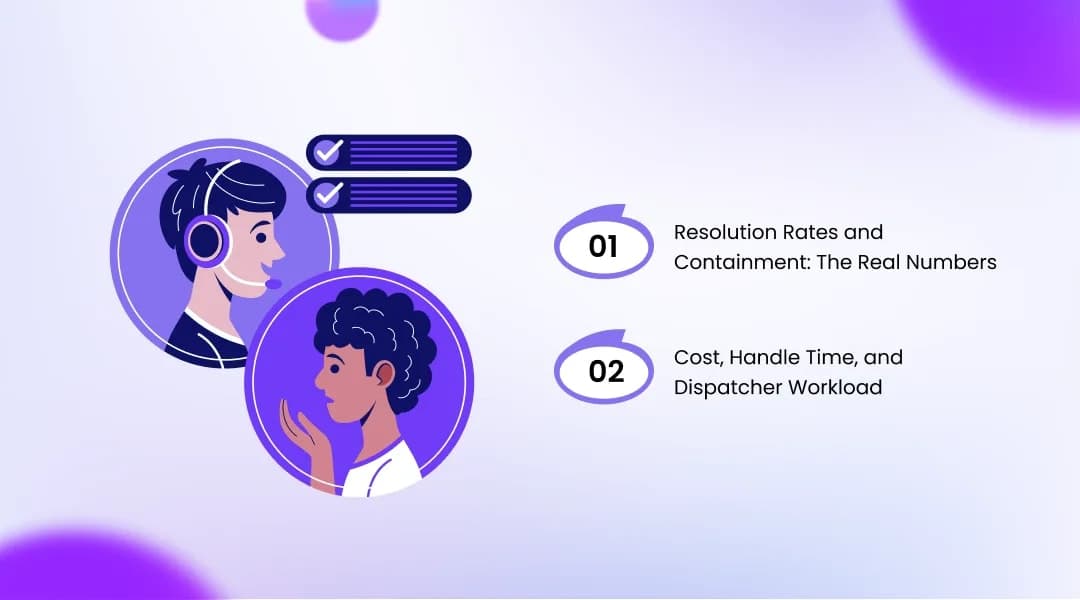
Short answer: for the calls that make up most of your volume, yes. For a handful of simple, predictable routing tasks, IVR still has a role. Let's look at where the data actually lands.
Resolution Rates and Containment: The Real Numbers
Featured snippet answer: AI voice agents typically raise call containment from IVR's 20-40% range to roughly 50-75%, and lift first-call resolution to 85-95%, compared to 65-75% for IVR self-service, according to CallBotics.
That gap compounds in logistics because of how many calls are variations on the same theme. A tracking question, a delivery exception, a reschedule request: these aren't edge cases; they're the bulk of the queue. When the system resolving them can only route 20-40% without a human, the rest lands squarely on your team.
Cost, Handle Time, and Dispatcher Workload
Logistics dispatchers reportedly spend around 6.5 hours per workday on exception management and check-calls, per Ampcome's enterprise logistics research. That's not strategic work. That's a phone line problem wearing a staffing problem's clothes.
Voice AI deployments in logistics have reported 40% lower call center costs and 28% faster resolution on tracking inquiries, according to data compiled by GrowwStacks with AI voice agents for call centers. I won't pretend every deployment hits those exact numbers. Results vary by call mix, integration depth, and how well the use cases are scoped at launch. But the direction is consistent across every source I checked.
What's the ROI of AI Voice Agents in Logistics?
This is usually the question that decides whether a pilot gets approved. Fair enough. Nobody should greenlight a phone system change on vibes.
Where the Savings Actually Come From
The ROI isn't a single line item. It shows up in three places at once, and logistics companies tend to underestimate the third.
Direct cost reduction: Fewer routine calls landing on paid agent time, especially for WISMO and status checks that make up nearly half of inbound volume.
Reduced abandonment and missed opportunity: Industry data points to 20-30% of inbound business calls going unanswered or abandoned entirely, per Retell AI. In logistics, an abandoned call can mean a missed pickup window or a lost booking.
Dispatcher time recovered: Every hour not spent on a routine check-call is an hour available for exception handling, the work that actually needs a person.
One documented case from CallSphere shows AI voice agents answering logistics calls within two rings, 24/7, across more than 50 languages, specifically to handle WISMO floods and delivery exceptions without adding staff.
What to Expect in the First 90 Days
I'd rather set honest expectations than oversell a timeline. Most well-scoped deployments start narrow: one or two high-volume intents, like shipment status or delivery scheduling, running alongside your existing IVR or phone system. That's intentional.
Trying to automate every call type on day one is how pilots fail. Starting with the highest-volume, most repetitive intent, letting it run, then expanding, is how they succeed. This is the approach we push for at OnDial, because we'd rather show a partner a working use case in month one than a broken promise in month six with AI voice agents by industry.
Do AI Voice Agents Integrate with TMS, WMS, and ERP Systems?
Yes, and this is where the "just a chatbot with a voice" skepticism usually falls apart once people see it in practice.
Integration Basics
A properly built AI voice agent for logistics connects to your Transportation Management System (TMS), Warehouse Management System (WMS), and ERP, reading live data during the call rather than working from a static script. That's what lets an agent pull a real shipment status instead of guessing, or log a driver check-in directly into your system of record.
This also means the agent can write back, not just read. A confirmed delivery window, an updated ETA, a proof-of-delivery note: these can be logged automatically instead of requiring a dispatcher to type it in after the call ends.
What This Means for Your Existing Tech Stack
You don't need to rip out your phone system or your TMS to test this. Most integrations sit alongside what you already run, connecting through existing APIs rather than replacing core infrastructure.
That said, integration depth is where deployments genuinely differ, and it's worth asking hard questions here. Ask any vendor exactly which systems the agent reads from and writes to, and what happens when a lookup fails mid-call. If they can't answer clearly, that's worth noting before you sign anything.
How to Decide: IVR, AI Voice Agent, or Both?
Neither system is inherently right for every call. The honest answer depends on your call mix.
When IVR Still Makes Sense
IVR is fine, even good, for simple, predictable routing where the outcome is always the same. Think office hours, department transfers, or a single yes/no branch with no follow-up questions. If that describes most of your call volume, a full replacement probably isn't worth the disruption.
When to Make the Switch
If WISMO calls, delivery exceptions, or driver check-ins make up a meaningful share of your queue, and they usually do in logistics, an AI voice agent solves a problem IVR structurally can't. It's not about replacing every human touchpoint. It's about routing the repetitive 80% away from your team so the remaining calls get the attention they actually need.
Conclusion
AI voice agents vs traditional IVR for logistics companies isn't a close call once you look at where your call volume actually sits. IVR routes; AI voice agents resolve. And when WISMO calls alone make up close to half your inbound volume, that difference determines whether your dispatchers spend their day on exceptions or on repetition.
Three things matter most here: IVR was built for volume, not complexity; AI voice agents raise containment and resolution rates where it counts; and the ROI shows up in cost, abandonment, and recovered dispatcher time, not just one line item.
You don't have to guess at this. If you're weighing whether your call center actually needs a rebuild or just a smarter front line, that's exactly the kind of conversation we have with logistics teams at OnDial every week, grounded in your real call data, not a generic pitch.
Curious what an AI voice agent would actually do with your WISMO and dispatch call volume? That's a conversation worth having before your next peak season, not during it.