Voice AI now handles 19% of inbound contact-center volume in 2026, up from just 6% in 2024, according to Forrester Wave research. That is a steep climb in two years. And it is exactly why the words call bot and chatbot keep getting tangled together in sales decks, vendor pitches, and your own team's planning meetings.
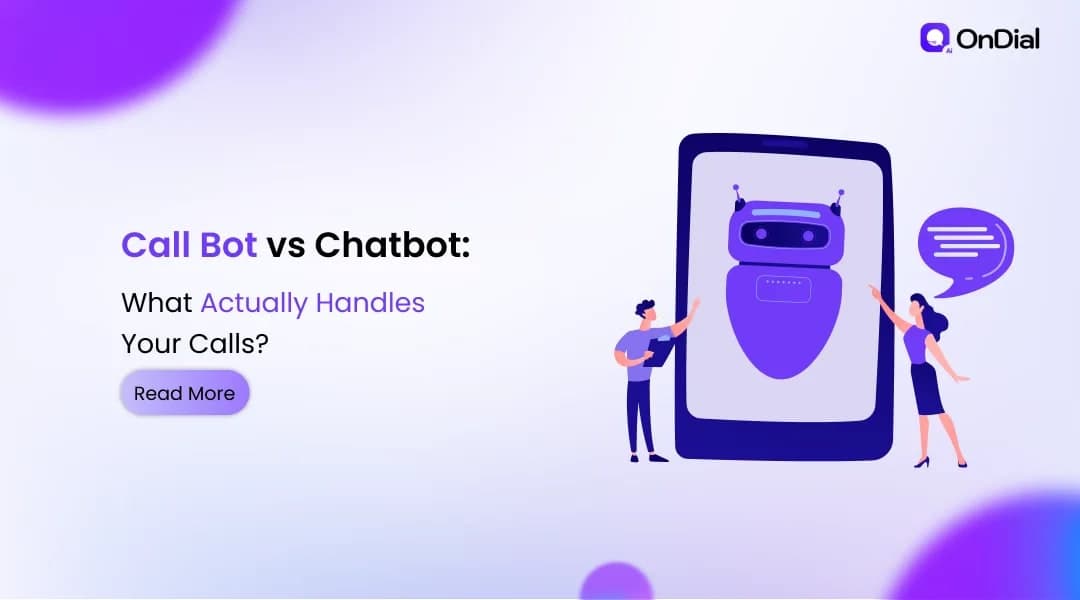
If you have ever stared at those two terms and quietly wondered which one picks up a ringing phone, you are not behind. You are asking the right question. Here is the short version of call bot vs chatbot: a call bot speaks on phone calls, while a chatbot types in a chat window. Same underlying AI, completely different doorway into your business.
I run voice AI deployments at OnDial, and I have watched smart founders buy the wrong tool simply because nobody drew this line clearly. So let me draw it. By the end, you will know which one answers your calls, which one belongs on your website, and why a surprising number of businesses end up running both.
What Is a Call Bot vs a Chatbot?
The cleanest way to separate these two is to ignore the marketing and look at the channel each one lives on. One listens and talks. The other reads and types.
The Core Difference in One Line
A call bot handles voice conversations over the phone using speech recognition and text-to-speech, so it can answer a ringing line and talk back. A chatbot handles typed conversations inside a website, app, or messaging window. The simplest test: if it speaks, it is a call bot. If it types, it is a chatbot.
That sounds almost too obvious to write down. But the confusion is real, and it is costly. I have sat in meetings where a team spent six weeks evaluating "chatbots" when what they actually needed was something to answer their phone lines at 9 PM. Wrong tool, wrong channel, weeks lost.
Why the Names Blur Together
The reason these terms overlap is that they share a brain. Both rely on the same family of language technology to understand what a person means and respond sensibly.
NLU (Natural Language Understanding): figures out the intent behind a sentence, whether it was spoken or typed.
NLP (Natural Language Processing): the broader engine that parses and structures human language.
The difference sits at the edges: a call bot adds ASR (automatic speech recognition) to hear you and TTS (text-to-speech) to talk back. A chatbot skips both because text is already text.
So when a vendor says "our chatbot can also do voice," what they usually mean is they bolted speech recognition onto a text engine. Sometimes that works. Often it does not, because voice is a far harder problem than it looks.
How a Call Bot Actually Handles a Phone Call
A call bot is voice automation built for the one channel that still drives the most urgent customer moments: the phone. When someone calls, they usually want something resolved now, not a ticket number.
What Happens in the Half-Second After the Phone Rings
A lot happens between "ring" and the bot's first word, and the timing is brutal. A caller expects a reply in under a second. Go past two seconds of silence and they assume the line dropped, then they start talking over the bot.
ASR converts the caller's speech into text in real time, accents and background noise included.
NLU reads the intent, so "I need to push my appointment" and "can we move my booking" land in the same place.
TTS turns the reply into a natural-sounding voice, and barge-in handling lets the caller interrupt mid-sentence, the way real conversations actually work.
This is the part most people underestimate. A chatbot can pause to think. A call bot cannot. Every delay is audible, and latency under 400 milliseconds is the difference between a conversation and an awkward standoff.
Where Call Bots Earn Their Keep
The economics here are hard to argue with. AI voice interactions cost roughly $0.50 to $1 per call versus $5 to $8 for a human-handled one, according to IBM data. That gap is why call bots have moved from novelty to necessity.
In the deployments we have run at OnDial, the highest-value use cases are almost always phone-first and repetitive:
Appointment booking and reminders for clinics, where no-shows quietly drain revenue.
Order and delivery status calls that would otherwise pile onto a small support team.
Loan recovery and payment reminders for lenders, handled politely and at scale, with full TRAI DLT consent records intact.
One honest caveat: a call bot is not a therapist. For an angry customer with a billing dispute, the right move is a fast, clean handoff to a human, not a bot trying to win them over.
How a Chatbot Handles Customer Conversations
A chatbot for customer service lives in text. Website widgets, WhatsApp, in-app messengers. It is the tool people picture first when they hear "AI," partly because it has been around the longest.
Text Is a Different Game Than Voice
Text gives the AI room to breathe. There is no ticking latency clock, no accent to decode, no background TV noise. A user types, the bot reads, and a half-second pause feels perfectly normal.
That comfort changes what is possible. A chatbot can show buttons, share a link, drop an image, or paste a step-by-step list right into the conversation. Try doing that out loud on a phone call and you will see why the two channels are not interchangeable.
Where Chatbots Win
Chatbots shine when the interaction is visual, self-paced, or something the customer would rather not say out loud. Consumer preference backs this up: roughly 68% of consumers say they prefer AI for simple status-style questions in 2026, up from 41% in 2024, per Forrester research.
FAQ and product lookups where people want to scan, not listen.
Form-style tasks like uploading a document or screenshot, which voice simply cannot do.
Late-night browsing on your website, catching the visitor who is comparing options at 11 PM and not ready to call.
The catch? Plenty of customers ignore the chat widget entirely and reach for the phone anyway. A chatbot only helps the people who choose to type.
Call Bot vs Chatbot: The Comparison That Actually Matters
Here is where the AI voice agent versus chatbot question gets practical. Forget the feature lists. The decision comes down to where your customers start the conversation.
The Comparison at a Glance
Factor | Call Bot (Voice) | Chatbot (Text) |
Channel | Phone lines, voice | Website, WhatsApp, in-app chat |
Core tech | ASR + NLU + TTS | NLU + text engine |
Speed pressure | Under 1 second, unforgiving | Relaxed, pauses are fine |
Best for | Urgent, hands-free, spoken tasks | Visual, self-paced, typed tasks |
Can share links/images? | No | Yes |
Handles a ringing phone? | Yes | No |
That last row is the one people forget. A chatbot will never answer your phone. If missed calls are your problem, a chatbot is not your fix.
The India Layer Nobody Mentions
This is the gap I see in almost every voice vs text customer support comparison written for a global audience: it ignores how Indians actually talk on the phone. And on the phone, we code-switch constantly.
Roughly 57% of urban Indian business conversations happen in Hinglish, a fluid mix of Hindi and English that switches mid-sentence, per Auto Interview AI's 2026 analysis. A caller might say, "Haan product accha hai, but pricing ka breakdown bhej do na." A call bot built for clean English falls apart on that line. A call bot built for Hinglish code-switching keeps the thread.
There is a compliance layer too. Outbound voice in India runs under TRAI DLT registration, and customer data sits under the DPDP Act 2023. A generic global chatbot rarely accounts for either. This is precisely the ground we built OnDial to stand on.
So Which One Should You Actually Use?
Counter-intuitive truth: the right answer is rarely "pick one." It is "pick the right one for each channel, then connect them."
Start With the Channel, Not the Tech
Ask one question before you compare a single feature. Where do your customers actually reach out? If your phone rings all day and you are losing leads to voicemail, a call bot is the obvious starting point. Contractors and home-service businesses miss 60 to 80% of incoming calls, per industry data, and each one can be worth thousands.
If instead your traffic is online and people browse before they buy, a chatbot catches them where they already are. The mistake is choosing based on what is trendy rather than where your customers live.
Why Most Businesses End Up Running Both
Once you map your channels honestly, a pattern shows up. Most growing businesses do not have a voice problem or a chat problem. They have both.
Chatbot handles the website browser comparing your pricing at midnight.
Call bot handles the customer who wants an answer now and dials your number.
Shared CRM ties them together, so a conversation that starts in chat and moves to a call does not start from zero.
The Indian voice AI market reflects this momentum, projected to grow from $153 million in 2024 to $957 million by 2030 at a 35.7% CAGR, according to NextMSC. Voice is not replacing chat. It is finally taking its rightful seat next to it.
Conclusion
Sorting out call bot vs chatbot comes down to three things you now know cold. A call bot speaks and answers phones; a chatbot types inside chat windows. Each one belongs on the channel where your customers actually show up. And for Indian businesses, Hinglish fluency plus TRAI DLT and DPDP compliance separate a tool that works here from one that only claims to.
You came in unsure whether an IVR or an AI Voice Agent was the right choice for answering your business calls. You leave knowing exactly what each does, where an AI Voice Agent delivers the greatest value, and why most successful businesses use both together. That clarity is worth far more than any feature list.
If your phones are the bottleneck, in Hindi, English, or Hinglish, that is the exact problem OnDial was built to solve. Book a demo and hear a call bot handle a real conversation, code-switching and all, before you commit to anything.