Here is a number that should bother every logistics operator: roughly half of all return-to-origin cases in Indian e-commerce happen not because of bad addresses or damaged parcels, but because the customer was simply unreachable when it mattered. In India, RTOs now cost high-volume brands up to 1.5% in revenue, with about half caused by unreachable customers. Delivery calls with AI agents exist to close exactly that gap. An AI delivery agent is a voice system that places and answers delivery-related calls, understands natural speech, and completes tasks like confirming, rescheduling, or verifying an order without a human on the line.
If you run delivery operations, you already feel this. The endless confirmation calls. The "where is my order" floods during festive peaks. The coordinator burning an afternoon on shift reminders.
I work on these flows every day at OnDial, and the pattern is always the same: most delivery calls are repetitive, time-sensitive, and perfect for automation, while a small slice genuinely needs a person. If you're exploring how AI transforms customer interactions across the supply chain, read our guide on AI Voice Agents for Logistics Customer Service. This guide breaks down which delivery calls AI agents handle well, where they fail, and what that looks like in Indian logistics specifically.
Why Delivery Calls Quietly Drain Logistics Profit
The cost of delivery calls rarely shows up as a single line item. It hides inside missed deliveries, second attempts, and support headcount. That is what makes it dangerous.
The Hidden Cost of Last-Mile Communication
Last-mile failure is mostly a communication failure, not a routing one. A driver reaches the address, the customer does not answer, and the parcel starts its slow journey back to origin. Last-mile delivery failures account for around 53% of total logistics costs, because exception mismanagement compounds both forward and reverse shipping charges.
The phone is where most of this is supposed to get resolved, and it usually does not. "Where is my order" queries account for roughly 70% of all customer service contacts in logistics and e-commerce, making them the single largest driver of support cost across the supply chain. That is a staggering amount of human time spent reading out tracking statuses.
Why Most Failed Deliveries Are a Phone Problem
In COD-heavy Indian markets, the math gets worse. Cash-on-delivery orders carry the highest RTO rates, with nearly 26% of COD shipments returned, compared with under 2% for prepaid orders. A confirmation call before dispatch is often the only thing standing between a sale and a return.
Here is the uncomfortable truth for ops leaders relying on manual calling teams:
Speed beats effort. Automated NDR resolution workflows hit 40-60% conversion, while manual processes manage only 10-20%.
Volume breaks humans. A manual floor cannot absorb 10,000 simultaneous calls on a festive Monday, while a voice system treats it as routine.
The window is tiny. Unresolved failed-delivery events convert to returns within 24 to 72 hours, so a call placed the next afternoon is often too late.
How AI Agents Handle "Where Is My Order" Calls
WISMO is the obvious starting point, because it is the highest-volume and most repetitive call type in the entire delivery cycle. WISMO simply means a customer asking "where is my order."
Real-Time Status Lookups Without Hold Music
When a customer calls to ask about their package, an AI agent pulls live tracking data from your TMS or order system and answers in plain language. It can read the current status, give an estimated window, and offer a reschedule, all in one short call.
This is where the volume relief shows up. AI agents handle 80-90% of WISMO calls without human intervention, and for a company receiving 3,000 such calls a day, that can free up 15 or more human agents. The agent connects to platforms like Locus, FarEye, or LogiNext so the status it reads is the real one, not a stale guess.
When to Escalate to a Human
How many of those calls actually needed a person? Probably far fewer than your team assumes.
A well-built agent is designed to know its own limits. It resolves routine status and reschedule requests, then hands off cleanly when the situation gets messy:
Damaged or lost shipment disputes, where empathy and judgment matter more than data.
Repeated failures on the same order, which usually signal a deeper problem.
Angry or escalating callers, who should reach a human quickly with full context attached.
(The goal was never full automation. It is removing the 80% of calls that are pure repetition so your people can own the 20% that are not.)
How AI Agents Rescue Failed Deliveries Before RTO
This is the highest-value use case in Indian logistics, full stop. An NDR (non-delivery report) is the flag raised when a delivery attempt fails, and an RTO is what happens when that parcel finally gives up and returns to the seller.
The NDR Window: Why Minutes Matter
The moment a delivery fails, a countdown starts. The faster you reach the customer, the higher your chance of saving the order. AI agents call within minutes of the failure, explain that an attempt was made, and offer a one-step reschedule.
The recovery numbers are consistent and meaningful. When a failed delivery triggers an automated voice or message follow-up, 35-50% of those customers respond and successfully receive the order on the rescheduled attempt. In projects I have seen, that single workflow often pays for the entire deployment, because every saved order is a doubled freight cost avoided.
Address Verification Before Dispatch
The cheapest failed delivery is the one that never happens. AI agents call to verify incomplete or suspicious addresses before the parcel leaves the warehouse, catching errors at the lowest-cost point in the chain. Incorrect addresses cause an estimated 8-12% of failed deliveries, so verifying before dispatch saves the entire attempt cost.
For COD orders, the same call doubles as a soft confirmation of intent. A customer who confirms on the phone is far less likely to refuse at the doorstep. That is direct RTO prevention, not just a nice-to-have notification.
How AI Agents Coordinate Drivers and Delivery Partners
Not every delivery call is customer-facing. A huge share of logistics calling happens internally, and it is just as repetitive.
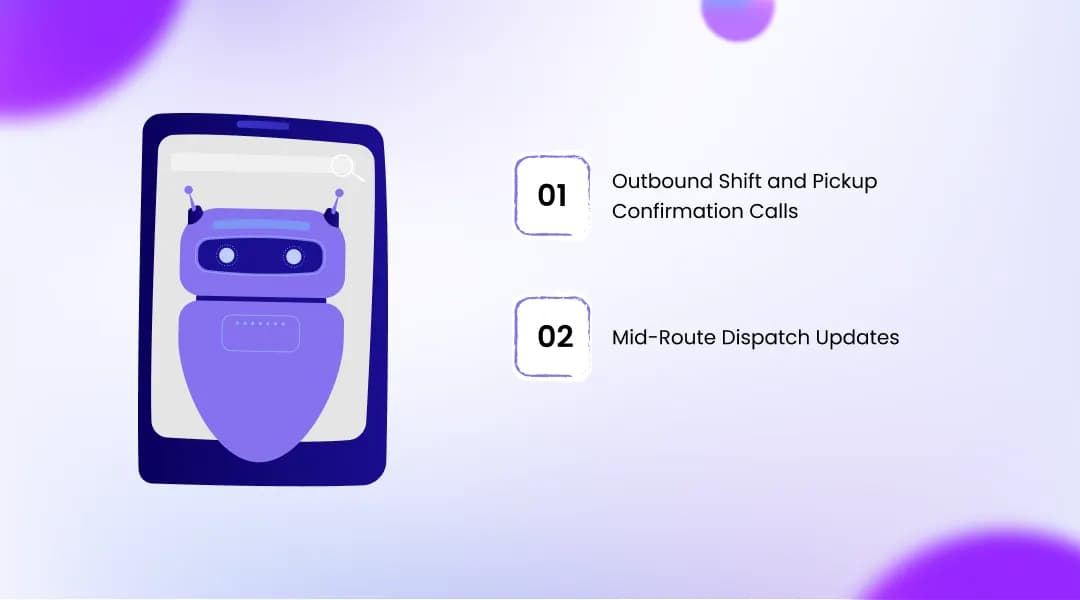
Outbound Shift and Pickup Confirmation Calls
A lot of an ops coordinator's day is the same handful of calls on repeat: confirming rider shifts, verifying pickup windows with sellers, and assigning driver slots. These calls are essential and mind-numbing in equal measure.
AI agents run this routine outreach at scale. They confirm shifts the night before, ring pickup reminders on the morning of, and flag no-shows early so the day does not fall apart at 9 AM. This mirrors what large players are already doing. DHL Supply Chain has deployed AI agents to autonomously handle routine phone calls, including follow-up calls with drivers and warehouse coordination.
Mid-Route Dispatch Updates
Routes change mid-day. New priority pickups, customer reschedules, a vehicle breakdown. Reaching drivers fast, without making them stare at an app while driving, is its own coordination tax.
A voice agent delivers clear, spoken instructions directly to drivers and captures their confirmation. It can also push updated timelines to affected recipients the instant a delay is logged. C.H. Robinson built and deployed more than 30 AI agents that perform millions of shipping tasks, acting on data autonomously rather than just analyzing it.
Why Multilingual Voice AI Is Non-Negotiable for Indian Logistics
This is the part most global guides skip, and it is the part that decides whether a delivery agent actually works in India. A delivery call only succeeds if the customer understands it.
Regional Language Coverage Across Tier 2 and Tier 3 Cities
India's delivery volume is exploding well beyond metros, and those customers do not all speak Hindi or English. A delivery agent that cannot switch languages is a delivery agent that gets hung up on.
Strong platforms now cover the real linguistic spread of the country. Leading Indian voice AI platforms support 14 Indian languages with models trained on telephony-grade audio, including Hindi, Tamil, Telugu, Kannada, Marathi, Bengali, Gujarati, and Hinglish code-switching. At OnDial, this is exactly why we build delivery flows around regional language first rather than bolting it on later.
Compliance: DLT, DPDP, and Consent
Automated outbound calling in India is regulated, and ignoring that is a fast way to get your numbers blocked. Any serious delivery-calling setup has to respect the rules.
TRAI DLT registration governs template and sender compliance for automated outreach.
The DPDP Act 2023 sets expectations around consent and handling of customer data captured on calls.
Disclosure and consent reads need to be consistent on every single call, which is one area machines genuinely beat humans. Voice agents hit 96-99% script and disclosure adherence, versus 70-85% for human floors.
What AI Delivery Agents Cannot (and Should Not) Do
Let me be honest about the limits, because anyone promising full automation is selling you something. AI delivery agents are excellent at volume and consistency, and weak exactly where humans are strong.
Where Human Judgment Still Wins
There are calls that should never be fully automated. A genuinely distressed customer whose medication did not arrive. A high-value dispute. A sensitive complaint that needs a real apology and a real decision.
The right model is a fallback-to-human workflow, not a wall of automation. The agent handles the routine majority and routes the human-sized problems to a human with the full conversation context already attached. Pushing automation past that line damages trust faster than it saves money.
How to Measure if It Is Working
Is this actually worth it for your operation? You will only know if you track the right numbers from day one.
Watch these metrics, not vanity stats:
NDR-to-delivery conversion rate, which tells you if your failed-delivery recovery is real.
WISMO deflection rate, the share of status calls resolved without a human.
RTO percentage trend over 60 to 90 days, since most teams see meaningful ROI in that window.
Escalation rate, because a healthy agent escalates the hard calls instead of bluffing through them.
Conclusion
Handling delivery calls with AI agents is not about replacing your team. It is about pointing your team at the calls that need them. The three takeaways worth keeping: failed deliveries are mostly a communication problem you can automate, the NDR recovery window is where the money is saved, and multilingual plus compliant calling is what makes any of this work in India.
You do not have to automate everything at once. Start with your highest-volume, most repetitive call type, measure it, and expand from there.
At OnDial, we build delivery-call flows around exactly this logic: regional language first, NDR recovery as the priority workflow, and clean human handoff for the calls that deserve a person. If your coordinators are still dialing manually through the festive peak, that is the workflow to fix first.