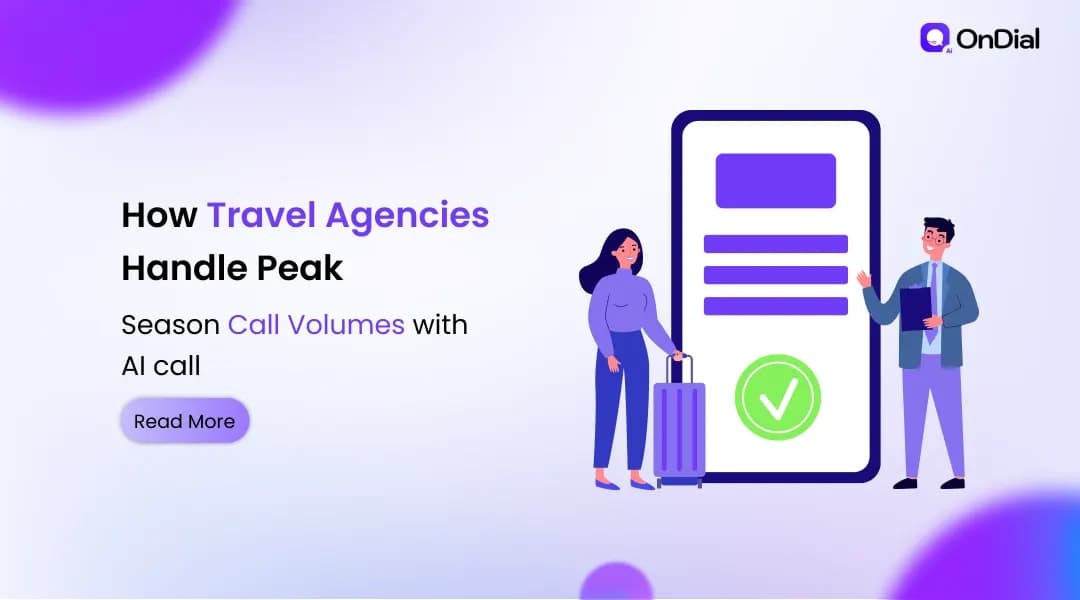
Peak season is when travel agencies have the most opportunity and the least room for operational mistakes.
Phone lines fill with new booking inquiries, existing customers need itinerary changes, travelers ask about availability, and teams spend hours making confirmation and follow-up calls. At the same time, many agencies are still relying on the same number of employees and phone lines they use during quieter months.
The result is predictable: longer wait times, missed calls, delayed callbacks, overloaded advisors, and potential bookings that never become revenue.
AI calling gives travel agencies another way to manage this imbalance. Instead of scaling phone operations only by adding temporary staff, agencies can use AI voice agents to answer routine inquiries, qualify travelers, automate outbound communication, and send complex conversations to human advisors.
For travel businesses preparing for a holiday rush, summer booking period, festival season, or international travel surge, the goal is not to remove humans from the customer journey. It is to make sure human advisors spend their time where their expertise has the greatest value.
Why Peak Season Creates a Call Handling Problem
Travel demand does not increase evenly across the year.
A travel agency may have manageable call traffic during ordinary weeks and then experience a sharp increase around school holidays, summer vacations, Christmas, New Year, Diwali, destination-specific travel periods, or major events.
The problem becomes more complicated because peak season calls are not all the same.
Some callers want a simple answer about a package. Others want to compare destinations. Some need a booking confirmation, while others are ready to discuss a complex honeymoon or group itinerary with an experienced advisor.
If every call follows the same human-only process, advisors quickly become overloaded.
Existing customers compete with new leads
During busy periods, the same employees often handle both existing customers and new prospects.
An advisor may be helping a traveler change a flight while another caller is waiting to ask about a new package. A third customer may be calling about documents or payment confirmation.
This creates a difficult tradeoff.
Serve existing customers immediately and new leads wait. Answer new inquiries and existing customers experience slower service.
AI calling can separate these workloads by handling appropriate routine conversations automatically while preserving human capacity for cases that require judgment.
Temporary hiring is not always the best answer
Hiring seasonal employees can increase capacity, but it introduces its own operational costs.
New staff need training on destinations, packages, booking procedures, CRM workflows, cancellation policies, escalation rules, and the agency's communication standards. They also need supervision.
For a short seasonal window, an agency may spend significant time preparing employees who become less useful once demand returns to normal.
AI calling offers a more flexible capacity model because call handling can scale with demand rather than being tied entirely to the number of employees scheduled for a shift.
What AI Calling Actually Does for a Travel Agency
AI calling is more than an automated phone menu.
A conversational AI voice agent can understand what a caller is asking, collect relevant information, respond using the agency's configured knowledge, and determine what should happen next.
For example, a traveler might say that they are planning a family holiday to Dubai in December and want to know what packages are available.
Instead of forcing the caller through multiple menu options, the AI can ask useful follow-up questions such as:
What are your preferred travel dates?
How many people are travelling?
What is your approximate budget?
Are you looking for flights, accommodation, or a complete package?
Do you have any specific hotel or activity preferences?
The answers can then be captured and passed to the appropriate workflow.
This makes AI calling particularly useful when the objective is not simply to answer calls, but to turn conversations into structured business information.
The Five Peak Season Call Workflows Travel Agencies Should Automate
The best implementation does not attempt to automate every conversation from day one.
Instead, agencies should begin with high-volume workflows where the process is predictable and the business impact is measurable.
1. Inbound booking inquiries
New booking calls are often among the most valuable conversations during peak season.
An AI voice agent can answer immediately, identify the traveler's intent, collect essential information, and determine whether the inquiry can be resolved automatically or should be transferred to an advisor.
This means a caller does not have to wait simply because every human advisor is occupied.
For complex bookings, the AI can collect the traveler's requirements before transferring or scheduling a consultation. The advisor then starts with useful context instead of repeating basic discovery questions.
2. Booking confirmations
Confirmation calls can consume large amounts of employee time, particularly for agencies handling group tours or high booking volumes.
An AI agent can contact travelers to confirm relevant details, communicate next steps, and identify customers who require human assistance.
This is especially useful when confirmation calls follow a predictable process.
3. Pre-departure reminders
Travelers often need reminders about documents, departure information, check-in requirements, payment deadlines, or itinerary details.
Instead of relying entirely on manual outbound calling, agencies can create automated voice workflows triggered by dates or customer status.
The AI can deliver the reminder and escalate exceptions.
For example, if a traveler confirms that everything is ready, the workflow can end. If the traveler reports a missing document or asks about an itinerary change, the conversation can be routed to the relevant team.
4. Abandoned inquiry follow-up
Peak season creates another hidden problem: leads that were interested but never received a timely follow-up.
A traveler may call, ask about a package, request pricing, and say they need to discuss the trip with their family. Without a structured follow-up process, that opportunity can disappear.
AI calling can re-engage these prospects according to defined rules.
The agent can check whether the traveler is still interested, answer basic questions, and schedule a conversation with a human advisor when the prospect is ready.
5. Post-trip feedback
Customer communication should not stop when the traveler returns home.
An automated voice workflow can contact customers after their trip, collect feedback, identify issues, and capture useful information for the agency.
This also creates an opportunity to identify dissatisfied customers early and route them to a human representative before a minor problem becomes a public complaint.
How AI and Human Travel Advisors Should Work Together
One of the biggest mistakes agencies can make is treating AI calling as a replacement for experienced travel advisors.
Complex travel planning often requires judgment.
A honeymoon involving multiple destinations, a corporate group trip, a special accessibility requirement, or a complicated international itinerary may require an experienced human who can understand nuance and make recommendations.
AI is better suited to the repetitive parts of the workflow.
A practical operating model looks like this:
AI handles the first layer.
It answers the call, identifies intent, collects information, answers routine questions, and performs predefined actions.
The human handles the high-value layer.
The advisor takes over when the conversation involves complex planning, negotiation, exceptions, sensitive customer situations, or a high-value booking requiring personalized guidance.
This creates a blended model where AI increases capacity without removing the human relationship that matters in travel.
What Travel Agencies Should Connect to AI Calling
An AI voice agent becomes much more useful when it can work with the systems the agency already uses.
Depending on the workflow, integrations may include:
CRM systems
Booking platforms
Calendars
Customer databases
Telephony systems
Messaging platforms
Payment or billing workflows
Analytics systems
The purpose of integration is simple: prevent information from becoming trapped inside the phone conversation.
If a caller provides their travel dates, budget, destination preference, and contact information, those details should be available to the advisor or sales team without requiring someone to manually recreate the conversation.
OnDial is designed to connect AI voice workflows with business systems and provide structured information from customer conversations.
Multilingual AI Calling Matters for Indian Travel Agencies
India's travel market presents a particular communication challenge.
Customers may prefer English, Hindi, Gujarati, Tamil, Telugu, Bengali, Marathi, Kannada, Malayalam, Punjabi, or another language depending on their location and preferences.
International agencies face a similar challenge when serving travelers across multiple countries.
A multilingual AI voice agent can help agencies provide a consistent first layer of support without requiring a separate staffing model for every language.
For example, an agency could receive a Hindi booking inquiry from a customer in North India, a Gujarati inquiry from Gujarat, and an English call from an international customer within the same period.
The important consideration is not simply the number of languages supported. Agencies should evaluate pronunciation quality, conversational accuracy, language switching, escalation behavior, and whether customer information remains consistent across languages.
OnDial's travel solution currently supports more than 100 languages and is positioned for multilingual travel communication.
How to Prepare an AI Calling System Before Peak Season
The best time to deploy peak-season automation is before call volumes reach their highest point.
Starting early gives the agency time to test real conversations, identify weak points, and refine escalation rules.
Step 1: Analyze your call history
Start with actual call data.
Identify:
Most common customer questions
Peak calling hours
Missed-call volume
Average call duration
Common booking inquiries
Repetitive outbound calls
Reasons for human escalation
After-hours demand
This shows where automation can create the greatest operational impact.
Step 2: Select the first workflows
Do not automate everything immediately.
Start with two or three predictable workflows such as booking inquiry qualification, booking confirmation, or pre-departure reminders.
Step 3: Define escalation rules
The AI should have clear boundaries.
Specify when it should transfer a caller, schedule a callback, collect additional information, or stop the conversation.
A well-designed escalation process is just as important as the AI's ability to answer questions.
Step 4: Test real scenarios
Testing should include normal conversations and difficult ones.
Try incomplete information, interruptions, unusual requests, different accents, multiple languages, frustrated customers, and requests outside the AI's knowledge.
The objective is not to prove that the AI can answer everything. It is to ensure that it knows what to do when it cannot.
Step 5: Measure the right metrics
Track performance before and after deployment.
Useful metrics include:
Call answer rate
Missed calls
Average response time
Qualified inquiries
Booking conversion rate
Human transfer rate
Callback completion rate
Customer satisfaction
Cost per handled conversation
Agent productivity
This turns AI calling from an experiment into an operational system that can be improved over time.
What Should Travel Agencies Look for in an AI Calling Platform?
Not every voice AI platform is equally suitable for travel operations.
Travel agencies should evaluate the platform against practical requirements rather than choosing based only on how natural the voice sounds.
Concurrent call capacity
Peak season is the moment when capacity matters most.
Ask how the platform behaves when call volume suddenly increases and whether additional calls experience delays or queueing.
Human handoff
The platform should make it easy to transfer important conversations to the right human team member.
The advisor should also receive enough context to understand why the caller was transferred.
CRM integration
Customer details and call outcomes should flow into the systems the agency already uses.
Manual data entry defeats much of the operational value of automation.
Multilingual support
If the agency serves multiple regions, test actual conversations rather than relying only on a language list.
Analytics
Managers should be able to understand what callers are asking, where conversations are ending, which calls require human intervention, and which workflows are producing results.
Transparency
Customers should know when they are interacting with an AI assistant.
The system should clearly identify itself and provide a straightforward path to human assistance when required.
How OnDial Fits Into Peak Season Travel Operations
OnDial provides AI voice agents designed to handle inbound and outbound business conversations, including lead qualification, appointment scheduling, customer support, follow-ups, multilingual communication, and analytics.
For travel agencies, the value is not simply having another phone answering system.
The stronger use case is connecting multiple workflows around the customer journey.
A new inquiry can be answered and qualified. A booking can trigger confirmation communication. A departure date can trigger reminders. An unanswered inquiry can enter a follow-up workflow. A post-trip interaction can generate feedback.
The agency can then use human advisors for conversations where experience, judgment, and personalization matter most.
Travel businesses looking to build this kind of operating model can explore AI Voice Agents for Travel and Tourism to see how OnDial applies voice automation specifically to travel workflows.
The Business Case for Peak Season AI Calling
The strongest reason to consider AI calling is not that it sounds impressive.
It is that peak season exposes the limitations of a fixed-capacity phone operation.
When demand increases sharply, an agency has three basic choices:
Let callers wait.
Add enough temporary staff to match the surge.
Use automation to absorb predictable demand while keeping humans focused on complex conversations.
For many agencies, the third approach provides a more flexible operating model.
AI does not need to replace the travel advisor. It needs to protect the advisor's time.
Every routine call handled automatically gives the human team more capacity for travelers who need expertise, reassurance, negotiation, or personalized recommendations.
That is where the economics of AI calling become more meaningful than simply reducing call handling costs.
Final Takeaway
Peak season should be the period when a travel agency captures the most demand, not the period when its phone system becomes a bottleneck.
AI calling can help agencies answer inquiries faster, qualify travelers, automate repetitive outbound communication, recover follow-up opportunities, support multiple languages, and route complex conversations to human advisors.
The most effective strategy is not to automate everything.
It is to identify the repetitive conversations that consume employee time, automate those workflows carefully, define clear escalation rules, integrate the AI with existing systems, and measure the results.
Travel agencies that build this infrastructure before their busiest season can enter high-demand periods with a phone operation designed to scale rather than one that depends entirely on adding more people.
For agencies evaluating the broader possibilities of conversational automation, AI calling for travel agencies provides another practical perspective on managing booking demand with voice AI.