A new lead fills out your form at 9:47 on a Tuesday night. By the time someone on your team sees it the next morning, opens the CRM, and finally picks up the phone, more than eleven hours have passed. In those eleven hours, that same buyer has filled out three more forms on three competitor websites, and one of those competitors called back within ninety seconds. This is the speed-to-lead problem, and it quietly drains more revenue from growing businesses than almost any other gap in the sales process. Research into lead response has repeatedly shown that the odds of qualifying a lead fall sharply after the first five minutes, and that the first company to respond captures the majority of deals. Yet the average business still takes hours, and sometimes days, to make first contact.
Most teams do not lose deals because their product is weaker or their pricing is higher. They lose because someone else got there first while the lead was still paying attention. AI voice agents change this equation completely by responding to every inbound lead in seconds, at any hour, in any language, without a human needing to be awake or available at that exact moment. This blog breaks down what speed to lead actually means for your revenue, why traditional follow-up fails at speed, how AI voice agents close the gap, and what measurable impact you can expect on your lead conversion rate.
What Speed to Lead Actually Means for Your Revenue
Speed to lead is the amount of time between the moment a prospect raises their hand and the moment your business makes meaningful contact. It is not the time to send an automated confirmation email. It is the time until an actual conversation begins, because that is when qualification, trust, and momentum are built. Every additional minute in that window is a minute your competitor can use to reach the same person first. Businesses using AI-powered lead qualification reduce this response window from hours to seconds while automatically identifying the highest-value prospects.
The reason this metric matters so much is that buyer intent is perishable. A person who requests a quote or books a callback is at the peak of their interest in that exact moment, and that interest cools quickly as they move on to other tasks or other vendors. When you reach them while their attention is still fresh, the conversation is easy. When you reach them nine hours later, you are interrupting their day and competing against every other option they have found since.
The 5 Minute Rule Explained
A good speed to lead time is under five minutes, and the strongest revenue teams push for under one minute. The widely cited Lead Response Management study found that contacting a web lead within five minutes rather than thirty minutes makes a business roughly one hundred times more likely to connect with that lead and about twenty-one times more likely to qualify it. That is not a marginal improvement in efficiency. That is the difference between a pipeline that fills itself and a pipeline that leaks most of what marketing pays to generate.
The five-minute rule holds across almost every industry that sells to individuals or businesses through inbound inquiry. It applies to a real estate agency fielding a property inquiry, a clinic booking a consultation, an insurance broker responding to a quote request, and a B2B software vendor working a demo signup. The mechanism is the same everywhere because human attention behaves the same everywhere. The faster you respond, the more likely the person on the other end is still available and still interested.
Why the First Responder Almost Always Wins
The first company to reach a lead wins a disproportionate share of the business. Some analyses of buyer behaviour suggest that a large majority of customers choose the first vendor that responds to them, simply because that vendor sets the frame, answers the first questions, and establishes the relationship before anyone else gets a chance. Once a buyer has had a helpful conversation with one provider, every later provider is fighting uphill against an anchor that has already been set.
This is why speed to lead is really a competitive advantage disguised as an operations metric. You are not only racing the clock. You are racing every other business that received the same inquiry or a similar one. In markets where three or four vendors compete for the same buyers, the one that answers first consistently takes the largest slice of the pipeline, and the ones that answer last survive on scraps.
The Hidden Cost of Slow Lead Response Time
The average lead response time across industries is measured in hours, not minutes. Research analyzing more than a million sales leads found that the typical first response took over forty hours, and that a meaningful share of leads never received any response at all. For a business generating even fifty inbound leads a month, a slow lead response time can mean dozens of qualified buyers handed directly to faster competitors every single month. Multiply that leakage across a year and the lost revenue often dwarfs the entire marketing budget that produced those leads.
What makes this cost invisible is that it never shows up as a failure. Nobody logs a lost deal for a lead that was answered eleven hours late, because from the inside it simply looks like the lead did not convert. The team assumes the lead was low quality, marketing assumes the sales team dropped the ball, and the real culprit, a slow lead response time, is never named. The money leaks out through a gap that no single person owns.
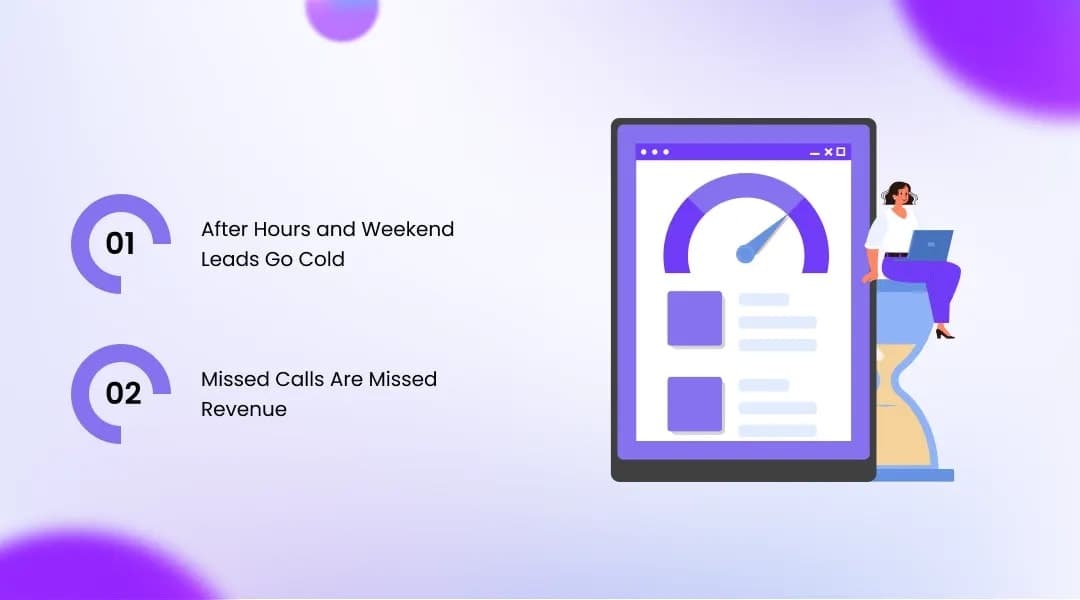
After Hours and Weekend Leads Go Cold
A large portion of inbound leads arrive outside standard business hours, in the evenings, on weekends, and during holidays when buyers actually have time to research. A lead that lands at 8 PM on Friday and waits until Monday morning for a response has been ignored for more than sixty hours. By then the buyer has either forgotten they inquired or has already spoken to a competitor who answered on Saturday. These after-hours leads are often the highest intent leads of all, because the person made the effort on their own time.
Missed Calls Are Missed Revenue
Every missed inbound call is a buyer who wanted to talk right now. Businesses using AI to capture every missed call recover opportunities that would otherwise go directly to competitors. A missed call does not wait patiently in a queue for a callback. In most cases, the caller dials the next business on their list, and that business earns the sale you paid to attract. For service businesses in particular, the correlation between answered call rate and revenue is direct and unforgiving, which is why answering every call, at every hour, is one of the highest leverage improvements a business can make.
Why Traditional Follow Up Fails at Speed
Traditional follow-up fails at speed because it depends on a human being available, alert, and free at the exact second a lead arrives, which is a condition that rarely holds. Sales reps are in meetings, on other calls, at lunch, asleep, or simply overwhelmed by volume. Even a highly motivated team physically cannot maintain a sub-five-minute response across a full day, let alone across nights and weekends. The problem is not effort or discipline. It is a structural mismatch between when leads arrive and when humans are available.
The tools that were supposed to fix this mostly moved the delay around rather than removing it. A CRM alert or an email notification tells a rep that a lead arrived, but a notification is not a conversation. The rep still has to see the alert, drop what they are doing, and place the call, and every one of those steps adds minutes or hours. Automation that only sends an autoresponder email creates the illusion of a fast response while the real conversation still waits for a human.
Several structural reasons explain why manual follow-up cannot hit consistent speed to lead targets:
Human teams cannot watch inbound channels around the clock, so any lead arriving outside working hours automatically waits until the next shift begins.
Reps handle leads in batches between other tasks, which means even during business hours most leads sit untouched for the length of a meeting or a call.
High-volume periods overwhelm the team, so the exact moments when the most leads arrive are the moments response time is slowest.
CRM alerts and email notifications create awareness but not contact, leaving the critical last step dependent on a human being free at that second.
None of these problems can be solved by asking the team to try harder. They are solved only by changing who, or what, makes the first contact. That is precisely the role that AI voice agents now fill, and it is why speed to lead has moved from an aspiration to something a business can actually guarantee.
How AI Voice Agents Close the Speed to Lead Gap
AI voice agents close the speed to lead gap by removing the human availability bottleneck entirely and placing an intelligent, natural-sounding call within seconds of a lead arriving. Instead of a lead waiting for a rep to become free, the moment a form is submitted, or a call comes in, an AI agent is already engaging the prospect in a real conversation. It qualifies them, answers their questions, and books the next step while their interest is still at its peak. This is the single most reliable way to guarantee a sub-five-minute response on every lead, every day.
Platforms like OnDial deploy production-grade AI voice agents that respond with sub-500-millisecond latency, which means the conversation feels immediate and natural rather than laggy or robotic. Because these agents run continuously, they treat a lead arriving at 2 AM on a public holiday exactly the same as one arriving at 11 AM on a Tuesday. The result is a response time that a human team cannot match, applied uniformly across every lead regardless of volume or timing.
Instant Outbound Callback in Seconds
An instant lead callback is the highest impact application of AI voice agents, because it attacks the response window directly. The moment a lead submits a form, requests a callback, or abandons a checkout, the AI agent places an outbound call within seconds, not hours. The prospect receives a call while they are still on your website or still thinking about the thing that made them inquire, which is the ideal moment to have a conversation.
This instant lead callback capability matters most for high-intent actions like demo requests, quote inquiries, and pricing questions. These are people ready to talk now, and reaching them now is what converts them. OnDial handles both inbound and outbound calls, so it can answer a ringing phone and also trigger an outbound callback the instant a digital lead lands, closing the window that manual teams leave wide open.
Real-Time Lead Qualification and Scoring
AI voice agents perform lead qualification during the first conversation, so your team only ever spends time on prospects worth pursuing. Rather than a rep manually working through a list of unqualified names, the AI agent asks the qualifying questions, captures the answers, and scores the lead based on your criteria before a human is ever involved. AI lead qualification turns a raw list into a ranked pipeline automatically.
This is where speed and quality reinforce each other instead of trading off. The agent reaches the lead instantly and, in the same call, gathers budget, timeline, needs, and intent. OnDial performs lead qualification and scoring in real time and passes fully qualified, prioritized leads to your sales team, which means reps stop wasting hours on dead ends and start every day with a list of people who are actually ready to buy. AI lead qualification at this speed is simply not achievable with a manual process.
Around the Clock Coverage Without a Night Shift
AI voice agents deliver true 24/7 coverage without the cost or complexity of a night shift. There is no roster to fill, no overtime to pay, and no drop in quality at 3 AM because the agent performs identically at every hour. A lead that arrives on a Sunday evening gets the same fast, professional response as one that arrives midweek, which means the after-hours and weekend leads that used to go cold now convert at the same rate as everything else.
Appointment Scheduling While Interest Is Hot
The best moment to book an appointment is inside the very first conversation, before the buyer moves on. AI voice agents handle appointment scheduling directly on the call, checking real availability and confirming a slot while the prospect is still engaged. This removes the back and forth of emails and callbacks that lets so many warm leads slip away. OnDial integrates appointment scheduling with calendar systems so that a qualified lead can be reached, qualified, and booked into a slot in a single seamless call, all within minutes of arriving.
The Measurable Impact on Your Lead Conversion Rate
Improving speed to lead produces one of the most direct and measurable lifts in lead conversion rate available to any business. When response time drops from hours to seconds, more leads are reached while still interested, more conversations happen, and more of those conversations turn into booked meetings and closed sales. The gains compound because you are converting leads you were previously losing entirely, not just improving the ones you already win.
The realistic outcomes businesses see when they move to instant response include several distinct improvements:
A significant rise in the percentage of leads that are successfully contacted at all, because the agent reaches them before they disengage or choose a competitor.
A higher proportion of contacted leads that become qualified opportunities, since the conversation happens while intent is at its peak.
A measurable increase in booked appointments and demos, because scheduling happens inside the first call rather than through slow follow-up.
Full recovery of after-hours and weekend leads that previously went unanswered, turning a dead segment of the pipeline into active revenue.
The financial logic is straightforward. If your marketing already generates the leads and you are simply reaching a larger share of them fast enough to convert, the incremental revenue arrives with almost no increase in acquisition cost. That is why speed to lead improvements tend to show up quickly in the numbers, often within the first month of deployment. OnDial provides call sentiment analysis and smart analytics on every conversation, so you can see exactly how response time, qualification rate, and lead conversion rate move as the system runs, and you can prove the impact rather than assume it.
What Deploying an AI Speed to Lead System Looks Like
Deploying an AI speed to lead system is far simpler than most business owners expect, and it does not require ripping out your existing tools or hiring technical staff. The goal is to place an AI voice agent at the exact point where leads arrive so that first contact happens automatically. A well-designed rollout can move from setup to live calls in days rather than months, especially on a no-code platform.
[IMAGE PLACEHOLDER: Simple diagram showing a lead entering a form, triggering an instant AI callback, qualification, and appointment booking]
A typical deployment follows a clear sequence:
Connect the AI agent to your lead sources so that every form submission, missed call, and inbound inquiry can trigger an immediate response.
Define your qualifying questions and scoring rules so the agent gathers exactly the information your sales team needs to prioritize.
Integrate your calendar and CRM so the agent can book appointments and pass structured lead data straight into your existing workflow.
Test the conversation flow, adjust the script and voice, and then switch on live calling across the hours and channels you choose.
OnDial supports both API and no-code deployment, which means a technical team can integrate it deeply into custom systems while a non-technical operations manager can configure and launch an agent without writing a line of code. It handles data in a GDPR and CCPA-compliant manner, which matters when your agents are having real conversations and capturing customer information at scale. OnDial supports over 100 languages through multilingual AI voice agents that automatically detect the customer's preferred language. Serving customers across more than 20 industries, the platform is built for the realities of production calling rather than for a demo, which is what separates a reliable speed-to-lead system from a fragile experiment.
Conclusion
Three points stand above everything else in this discussion. First, speed to lead is one of the strongest predictors of who wins a deal, and the first company to respond captures a disproportionate share of the business. Second, traditional manual follow-up cannot reliably hit sub-five-minute response because it depends on a human being free at the exact moment a lead arrives, which leaves nights, weekends, and busy periods uncovered. Third, AI voice agents close this gap by reaching, qualifying, and booking leads within seconds of arrival, which lifts lead conversion rate without raising acquisition cost.
OnDial delivers exactly this. It deploys production-grade AI voice agents that respond with sub-500-millisecond latency, handle both inbound and outbound calls 24/7, perform real-time lead qualification and scoring, book appointments on the call, and do it all across more than 100 languages with GDPR and CCPA-compliant data handling and both API and no-code deployment. For businesses that lose deals to slow response, this is the difference between paying to generate leads and actually converting them. If you want to see what instant response does to your own pipeline, start a free trial or schedule a demo with OnDial and watch your speed to lead become a competitive advantage instead of a leak.