Gartner projects that conversational AI will strip $80 billion in agent labor costs out of contact centers in 2026 alone. That number is not a forecast anymore. We are living in that year, and it explains why 67% of Fortune 500 companies now run production voice AI, according to research compiled by NextLevel.AI and AInora.
If you lead customer experience, IT, or compliance, you have probably felt the pressure that comes with a stat like that. Maybe you are excited. Maybe you are quietly nervous about betting a core business function on a technology you have watched fail before.
That tension is fair. AI call handling for enterprises is a system that uses AI voice agents to answer, understand, and resolve inbound and outbound phone calls without a human on the line. Done well, it deflects most routine calls and pays for itself in months. Done badly, it hangs up on your best customers and creates a compliance mess.
Here is what you will learn: how the technology works, why deployments fail, what regulators expect, and the exact checklist I use with enterprise teams before a single call goes live.
What AI Call Handling Actually Means for Enterprises
The phrase gets thrown around loosely, so let me define it precisely before we go deeper. An AI call handling system is a platform that manages AI-powered customer phone conversations from start to finish using speech recognition, natural language understanding, and voice generation.
The Shift From IVR Menus to Conversational Agents
The old interactive voice response (IVR) systems relied on rigid decision trees that frustrated callers. Press one for billing. Press two for support. Callers hated it, and most of them mashed zero to reach a human as fast as possible.
Modern enterprise voice AI deployment replaces that rigid menu with open conversation. A caller states their problem in plain language, and the agent understands intent, pulls the relevant account data, and resolves the request. In projects I have worked on at OnDial, the difference in caller sentiment between a menu and a natural agent is immediate and measurable.
Where AI Call Handling Fits in Your Stack
An AI voice agent is not a standalone island. It sits between your telephony layer and your systems of record, which is exactly where most of the engineering effort goes.
Telephony integration. The agent connects to your existing SIP, PBX, or carrier setup so you are not ripping out infrastructure you already paid for.
CRM and core systems. Real value shows up when the agent reads and writes to Salesforce, your booking engine, or your billing platform during the call, not after it.
Escalation routing. The agent needs a clean path to hand a complex call to a human, with full context attached so the customer never repeats themselves.
How Enterprise AI Call Handling Works Under the Hood
You do not need to be an engineer to buy this technology. But you do need to understand the pipeline, because that is where the failure points hide.
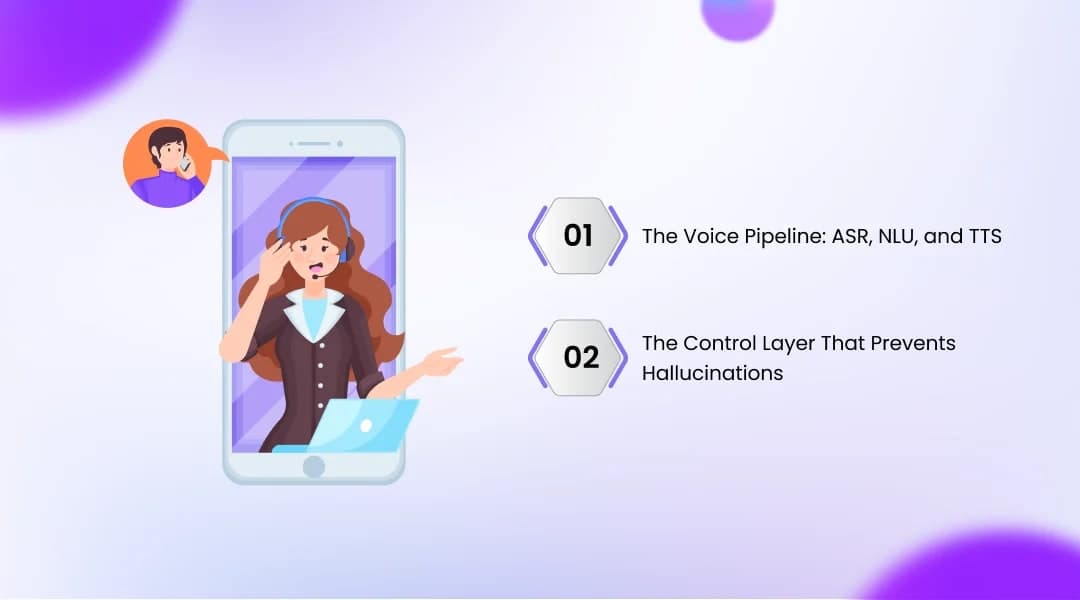
The Voice Pipeline: ASR, NLU, and TTS
Every call runs through three stages. First, automatic speech recognition (ASR) turns the caller's audio into text. Second, natural language understanding (NLU) figures out what the caller actually wants. Third, text-to-speech (TTS) turns the agent's response back into a natural voice.
Each stage adds delay, and delay is the enemy of a natural conversation. The best teams stream every stage so the agent starts responding before the caller has finished the thought. According to AInora, median end-to-end response latency for production voice AI dropped to 680 milliseconds in 2026, down from 1,200 milliseconds two years earlier. That improvement is the single biggest reason these systems finally feel human.
The Control Layer That Prevents Hallucinations
Here is the part vendors rarely put on the slide. A raw large language model, left to talk directly to your customer, will occasionally invent things. It might confirm an appointment slot that does not exist.
The fix is a control layer that sits between the model and your systems of record. It constrains what the agent can say and do, so the model reasons but the business logic decides. Engineering teams at firms like deepsense.ai have documented re-architecting a struggling voicebot this way, eliminating hallucinations while holding median API latency near 520 milliseconds. Skip this layer, and you are shipping a demo, not a production system.
Why Most Enterprise Voice AI Projects Fail
Let me be blunt about something. Most failed deployments have nothing to do with the AI model being weak.
The failures cluster around architecture. A sandbox bot that dazzled the board collapses the moment it meets production load, seven enterprise integrations, and real callers who talk over each other. So what actually breaks?
Latency, Not the Model, Is Usually the Killer
Voice AI fails louder than any other kind of AI. The customer hears the two-second pause. The customer hears the awkward interruption. And the customer hangs up.
I have seen teams roll out to five percent of inbound calls, only to watch the containment rate sit at 31% while customers get cut off mid-sentence. The root cause is almost never the language model. It is blown latency budgets, weak conversational memory, and integrations that were never stress-tested. Fix the pipeline before you blame the intelligence.
The Cold-Handoff Problem
Now think about what happens when the AI decides it cannot help. A cold handoff is when the agent transfers a caller to a human with no context, forcing the customer to explain everything again.
The customer feels punished for using the automated system in the first place, which erodes trust in the whole channel.
The human agent starts blind, adding handle time and frustration on both ends of the line.
The metric that matters, first-call resolution, quietly collapses even though your containment dashboard looks fine.
A warm handoff that passes the full transcript and intent is not a nice-to-have. It is the difference between an agent your customers tolerate and one they trust.
The Compliance Reality You Need to Handle Before Deployment
This is the section that decides whether your project ships or stalls in procurement. And it is the one most buyers underestimate.
By early 2026, 84% of organizations admitted they could not pass an AI agent compliance audit, according to research cited by Retell AI. A single 90-second support call can capture a name, a date of birth, a spoken password, and a medical detail, all in one audio stream. Voice is dense with regulated data, which makes governance a deployment prerequisite rather than a later cleanup task.
Global Standards: SOC 2, HIPAA, PCI DSS, and GDPR
For any enterprise deployment, a few certifications form the baseline. SOC 2 Type II proves your vendor's controls actually worked over a period of time, not just on paper on one day.
The trap most buyers fall into is accepting a Type I report because it carries the same logo. It is not the same protection. Depending on your industry, you will also need HIPAA for health data, PCI DSS for payment information, and GDPR alignment for European residents, where penalties reach into the millions of euros. Ask your vendor to produce a current Type II report and a data-processing agreement under NDA within 48 hours. Vendors who can rarely deserve to advance.
The India Layer: TRAI DLT and the DPDP Act 2023
If you operate in India, or call Indian customers, TRAI compliance is your baseline, not your finish line. TRAI DLT is the registration framework for commercial voice communication, and it does not distinguish between a human-placed call and an AI-placed one.
That means principal-entity registration, correct number series, real-time DND scrubbing, and calling only within the 9 AM to 9 PM window. Layered on top sits the DPDP Act 2023, India's data protection law, which requires consent that is free, specific, informed, and revocable, with penalties up to 250 crore rupees. At OnDial, we build DLT number validation, DND scrubbing, and consent logging as hardcoded infrastructure that a campaign setting cannot switch off, because retrofitting compliance after the first regulatory notice is how you earn a six-month operational pause.
What AI Call Handling Costs and What ROI to Expect
Let me answer the question every executive really wants answered. Is this actually worth it?
Cost Per Call: AI Versus Human Agents
The economics are the reason adoption moved from pilot to production. An AI-handled call costs roughly $0.40, compared to $7 to $12 for a human agent, according to figures compiled by NextLevel.AI. That is a 90 to 95% reduction per automated interaction.
A Forrester Consulting study found enterprises reaching 391% ROI over three years with a payback period under six months. Those returns are real, but they are not automatic. They depend entirely on how well you scope and deploy, which is why the checklist below matters more than the pricing sheet.
Setting Realistic Containment Targets
Containment rate is the share of calls your AI resolves fully without a human. It is the single number that determines whether your business case holds.
Industry data suggests well-configured systems can resolve around 70% of routine inbound calls without human intervention, per the AInora Voice AI Adoption Report. But do not promise your board 90% on day one. Start with your most structured, highest-volume call types, prove the number, then expand. A pilot that claims 85% containment on a narrow slice tells you nothing about your messy general queue.
A Pre-Deployment Checklist for Enterprise Buyers
Everything above leads here. This is what I walk enterprise teams through before they commit.
Documents to Confirm Before Any Demo
In 2026, compliance documentation comes before the technical demo, not after it. Get these in writing first.
A current SOC 2 Type II report covering the last twelve months, available under NDA quickly.
A sub-processor list, so you know exactly whose infrastructure touches your call data.
A data-processing agreement and, where relevant, a BAA, ideally self-signable rather than gated behind a six-figure minimum.
A clear answer on data residency, especially if regulations require that customer data stay within your country's borders.
How to Run a Pilot That Predicts Production
A flawless demo tells you almost nothing. A well-designed pilot tells you everything. (This is the step teams skip and then scramble to patch once something breaks live.)
Run your pilot on real call types under live compliance configuration, not a sanitized sandbox. Test the edge cases on purpose: callers who interrupt, who spell out complex names, who get frustrated. Measure containment, latency, and handoff quality against baselines you documented before you started. If the pilot holds up under those conditions, you have something worth scaling. If it does not, you found out for the price of a pilot instead of your reputation.
Conclusion
AI call handling for enterprises has crossed from experiment to operational infrastructure, and the three things that decide your outcome are clear. Get the architecture right so latency and handoffs do not sink you. Treat compliance as a deployment prerequisite, from SOC 2 through TRAI DLT and the DPDP Act. And prove your containment rate on real calls before you scale.
You do not have to guess your way through this. With the checklist above, you can walk into any vendor conversation knowing exactly what to verify and what to ignore. That is the difference between deploying fast and deploying well.
If you are scoping a deployment for the Indian market or a multilingual customer base, OnDial builds voice agents with DLT, DND, and DPDP consent handling as hardcoded infrastructure. Talk to our team about mapping the compliance and architecture requirements for your specific use case before your first call goes live.