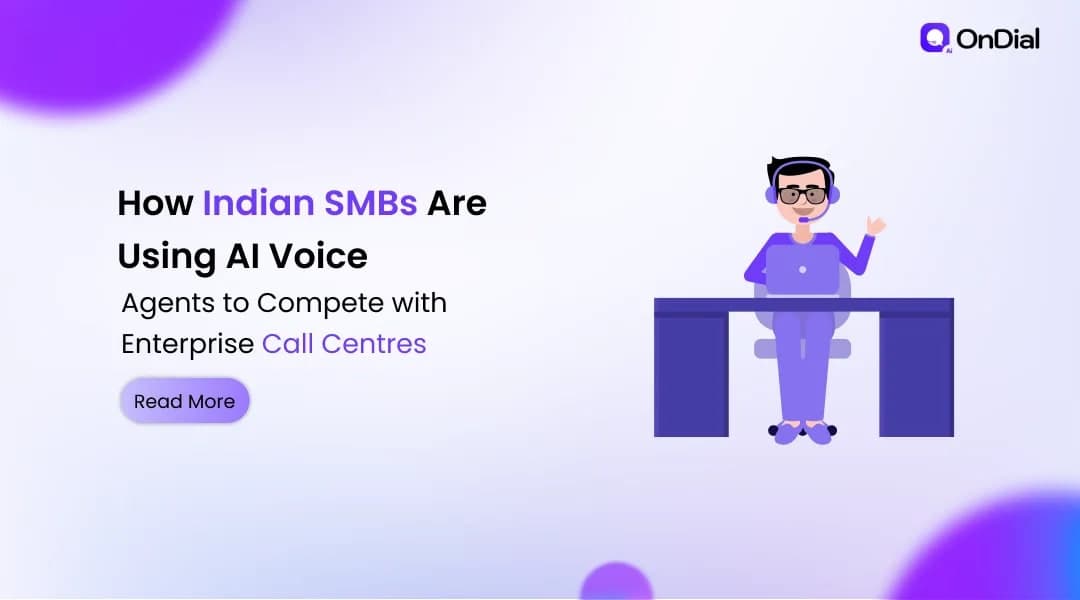
Here is a number that stopped me mid-conversation during a recent client call: 91% of SMBs that have adopted AI report measurable revenue growth through improved customer service and lead conversion (VoiceInfra, 2026). Not “felt better about operations.” Not “saw some improvement.” Measurable revenue growth.
If you run a small or medium business in India and you have been watching large enterprises pour crores into call centres while you scramble with three phones and a WhatsApp group, I understand the frustration. The gap feels permanent. AI voice agents for Indian SMBs are closing that gap faster than most founders realize.
Indian SMBs, over 63 million of them contributing roughly 30% of the nation’s GDP, are now deploying AI voice agents that handle sales calls, support queries, appointment bookings, and payment reminders around the clock. These are not the robotic IVR menus you remember. They are conversational, multilingual, and available at pricing that makes sense for a 10-person team.
In this article, I will walk you through how this shift is playing out on the ground: real use cases, real numbers, and what I have learned at OnDial about what separates a successful voice AI deployment from an expensive experiment.
What Are AI Voice Agents and Why Do Indian SMBs Need Them?
Beyond the Old IVR: A New Category of Technology
An AI voice agent is software that uses artificial intelligence to understand and respond to spoken language in real time. Unlike traditional IVR systems that force callers through “press 1, press 2” menus, a modern voice agent holds a genuine conversation, understands follow-up questions, and completes tasks like scheduling, lead qualification, or payment collection without human involvement.
That distinction matters more than it sounds. The old IVR was a gatekeeper. The new AI voice agent is a participant.
Why Indian SMBs Specifically Cannot Afford to Wait
India has a unique problem: consumer expectations have been trained by apps like Swiggy, Zomato, and PhonePe, which respond instantly. But most SMBs still run customer support with a handful of people juggling multiple responsibilities, basic phone lines, and zero after-hours coverage. The result? Unanswered calls, delayed responses, and customers quietly switching to competitors.
I have personally seen this pattern with dozens of businesses across real estate, healthcare, and EdTech. A clinic in Pune was losing 35% of its new patient inquiries because calls came in during lunch hours and after 6 PM. Nobody was answering.
That is the core problem AI voice agents solve: they ensure every call gets answered, every lead gets qualified, and every customer interaction feels responsive, even when your team is a fraction of the size of a Tier-1 enterprise’s contact centre.
The Real Cost Gap Between Enterprise Call Centres and AI Voice Solutions

What Enterprise Call Centres Actually Cost
Let me put this in plain terms. A domestic call centre in India with 100 seats spends north of INR 20 lakh per month on agent salaries alone, before you add infrastructure, quality assurance, training, and attrition costs. Call centre attrition in India runs between 30% and 50% annually, which means you are constantly rehiring and retraining. Enterprise contact centres managed by players like Gnani or SquadStack handle 30 million or more daily voice interactions, but their pricing structures reflect that scale, often running into six figures annually.
How AI Voice Agents Change the Math for SMBs
AI voice agents flip this equation. Platforms built for the Indian market offer usage-based pricing, meaning you pay per call or per minute rather than committing to a flat enterprise rate. For a business making 500 to 2,000 calls per month, the cost can be 60% to 70% lower than hiring equivalent full-time staff. Businesses adopting AI voice solutions report operational cost reductions of 20% to 30%, according to industry benchmarks.
(Here is where I have to be honest with you: these numbers assume you choose the right platform and configure it properly. A poorly set up voice agent can waste money just as easily as a poorly trained human agent.)
How Indian SMBs Are Actually Deploying AI Voice Agents
Lead Qualification and Sales Follow-Up
This is the highest-impact use case I see across our clients at OnDial. Your phone rings 40 times a day. Half those calls are from leads who are not ready to buy. Your team spends hours speaking to people who disappear the moment you send a quote. Meanwhile, the serious buyer who called at 7 PM got no answer and signed with a competitor by morning.
An AI voice agent answers every inbound call instantly, asks the right qualifying questions in the right order (budget, timeline, location, service requirement), scores the lead, and routes only the high-intent ones to your sales team. The rest get automated follow-ups. Your team closes more because they only talk to people who are ready.
Customer Support and After-Hours Coverage
For clinics, salons, service centres, and D2C brands, missed calls during peak hours or after business hours are lost revenue. AI voice agents handle appointment scheduling, order status inquiries, and basic support requests 24 hours a day without adding a single headcount. One real estate firm I worked with saw its response time drop from an average of 4 hours to under 10 seconds after deploying voice AI.
Payment Reminders and Collections
Banks and NBFCs in India running multilingual outbound campaigns using AI voice agents report measurable drops in early-stage delinquency. The reason is simple: reach is wider and timing is consistent. Human agents are reserved for dispute resolution and high-value conversations where empathy and negotiation matter most. This same model works for SMBs in lending, insurance, and subscription services.
The Multilingual Advantage: Why Voice AI Works Better in India

Code-Switching Is Not an Edge Case
Here is something most global voice AI platforms get wrong about India. The default mode of communication for hundreds of millions of Indians is not pure Hindi or pure English. It is a fluid, sentence-level mixture: Hinglish, Tanglish, Benglish. A customer in Surat might start a sentence in Gujarati, switch to Hindi mid-thought, and drop in an English word for good measure.
Platforms built specifically for India, like Bolna, Sarvam, or OnDial, handle this code-switching natively because they have trained their models on how Indians actually speak. Global platforms often struggle here, which is why a platform’s Indian language depth is the single most important evaluation criterion for an SMB buyer.
Regional Reach Opens New Markets
A clear majority of Indian internet users prefer support in their local language, especially in Tier-2 and Tier-3 cities. When your AI voice agent can handle calls in Tamil, Telugu, Marathi, Bengali, and Gujarati, you are not just improving support. You are opening markets that were previously unreachable without hiring native-language staff. The Indian voice AI market was valued at USD 153 million in 2024 and is projected to reach USD 957 million by 2030 at a CAGR of 35.7% (NextMSC), and multilingual capability is a major driver of that growth.
Choosing the Right AI Voice Agent Platform: What to Evaluate
The Six Dimensions That Actually Matter
After working with businesses across BFSI, healthcare, real estate, and EdTech, I have distilled the evaluation down to six dimensions. Skip any one of these and you risk a failed deployment.
Language depth: Does the platform handle Hinglish code-switching and regional dialects on real telephony lines, not just in demo environments? Test it on a noisy mobile call from a Tier-3 city, not a quiet office.
TRAI and DPDP compliance: India’s Digital Personal Data Protection Act now requires structured consent management for voice data. Platforms that handle DLT registration, DND filtering, and consent logging out of the box save you months of legal headaches.
Multi-turn conversation quality: Can the agent handle interruptions, retain context over five or more turns, and recover gracefully when the caller goes off-script? This separates real AI from glorified decision trees.
CRM and workflow integration: Your voice agent needs to push data into your existing CRM, booking system, or payment gateway. If the platform requires heavy developer work to integrate, the total cost of ownership climbs fast.
Pricing transparency: Usage-based models work best for SMBs. Watch for hidden charges on concurrent call capacity, recording storage, or language add-ons.
Deployment speed: If it takes more than two weeks to go live with basic use cases, something is wrong. The best India-focused platforms offer pre-built templates for common workflows like appointment booking, lead qualification, and COD confirmation.
A Quick Reality Check
Not every business needs an AI voice agent. If you handle fewer than 20 calls a day and your team comfortably manages them, the ROI may not justify the setup effort. Start with the pain point: are you missing calls? Are leads going cold? Is your support team overwhelmed? If the answer to any of those is yes, voice AI deserves serious evaluation.
Common Mistakes SMBs Make When Adopting Voice AI
Choosing a Global Platform Without India-Specific Testing
I have seen businesses pick a well-known international voice AI platform because the demo sounded impressive in English, only to discover it cannot handle a caller switching from Hindi to English mid-sentence. Always test with real Indian callers, on real phone lines, in the languages your customers actually use.
Ignoring the Data Feedback Loop
Every call your AI voice agent handles generates data: common questions, drop-off points, phrases the system misunderstood, outcomes that led to conversions. The best platforms use this data to continuously refine accuracy. If you deploy and forget, performance stagnates. Schedule monthly reviews of call analytics. Look at where conversations break down and feed improvements back into the system.
Trying to Replace Humans Entirely
This is the mistake that costs the most goodwill. AI voice agents are exceptional at handling high-volume, repetitive interactions. They are not ready to replace a skilled human in complex negotiations, emotionally sensitive conversations, or situations that require genuine judgment. The winning formula is AI for the front line, humans for the moments that matter. At OnDial, we always design deployments with clear escalation paths to human agents because that is what builds trust with your customers.
Conclusion
AI voice agents for Indian SMBs are no longer a future promise. They are an operational reality for thousands of businesses across healthcare, real estate, BFSI, and e-commerce. The three things worth remembering: first, the cost gap between enterprise call centres and AI voice solutions has collapsed for businesses willing to adopt usage-based platforms. Second, multilingual capability is not optional in India; it is the entire point. Third, successful deployment requires choosing an India-first platform, configuring it with clear escalation paths, and reviewing call data monthly.
If you have read this far, you are likely past the “should I consider this?” stage and into “how do I start?” That is the right question. At OnDial, we help Indian businesses go live with AI voice agents in days, not months, with pricing designed for real SMB budgets and support in the languages your customers actually speak. Explore how OnDial can work for your specific use case at ondial.ai.
Indian SMBs now have access to the same voice AI capabilities that were exclusive to enterprise contact centres two years ago, at a fraction of the cost and with better language support for the Indian market.