Every insurance company knows the sting of a lapsed policy. A customer who was perfectly happy with their coverage simply forgets to renew, misses a payment deadline, or never picks up the phone when the renewal reminder comes through. What most insurance operations leaders underestimate is how rapidly these individual lapses compound into a systemic revenue problem. Industry data consistently shows that the average policy lapse rate across life and health insurance sits between 15% and 25% annually, with some product lines and demographics experiencing even steeper attrition. For a mid-sized insurer carrying 50,000 active policies with an average annual premium of $1,200, even a modest 18% lapse rate translates to $10.8 million in lost annual premium revenue.
The problem runs deeper than a single year of lost revenue. The lifetime value of an insurance customer extends across renewals, cross-sells, and referrals. When a policy lapses, the insurer loses not just the current year's premium but the entire projected revenue stream from that relationship. The cost of acquiring a new customer to replace a lapsed one is five to seven times higher than the cost of retaining an existing policyholder through a well-timed renewal conversation. This math makes policy retention one of the highest-leverage operational challenges in the insurance business, yet most companies still approach it with outdated tools and understaffed call centers.
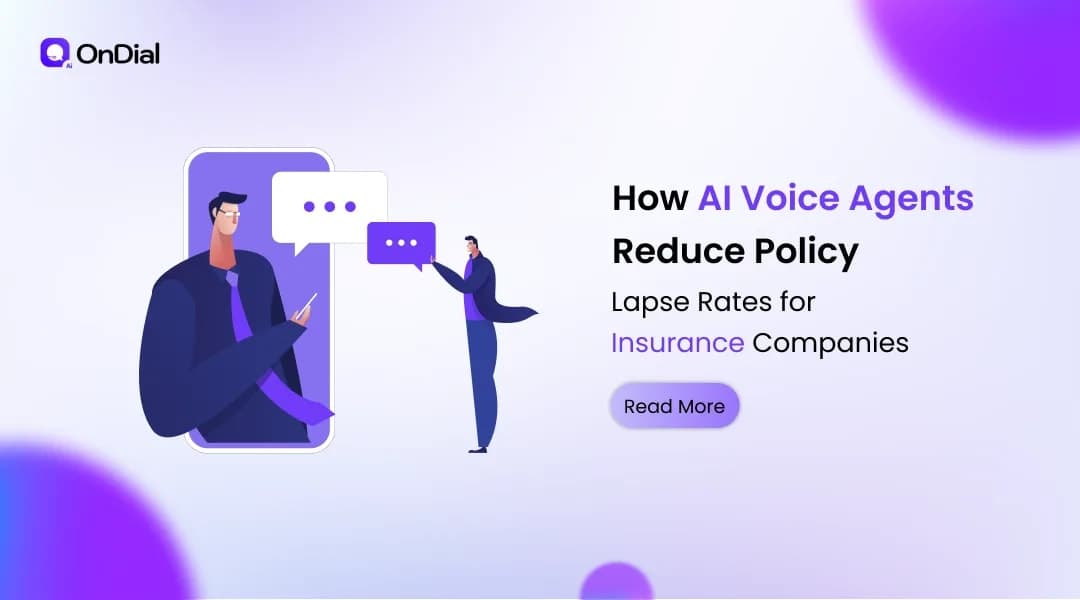
AI voice agents for insurance are changing this equation fundamentally. By automating renewal outreach at scale, these systems ensure that every policyholder receives a timely, personalized renewal conversation, not a generic reminder email that gets buried in an inbox. This blog breaks down exactly how AI calling for insurance companies works, what kind of results insurers are seeing, and what implementation looks like in practice for operations teams ready to stop the revenue bleed from preventable policy lapses.
What Policy Lapse Really Costs Beyond the Premium
The direct premium loss from a lapsed policy is only the surface layer of the financial damage. Underneath it sit several compounding costs that rarely appear in a single line item on quarterly reports but collectively erode profitability across the entire book of business. First, there is the sunk acquisition cost. The marketing spend, agent commissions, underwriting expenses, and onboarding effort invested in acquiring that customer are unrecoverable once the policy lapses. For many insurance products, the insurer does not break even on acquisition costs until the second or third renewal cycle, meaning a lapse in year one or two represents a net financial loss on that customer relationship.
Second, lapsed policies increase the insurer's risk profile in ways that are not immediately obvious. Policyholders who lapse and later seek reinstatement or new coverage often do so because they have experienced a change in health, circumstances, or risk profile. This adverse selection pressure raises loss ratios over time. Third, high lapse rates signal deeper customer experience problems that affect brand perception and Net Promoter Scores, making future acquisition more expensive as word of mouth deteriorates. When you add these layers together, the true cost of a lapsed policy is often three to four times the face value of the lost premium.
Why Traditional Renewal Processes Fail
Most insurance companies rely on a combination of automated email reminders, SMS notifications, and manual outbound calls from retention teams to drive renewals. Each of these channels has structural limitations that cap their effectiveness. Email open rates for insurance communications average between 18% and 22%, and click-through rates on renewal action links sit below 3%. SMS reminders perform marginally better for awareness but offer no mechanism for addressing the policyholder's questions or concerns about their renewal. These one-directional channels inform, but they do not persuade.
Manual outbound calling remains the most effective renewal channel because it allows for real conversation, objection handling, and personalized engagement. The problem is scale. A single insurance call center agent can make between 40 and 60 outbound calls per day, with meaningful renewal conversations consuming 5 to 8 minutes each. For an insurer with 10,000 policies approaching renewal in a given month, reaching every policyholder with a personal call would require a dedicated team of 15 to 20 agents working full time on nothing but renewals. Most insurers simply cannot justify that headcount, so they prioritize high-value policies for personal outreach and let lower-premium policies receive only automated reminders. The result is predictable: the policies that get the least personal attention lapse at the highest rates, and the cumulative revenue loss adds up quarter after quarter. If maintaining personalized conversations is a concern, How Insurance Companies Automate Policy Renewal Calls Without Losing the Personal Touch explains how AI preserves customer experience while scaling outreach.
How AI Voice Agents Transform Insurance Renewal Outreach
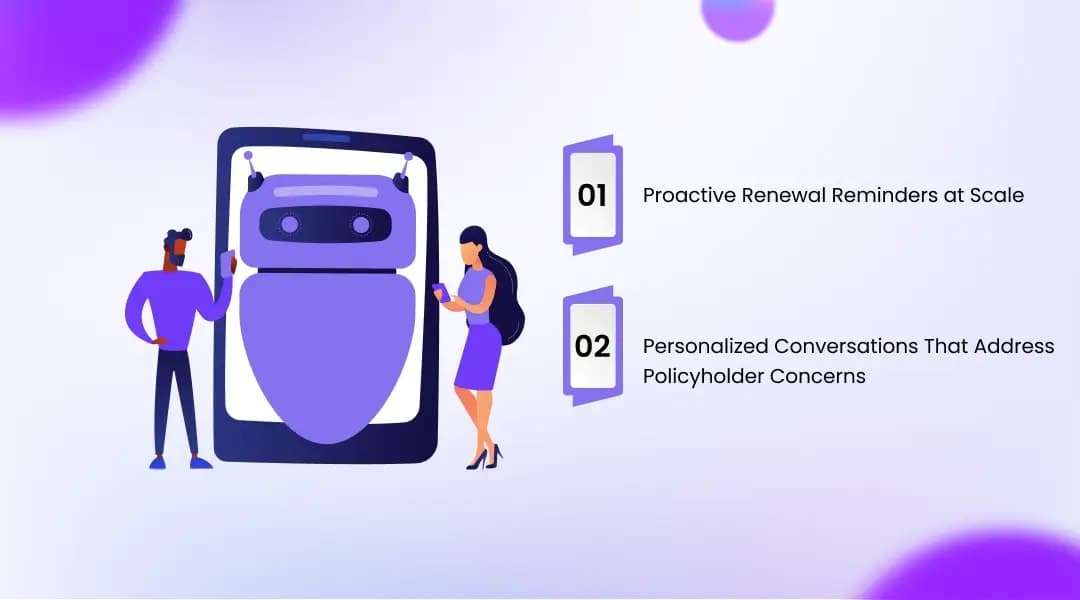
AI voice agents solve the fundamental scaling constraint that makes traditional renewal processes fail. These systems conduct natural, two-way voice conversations with policyholders at a volume that no human team can match, while maintaining the conversational quality and objection-handling capability that makes phone outreach effective in the first place. Instead of choosing between scale and quality, insurers using AI voice agents get both.
The transformation starts with timing. AI voice agents can initiate renewal outreach 30, 21, 14, and 7 days before a policy expiration date, following a cadence optimized for each product line and customer segment. Because the system is not constrained by agent availability, every policyholder in the renewal window receives their call at the optimal time, not whenever a human agent happens to get to their name on a list. This proactive, cadenced approach to renewal reminders at scale is one of the most immediate operational improvements insurers experience when they automate insurance renewal calls.
Proactive Renewal Reminders at Scale
A well-configured AI voice agent handles the entire renewal reminder workflow autonomously. The system pulls policy data from the insurer's management platform, identifies policies approaching renewal, and initiates outbound calls according to predefined business rules. Each call opens with the policyholder's name, references their specific policy type and coverage details, and communicates the renewal deadline along with any changes to premium, coverage terms, or payment options. The conversation feels personalized because it is: the AI agent is working from the actual policy record, not reading a generic script.
OnDial's AI voice agents handle this kind of structured outbound campaign with sub-500 millisecond response latency, which means the conversation flows naturally without the awkward pauses that make automated calls feel robotic. When a policyholder responds to a renewal reminder with a question about their premium increase or a coverage change, the AI agent processes the response and delivers a relevant answer in real time. This responsiveness is critical for insurance conversations where hesitation or confusion on the part of the caller immediately erodes trust and increases the likelihood of a lapse.
Personalized Conversations That Address Policyholder Concerns
The reason phone calls convert better than emails for insurance renewals is that policyholders often have specific concerns they want addressed before committing to another year of coverage. Common renewal objections include premium increases, perceived lack of value from the coverage, changes in personal circumstances, and competitive offers from other insurers. A static email or SMS cannot engage with any of these objections. An AI voice agent can.
Modern AI calling for insurance companies uses natural language understanding to identify the policyholder's concern, match it against a library of trained responses, and deliver a relevant answer that addresses the objection directly. If a policyholder says their premium went up and they are considering switching, the AI agent can explain the factors behind the increase, highlight the value of continuity and claims history, and offer to connect them with a human advisor for a coverage review. If the concern is about a life change such as a new home, a marriage, or retirement, the agent can note the change for follow-up and schedule a callback from a licensed advisor who can adjust the policy. This ability to handle nuanced, branching conversations is what separates AI voice agents from basic robocall or IVR systems.
The Mechanics of AI Calling for Insurance Companies
Understanding how AI voice agents actually work in an insurance context removes much of the hesitation that operations teams feel when evaluating automation. The technology is sophisticated, but the operational workflow is straightforward once the system is configured for your specific policy products and renewal processes.
How a Renewal Call Actually Works with an AI Agent
The sequence begins when the AI platform receives a trigger from the policy management system indicating that a specific policy is entering the renewal window. The system checks the policyholder's contact preferences, preferred language, and any prior interaction history. It then initiates an outbound call at a time optimized for answer rates based on demographic and geographic data. Businesses new to voice automation can also explore What Is an AI Voice Bot? Benefits, Use Cases & Real Examples to understand the underlying technology before implementing insurance workflows.
When the policyholder answers, the AI agent introduces itself, identifies the purpose of the call, and delivers the renewal information specific to that policy. The conversation follows a dynamic flow rather than a rigid script. If the policyholder confirms they want to renew, the agent can capture verbal confirmation, send a payment link via SMS during the call, or schedule a follow-up with a payment processing team. If the policyholder has questions, the agent addresses them. If the policyholder is not interested, the agent captures the reason for the decline, tags the record accordingly, and ends the call professionally. Every call is recorded, transcribed, and analyzed for sentiment and outcome data.
OnDial's platform supports this entire workflow through both API integration and no-code deployment options, which means insurance companies can connect the AI agent to their existing policy management system without building custom middleware. The no-code option is particularly relevant for mid-sized insurers and MGAs that do not have large internal development teams but still need enterprise-grade automation.
Handling Objections, Questions, and Escalations
One of the most common concerns insurance operations leaders raise about AI calling is whether the technology can handle the complexity of real insurance conversations. The answer depends entirely on the platform and how it is configured. A well-trained AI voice agent for insurance is not attempting to replace a licensed insurance advisor. It is handling the 70% to 80% of renewal conversations that follow predictable patterns and escalating the remaining 20% to 30% that require human expertise.
The AI agent is trained on objection libraries specific to each insurance product. For a health insurance renewal, this might include responses to premium increase concerns, network change questions, and coverage comparison requests. For auto insurance, the library might cover claims history impacts, no-claim bonus explanations, and add-on coverage options. When a conversation moves beyond the agent's trained scope, the system executes a warm transfer to a human agent or schedules a callback, passing along the full conversation transcript and identified concern so the human agent picks up exactly where the AI left off. Similar escalation strategies are discussed in How Voice AI Is Transforming Modern Customer Service.
This hybrid approach is where insurance call center automation delivers the strongest results. The AI handles volume and consistency while humans handle complexity and compliance-sensitive discussions. Neither replaces the other. Together they produce a renewal operation that is both more efficient and more effective than either approach alone.
Quantified Impact: What Insurance Companies Gain from AI Voice Agents
The business case for AI voice agents in insurance renewal is built on three pillars: improved renewal rates, reduced operational costs, and enhanced data quality for downstream decision-making. Each of these delivers measurable returns that compound over time.
Renewal Rate Improvements
Insurance companies that implement AI voice outreach for renewals typically see a 12% to 20% improvement in renewal rates within the first six months of deployment. This improvement comes from two sources. First, the AI agent reaches policyholders who would never have received a personal call under the traditional prioritized outreach model. These are often mid-tier and lower-premium policies that were previously handled only through email and SMS reminders. Second, the AI agent's ability to conduct timely, multi-touch outreach means that policyholders who miss the first call receive follow-ups at appropriate intervals, increasing the overall contact rate from the typical 30% to 40% range to 60% or higher.
For a company with 50,000 policies and an average premium of $1,200, moving the lapse rate from 18% down to 12% through AI-assisted renewal outreach recovers approximately $3.6 million in annual premium revenue. That single metric often justifies the entire investment in the technology within the first quarter of operation.
Cost Savings Versus Traditional Call Centers
The cost comparison between AI voice agents and human call center teams for renewal outreach is stark. A fully loaded call center agent, including salary, benefits, training, management overhead, facilities, and technology costs, typically costs an insurance company between $35,000 and $55,000 per year in the US market and between 4 to 7 lakh rupees annually in India. Each agent handles 40 to 60 calls per day. An AI voice agent can handle thousands of simultaneous calls at a fraction of the per-call cost, with no training ramp time, no attrition, and no quality variance between the first call of the day and the last.
OnDial's pricing model is structured around usage rather than headcount, which means insurers pay for calls made rather than maintaining a fixed team. This aligns the cost structure directly with the renewal pipeline volume, eliminating the overhead of staffing for peak renewal periods and the waste of idle capacity during slower months. For seasonal insurance products where renewal volumes spike in specific quarters, this variable cost model delivers significant savings compared to maintaining a year-round call center team sized for peak demand.
Why OnDial Is Built for Insurance Renewal Automation
Not every AI voice platform is equipped to handle the specific requirements of insurance renewal operations. Insurance conversations involve regulated language, data privacy obligations, multilingual policyholder bases, and integration with legacy policy administration systems. OnDial's platform addresses each of these requirements with capabilities specifically designed for enterprise insurance operations.
Multilingual Support for Diverse Policyholder Bases
Insurance companies in India and other multilingual markets face a challenge that most AI voice platforms cannot solve: policyholders who speak different languages, switch between languages mid-conversation, and expect to be addressed in their preferred regional language. An insurer operating across multiple Indian states might have policyholders who prefer Hindi, Tamil, Telugu, Marathi, Bengali, Gujarati, Kannada, Malayalam, or Punjabi. Reaching each of these policyholders in their preferred language with a human call center would require recruiting, training, and managing agents fluent in each language, a logistical and financial burden that most insurers simply absorb as a limitation.
OnDial supports over 100 languages, including 9 Indian languages with more than 80 Indian voice variations. This means a single AI deployment can conduct renewal calls in Tamil for a policyholder in Chennai, switch to Hindi for a policyholder in Lucknow, and handle a conversation in Gujarati for a policyholder in Ahmedabad, all within the same campaign. The system identifies the policyholder's preferred language from their profile data and conducts the entire conversation in that language, including objection handling and confirmation steps. This capability alone can improve contact rates and renewal conversion in linguistically diverse markets by 25% or more compared to English-only outreach.
Compliance and Data Security for Insurance Operations
Insurance is among the most heavily regulated industries, and any technology that touches policyholder data and conducts conversations about coverage must meet strict compliance standards. OnDial operates with GDPR and CCPA-compliant data handling, which provides the baseline data protection framework that insurers need. Call recordings, transcripts, and policyholder data are handled according to established data governance protocols, with audit trails that support regulatory review requirements.
For insurance companies operating in markets with specific telecom regulations such as India's TRAI DNC registry and DLT compliance requirements, the platform's compliance framework ensures that outbound calls are made only to opted-in numbers and that all mandatory regulatory disclosures are included in the call flow. This regulatory alignment is not optional for insurance companies. It is a prerequisite, and any AI calling platform that does not address it comprehensively is not viable for production insurance deployments.
Implementing AI Voice Agents in Your Insurance Operations
The path from evaluating AI voice agents to running a production renewal campaign is shorter than most insurance operations teams expect. The implementation process follows a structured sequence that can move from pilot to full deployment in 4 to 8 weeks for most insurance companies.
Integration with Policy Management Systems
The first technical requirement is connecting the AI voice platform to the insurer's policy management system, CRM, or data warehouse. This connection allows the AI agent to pull policy details, renewal dates, premium information, and policyholder contact preferences in real time. OnDial supports both API integration for companies with development resources and no-code deployment for teams that need to move quickly without engineering support. For insurers using standard policy administration platforms, pre-built connectors can reduce integration time to days rather than weeks.
The data flow is bidirectional. The AI platform sends call outcomes, sentiment scores, objection types, and renewal confirmations back to the policy management system, updating records automatically and triggering downstream workflows such as payment processing, policy issuance, or human agent follow-up assignments. This closed-loop data architecture means the AI renewal operation is not a siloed tool but an integrated component of the insurer's existing technology stack.
Timeline from Pilot to Full Deployment
A typical implementation begins with a pilot campaign targeting a single product line or geographic segment. The pilot phase, lasting 2 to 3 weeks, involves configuring the AI agent's conversation flows for the specific insurance product, training the objection handling library, setting up the integration with the policy system, and running a limited batch of 500 to 1,000 renewal calls. The pilot serves two purposes: validating the AI agent's conversation quality and renewal conversion rate, and generating baseline data for comparison against the insurer's existing renewal process.
Following a successful pilot, the deployment expands to additional product lines and policyholder segments in phases. Most insurance companies reach full production deployment across all eligible renewal campaigns within 6 to 8 weeks of starting the pilot. The phased approach allows the operations team to refine conversation flows, optimize call timing, and build confidence in the system's performance before scaling to full volume. OnDial's platform provides real-time analytics and call sentiment tracking throughout this process, giving operations leaders visibility into renewal rates, contact rates, objection patterns, and agent performance at every stage of the rollout.
Conclusion
Policy lapse is not an inevitable cost of doing business in insurance. It is an operational problem with a clear, proven solution. The core dynamics are straightforward: most policies lapse not because policyholders want to leave, but because the insurer's renewal outreach is too limited in scale, too impersonal in delivery, or too slow in timing to reach every customer with the right message at the right moment. AI voice agents solve all three of these constraints simultaneously by delivering personalized, two-way renewal conversations to every policyholder in the renewal window, at the optimal time, in their preferred language, and at a cost structure that makes universal outreach financially viable for the first time.
The quantified impact speaks clearly. Insurers implementing AI voice outreach are recovering millions in premium revenue that was previously lost to preventable lapses, while simultaneously reducing the per-call cost of their renewal operations by 60% to 80% compared to traditional call center models. The technology is no longer experimental. It is production-grade, and the insurers adopting it now are building a structural retention advantage that compounds with every renewal cycle.
OnDial delivers exactly this capability with the reliability, language breadth, and deployment flexibility that insurance operations require. With sub-500 millisecond response latency, support for over 100 languages including 9 Indian languages, GDPR and CCPA compliant data handling, and both API and no-code integration paths, OnDial gives insurance companies the ability to automate renewal outreach at scale without compromising conversation quality or regulatory compliance. If your insurance company is ready to stop losing premium revenue to preventable policy lapses, schedule a demo with OnDial and see how AI voice agents can transform your renewal operation within weeks, not months.