Here's a number that stopped me mid-scroll: 64% of event professionals plan to increase their conversational AI investment this year, according to research published by KNVI Labs. That's not early-adopter territory anymore. That's mainstream momentum. And if you've ever managed a conference, trade expo, or large corporate event, you probably understand why. The phones don't stop ringing. Attendees want schedule updates. Sponsors need logistics details. Your registration team is drowning in repetitive questions while the work that actually requires human judgment gets pushed to the margins.
AI voice agents for event management are changing that equation. These are conversational AI systems that handle phone-based interactions: answering attendee calls, confirming RSVPs, providing event details, and collecting feedback, all through natural, human-like speech. They work around the clock, handle multiple calls simultaneously, and never need a coffee break. Organizations planning large conferences and exhibitions increasingly rely on enterprise AI voice agents to automate attendee communication from registration through post-event follow-up.
In this article, I'll walk you through exactly how voice AI fits into each stage of the event lifecycle, what the real ROI looks like, and how to start without overcomplicating things.
What AI Voice Agents Actually Do in Event Management
An AI voice agent is a system that uses speech recognition, natural language processing (NLP), and text-to-speech to hold spoken conversations with callers. It is not a phone tree. It is not a pre-recorded message. It listens, understands intent, and responds dynamically.
For events, this means a single system can handle thousands of concurrent calls about venue directions, ticket availability, schedule changes, and parking details without putting anyone on hold. And here's the part most people miss: modern voice AI doesn't just respond to inbound queries. It initiates outbound calls too, confirming attendance, sending reminders, and following up with no-shows.
How Does It Differ from a Standard IVR?
Traditional IVR systems force callers through rigid menus: "Press 1 for registration, press 2 for directions." AI voice agents let callers speak naturally. A caller can say, "I need to change my registration from Day 1 to Day 2," and the system understands, processes, and confirms the change in real time. The difference in caller satisfaction is significant. Research on conversational flow shows natural human conversations have pauses of only 200-500 milliseconds, and modern voice AI platforms now match that latency. Businesses evaluating whether to modernize legacy phone systems can also explore Best Voice Agents for Smart Business Communication for a broader comparison of conversational AI and conventional call workflows.
Where Does Voice AI Fit in the Event Lifecycle?
The most effective deployments cover three distinct phases: pre-event communication, day-of support, and post-event engagement. Each phase has different call volumes, different caller needs, and different automation opportunities. Let me break each one down.
Pre-Event: Automating Registration and RSVP Calls
The weeks before a major event are when call volumes spike the hardest. People want to know check-in times, agenda details, dietary accommodation options, parking instructions, and whether their registration went through. Your team fields the same 15 questions hundreds of times.
Voice AI for event registration handles this entire category of communication. The agent can confirm registration status by looking up caller details in your CRM, walk attendees through the agenda, share venue directions, and process last-minute RSVP changes.
Proactive Outbound Confirmation
Here's where it gets interesting. Instead of waiting for attendees to call, AI voice bots for events can place outbound confirmation calls days before the event. Teams deploying voice AI for confirmation workflows report 85% confirmation rates and 8-12% attendance improvements compared to email-only approaches, according to KNVI Labs research. That's not a marginal gain. For a 500-person conference with an average no-show cost of $47,000, even a 10% attendance improvement changes the financial outcome of the entire event. Similar proactive outreach strategies are discussed in The AI Voice Agent That Works While You Sleep, where always-on outbound engagement helps recover missed opportunities beyond standard business hours.
At OnDial, I've seen this pattern play out across industries: the moment you shift from passive communication (hoping people read your email) to active voice outreach (calling to confirm), attendance numbers move. Meaningfully.
Day-Of: Real-Time Attendee Support That Scales
Event day is controlled chaos. Attendees call asking where to park. Exhibitors need booth setup instructions. Speakers want schedule confirmations. Sponsors ask about branding placement. And your team is simultaneously managing vendor logistics, AV setups, and a dozen fires you didn't plan for.
AI attendee support systems handle the high-volume, repetitive portion of this communication load. According to a Gitnux industry report, AI chatbots and voice agents handled 80% of attendee queries instantly during hybrid events, reducing support staff needs by 40%.
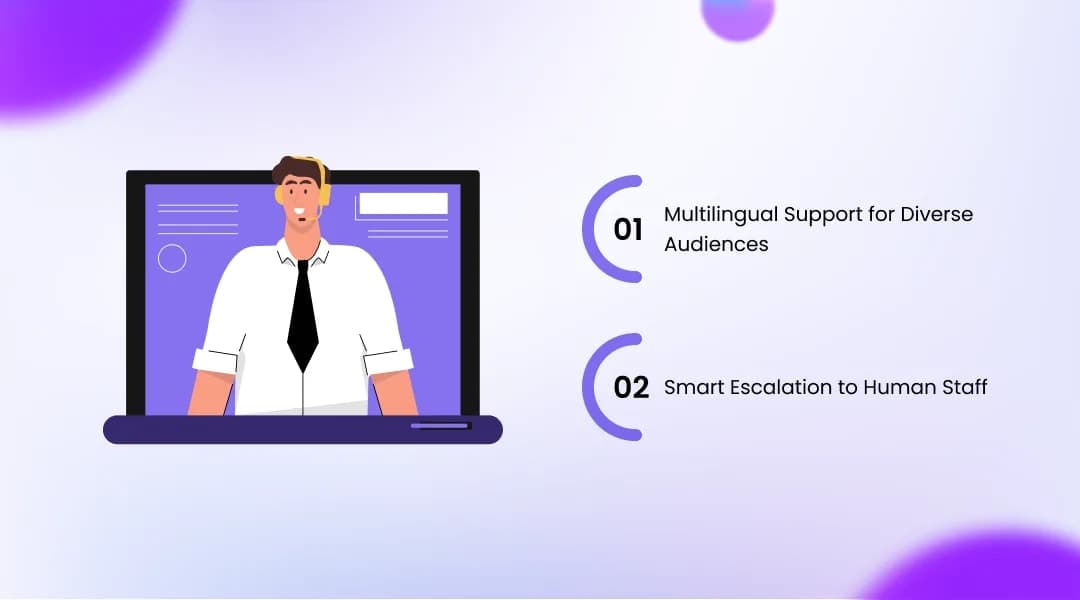
Multilingual Support for Diverse Audiences
Have you considered what happens when your event draws international attendees? A corporate summit in Mumbai might have attendees speaking Hindi, Gujarati, Tamil, and English. A global trade expo needs support in dozens of languages.
Modern conversational AI for events supports 100+ languages with natural pronunciation, which means your AI agent can handle a call in French at 9:01 AM and switch to Japanese at 9:02 AM without any configuration changes. That's a capability most event teams simply cannot replicate with human staff alone. This capability becomes even more valuable for global conferences using multilingual AI voice agents to provide consistent attendee experiences regardless of language.
Smart Escalation to Human Staff
Not every call should stay with AI. When a caller expresses frustration, asks about a sensitive sponsorship issue, or has a problem that falls outside the agent's knowledge base, the system transfers the call to a human team member with full conversation context. The human agent picks up knowing exactly what was discussed, so the caller never repeats themselves. This warm-transfer approach is what separates a good voice AI deployment from a frustrating one.
Post-Event: Feedback Collection and Follow-Up
Most event teams know they should collect feedback. Most don't do it well. Email surveys get 10-15% response rates on a good day. Phone surveys conducted by human staff are expensive and slow.
AI voice agents solve this by placing outbound calls to attendees within 24-48 hours of the event, asking structured feedback questions, and recording responses for analysis. The conversation feels natural, the data is structured, and your team gets actionable insights without spending dozens of hours on the phone.
What tasks can voice AI automate for event planners? AI voice agents automate registration confirmations, RSVP management, schedule inquiries, venue directions, ticket support, post-event surveys, and proactive attendance confirmation calls, all through natural spoken conversations.
The ROI Case for Event Management Automation
Let me put some hard numbers on this. Confirmation workflows that previously required 85 staff hours on a 500-person event now require approximately 10 hours with voice AI: an 88% reduction in labor, as documented by KNVI Labs.
Beyond time savings, the cost differential is striking. Voice AI costs roughly $0.40 to $1.18 per interaction, compared to $7 to $12 per call for human agents, according to compiled data from Teneo.ai and Forrester research. And Deloitte's Tech Trends report found that 91% of companies using AI voice agents for 12 months or more would invest again.
The events industry reported 25% higher attendee satisfaction scores at events using AI compared to those without, according to Gitnux research. That's not just an operational improvement: that's a brand differentiator.
Is AI really worth it for managing events? Yes. Event teams using voice AI report 88% reduction in confirmation labor hours, 8-12% higher attendance rates, and measurable satisfaction improvements. The median ROI breakeven is approximately 3.2 months.
How to Get Started with Voice AI for Your Events
Starting doesn't require a massive technology overhaul. Here's the practical path I recommend, based on what I've seen work at OnDial across dozens of deployments.
Start with One High-Volume Workflow
Don't try to automate everything on day one. Pick the single workflow that generates the most repetitive calls: usually registration inquiries or attendance confirmations. Deploy your AI voice agent on that workflow, monitor for 2-4 weeks, and optimize based on real call data.
Integrate with Your Existing Stack
Your voice AI agent needs to connect to your event management platform, CRM, and calendar systems. Most modern platforms offer API-based integrations or no-code connectors. At OnDial, we've built integrations that sync within seconds of a call ending, so your data stays current without manual entry.
Plan Your Escalation Rules
Define exactly when the AI should hand off to a human. Set triggers for specific keywords (like "complaint" or "refund"), caller sentiment signals, or topics outside the agent's knowledge base. Getting this right is the difference between attendees feeling supported and attendees feeling ignored.
Conclusion
AI voice agents for event management are no longer experimental. They handle the communication load that buries event teams: registration calls, attendance confirmations, day-of support, and post-event feedback. The data supports it: 88% reduction in confirmation labor, 8-12% attendance improvements, and satisfaction scores that set your events apart.
The practical starting point is simple. Pick one high-volume workflow, deploy a voice AI agent, measure for a month, and expand from there. If you're exploring how voice AI can fit your specific event operations, OnDial builds tailored voice AI solutions designed for exactly this kind of high-volume, multilingual communication challenge. Reach out to explore what a deployment looks like for your next event.
AI voice agents give event teams the ability to handle thousands of attendee interactions simultaneously, improve attendance rates, and free human staff for the work that actually requires human judgment and creativity.