Gartner predicts that by 2029, agentic AI will autonomously resolve 80% of common customer service issues without human intervention. That is not a soft forecast. It represents a structural shift in how call centers operate, who handles what, and where enterprise money flows. An agentic AI call center uses AI systems that independently reason through problems, take action across multiple platforms, and complete entire customer interactions end-to-end, rather than simply responding to prompts. If you have been watching vendors pitch "AI-powered" everything and wondering what is real versus what is noise, you are not alone. I have spent years working with enterprise teams navigating exactly this confusion. In this guide, you will learn what agentic AI actually does in a call center, how it compares to the chatbots you already have, the ROI data behind adoption, and a practical framework for getting started.
What Is an Agentic AI Call Center?
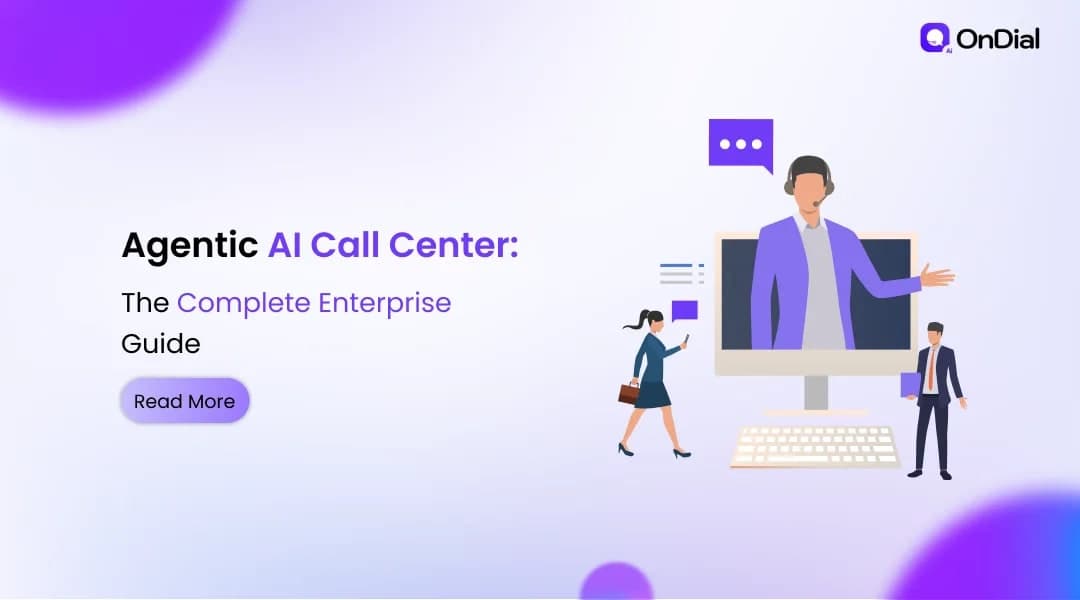
An agentic AI call center is a customer service operation where AI agents can set goals, make multi-step decisions, and take autonomous action to resolve customer issues. Unlike a chatbot that follows a scripted decision tree, an agentic system reasons about what is happening in a conversation, accesses external tools and databases, and completes tasks from start to finish.
Think of it this way: a chatbot answers questions. An agentic AI agent completes work. If you're still evaluating core voice AI capabilities, Key Benefits of Advanced AI Voice Agents explains how enterprise voice AI differs from traditional automation.
How Agentic AI Differs from Traditional Chatbots
This distinction is not just marketing language. The architectural difference changes everything about what your call center can automate.
Traditional chatbots match keywords to pre-written responses. When a customer's request does not follow the expected path, the system breaks. The customer gets transferred, repeats themselves, and leaves frustrated. According to Gartner, only 14% of self-service interactions through traditional channels resolve fully. That is a staggering failure rate for technology that was supposed to reduce call volume. Organizations modernizing customer operations often begin with Enterprise AI Call Automation: Transform Customer Service, Sales & Support, which explores practical automation strategies beyond simple chatbots.
Agentic AI operates differently in three fundamental ways. First, it reasons about context rather than matching keywords. Second, it preserves memory across channels and sessions, so a customer who starts on chat and switches to phone does not restart from zero. Third, it takes autonomous action: filing tickets, issuing refunds, updating CRM records, scheduling callbacks, all within governed guardrails.
Core Capabilities That Define Agentic Systems
Not every "AI agent" label on a vendor website means the same thing. Genuine agentic AI in a call center context includes a specific set of capabilities that separate it from earlier automation.
Goal-oriented reasoning means the AI pursues a defined outcome, like resolving a billing dispute, rather than just generating a response. Multi-system execution means it can query the CRM, verify identity, check account history, and initiate a refund in a single interaction. Continuous learning means the system improves its resolution accuracy over time, typically by 10-15% within the first six months of deployment, according to data from Cyara's research.
An agentic AI system is autonomous software that sets sub-goals, selects tools, evaluates its own results, and iterates, all without waiting for human input at every step.
Why Enterprise Call Centers Are Moving to Agentic AI
The shift is not happening because AI is trendy. It is happening because the economics and operational pressures have converged in a way that makes inaction the riskier option.
The Cost Equation That Changed Everything
Here is the number that keeps showing up in every boardroom conversation I have been part of: AI resolutions cost an average of $0.62 per interaction, compared to $7.40 for human agents, according to McKinsey's AI in Customer Service 2026 report. For voice-specific interactions, the gap narrows slightly but remains dramatic: voice AI costs roughly $0.40 per call versus $7 to $12 for a human agent. These economics closely align with the deployment examples covered in How AI Call Platforms Increase Productivity and Customer Satisfaction.
Scale that across a contact center handling 1,200 interactions per day, where 800 are routine queries with identical resolution paths. The math is not subtle.
But cost reduction alone does not explain the urgency. What is driving the acceleration is what happens to the other 400 calls. When AI handles the routine volume, human agents have more capacity for complex, high-value interactions. Queue pressure drops. Average handle time on difficult cases improves. First contact resolution climbs. In projects I have worked on at OnDial, we have seen this pattern consistently: the ROI story is not just about replacing human effort. It is about making human effort worth more.
Operational Pressure from Every Direction
A 2026 Gartner survey found that 91% of customer service and support leaders are under executive pressure to implement AI. At the same time, annual agent turnover in contact centers runs at 30-45%, with some centers hitting 60%. You cannot hire your way out of a staffing problem that structural.
What about customer expectations? 76% of consumers still prefer phone calls for customer support. Customers are not abandoning voice. They are demanding better voice experiences. And they want those experiences available at 11 PM, not just during business hours.
Have you audited how many of your inbound calls are the same ten questions asked 200 times a day?
That single question has been the starting point for nearly every successful agentic AI deployment I have seen.
Real-World Use Cases for Agentic AI in Call Centers
Theory is one thing. Let me walk through where agentic AI is producing measurable results right now.
Autonomous Tier-1 Resolution
Tier-1 calls- order status, password resets, return initiation, appointment scheduling- represent the highest-volume, lowest-complexity segment of call center work. Agentic AI handles these end-to-end without human involvement.
Simplyhealth, a UK health insurer, deployed agentic AI to automate claims processing. The result: 160,000 fewer calls per year were routed to human agents, and claim satisfaction rose to 99%. What is especially notable is what happened to human agents afterward. They took on more complex work, and received a 35% pay increase over three years as their roles shifted upstream.
In e-commerce, agentic AI looks up shipping status, initiates returns, updates inventory, and sends confirmation through the customer's preferred channel. In banking, it verifies identity, walks customers through security protocols, and initiates claims, all while maintaining regulatory compliance.
Median tier-1 deflection across enterprise CX programs in 2026 sits at 41.2%, with the top quartile reaching 58.7%, according to Zendesk CX Trends data. Refund and password-reset intents deflect at 70% or higher. Nuanced complaints rarely break 25%.
Intelligent Call Routing and Workforce Optimization
This is where agentic AI moves beyond the call itself and into operations.
Traditional IVR forces every customer through the same decision tree, regardless of whether they have a simple billing question or a complex technical issue. Agentic AI replaces static menus with natural conversation, identifying intent and routing to the best resource, whether that is another AI agent or a specific human specialist.
Beyond routing, agentic systems predict call volume, adjust staffing dynamically, and reallocate agent skills based on real-time demand. They monitor every interaction for compliance, flag coaching opportunities, and surface quality insights automatically. CVS Health implemented this approach and moved from scoring 5% of calls to 100%, shifting from weeks-old post-mortem insights to real-time operational intelligence.
How to Implement Agentic AI in Your Call Center
Deloitte predicts that within two years, nearly three in four companies will be using agentic AI at least moderately. But here is the uncomfortable counterpoint: Gartner also predicts that over 40% of agentic AI projects will fail or be canceled by 2027, due to escalating costs, unclear business value, or insufficient risk controls.
The difference between success and failure is almost never the technology. It is the implementation approach.
Start with the Right Use Case, Not the Biggest One
I have watched companies try to deploy agentic AI across every channel simultaneously. It ends poorly. Every time.
The proven approach is narrower. Identify your highest-volume, lowest-complexity call type. Appointment scheduling and order status are the most common starting points. Deploy there. Measure containment rate, customer satisfaction, and resolution accuracy. Build organizational confidence. Then expand.
At OnDial, we advocate for piloting with a single, well-defined workflow. Not because the technology cannot handle more, but because change management determines whether implementations succeed or stall. Your human agents need to trust the system. Your QA team needs to validate its decisions. Your compliance team needs to see the guardrails working.
Enterprise-grade platforms integrate with CCaaS providers like Genesys, NICE CXone, Cisco, and Amazon Connect, plus CRM systems like Salesforce. Pre-built integrations matter enormously here. Custom development can add months to implementation timelines and create ongoing maintenance debt.
Build the Human-AI Boundary with Intention
This is the part most implementation guides skip, and it is the part that matters most.
The question is not "what can AI automate?" It is "where does human judgment create irreplaceable value?" Not all customer interactions are equal. A password reset and a complaint from a 10-year customer about a billing error that triggered a fraud alert require fundamentally different handling.
A well-designed agentic AI call center uses confidence scoring. Before taking action, the AI evaluates data quality and intent clarity. If the confidence score falls below a defined threshold, the agent pauses and either asks clarifying questions or escalates to a human with full context, including conversation history, entities extracted, and actions already taken.
The organizations winning with agentic AI are not the ones automating the most. They are the ones designing the human-AI boundary with the same rigor they apply to agent training and routing logic.
Risks and Limitations You Should Know About
I would not trust a guide that pretended this technology has no rough edges. It does. Acknowledging them honestly is how you avoid the expensive mistakes.
Hallucination, Compliance, and the Trust Problem
AI hallucinations, where the system generates confidently wrong information, account for only 0.34% of AI-handled tickets according to industry data. But 71% of CX leaders rank hallucination as a top-three governance risk because each incident is publicly visible and disproportionately damaging to brand trust.
For regulated industries, the compliance dimension is non-negotiable. HIPAA, GDPR, PCI DSS, SOC 2: agentic AI that accesses sensitive customer data must meet the same standards as human agents. Data minimization, encryption, and regular security audits are baseline requirements, not optional extras.
The EU AI Act compliance deadline for high-risk agentic systems is August 2026. Most enterprises are not ready.
Why 40% of Projects Fail Before Delivering Value
Gartner's prediction that over 40% of agentic AI projects will fail by 2027 is not a warning about the technology itself. It is a warning about how organizations deploy it. The three most common failure modes are:
Starting too broad (automating everything at once instead of proving value on one workflow), underinvesting in change management (treating it as a software install rather than operational transformation), and neglecting governance frameworks that should evolve alongside the AI's expanding capabilities.
One enterprise misstep worth studying: Klarna's aggressive all-in approach to AI customer service generated customer backlash until the company reintroduced human agents into the mix. The lesson is clear. The goal is not maximum automation. It is the right automation, in the right places, with the right human oversight.
Conclusion
An agentic AI call center is not a futuristic concept. It is an operational reality producing measurable results: 80% autonomous resolution projected by 2029 (Gartner), 90%+ cost reduction per interaction, and improved experiences for both customers and human agents. The enterprises succeeding are the ones starting narrow, building trust incrementally, and designing the human-AI boundary with care rather than chasing maximum automation. If your team is evaluating where agentic AI fits into your call center operations, OnDial can help you design a voice-first implementation strategy built around your specific workflows, compliance requirements, and customer expectations, not a one-size-fits-all vendor template. The call center is not disappearing. It is becoming something better: faster for customers, more meaningful for agents, and far more efficient for the business.