Indian mobile users received a staggering 4,168 crore spam calls over a single year, according to a recent India Insights Report. That number is why TRAI DLT for AI calling has stopped being a back-office formality. It is now the line between a campaign that scales and one that gets shut off in 24 hours. If you are deploying voice AI and feeling uneasy about where the rules land, you are not being paranoid.
Here is the short version. AI calling is legal in India, but only when it runs on the Distributed Ledger Technology platform that the Telecom Regulatory Authority of India mandates for every commercial caller. You register your business, your numbers, and your scripts, then scrub against Do Not Disturb lists and disclose that the voice is artificial. Skip any of those, and a single complaint can flag your number across the entire network.
I have spent years at OnDial building AI voice systems for Indian businesses, and I have watched good campaigns collapse over paperwork nobody read. This guide walks you through exactly what TRAI DLT requires, where AI calling quietly breaks the rules, and how to build a stack that survives both regulators and their algorithms.
What TRAI DLT Means for AI Calling in India
Most teams hear "TRAI DLT" and picture a registration form. The reality is closer to a permission system that watches every call you place. Understanding AI calling compliance in India starts with seeing DLT as infrastructure, not a one-time tick box.
Is AI Calling Legal in India Under TRAI Rules?
Yes, AI calling is legal in India when you have TRAI-compliant consent, real-time DND verification, and clear AI disclosure on every call. Miss any one of those three and your campaign moves from legal to liable, sometimes within a single complaint cycle.
The governing law is the Telecom Commercial Communications Customer Preference Regulations, known as TCCCPR 2018. This framework covers promotional, transactional, and service calls. AI-generated voice calls fall squarely inside its scope. There is no separate "AI exemption" waiting for you.
So the legality is conditional, not automatic. Think of it less like a yes or no question and more like a driving licence: you can drive, you just have to pass the test and follow the rules of the road. The penalties for ignoring them are real, and they are getting steeper.
How the DLT Platform Actually Works
DLT, or Distributed Ledger Technology, is TRAI's blockchain-based system that pre-registers every legitimate commercial caller, number, and script before a single call goes out. Six telecom operators host these platforms, including Airtel, Jio, Vodafone Idea, and BSNL. Register on one, and your details mirror across all of them automatically.
Every commercial call gets checked against this ledger in real time. The system verifies that your sending identity, your number, and your script all match approved records. If they do not match, the call is blocked during scrubbing, even when your intent is completely legitimate.
That is the part teams underestimate. DLT is not a filing cabinet you visit once. It is a live gatekeeper. In projects I have worked on, the businesses that treat it as ongoing infrastructure rather than a launch-day chore are the ones that never face a sudden disconnection.
DLT Registration for AI Calling: The Setup You Cannot Skip
DLT registration for AI calling is the formal recognition of who is calling and what they are allowed to say. It is sequential, document-heavy, and unforgiving of shortcuts. Here is what the process actually demands.
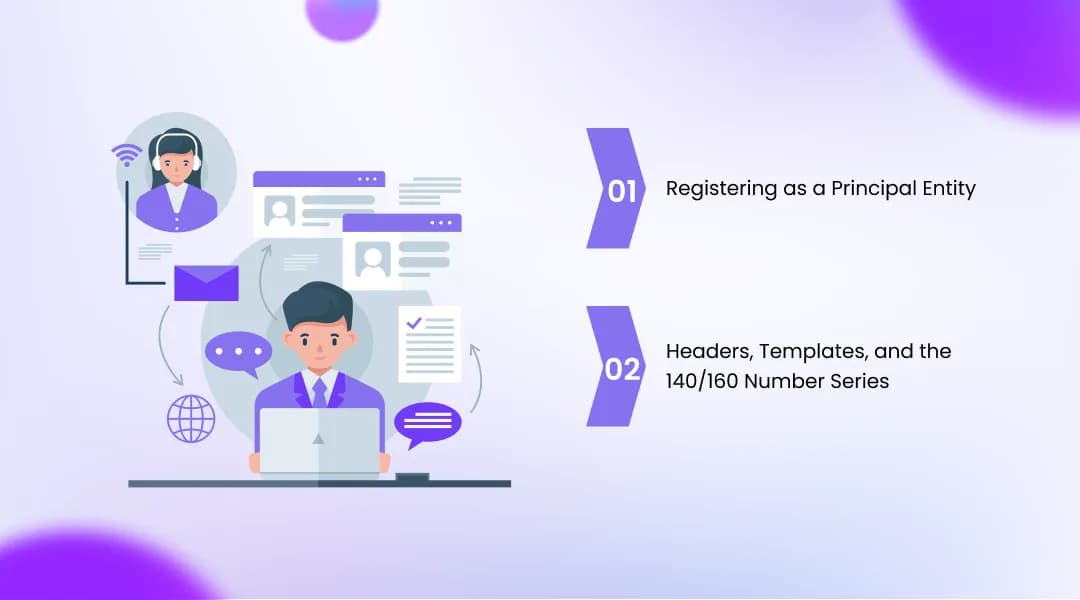
Registering as a Principal Entity
The first step is registering as a Principal Entity, which is the brand whose communication is being sent. That could be your fintech, your hospital, your D2C label, or your edtech platform. Your AI calling provider registers separately as the telemarketer, and the link between you must stay active.
You will need a specific set of documents to complete this:
Certificate of incorporation or business registration, proving the entity is real and legally formed.
GST registration and company PAN, used to verify tax identity and financial standing.
Authorised signatory details and an authorisation letter, confirming who is allowed to act for the business.
A one-time registration fee, typically in the range of ₹5,900 to ₹7,500 depending on the platform you choose.
Verification usually takes two to five business days. Once your Principal Entity registration is approved, it mirrors across all six operator platforms without extra filing. This is the foundation. Nothing else works until it is in place.
Headers, Templates, and the 140/160 Number Series
After your entity is verified, you register headers and call templates. Headers are the identity customers see at the point of origination. Templates are the approved scripts your AI is allowed to speak. Every script variation must be pre-approved before it ever reaches a phone.
The number series rule is equally strict, and AI callers break it constantly. Promotional calls must originate from the 140 series. Transactional and service calls use the 160 series. Using a regular ten-digit mobile number for commercial AI calling is one of the most common violations I see, and TRAI's monitoring systems flag it automatically.
Why does this matter so much? Because the number series is a signal. It tells the network, and the person receiving the call, exactly what kind of communication is coming. Get it wrong and you have announced yourself as a rule-breaker before anyone even answers.
Consent, AI Disclosure, and DND Scrubbing
This is where most campaigns legally collapse. Registration gets you permission to operate. Consent and disclosure govern every individual call you place. The two are not the same, and conflating them is expensive.
The Four Consent Criteria and Why AI Must Announce Itself
Valid consent under TRAI must meet four criteria: it has to be informed, specific, unambiguous, and revocable. Informed means the person knows an AI voice system is contacting them for a defined purpose. Specific means consent is tied to one category, not a blanket future permission.
Disclosure is the criterion AI callers most often dodge. A compliant opening sounds like this: the call identifies the company, states plainly that it is an AI voice assistant, and asks whether the person consents to continue. If the answer is no, the call must end immediately.
And here is the uncomfortable truth. That disclosure matters even when your AI sounds indistinguishable from a human. Passing off an AI as a live agent is not just non-compliant: it can qualify as a deceptive trade practice under Indian consumer law. (Yes, even if the voice is genuinely impressive, especially then.)
How DND Scrubbing and the Penalty Math Work
DND scrubbing is the process of checking your call list against the National Do Not Disturb registry before you dial. It is not optional, and it is not a once-a-year task. TRAI requires scrubbing to be refreshed roughly every 30 days to stay valid.
The economics make the case better than any warning could. Per-number scrubbing costs between ₹0.01 and ₹0.05, so a list of 100,000 numbers runs ₹1,000 to ₹5,000. The cost of skipping it and drawing an upheld complaint can run to ₹25,000 per complaint. The math is not subtle.
The enforcement is real too. In January 2026, the Telecom Regulatory Authority of India imposed financial disincentives of more than ₹150 crore on telecom operators for failing to act on spammers, as reported by Business Standard. When the regulator fines the carriers that hard, the carriers pass that pressure straight down to callers like you.
The False-Positive Problem: When TRAI's AI Flags Your AI
Here is something almost no compliance guide tells you. You can do everything right and still get blocked. That is the strange new reality of AI calling in India, and it is the part worth slowing down for.
Why Legitimate AI Calls Get Blocked
TRAI now uses its own AI and machine learning systems to detect unregistered telemarketers and AI-generated calls. These systems analyse call patterns: unusually high volumes, very short durations, and low incoming-to-outgoing ratios. They also analyse audio signatures for synthetic artifacts.
That creates a paradox for honest operators. Your perfectly registered, fully consented AI campaign can trip the same signals a spam operation does. A lending business I am familiar with watched legitimate calls get marked as spam simply because borrowers who skip payments tend to block incoming numbers, generating false positives at scale.
So compliance is no longer only about following the written rules. It is also about not resembling the thing the algorithm is hunting for. You are being judged by a machine that does not read your registration certificate.
Building a Compliance Posture That Survives Detection
The fix is to engineer your calling behaviour to look like what it is: legitimate. That means several deliberate choices working together.
Use high-quality voice synthesis that passes naturalness checks, so your audio does not carry obvious synthetic artifacts that detection systems penalise.
Pace your call volume sensibly, avoiding the spike patterns that machine learning flags as bulk spam behaviour.
Keep watertight audit trails, logging consent status, timestamps, and opt-out records for every single call you place.
Build human escalation paths, so a person can take over when a conversation needs it, which also satisfies sector rules.
At OnDial, this is exactly the layer we obsess over, because TRAI registration alone does not protect you from a detection system that has never met you. The goal is to be invisible to spam filters and fully visible to auditors at the same time.
Beyond TRAI: DPDP, RBI, and the Wider Compliance Map
A vendor telling you "we are TRAI-compliant" is giving you a technically accurate but dangerously incomplete picture. TRAI governs the call. Other regulators govern the data that call generates, and the sector you operate in. This is the layer that catches confident businesses off guard.
The DPDP Act Overlap
The Digital Personal Data Protection Act 2023 governs what happens to the personal data your calls collect. Every AI call generates such data, which means DPDP jurisdiction applies the moment you start talking. Its consent architecture overlaps with TRAI's, and the two are converging toward a shared meaning of consent.
The stakes here dwarf telecom fines. DPDP penalties can reach up to ₹250 crore for serious violations. Worse, because the consent provisions overlap, a single failure can expose you to double penalties under both frameworks at once. Treating TRAI consent and DPDP consent as one reconciled system is no longer optional.
Sector Rules for Fintech and Insurance
If you operate in regulated sectors, more rules stack on top. AI calling for debt collection, for example, must follow the RBI Fair Practices Code. That restricts calls to 8:00 AM to 7:00 PM, caps call frequency, mandates identification of the calling entity, and requires a human escalation option.
Insurance calling adds IRDAI disclosure norms. Following the 2026 IT Rules amendment, there is also sharper focus on labelling synthetically generated voice and prohibiting impersonation of real individuals. The honest takeaway: your compliance map has at least four layers, and skipping any one of them leaves a gap a regulator can walk through.
Conclusion
Getting TRAI DLT for AI calling right comes down to three things: register your entity, numbers, and scripts on the DLT platform, disclose the AI and capture revocable consent, and scrub every list against DND before you dial. Layer DPDP and your sector rules on top, and you have a stack that scales legally rather than fragily.
You do not need to fear the regulator anymore. You need a system. Compliance is not a tax on growth here. It is the infrastructure that makes growth durable when the enforcement window keeps shrinking.
That is the work we do at OnDial: building AI voice System for Indian businesses with consent, disclosure, and DND verification engineered in from the first call, not bolted on after a complaint. If you are planning a campaign and want it built to survive both audits and detection systems, that is exactly the conversation worth having now, before you dial.