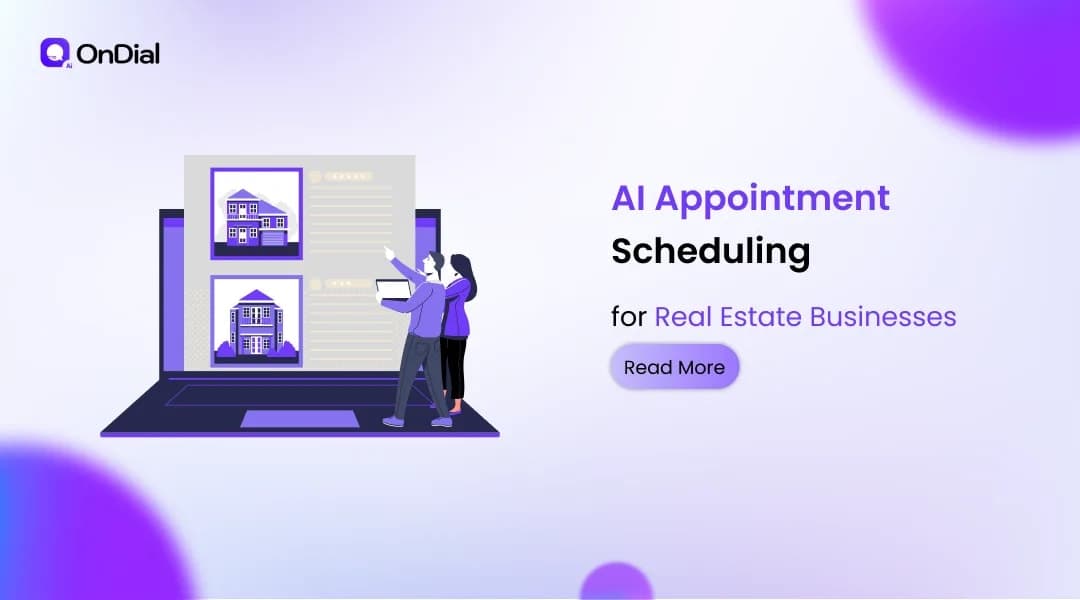
Here is the number that stopped me the first time I saw it: agents miss close to half of their incoming calls, yet nearly 8 in 10 buyers and sellers end up working with whichever agent responds first. AI appointment scheduling for real estate closes that gap by answering every call, chat, or form fill the moment it comes in, then booking the showing directly into your calendar without you touching your phone. It uses voice AI or conversational AI to talk with a lead, check availability, and confirm a time, all while you're mid-showing or off the clock. I've watched this shift play out with real estate teams building voice AI systems at OnDial, and the pattern is consistent: the businesses that respond fastest win the most appointments, almost regardless of price or property. In this guide, I'll walk you through what this technology actually does, why the old way of scheduling is quietly costing you money, how the technology works under the hood, what to look for before you buy, and how to roll it out without disrupting your team.
What Is AI Appointment Scheduling for Real Estate?
AI appointment scheduling for real estate uses conversational AI and voice technology to answer client inquiries, check calendar availability, and book property showings automatically, without a human handling the back-and-forth. That's the whole idea in one sentence. Everything else in this guide is just detail on how that sentence becomes reality inside a busy brokerage.
How It Differs from Basic Online Booking Tools
A basic booking widget on your website is passive. It waits for someone to click a link, pick a slot, and fill out a form, and if they have a question first, they're stuck.
AI appointment scheduling is active. It can pick up a phone call, answer questions about a listing, ask qualifying questions about budget and timeline, and then move straight into booking. The difference is conversation versus a static form. One waits for the lead to do the work; the other does the work for the lead.
The Core Technology Behind an AI Appointment Setter for Real Estate
An AI appointment setter for real estate typically combines a few distinct pieces of technology working together:
Natural language processing (NLP): This is what lets the system understand what a caller actually means, not just match keywords. It's the difference between a rigid phone tree and something that feels like a conversation.
Calendar and CRM integration: The AI needs live access to your calendar (Google Calendar or Outlook, typically) and your CRM so it books real slots and logs the lead correctly.
Voice or chat interface: Some tools work over phone calls, others over SMS or web chat, and the strongest ones cover all three channels consistently.
Each piece matters on its own, but the value only shows up when they're connected. A smart calendar with no conversational front end still can't handle a first-time caller with questions about a listing.
Why Real Estate Businesses Are Losing Deals Without It
Here's an uncomfortable question: how many calls did you miss last week while you were standing in someone's kitchen doing a walkthrough? Most agents don't actually know the number, and that's part of the problem.
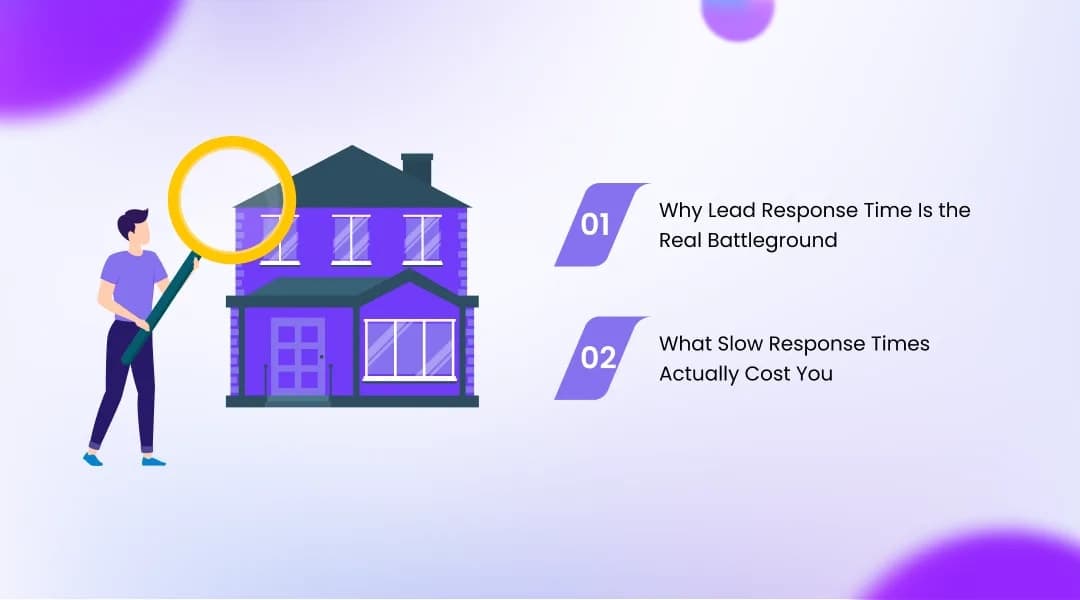
Why Lead Response Time Is the Real Battleground
Research from MIT's Lead Response Management study, which analyzed more than 15,000 leads and over 100,000 call attempts, found that the odds of qualifying a lead drop by roughly 21 times when response time slips from five minutes to thirty. Real estate lead response time isn't a nice-to-have metric. It's arguably the single biggest lever on whether a lead turns into a showing at all.
The National Association of Realtors has also reported that more than half of buyer leads originate from phone calls, which means a missed call isn't a missed message. It's a missed buyer. Agents typically miss somewhere between 40 and 46 percent of incoming calls, largely because they're occupied with showings, closings, and inspections for several hours a day.
What Slow Response Times Actually Cost You
Let's put real numbers around this. If you generate 100 leads a month and miss 40 of them, even a modest 3 percent conversion rate on those missed leads at a typical commission can leave tens of thousands of dollars on the table every year.
Missed calls are not neutral. A caller who doesn't reach you rarely calls back. Industry research puts the rate of callers who never redial after a missed call above 90 percent, which means every unanswered ring is functionally a closed door, not a paused conversation.
I'll be honest here: not every missed call was ever going to convert. Some are wrong numbers, some are tire-kickers. But you don't get to sort the good leads from the noise if you never pick up in the first place.
How AI Voice Agent Scheduling Works, Step by Step
AI voice agent scheduling works by combining real-time speech recognition, intent detection, and calendar access so the system can hold a natural phone conversation and book a confirmed appointment before the call ends. No hold music, no callback promises, no "someone will reach out."
From First Ring to Booked Showing
Picture a buyer calling about a listing at 9 PM on a Thursday. Here's roughly what happens with a well-built AI voice agent:
The call is answered within a few seconds, at any hour, on any day.
The AI asks qualifying questions, such as budget range, timeline, and whether the buyer is pre-approved.
It pulls relevant listing details from your MLS feed or property database in real time.
It checks your actual calendar availability and offers open slots that work for both sides.
It confirms the booking, sends a calendar invite, and logs the full conversation into your CRM.
That entire sequence can happen in under three minutes, with zero human involvement until it's time for the actual showing.
Handling Reschedules, Cancellations, and No-Shows
Booking the first appointment is the easy part. Real scheduling systems also have to handle the messy middle: the buyer who needs to move the time, the seller who forgets, the no-show at 2 PM on a Saturday.
Good platforms handle this automatically through:
Automated reminder sequences sent by text or email a day and again a few hours before the appointment, which measurably cuts down no-shows.
Self-service rescheduling, where the lead can text back "can we do 4 instead" and the AI adjusts the booking without a human relay.
Smart rebooking, where a canceled slot is automatically offered to another warm lead instead of sitting empty.
This is the part that quietly saves the most administrative time, because reschedules and no-shows are exactly the kind of repetitive coordination that burns hours without ever showing up on a commission statement.
What to Look for in an AI Receptionist for Real Estate

Not every AI receptionist for real estate is built the same, and the differences matter more than the sales pages suggest. Here's what I'd actually check before signing a contract.
Must-Have Features
At a minimum, an AI receptionist for real estate should offer:
True calendar sync, not a static booking form pretending to be dynamic.
CRM integration with platforms real estate teams already use, such as Follow Up Boss, kvCORE, or Top Producer.
Multi-channel coverage, since leads come in through phone, WhatsApp Business, SMS, and web chat, often for the same listing.
Human handoff logic, so complex questions (pricing negotiations, unusual financing, access restrictions) route to a person instead of being improvised by the AI.
Skip any tool that can't clearly explain how it handles that last point. An AI that tries to answer everything, including questions it shouldn't, is a liability dressed up as a feature.
Red Flags to Avoid When Evaluating Vendors
A few warning signs I'd take seriously during a demo:
Vague answers about data privacy or call recording compliance, particularly around TCPA rules if you're in the US. This should never be a shrug-and-move-on question.
No visibility into call transcripts or booking logs, which makes it impossible to audit what the AI actually said to a client.
Scripts that sound obviously robotic in the demo itself. If it sounds stiff when the vendor is trying to impress you, it will sound worse on a real call.
One sentence, because it deserves its own line: if a vendor can't show you a real call recording, ask why.
Conversational AI for Property Showings: Real-World Use Cases
The theory is straightforward. What it looks like day to day depends heavily on the size and shape of the business using it.
Solo Agents and Small Teams
For an independent agent, conversational AI for property showings often functions as a full-time assistant that never sleeps and never takes a lunch break. A solo agent juggling listings, showings, and paperwork typically can't answer every call in real time, and a missed call at that scale is a much bigger percentage hit to their pipeline than it would be at a large brokerage.
In projects I've worked on at OnDial, the agents who benefited most from voice AI weren't the highest-volume producers. They were the ones running lean, where a single after-hours call answered correctly meant the difference between a booked weekend showing and a lead gone cold by Monday.
Brokerages and Property Management Companies
At the brokerage level, the use case shifts toward coordination at scale. Multiple agents, shared calendars, and dozens of simultaneous inquiries require routing logic, not just answering logic.
Property management companies see a slightly different pattern: high call volume around tenant maintenance, lease renewals, and tour requests for vacant units. Here, an AI system that can triage urgency (a broken water heater versus a general question) and still book tours automatically tends to deliver the clearest return, since it reduces dependence on a large front-desk staff without sacrificing responsiveness.
Getting Started: Implementing AI Scheduling Without the Headaches
Rolling this out doesn't need to be a six-month IT project. Most teams can be live within one to two weeks if the scope stays realistic.
Integration With Your Existing CRM and Calendar
Start with what you already use. Most established AI scheduling platforms connect to Google Calendar, Outlook, and mainstream real estate CRMs through existing APIs, so you're rarely rebuilding your tech stack from scratch. Confirm this integration works both ways: appointments booked by the AI should appear instantly in your calendar, and lead details should land automatically in your CRM.
Test the connection on a small slice of your call volume before routing everything through it. A short pilot period, even just a week, surfaces integration gaps while the stakes are still low.
Setting Realistic Expectations for Week One
I want to be honest about the limitations here, because overselling this technology helps no one. An AI scheduler will not close a hesitant seller or negotiate a tricky financing situation. It's not a replacement for the relationship-building parts of real estate. It's a replacement for the repetitive coordination work that eats hours without building any relationship at all.
Give the system a defined script for your specific business (property types, service area, common objections) and expect a short adjustment period as it learns your calendar patterns and your team's preferred handoff points. Should you review the first few weeks of transcripts closely? Yes. That review period is where you catch the edge cases before they become client complaints.
Conclusion
AI appointment scheduling for real estate comes down to three things: it answers every call your team physically can't, it books showings without the back-and-forth that burns your afternoon, and it keeps your CRM current without anyone typing notes from memory. The agents and brokerages that adopt this early aren't doing it because it's trendy. They're doing it because 78 percent of buyers work with whoever responds first, and a missed call can't respond to anyone with Turn Missed Calls Into Sales With AI Voice.
You don't need to overhaul your business to start. You need a system that answers the phone the way you would, if you could be everywhere at once. That's the specific problem OnDial's voice AI was built to solve for real estate teams: a human-sounding assistant that books the showing, logs the lead, and hands off the complicated questions to you, built around your calendar, your listings, and your workflow, not a generic script.