More than half of utility customers in the United States, 55%, went through a power outage last year, according to JD Power's Utilities Outlook 2026. That single number explains why utility call centers spend so much of the year underwater. If you run customer service for a water, gas, or electric provider, you already know the feeling: the phones ring in bursts you can't staff for, and every missed call is a customer who now trusts you less.
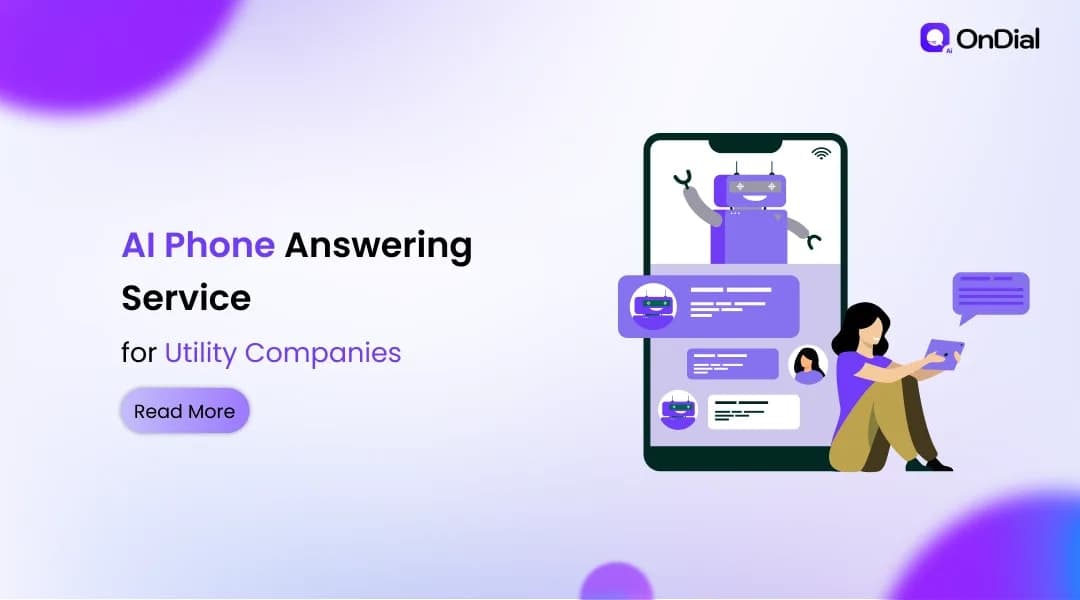
An AI phone answering service for utility companies is a voice system that answers inbound calls, understands what the customer needs (an outage report, a billing question, a new service request), and either resolves it directly or routes it to the right human. It is not a phone tree. It is not a chatbot wearing a headset. Here's what you'll learn: what this technology actually does, where it fits your operation, how to evaluate it honestly, and where its limits are.
What Is an AI Phone Answering Service for Utility Companies?
An AI phone answering service for utility companies is a voice system that answers calls, understands intent using natural language processing, and resolves or routes billing, outage, and service requests without a live agent. It runs 24 hours a day and can handle many calls at once, which matters most during storms and billing cycles when volume spikes hardest.
I've worked on voice AI deployments across several service industries at OnDial, and the utility sector is one of the few where this technology solves a genuinely painful, recurring operational problem rather than a nice-to-have convenience.
How It Differs From Traditional IVR
Old-school IVR makes callers press 1 for billing, 2 for outages, 3 for a human. It's rigid, and anyone who has ever screamed "representative" at their phone knows exactly how frustrating that rigidity feels.
A modern AI voice agent listens to what the customer actually says, in their own words, and figures out intent from there. A caller can say "my lights went out an hour ago" and the system understands that's an outage report, not a billing call, without a single menu press.
Natural conversation: The customer speaks normally instead of navigating a decision tree.
Context retention: The system remembers what was said earlier in the same call.
Dynamic routing: Complex or emotional calls get sent to a human agent automatically, based on what the AI hears.
What It Can Actually Do on a Live Call
In practice, a well-built AI phone answering service can pull a customer's account, confirm an outage against your outage management system, take a payment, or schedule a service appointment. It logs everything into your CRM as it goes.
What it cannot do is make judgment calls on genuinely ambiguous, high-stakes situations. A gas leak report, for instance, should always route straight to a live dispatcher. Good implementations are built around that boundary, not around pretending the boundary doesn't exist.
Why Utility Companies Are Turning to AI Answering Services in 2026
Here's the uncomfortable truth: hiring your way out of this problem doesn't scale anymore. Utility call volume is spiky by nature, and staffing for the worst day of the year means overpaying for the other 350 days.
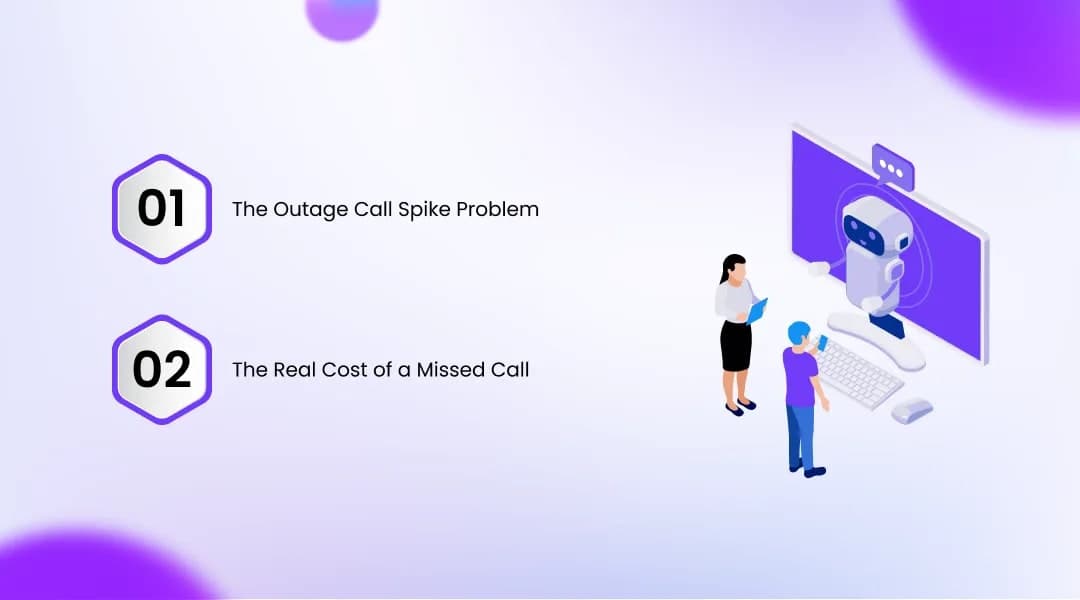
The Outage Call Spike Problem
Energy customer service has some of the most extreme demand volatility of any industry. A heat wave, a freeze, or a storm can flood a contact center with the same question from thousands of callers at once: "When will my power be back?”
National Grid rolled out an AI virtual assistant and reduced call center volume by 41%, saving roughly £12 million a year. That's not a hypothetical. That's a utility with millions of customers proving the model holds up under real storm-season pressure.
Predictable surge, unpredictable timing: Utilities can forecast that outages will happen, just not exactly when.
Same question, thousands of times: Most outage calls are a restoration-time check, which is exactly the kind of repetitive query AI handles well.
Regulatory visibility: Slow response during outages draws public and regulatory scrutiny, so speed isn't optional.
The Real Cost of a Missed Call
Across service industries broadly, 62% of business calls go unanswered, and roughly 85% of callers who don't reach a live person never call back. Utilities don't lose a "customer" the way a plumber does (people can't switch electric providers in most markets), but they absolutely lose trust, generate complaints, and increase repeat-contact volume.
I'll be direct here: for a utility, the cost of a missed call isn't lost revenue in the traditional sense. It's regulatory risk, reputational damage, and an angrier customer calling back three more times.
Core Use Cases: Where AI Voice Agents Fit Into Utility Operations
Not every call type is a good fit for automation, and pretending otherwise is how these projects fail. The strongest results come from targeting high-volume, low-complexity workflows first.
Outage Reporting and Status Updates
This is the highest-value use case in the entire category. When an AI voice agent connects to your outage management system in real time, it can confirm whether an outage is already known, give an estimated restoration window, and log a new report if it isn't.
Instant confirmation: No hold time to find out if your street is already on the outage map.
Consistent messaging: Every caller gets the same accurate restoration estimate, not whatever an overwhelmed agent remembers.
Safety routing: Reports involving downed lines or gas smells escalate immediately to a live dispatcher.
Billing, Payments, and Account Questions
Billing confusion generates a huge share of repeat calls, and much of it is routine: confirming a due date, explaining a higher-than-usual bill, or setting up a payment arrangement. An AI answering service can pull account data and walk a customer through these questions directly.
One thing worth saying plainly: billing disputes and hardship cases still need a human. The best deployments I've seen treat AI as the front door for the easy 70%, not a replacement for judgment on the hard 30%.
How to Evaluate an AI Phone Answering Service Before You Buy
So how do you actually tell a serious platform from a demo that looks good in a sales call? Start with integration depth, not voice quality. Voice quality is table stakes now. Integration is where projects succeed or quietly fail.
Integration With Your Existing Systems
An AI phone answering service is only as useful as the data it can see. If it can't check your outage management system (OMS) or your customer information system (CIS) in real time, it's just a fancy voicemail with better manners.
Ask any vendor exactly which systems they've connected to in production, not in theory. Ask for a reference customer who has been live for at least two full billing cycles, not two weeks.
Escalation Paths for Complex or Emergency Calls
The single most important design decision in any deployment is how and when a call hands off to a human. A gas leak, a downed power line near a school, a customer in genuine financial distress: these need a person, immediately, with full context already captured.
Clear escalation triggers: Define upfront which keywords or situations force an instant human handoff.
Warm handoff, not a cold transfer: The human agent should receive the call history, not start from zero.
Regular audits: Review escalated calls monthly to catch edge cases the system missed.
Common Concerns and Honest Limitations
I'd rather lose your interest here than oversell you. Every utility team I've talked to has the same two worries, and both are reasonable.
Will Customers Actually Accept Talking to an AI?
Acceptance is higher than most operations leaders expect, largely because customer expectations have shifted. Zendesk's CX Trends research found 74% of customers now expect 24/7 availability, and a majority say they'd rather get a fast answer than wait for a specific human.
That said, tone matters enormously for a utility. A customer reporting an outage during a storm is stressed, sometimes scared. The system needs to sound calm and competent, not chirpy. (This is the part vendors underinvest in, and it shows.)
What AI Still Cannot Replace
An AI phone answering service is not a substitute for field crews, emergency dispatch judgment, or genuinely difficult customer conversations. It's a filter that removes routine volume so your human team can spend their time on the calls that actually need a person.
Be honest with your team about this from day one. The rollouts that struggle are usually the ones sold internally as "replacing the call center" instead of "removing the repetitive 60% of it." Modern Contact Centers Are Replacing Call Scripts.
Conclusion
An AI phone answering service for utility companies solves a specific, recurring problem: too many routine calls hitting your team at the worst possible moments. Used well, it absorbs outage status checks and billing questions instantly, while keeping humans in charge of anything urgent or sensitive. The utilities getting real value from it, like National Grid, treat it as a filter for volume, not a replacement for judgment.
If your team dreads the next storm season, that's usually the clearest sign it's time to look at this seriously with AI voice agent industry solutions. At OnDial, we build voice AI around exactly this kind of high-stakes, high-volume communication problem, and we're happy to walk through what an outage-ready deployment would actually look like for your call patterns.