I need to tell you something that might sting a little.
That IVR system you spent six months implementing? The one with the carefully designed menu tree and the on-hold music your team debated for two weeks? Your customers hate it.
I'm not guessing. I spent four years managing call center operations for a mid-size insurance company in Mumbai. I watched our IVR drop-off rates climb past 30%. I listened to call recordings where people literally cursed at the automated menu before hanging up. And I sat in meetings where we kept "optimizing the call flow" as if rearranging deck chairs on the Titanic would somehow fix the iceberg problem.
Here's what finally hit me: traditional IVR was designed for the company's convenience, not the customer's. It routes calls. It deflects volume. It was never built to actually solve a customer's problem on its own.
The question of conversational AI voice bot vs IVR isn't really about technology. It's about whether you're still designing your phone experience around your org chart or around the person calling you.
Let me walk you through what I've learned after helping 30+ companies navigate this exact decision.
What is a Traditional IVR System?
Definition
Interactive Voice Response, or IVR, is the touchtone or basic speech-recognition system that greets you when you call virtually any business. "Press 1 for billing. Press 2 for support. Press 3 to quietly lose your mind." You know the drill.
How It Works
IVR operates on a fixed decision tree. A caller hears pre-recorded prompts, inputs a response via keypad or simple voice commands ("yes," "no," "agent"), and gets routed down a predetermined path. The logic is static. If your problem doesn't fit neatly into one of the menu options - tough luck.
Common Use Cases
IVR still handles the basics across industries: checking account balances in banking, confirming appointment times in healthcare, routing to the right department in telecom. For high-volume, low-complexity tasks, it does the job. Barely.
What is a Conversational AI Voice Bot?
Definition
A conversational AI voice bot is an AI-powered voice assistant that understands natural human speech, interprets intent, and responds in a way that feels like talking to an actual person - not a phone tree.
How It Works (NLP, AI, Automation)
This is where it gets interesting. These bots are built on natural language processing (NLP) and machine learning models that can parse meaning from messy, real-world speech. Someone says, "Yeah, I got charged twice for that order I placed last Thursday" — and the bot understands what happened, when it happened, and what the caller wants done about it. It pulls data from your CRM, processes the request, and either resolves it or hands off to a human agent with full context.
No menu. No "press 1." Just a conversation.
Real-World Applications
Think order tracking and returns for e-commerce. Appointment scheduling in healthcare. Claim status updates in insurance. Loan inquiry handling in banking. Companies like OnDial build these conversational AI voice bot solutions specifically for businesses that have outgrown their legacy phone systems and need something that actually talks with customers, not at them.
Key Differences: AI Voice Bot vs Traditional IVR
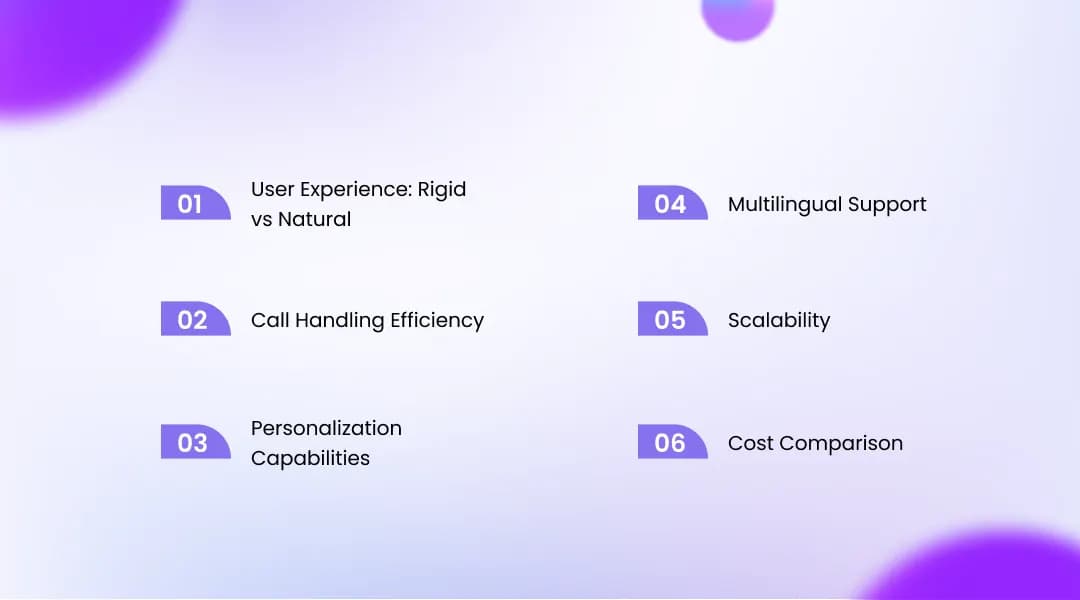
Let me be blunt. The difference between an AI voice bot vs traditional IVR isn't incremental. It's architectural. Here's where the gap shows up:
User Experience: Rigid vs Natural
IVR forces customers into your predefined boxes. "Press 1. Press 2." If their problem is nuanced, they're stuck. An AI voice assistant lets them speak naturally — in their own words, in their own language, at their own pace. One feels like filling out a government form. The other feels like calling a smart colleague.
Call Handling Efficiency
Traditional IVR routes calls. That's it. A conversational AI voice bot resolves calls. It can handle FAQs, process transactions, update records, and escalate intelligently — all within the same interaction. I've seen clients reduce their average handle time by 40% within three months of deployment.
Personalization Capabilities
IVR treats every caller like a stranger. An AI voice bot integrates with your CRM, order management system, and customer data platform. It knows who's calling, what they bought, and what they probably need. That context changes everything.
Multilingual Support
Here's one that matters enormously in India. Traditional IVR multilingual support means recording every menu prompt in every language — expensive, slow, and rigid. AI voice bots handle multilingual conversations dynamically, switching between Hindi, English, Tamil, or Marathi mid-sentence if the caller does.
(I once watched a demo where a caller switched from Hindi to English halfway through explaining a billing issue. The bot didn't blink. The IVR vendor in the room went very quiet.)
Scalability
IVR scales by adding more phone lines. AI voice bots scale by handling more concurrent conversations — no additional infrastructure, no new hires, no training ramp-up. Black Friday call surge? Handled. Monsoon season insurance claims spike? Handled.
Cost Comparison
IVR is cheaper to set up initially. Full stop. But its long-term cost structure is brutal — agent escalation rates stay high, customer churn from bad experiences compounds, and every menu update requires vendor involvement. AI voice bots cost more upfront but bend the cost curve down aggressively over 12–18 months.
Limitations of Traditional IVR Systems
I'm not here to bury IVR for sport. I used it for years. But let's be honest about what it can't do.
Long wait times — IVR doesn't solve problems; it queues them. Customers still wait for agents on the other end of the routing.
Poor user experience — Nobody has ever hung up from an IVR interaction and thought, "Wow, that was delightful." Ever.
High drop-off rates — Industry data consistently shows IVR abandonment rates between 25–35%. That's not a stat. That's a revenue leak.
Limited flexibility — Changing a single menu option often means re-recording prompts, reconfiguring logic trees, and testing across scenarios. It's slow, expensive, and fragile.
Quick question for you: when was the last time you enjoyed calling a business with an IVR system? I'll wait.
Benefits of Conversational AI Voice Bots
Now let me tell you what I've actually seen happen when companies deploy conversational AI for customer service.
24/7 automation — The bot doesn't sleep. It doesn't call in sick. It handles your midnight callers and your Sunday morning complainers with the same energy.
Human-like conversations — Modern NLP makes these interactions feel natural. Not perfect — but light-years ahead of "I'm sorry, I didn't understand your selection."
Faster resolution — By accessing backend systems in real-time, AI voice bots resolve issues in a single interaction that IVR would take three transfers and twenty minutes to fumble through.
Reduced operational costs — Fewer escalations to live agents means fewer agents needed for Tier 1 queries. The math is straightforward.
Better customer satisfaction — Customers who get their problem solved quickly, in their own language, without being put on hold — they come back. They spend more. They tell people.
Use Cases: Where AI Voice Bots Outperform IVR
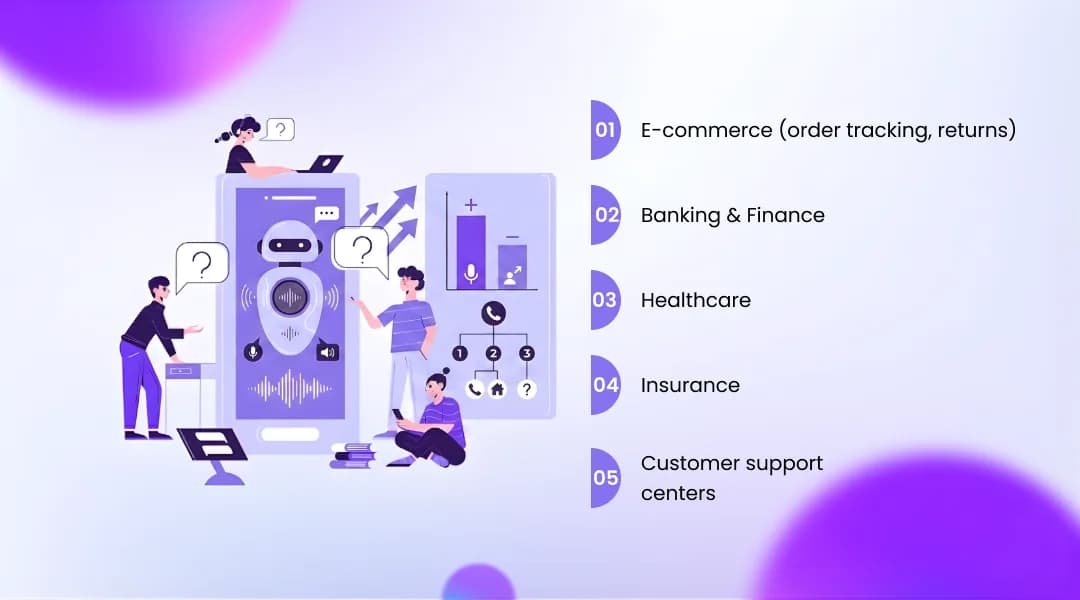
This is where theory meets the road. Here's where I've personally seen AI voice bots for call centers outperform IVR by wide margins:
E-commerce (order tracking, returns):
A D2C brand I consulted for was handling 8,000+ daily "where is my order" calls. Their IVR could route callers to an agent. The AI voice bot could pull tracking data and give a real-time update in under 30 seconds. Agent load dropped 55%.
Banking & Finance:
Loan status inquiries, balance checks, EMI reminders — high-volume, repetitive, and perfectly suited for voice AI. One NBFC client automated 70% of inbound queries within 90 days.
Healthcare:
Appointment scheduling, prescription refill reminders, lab report status. Sensitive? Yes. But when done right — with proper data security and empathetic conversation design — the results are remarkable.
Insurance:
Claim filing and status updates. Policy renewal reminders. These are workflows that IVR handles badly because they require context. AI handles them well because context is exactly what it's built on.
Customer support centers:
Any operation handling more than 5,000 calls/day with repetitive query patterns should be evaluating AI voice bots. Period.
IVR vs AI Voice Bot: Cost & ROI Comparison
Let me give you the honest numbers, not the marketing version.
Factor | Traditional IVR | AI Voice Bot |
Setup Cost | ₹2–5 lakhs (basic) | ₹5–15 lakhs (depending on complexity) |
Maintenance | Ongoing vendor fees, re-recording costs | Continuous learning; lower incremental costs |
Agent Dependency | High — IVR routes, agents resolve | Low — bot resolves 50–70% of queries autonomously |
ROI Timeline | Slow; limited efficiency gains | 12–18 months to positive ROI for most mid-market companies |
Hidden Costs | Customer churn from bad experience | Integration effort with existing systems |
The real question isn't "how much does it cost to switch from IVR to AI voice bot?" It's "how much is your current IVR costing you in lost customers?"
When Should You Replace IVR with AI Voice Bots?
Not every company needs to rip out IVR tomorrow. But you should seriously evaluate the switch if:
Signs your IVR is failing:
Your abandonment rate is above 20%
Callers consistently press "0" to reach an agent immediately
Your CSAT scores on phone interactions are flatlined or declining
You're adding menu options to fix problems that menus created
Business scenarios that demand the upgrade:
You're scaling into new regions or languages
Call volumes are growing faster than your hiring budget
You're competing against brands that already offer conversational support
Your customer base skews younger and expects self-service that actually works
If three or more of these apply to you, the IVR isn't just underperforming. It's actively working against you.
Future of Customer Support: AI-First Communication
Here's where I'll step back from the tactical and say something bigger.
The companies winning the customer experience race over the next five years won't be the ones with the best agents. They'll be the ones with the best AI-human collaboration model. Voice AI adoption is accelerating — not because it's trendy, but because customer expectations have fundamentally shifted. People don't want to navigate menus. They want to state their problem and have it solved.
The trend is clear: AI-first communication, with human agents handling the exceptions that require judgment, empathy, or authority. Companies building this architecture now — with partners like OnDial who specialize in tailored, human-centric voice AI — are the ones that will own the next decade of customer loyalty.
The rest will still be asking callers to press 1.
Conclusion
Look, I've been on both sides of this. I've deployed IVRs. I've optimized them. I've watched them fail despite the optimization. And I've seen what happens when a company finally makes the shift to a conversational AI voice bot - the call metrics improve, the customer complaints drop, and the ops team stops putting out fires long enough to actually think strategically.
AI voice bot vs traditional IVR isn't a close call anymore. IVR was the right tool for 2010. It's not the right tool for 2026.
If your phone system is still asking customers to press buttons, it's time to let them talk instead.