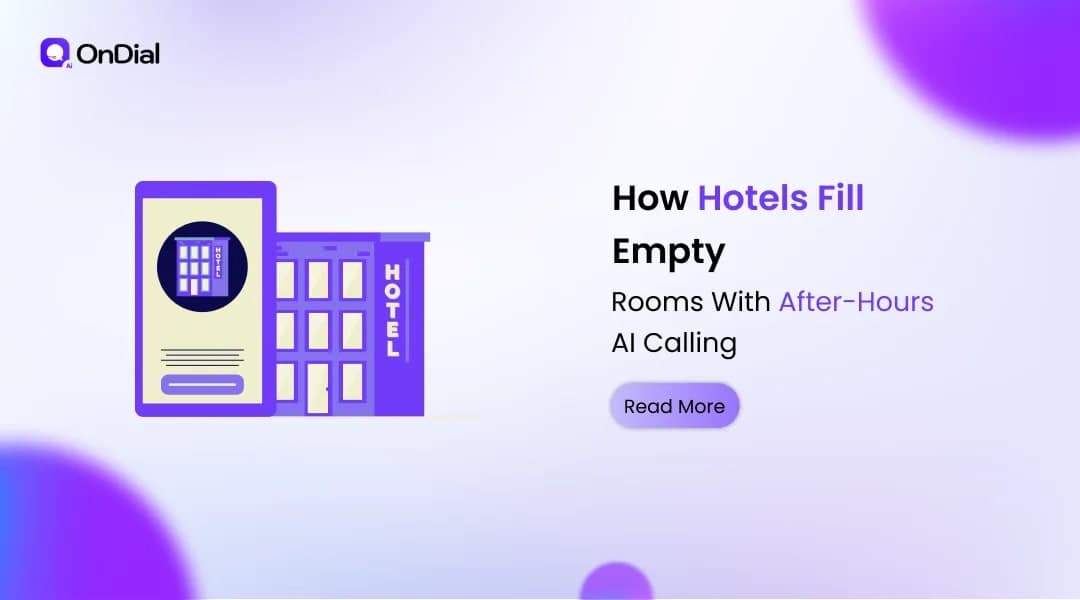
Here is the number that should keep every hotelier up at night: after-hours calls represent 31% of reservation inquiries, according to AgentZap's 2026 phone-statistics report. Almost a third of the people trying to book you are calling when your front desk is dark. I have spent years at OnDial watching this exact gap drain revenue, and I know the feeling on your side of it: you are not lazy, you are stretched. After-hours AI calling is simply a voice agent that answers your hotel phone around the clock, checks live availability, and confirms the booking before the caller hangs up and opens Booking.com instead.
You already sense the leak. What you may not have is a clear picture of how big it is, how the fix actually works, and whether it sounds robotic or human. So let me walk you through what happens to that 11 PM call, what it costs you, and how a single answered ring can fill a room that was going to sit empty.
Why the After-Hours Phone Is Your Most Expensive Blind Spot
The expensive truth nobody puts on a P&L: an empty room at midnight is not a vacancy problem, it is a phone problem. Most of those rooms had a buyer. The buyer called. Nobody picked up.
The dead zone between 10 PM and 8 AM
Between late evening and early morning, most properties run on a single overnight clerk or nobody at all. That one person is the receptionist, the security officer, and the night auditor at the same time. When they are mid-task, the phone simply rings out.
This is not a failure of effort. It is a structural gap. Across the industry, 40 to 60% of hotel calls go unanswered, especially during peak hours, shift changes, and after hours, per Upriser.ai data cited by HelloShift. The overnight stretch is the deepest part of that dead zone.
What an unanswered ring actually costs
Let me put a real figure on it. Missed-call revenue is the money that walks out before it ever arrives.
A missed after-hours call costs a hotel a booking worth roughly $180 to $400, because reservation calls convert at 30 to 50% when answered live but drop under 10% when forced to voicemail. According to TurboCall's 2026 benchmarks, a typical 50-room property leaves $5,000 to $8,000 a month of recoverable revenue on the table. Multiply that across a season. The night shift is not a cost centre. It is an unattended sales counter.
What After-Hours AI Calling Actually Does
Counter-intuitive, but true: the best AI calling does not try to sound like a robot doing a hotel's job. It does the hotel's job, and happens to be AI.
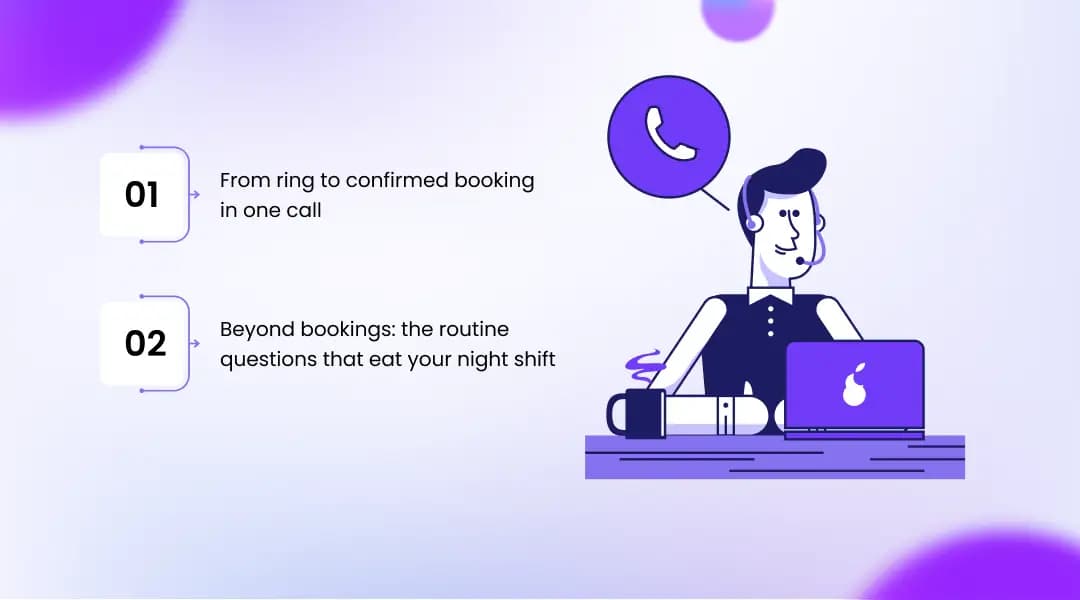
From ring to confirmed booking in one call
After-hours AI calling answers every inbound call instantly, uses natural language processing to understand what the guest wants, checks live room availability in your PMS, and writes a confirmed booking back in real time, with no staff involved. That is the whole loop, and the PMS write-back is the part that separates a real agent from a glorified voicemail.
Here is what that looks like at 1 AM. A traveller asks for a king room for two nights this weekend. The agent reads live inventory, quotes the rate, takes the details, and confirms. (No hold music. No "press 1 for reservations." No callback promise that hands the guest to an OTA by morning.) The booking is in your system before you wake up.
Beyond bookings: the routine questions that eat your night shift
Not every after-hours call is a fresh booking. Plenty are existing guests asking small things that still need answering.
Check-in and late-arrival queries: door codes, parking, what time the desk reopens.
Property FAQs: WiFi password, pool hours, pet policy, breakfast timing.
Warm transfers: when a call is genuinely complex or high-value, the agent hands it to a human with full context attached, not a cold "please hold."
These routine questions consume 60 to 70% of a front desk's time, SendSquared notes. Clearing them automatically frees your one-night clerk to actually run the property.
How AI Calling Fills Rooms That Would Have Stayed Empty
Have you ever calculated what a single recovered booking per night does to your monthly occupancy? Most owners have not. The math is quietly enormous.
Recovering direct bookings from the OTA leak
Every after-hours call you miss is a near-certain OTA booking. The guest hangs up, opens an app, and books anyway, except now you pay for it.
A direct booking is a reservation made through your own phone or website, with no third-party commission attached. That matters because the average OTA commission in 2026 runs between 15% and 25% per booking, per Mews. Worse, phone bookings generate 23% higher ADR than OTA bookings, since direct calls let you upsell. Answering the night phone is not just about saving a sale. It is saving a richer one.
Capturing the late, the last-minute, and the different-time-zone caller
The after-hours caller is a specific, high-intent animal. International guests dialling from another time zone. Business travellers planning at 10 PM. Last-minute drivers looking for a bed tonight.
These callers convert hard when reached and vanish completely when ignored. 78% of customers go with the first business to answer their call, according to data cited by My AI Front Desk. After hours, you are often the only one who could have answered. Be the one who does.
Why This Matters More for Indian Hotels
I will be blunt about something most global vendors skip. The Indian market does not behave like the American one, and that changes the after-hours equation.
Multilingual guests, one calm voice
A guest from Surat, a traveller from Chennai, and a foreign tourist may all call the same Gujarat property in one night. Your night clerk cannot fluently switch between Hindi, Gujarati, Tamil, and English at 2 AM. Miscommunication becomes lost trust, and lost trust becomes a lost booking.
A well-built voice agent handles all of them in the caller's own language without missing a beat. In projects I have worked on at OnDial, this single capability often recovers more Tier 2 and Tier 3 bookings than any rate change, simply because the guest finally felt understood.
Compliance and trust: doing it the right way
Automated calling in India is not a free-for-all, and it should not be. Outbound and reminder calls fall under TRAI's DLT framework, and any guest data you capture sits under the DPDP Act 2023.
A serious deployment respects both: consented contact, transparent identification, and clean data handling. We build for that openly, because a booking won by cutting a compliance corner is a liability, not a win.
Is After-Hours AI Calling Actually Worth It?
Fair question, and the honest answer is: usually yes, but not always, and not for every reason vendors claim. Let me give you the real comparison.
The honest cost comparison
Here is the part where a lot of marketing gets slippery, so I will keep it grounded.
Human overnight cover: a dedicated reservations or night agent runs into thousands per month once you count benefits and turnover.
Traditional answering service: cheaper, but most take a message instead of booking, because they have no PMS access. The guest still ends up on an OTA by morning.
AI voice agent: AI receptionists typically cost a fraction of a human receptionist's monthly salary, per My AI Front Desk, and they actually complete the booking.
The worth-it test is simple. If after-hours calls regularly go unanswered and your direct-booking share is thin, the recovered revenue clears the cost fast.
Where AI should hand off to a human
Now the limitation, honestly stated, because anyone who tells you AI handles everything is selling, not advising.
AI is excellent at availability, FAQs, and clean bookings. It should not be the final word on an angry complaint, a delicate group negotiation, or a sensitive special request. The right design escalates these with a warm transfer and full context. Used that way, AI is not replacing your people. It is making sure your people only get the calls that truly need them.
Conclusion
After-hours AI calling turns your darkest, quietest hours into a working sales channel. Remember the three things that matter: a third of reservation inquiries arrive after hours, an unanswered ring is a near-guaranteed gift to an OTA, and the fix costs less than the revenue it recovers. You do not have to accept empty rooms as the price of a small night crew anymore.
You now know exactly where the leak is and how to close it. If you run a property where the phone goes quiet after dark, let OnDial build you a voice agent that answers in your guests' languages, books straight into your PMS, and hands the tricky calls to your team. Your night shift can start earning its keep.