Let me guess.
You’ve heard the pitch already. “AI voice agents will replace your call center.” “Customers prefer bots now.” “This is the future of customer calls.”
And your internal alarm bells went off.
Good. They should.
I’ve been around long enough to know that every new technology gets oversold before it gets understood. AI voice agents are no exception. Some are brilliant. Some are just old IVR systems wearing a neural network badge.
This article is about separating the two.
I’m going to walk you through what the best AI voice agents actually do, where they genuinely help, where they fall flat, and how companies like OnDial approach voice AI without insulting your customers’ intelligence.
No hype. No mysticism. Just reality.
What Are AI Voice Agents?
At their core, AI voice agents are software systems that can hold spoken conversations with humans over the phone.
Not menus. Not “Press 1 for billing.”
Actual conversations.
Modern AI voice agents combine speech recognition, natural language understanding, dialogue logic, and speech synthesis to listen, think, and respond in real time. When done well, they sound less like a robot and more like a calm, competent support rep who never gets tired.
When done poorly?
You hang up. Immediately.
That distinction matters more than most vendors admit.
How AI Voice Agents Work
Here’s the simplified version I use with non-technical teams:
The caller speaks.
Speech-to-text converts voice into language.
The system interprets intent, context, and history.
Business logic decides the response.
Text-to-speech delivers a spoken reply.
The loop continues.
Behind the scenes, this involves large language models, conversation state management, integrations with CRMs, ticketing tools, and analytics platforms.
(Yes, it’s complex. No, complexity alone doesn’t make it valuable.)
What makes the best AI voice agents stand out is not intelligence—it’s restraint. They know when to answer, when to ask, and when to escalate to a human.
Key Benefits of Using the Best AI Voice Agents

24/7 Customer Availability
Humans need sleep. Your customers don’t care.
AI voice agents handle AI phone calls at 2 AM, on holidays, and during peak surges without degrading service quality. For global businesses, this alone changes the economics of support.
Reduced Operational Costs
Let’s talk numbers without getting cynical.
AI voice automation doesn’t replace teams overnight. What it does is absorb repetitive, high-volume interactions that burn out human agents.
Password resets. Order status. Appointment confirmations.
That’s where cost savings actually come from.
Faster Call Handling & Resolution
Speed matters. But clarity matters more.
Well-designed AI call handling software reduces average handle time by understanding intent early and routing or resolving without friction. No transfers. No looping questions.
Just progress.
Improved Customer Experience
Here’s the unpopular truth:
Customers don’t hate bots. They hate being misunderstood.
The best voice AI solutions for businesses focus obsessively on conversation design. Tone. Pacing. Recovery when things go wrong. This is where OnDial’s human-centric approach shows up, voice AI that adapts instead of bulldozing through scripts.
Scalable Communication
Human teams scale linearly. Voice AI scales elastically.
During promotions, outages, or seasonal spikes, AI voice agents for enterprises absorb demand without panic hiring or service collapse.
Best AI Voice Agents vs Traditional Call Handling
Traditional call centers are rigid. AI voice agents are adaptive.
But adaptability only works when paired with intent.
Legacy systems treat callers like tickets. Modern conversational AI voice agents treat them like participants in a dialogue. That difference shows up in CSAT, resolution rates, and trust.
And yes, humans still matter. The smartest systems know when to step aside.
Top Use Cases of AI Voice Agents Across Industries
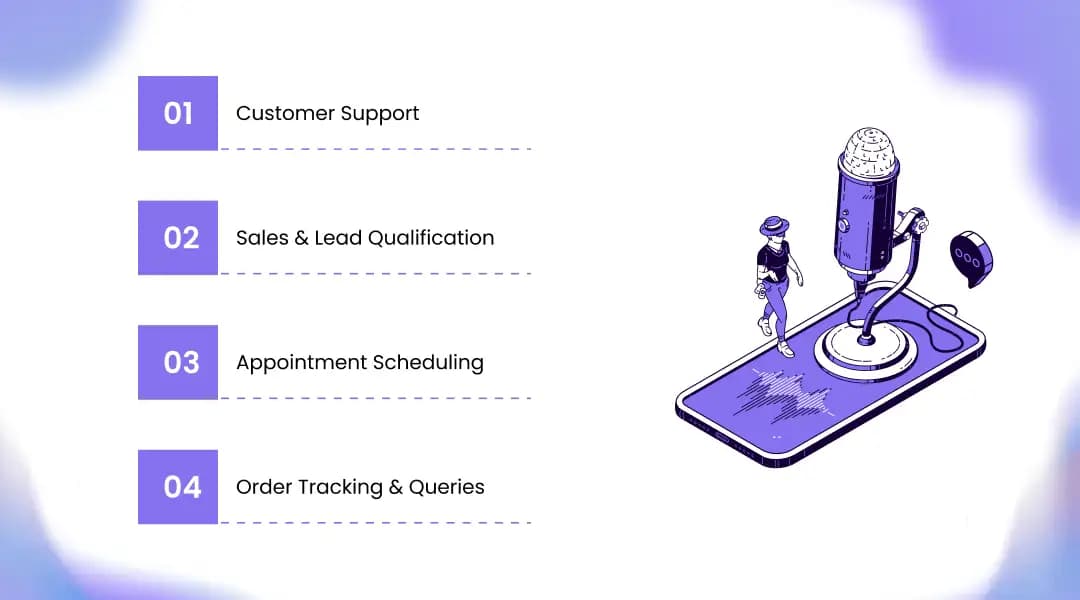
Customer Support
From FAQs to issue triage, AI voice agents for customer support reduce wait times and surface context before human escalation. Support teams finally get breathing room.
Sales & Lead Qualification
AI doesn’t sell like a human. It qualifies better.
For inbound calls, AI voice agents for sales calls capture intent, budget signals, and urgency before routing hot leads to humans who can actually close.
Appointment Scheduling
Healthcare, real estate, service businesses, this is low-hanging fruit. AI handles scheduling, reminders, and rescheduling without human back-and-forth.
Order Tracking & Queries
E-commerce lives here. Status updates. Returns. Delivery questions. AI voice agents answer instantly, consistently, and without burnout.
Features to Look for in the Best AI Voice Agents
If you’re evaluating platforms, ignore flashy demos. Look for this instead:
Natural interruption handling
Context retention across turns
Clean CRM and ticketing integrations
Transparent analytics
Human handoff without friction
This is where choosing a Best AI Voice Agent Platform or working with a Best AI Development Company actually matters. Customization beats templates every time.
How AI Voice Agents Improve Business Productivity
Productivity isn’t about doing more. It’s about doing the right things with human time.
AI voice agents take the predictable load off your team. Humans focus on nuance, judgment, and relationships. That’s the real win.
I’ve watched teams shrink their backlog, not their headcount.
That’s progress.
Challenges & Limitations of AI Voice Agents
Let’s be honest.
AI voice agents still struggle with:
Heavy accents in noisy environments
Emotional escalation
Poorly defined business rules
Ignoring these limits is how trust gets destroyed. Addressing them upfront is how systems improve.
Transparency builds adoption. Always has.
How to Choose the Right AI Voice Agent for Your Business
Start with your calls. Not the technology.
Map your most common customer calls. Identify failure points. Decide where automation helps and where humans must stay involved. Then and only then, look at vendors.
If you plan to hire AI voice agents, partner with teams like OnDial that treat voice AI as a collaboration, not a product drop.
Conclusion
AI voice agents are not magic. They’re tools.
Powerful ones, when designed with respect for human conversation.
The benefits of AI voice agents show up when businesses stop chasing novelty and start designing for reality. Clarity beats cleverness. Trust beats tricks.
And that’s where real transformation actually happens.