Back to all posts
InsightsOct 18, 20254 min read
AI Voice Bots vs Human Agents: Which Is Best for Your Business?
Divyang Mandani
Founder & CEO
Founder & CEO
Let me ask you something, have you ever called a company, only to be greeted by endless hold music and robotic menus, and hung up frustrated? Yeah, me too.
Now, imagine a world where a virtual voice assistant picks up immediately, understands your problem, and even remembers your previous interactions. Magic? Not quite. This is the promise of AI voice bots. But here’s the kicker: humans still bring something no bot can replicate.
I’ve spent over a decade working with businesses trying to balance efficiency with empathy. I’ve seen startups bet everything on AI, only to lose customers. And I’ve seen human teams struggle under repetitive calls that could have been automated. Today, I’m going to break it down for you—plainly, honestly, and without fluff—so you can decide whether AI, humans, or a mix is right for your business.
AI voice bots are software-driven agents that can conduct conversations over the phone. Unlike simple IVR systems, these bots understand natural language, process intent, and respond dynamically. They can schedule appointments, answer FAQs, escalate calls, and more.
At the core, AI call agents combine speech recognition, natural language processing, and machine learning. They “listen,” interpret what the caller wants, and provide accurate responses. Over time, they learn from interactions, improving accuracy.
E-commerce platforms use AI bots for order status and returns.
Banks deploy AI voice assistants for balance inquiries and fraud alerts.
Healthcare providers schedule appointments and answer insurance queries.
These bots don’t just answer calls—they can reduce wait times, cut errors, and handle thousands of interactions simultaneously.
Human agents aren’t going anywhere. They handle tasks AI cannot: interpreting nuanced complaints, navigating unusual requests, and providing reassurance when things go wrong.
Humans excel at empathy. A caller frustrated by a billing error doesn’t just want a solution—they want to feel heard. This emotional intelligence is critical for high-value interactions and complex problem-solving.
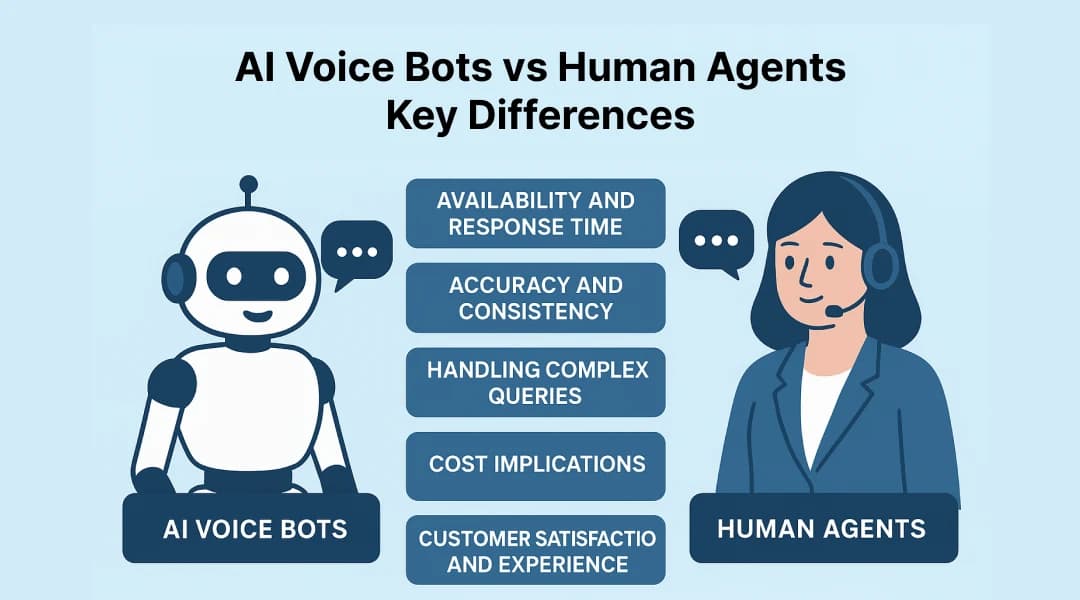
AI bots: 24/7, instant responses. Humans: Limited hours, potential for delays.
Bots follow rules perfectly, every time. Humans, well… mistakes happen, fatigue sets in.
Bots struggle with ambiguous issues. Humans can read tone, sense frustration, and think creatively.
Bots: High upfront cost, low incremental cost per call. Humans: Ongoing salaries, training, and attrition costs.
Bots excel for routine queries. Humans excel for high-stakes, sensitive interactions.
24/7 availability: No breaks, no holidays, no waiting.
Scalability: Handle spikes in calls without hiring.
Cost savings: Reduce reliance on large call centers.
Quick handling of repetitive tasks: FAQs, status updates, confirmations.
Emotional connection: Humans empathize, calm, and reassure.
Handling complex and sensitive issues: Escalations, complaints, or unusual scenarios.
Personalization: Adjust tone, language, and approach to the caller.
Business size: Small businesses may prioritize human touch; large enterprises benefit from automation.
Query complexity: Repetitive queries = AI; nuanced issues = humans.
Cost constraints: Hybrid models often balance efficiency and empathy.
AI bot handles initial triage and routing, humans resolve escalated issues.
AI collects preliminary info, human agents finalize complex resolutions.
Look for:
Natural language understanding
CRM integration
Customizability
Reporting and analytics
Use AI insights to pre-brief agents
Teach humans to handle escalations efficiently
Encourage collaboration between bot and human teams
Customer satisfaction (CSAT)
First-call resolution
Average handling time
Cost per interaction
Adoption rate of AI Phone Calls and AI Voice Assistants
Here’s the truth: neither AI voice bots nor human agents are universally superior. They’re tools. The winning strategy? A hybrid approach. Use AI for efficiency and humans for empathy. When orchestrated well, your business can scale smarter, reduce support costs, and keep customers genuinely satisfied.
Your customers won’t care about technology. They’ll care about you solving their problem—fast, efficiently, and with a human touch when it matters.
Founder & CEO
Divyang Mandani is the CEO of OnDial, driving innovative AI and IT solutions with a focus on transformative technology, ethical AI, and impactful digital strategies for businesses worldwide.
View all articles by Divyang MandaniGet comprehensive answers to common questions about AI voice agents and how they can transform your customer service.
Don't let your customers wait on hold. Join thousands of businesses using OnDial to provide instant, intelligent customer service 24/7.
Discover how AI voice agents in travel reduce hold times, automate multilingual support, manage disruptions, and improve every customer call experience today.
AI voice agents for hotels answer every call day or night, quoting rates and availability while routing complaints and VIP requests straight to your staff.

Missed client calls quietly drain consulting revenue every single month. Discover the real cost per call, why top firms lose them, and how to close the gap.